


When you hit 'send' on a carefully crafted email, you expect it to land in your prospect's inbox. But what happens when it comes right back with an automated "undeliverable" message? That, in a nutshell, is a bounced email.
For sales teams, this isn't just a minor tech hiccup. It's a dead end—a clear signal that your message never reached its destination, stopping a potential conversation before it even started. For SDRs spending hours on research, AEs waiting for quality handoffs, and leaders trying to build a predictable revenue engine, bounces represent wasted effort and stalled pipeline.
What Exactly Is A Bounced Email In Sales?
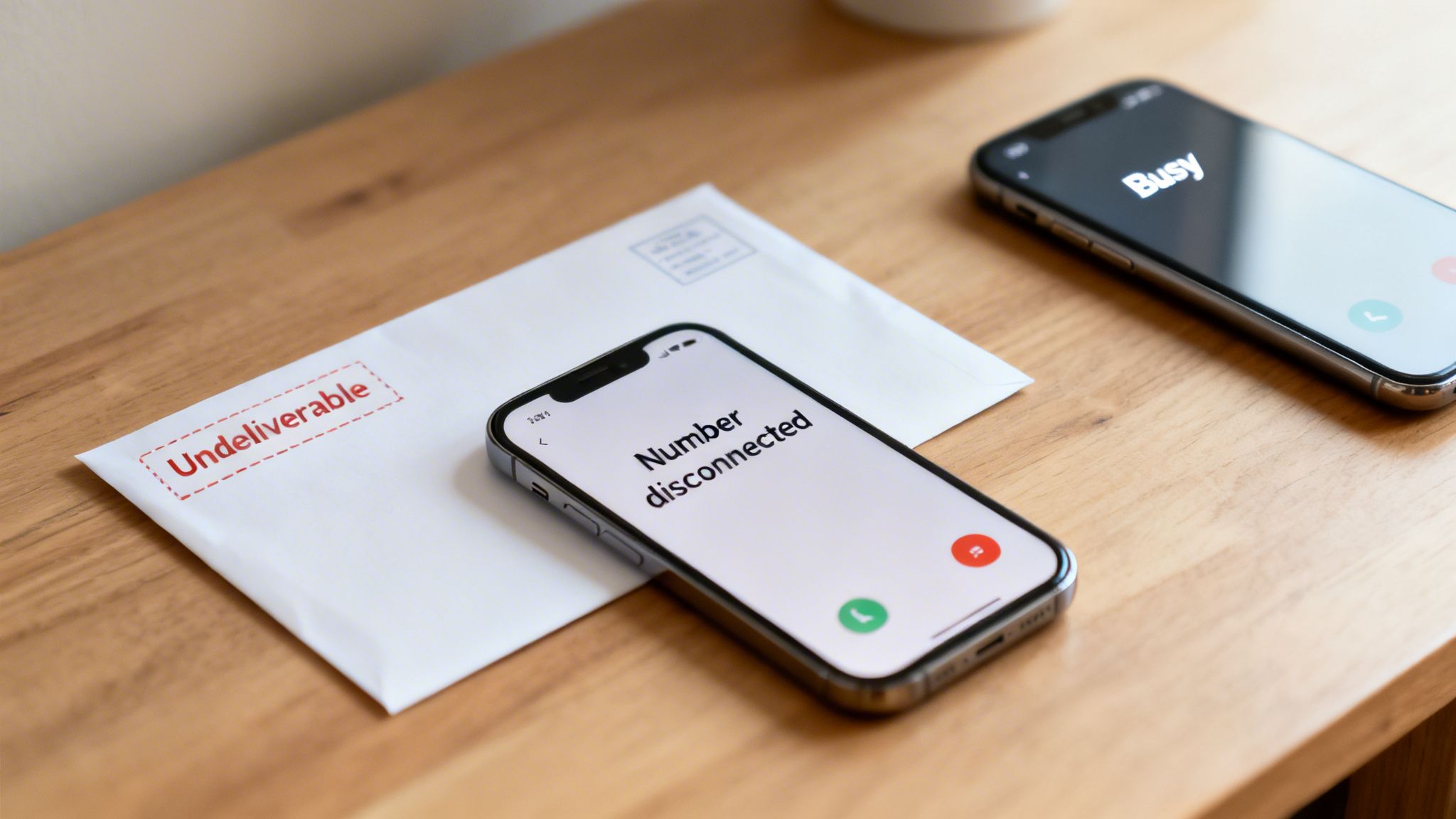
Think about the time your SDRs invest in researching prospects, building lists, and writing personalized outreach. A bounced email means all that effort was for nothing on that specific contact. The door was closed before they could even knock.
To protect your sender reputation and ensure your emails actually get delivered, you first need to understand that not all bounces are the same. The easiest way to think about it is to compare it to making a sales call.
Hard Bounces: The Dead Ends
A hard bounce is like dialing a phone number only to hear "this number has been disconnected." It's a permanent failure. The email address is bad, and it will never work.
This usually happens for a few key reasons:
- The email address simply doesn't exist.
- There's a typo in the address or domain name (e.g.,
jane.doe@gamil.com). - The recipient's server has blocked you entirely.
The instruction here is crystal clear: remove these contacts from your lists immediately. Continuing to email them is a waste of time and actively harms your domain's reputation, making it harder for all your reps to land in the inbox.
Soft Bounces: The Temporary Roadblocks
A soft bounce, on the other hand, is like getting a busy signal. The phone number is correct, but you couldn't get through right now. It's a temporary delivery problem.
Common culprits for soft bounces include:
- The prospect's inbox is full and can't accept new mail.
- Your email file, perhaps with a large attachment, is too big.
- Their email server is temporarily down or offline.
With soft bounces, the contact is likely valid. The best course of action is often to wait and have your sales engagement platform try again automatically. You don't want to discard a good lead because of a temporary glitch. A modern prospecting platform handles this automatically, so your team doesn't have to think about it.
Hard Bounce vs. Soft Bounce At A Glance
For a quick reference, here’s a simple breakdown to help your team instantly know what they’re dealing with and what to do next.
| Bounce Type | What It Means For Your Team | Common Causes | Required Action |
|---|---|---|---|
| Hard Bounce | Permanent failure. The lead is unreachable at this address. | Invalid/fake email, typos in address, domain doesn't exist. | Delete the contact from all mailing lists immediately. |
| Soft Bounce | Temporary failure. The lead is likely valid but unavailable now. | Full inbox, server is down, email file is too large. | Monitor and Retry. A modern platform will re-attempt delivery automatically. |
Understanding this distinction is critical. While soft bounces are temporary hurdles, hard bounces are data quality problems that need to be solved at the source—before you ever hit send.
Every hard bounce is more than just a failed email; it's a wasted touchpoint that drags down your team's efficiency. Keeping these invalid contacts in your CRM poisons your data, skews your forecasting, and damages your sender reputation, making it harder for all future emails to get delivered.
Ultimately, a high bounce rate is a red flag for a bigger issue, almost always pointing to stale or unverified contact data. If your foundation is weak, your outreach efforts are just shots in the dark. To build a stronger foundation, check out our guide on how to get a valid email address for anyone. Without clean data, your team is wasting precious time on emails that have zero chance of ever being read.
Hard Bounces And Soft Bounces Explained

When an email bounces, it's not just a failed delivery; it's a critical piece of feedback. But not all bounces are created equal, and lumping them all together is a mistake that can either cost you good leads or wreck your sender reputation.
You need to know the difference between the two main types: hard bounces and soft bounces. A modern sales platform should differentiate them automatically, but understanding what they mean is crucial for protecting your pipeline and your domain.
Understanding Hard Bounces
A hard bounce is a permanent failure. Think of it as hitting a brick wall—there’s no way through. This happens because the email address is fundamentally invalid, and no matter how many times you try, your message will never be delivered. For any SDR or RevOps leader, the rule here is simple and absolute: remove these contacts from your lists immediately.
Common causes include:
- Invalid Email Address: A simple typo (
jane.doe@gmai.com), a fake address, or just plain incorrect data. - Non-Existent Domain: The company might have folded, or its domain name (
@company.com) is no longer registered. - Recipient's Server Block: In more serious cases, the recipient's email server has decided to block your domain entirely, usually because of a poor sender reputation.
Keeping hard bounces on your lists is like a salesperson repeatedly calling a disconnected phone number. It wastes time, clutters your CRM, and—worst of all—tells email providers that you aren't managing your data. That's a huge red flag that hurts deliverability for your entire team.
Decoding Soft Bounces
A soft bounce, on the other hand, is a temporary setback. This is more like getting a prospect's full voicemail box. The person and the phone number are real, but you just couldn't get through at that exact moment. The email address is likely valid, but a temporary hiccup prevented delivery.
These roadblocks are usually temporary:
- Full Mailbox: The prospect's inbox has reached its storage capacity and can’t accept any new mail.
- Email File Too Large: Your email, especially if it includes a heavy attachment like a sales deck, exceeds the size limit set by their server.
- Server Temporarily Down: The recipient’s email server is offline, maybe for maintenance or because of a technical issue.
The right move here isn’t to delete the contact but to try again. A good outbound platform will handle this automatically, re-attempting delivery after a short interval without you having to lift a finger.
In 2026, top sales teams are obsessed with data hygiene. A healthy overall bounce rate should stay below 2%. If you see it creeping over 5%, it's time for immediate intervention. To learn more about hitting these benchmarks, check out our complete guide on email deliverability best practices. It’s essential for protecting your sender score and making sure your emails actually land where they’re supposed to.
The Real Reasons Your Sales Emails Are Bouncing
Bounced emails are almost never a random fluke. Think of them as a warning light on your go-to-market dashboard. They’re telling you that something is fundamentally broken in how your team is finding leads, managing data, or executing outreach.
Getting to the bottom of it is the only way to stop your team from pouring effort into messages that are destined to go nowhere. For most sales teams, the problems almost always trace back to two areas: the quality of your contact data and the technical side of your sending practices.
The Number One Culprit: Flawed Data
More often than not, a high bounce rate comes down to one simple thing—bad data. If your SDRs are starting with faulty information, their outreach is doomed before they even hit "send." This issue is especially painful for teams juggling fragmented tools or still relying on manual data entry.
Take a hard look at your process and ask yourself:
- Are you working off stale lists? Contact data decays shockingly fast. People change jobs, companies get acquired, and old email addresses are shut down for good. That list you bought six months ago is now a minefield of hard bounces.
- Could manual typos be the problem? A simple fat-finger error in the CRM—like
jane.doe@gamil.cominstead of@gmail.com—guarantees a hard bounce. These tiny mistakes seem harmless, but they pile up and slowly poison your entire database. - Are you trusting unverified sources? Scraping websites or grabbing data from a single provider without cross-checking is a gamble. Without a system to confirm an email is active before you reach out, you’re basically prospecting in the dark.
For sales leaders and RevOps teams, a bounce rate over 2% isn't just a deliverability metric; it's a direct measure of operational drag. It means your team's most precious resource—time—is being wasted on dead-end leads created by unreliable data.
Technical Triggers That Hurt Deliverability
It's not just about who you're emailing. Even teams with pristine data can run into trouble if how they send emails looks suspicious to recipient servers. Mailbox providers are always on the lookout for behavior that smells like spam.
Here are a couple of common technical missteps to watch for:
- Sending High Volume from a New Domain: If you fire up a brand-new domain and immediately try to blast out a thousand emails, you're going to set off every alarm bell. You haven't built any trust or "sender reputation" yet, so spam filters see this as a classic spammer move.
- Sudden Spikes in Sending Volume: Even with a seasoned domain, going from sending 100 emails a day to 5,000 overnight is a huge red flag. Mailbox providers like Google and Microsoft will see this sudden surge as a potential account takeover and may start temporarily rejecting your emails (soft bounces) to protect their users.
Ultimately, fixing these issues means moving away from a scattered, reactive approach. Instead of trying to patch together separate tools for sourcing, verification, and outreach, a unified platform like Willbe builds these safeguards right into the workflow. It ensures data is verified from the start and that your sending patterns are managed intelligently, stopping bounces before they ever have a chance to damage your pipeline.
The True Cost Of A High Bounce Rate
It’s easy to write off a high bounce rate as just another deliverability problem—a technical annoyance for your RevOps team to sort out. But that’s a dangerous mistake. In reality, it’s a direct hit on your revenue engine, creating a domino effect that can cripple your entire sales motion.
The first casualty is always your sender reputation. Think of this like a credit score, but for your sales team's email domain. Every single hard bounce is a black mark. It tells inbox providers like Google and Microsoft that you might be sending spam. Over time, that damage makes it harder for any email from your company to land in an inbox, even messages to your most qualified, engaged prospects.
From Poor Reputation To Blacklisted Domain
If you let a high bounce rate slide, the consequences escalate quickly. What starts as a ding to your reputation can get you completely shut out.
- Getting Blacklisted: Keep sending to bad addresses, and you’ll eventually land your domain on a public or private blacklist. Once you're on that list, providers will automatically reject or junk your messages, effectively silencing your outbound engine.
- Account Suspension: Your sales engagement platform and email service provider will step in and suspend your account. They have to protect their own infrastructure, and they won't hesitate to shut you down until you prove you've cleaned up your act.
When your outbound engine is dead in the water, your pipeline generation grinds to a halt. SDRs can't book meetings, AEs have no new opportunities to work, and your revenue forecast becomes a complete guessing game. It's a self-inflicted wound caused by bad data.
The Hidden Costs To Your Bottom Line
Beyond the technical penalties, a high bounce rate quietly drains money and resources from your operations. In B2B sales, bouncing emails from a sketchy list can torch your reputation faster than a bad pitch ever could. While recent reports show that global delivery rates are holding strong, you can explore the latest email benchmarks and see for yourself how even small percentages can signal major issues.
These seemingly small numbers translate into very real financial losses:
- Wasted SDR Hours: Every bounce is time your reps spent researching and personalizing an email for a contact who was never going to see it.
- Inaccurate Forecasting: When your activity reports are full of thousands of emails that never landed, your pipeline forecasts become fiction. That makes for some frustrating conversations with leadership.
- Slower Revenue Growth: At the end of the day, bounces are a brake on your growth. They slow down your ability to generate predictable revenue and put your most important company goals at risk.
A Modern Playbook To Reduce Your Email Bounce Rate
It’s one thing to know why your emails are bouncing, but it’s another thing entirely to build a fix that actually scales with your team. The best approach isn't a frantic, last-minute list cleanup every quarter; it’s about weaving smart, proactive habits into your team's daily sales process.
This playbook gives you four essential strategies focused on speed, precision, and building a more predictable pipeline.
Start With Great Data, Period
Your bounce rate is a mirror reflecting the quality of your contact list. If you're starting with stale, outdated information, you're setting your team up for failure. Instead of buying old lists or patching together data from a single source, you need a system that begins with verified, constantly refreshed contacts. This alone will stop most hard bounces before an SDR even thinks about writing a subject line.
A big piece of this puzzle is regularly enriching your contact data. Knowing what is data enrichment is the first step, as this process automatically fills in the blanks and validates your contacts, turning a tedious manual chore into a seamless background task.
Automate Your List Hygiene
Let’s be honest: the days of manually scrubbing CRM records are long gone. It’s a massive time sink for any RevOps team and simply doesn't scale. Your go-to-market platform should be doing this heavy lifting for you.
The right tool doesn't just clean a list once. It validates contacts in real-time as they're added to a sequence and keeps an eye out for any changes. This ensures your data stays clean, preventing the slow creep of data decay from quietly killing your pipeline.
Don't Skip the Email Warm-Up
As your team grows, you'll be adding new reps and new email accounts. Firing off hundreds of emails from a "cold" domain or inbox is a huge red flag for providers like Google and Microsoft. You'll land in the spam folder—or worse, get blocked entirely.
A proper warm-up process is an absolute must. It involves gradually increasing the number of emails sent from a new account to build up a positive sender reputation. Good platforms will automate this, mimicking how a real person would use email, which signals to inbox providers that you're a legitimate sender, not a spammer. We cover this in more detail in our guide on email validation software.
This next image shows exactly what’s at stake—how a high bounce rate creates a domino effect that goes from a damaged reputation straight to lost revenue.
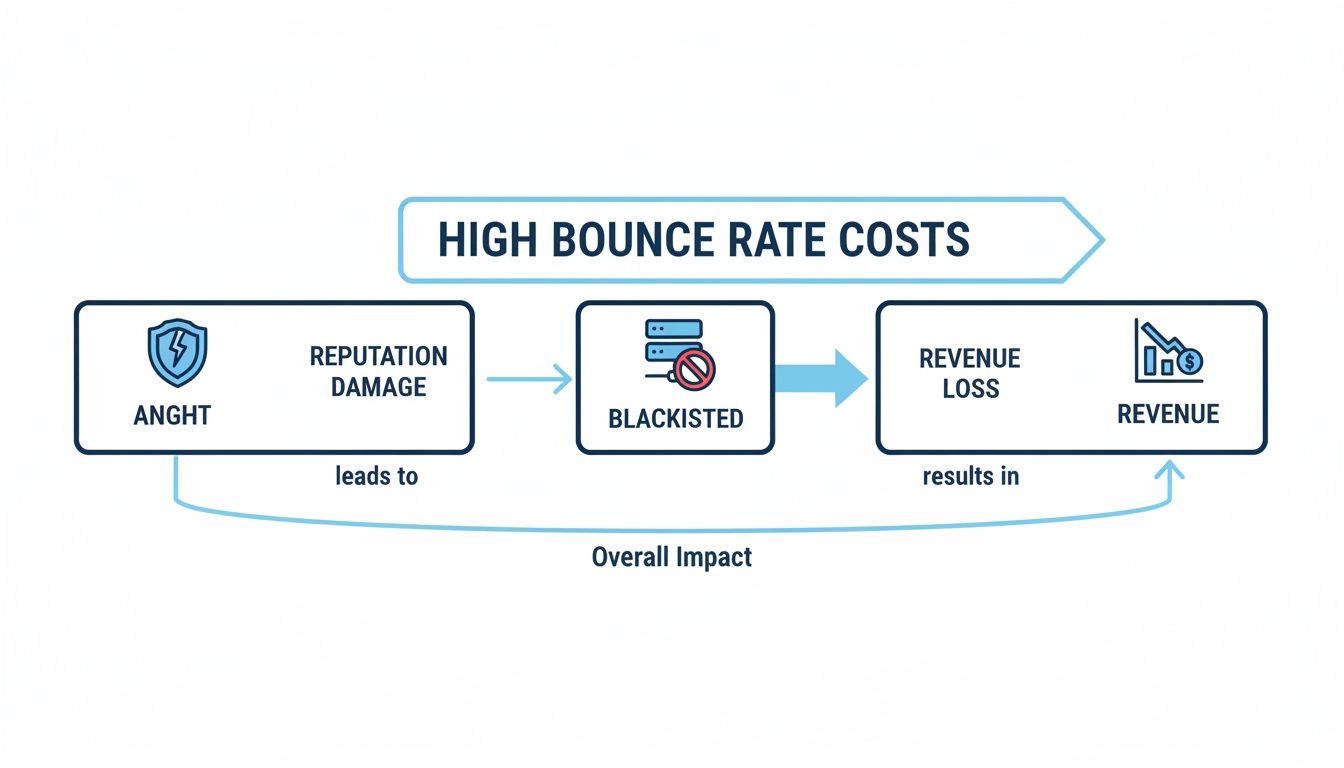
As you can see, ignoring bounces puts you on a direct path to getting blacklisted, which can completely shut down your email outreach. Every step in this playbook, from focusing on data quality to consistent monitoring, is your defense against this costly outcome.
Stop Bounces Before They Start With Willbe
Instead of just reacting to a high bounce rate, what if you could sidestep the problem entirely? The smartest way to fix bounces is to prevent them from happening in the first place. This is where an all-in-one prospecting platform like Willbe replaces fragmented tools and manual workflows, turning outbound from a guessing game into a reliable pipeline-builder.
Think about it: a reactive strategy means your SDRs are constantly hitting dead ends, while your RevOps team is trapped in a never-ending cycle of cleaning up bad data. Willbe flips this script by making data quality a core part of your prospecting process from the very beginning.
Start With Hyper-Accurate, Verified Data
The main culprit behind most hard bounces is simply bad contact information. Willbe gets right to the root of this problem. Rather than pulling from a single, often outdated database, our platform cross-references and validates contact details against dozens of B2B data sources in real time.
This means your sales team starts every campaign with data they can actually trust. The result is straightforward: you all but eliminate hard bounces because your reps are only reaching out to contacts who are confirmed to be in their current roles.
When your team trusts their data, they prospect with confidence. They spend less time second-guessing their lists and more time engaging high-value accounts, knowing their messages will actually be delivered.
Automate CRM Hygiene and Data Management
You know how it goes. People switch jobs, companies get acquired, and old email addresses become digital graveyards. This data decay clogs up your CRM with useless information, creating a massive headache for RevOps teams wrestling with manual cleanups and broken syncs.
Willbe solves this with automated CRM syncing and smart list management. Our platform keeps your most important systems clean and current, no manual work required.
- Real-Time Updates: As soon as contact information changes in the market, Willbe automatically updates the record in your CRM.
- Seamless Integration: Everything syncs perfectly, creating a single source of truth and getting rid of the friction that comes from juggling different tools.
When your outreach is built on a foundation of clean, reliable data, everything runs more smoothly. Sales leaders can forecast with more accuracy, SDRs can hit their meeting targets, and you can scale your efforts without burning through lists or hiring more people. It’s about creating a system where bounces are the rare exception, not the frustrating rule.
Answering Your Top Questions About Bounced Emails
We've covered a lot of ground, but a few questions always come up. Let's tackle the most common ones that sales pros ask about keeping their bounce rates low and their outreach effective.
What Is A Good Email Bounce Rate In 2026?
Think of 2% as the upper limit. If your bounce rate is hovering under that mark, you’re in a great spot for B2B outbound.
Once you start creeping into the 2-5% range, consider it a yellow flag. It’s a clear signal that something is off with your email lists or sending habits, and it's time to investigate before it gets worse. Anything over 5% is a full-blown emergency. A rate that high is actively tanking your sender reputation and puts your entire domain at risk of being blacklisted.
Can A Soft Bounce Turn Into A Hard Bounce?
Absolutely. A soft bounce is a "maybe later" from the server. But if you keep sending to an address and it always soft bounces, the recipient's email provider eventually assumes the problem is permanent and converts it to a hard bounce.
This happens all the time. An employee leaves a company and their mailbox sits full for weeks before being deleted, or a server that was temporarily down is just never brought back online. This is exactly why you need a platform that can differentiate between a one-time glitch and a recurring dead end.
How Often Should I Verify My Email List?
In the past, teams got away with verifying their lists quarterly. That simply doesn't work anymore. With contact data decaying at over 30% per year, a list that was clean three months ago could be a mess today.
For that reason, you should be using a platform that provides continuously verified data on demand. If you're stuck with static lists, you have to re-verify them right before launching any new campaign. There's no way around it if you want to avoid a spike in bounces that kills your domain reputation.
Key Takeaway: Personalization doesn't fix a bad email address. However, highly relevant messages are far less likely to be flagged as spam by recipients or their servers. High-volume, generic email blasts are more likely to trigger spam filters, which can result in delivery failures that look like bounces.
Stop chasing dead ends and start building predictable pipeline with data you can trust. Willbe delivers verified, hyper-accurate contact information and automates list hygiene, so your team's outreach always hits the mark. See Willbe in action.