


Let's be clear: in B2B sales, a valid email address is the only kind that matters. It's an address that can actually receive your message, confirmed through a series of technical checks. For any sales team running outbound, this isn't just a technical detail—it's the foundation of your entire GTM motion.
Why a Valid Email Is Your Pipeline's Foundation
Every outbound sequence lives or dies by its deliverability. A high bounce rate isn't just a frustrating waste of time; it actively poisons your sender reputation. Rack up enough bounces, and you risk getting your entire domain blacklisted, making your team's outreach invisible.
This isn't a small technical hiccup. It's a massive revenue problem.
Think about your top SDR. They spend hours digging into a target account, pinpointing the perfect decision-maker, and using AI to craft a hyper-personalized email. They hit send, confident this is the one that will book a meeting, only to get that dreaded bounce-back notification. All that work? Gone. The opportunity is dead on arrival.
This exact scenario plays out every day in sales organizations, silently killing pipeline and torching valuable SDR hours.
The Scale of the Challenge
The sheer volume of email flying around makes this even more critical. By 2026, the world is expected to hit a staggering 392.5 billion emails sent and received daily. As detailed in the latest industry reports, this explosion means cutting through the noise is tougher than ever. An invalid email guarantees you won't even get a chance.
This is precisely why high-growth teams treat email validation as a core part of their revenue engine, not just an admin chore.
Building a predictable pipeline starts with a deliverable foundation. Your team's research, your expensive tech stack, and your powerful messaging are worthless if they never land in the inbox.
Beyond the Bounce: The Real Costs
The damage from bad email data goes way beyond a single bounced message. It creates a domino effect of problems that can undermine your entire go-to-market strategy.
The table below breaks down the true cost of an invalid email—it’s not just about a lost contact, but about systemic damage to your sales operation.
The True Cost of an Invalid Email Address
| Impact Area | Direct Cost for Sales Teams | Long-Term Business Risk |
|---|---|---|
| Wasted Resources | Reps spend hours on manual list cleaning or on outreach that will never be seen. | Decreased ROI on sales salaries, tools, and data subscriptions. |
| Damaged Reputation | Each hard bounce tells providers like Google and Microsoft you’re a low-quality sender. | Your domain gets flagged, causing even valid emails to land in spam folders across your entire organization. |
| Flawed Analytics | A dirty list skews open, click, and reply rates, making it impossible to know what's working. | Sales leaders make poor strategic decisions based on inaccurate campaign performance data. |
| Lost Opportunities | That perfect-fit prospect you spent hours researching never even sees your message. | Your total addressable market effectively shrinks, and you miss out on real revenue opportunities. |
In the end, relying on unverified emails is like trying to build a revenue engine with dirty fuel. The system will inevitably sputter and fail.
- Wasted Rep Time: Every hour spent dealing with bounced emails or cleaning lists is an hour not spent selling. For SDRs and BDRs, this lost time is a direct hit to their ability to make quota.
- Damaged Sender Reputation: This is the big one. Too many bounces act as a major red flag for email providers. Once they label your domain as risky, even your perfectly legitimate emails start getting sent straight to spam.
- Inaccurate Analytics: When your contact list is full of duds, your metrics are meaningless. You can't trust your open, click, or reply rates, making it impossible for leaders to know which campaigns are actually resonating.
A valid email address is simply the ticket to the game. While you can learn methods for how to find almost any company's email address, verifying that it actually works is what separates the pros from the amateurs. It’s about running your GTM engine on clean fuel, so your team can build a predictable pipeline and scale what works.
How to Actually Verify an Email Address in B2B Prospecting
If you've ever spent hours building a prospect list only to see half your first-touch emails bounce, you know the frustration. In the past, verifying emails meant exporting a CSV, uploading it to some random online tool, and crossing your fingers. That process is slow, unreliable, and simply doesn't scale.
Modern B2B prospecting isn't about one-off checks. It's about a sophisticated, multi-step validation process that happens automatically, in the background, before your reps ever hit "send."
Let's pull back the curtain on what’s really happening when a modern GTM platform confirms an email address for you.
The Behind-the-Scenes Validation Sequence
Think of it as a quick, three-part security check that every email goes through in a matter of seconds.
The Syntax Check: First things first—does the email even look right? This is the most basic check, scanning for obvious typos like
jane.doe@company(missing the.com) or illegal characters. It's a simple first pass that filters out easy-to-spot junk.The Domain & Server Check: Next, the system checks if the domain itself (
@company.com) is real and has a mail server (an MX Record) set up to receive emails. This step stops you from sending messages into the void to a company that doesn't exist or doesn't have a functioning email system.The SMTP Handshake: This is where the real verification happens. The platform sends a live "ping" to the company's mail server and essentially asks, "Hey, do you have a mailbox for 'jane.doe'?" without actually delivering an email. The server's response confirms whether that specific user exists. This handshake is what gives you a high degree of confidence and drastically cuts your bounce rate.
With an all-in-one platform like Willbe, this entire sequence is automated for every single contact. Instead of a sales rep getting bogged down in data cleaning, the system flags risky or invalid addresses instantly, ensuring your team only works with verified data.
The Real-World Impact of Clean Data
This shift turns email verification from a manual headache into an invisible, real-time part of your sales motion. Picture an SDR building a list of 100 prospects. A platform with built-in validation can check all 100 emails on the fly, flagging the bad ones and serving up a clean, ready-to-use list.
This doesn't just save a few minutes. It prevents the cascade of problems that stem from using bad data. A single invalid email creates more damage than you might think.
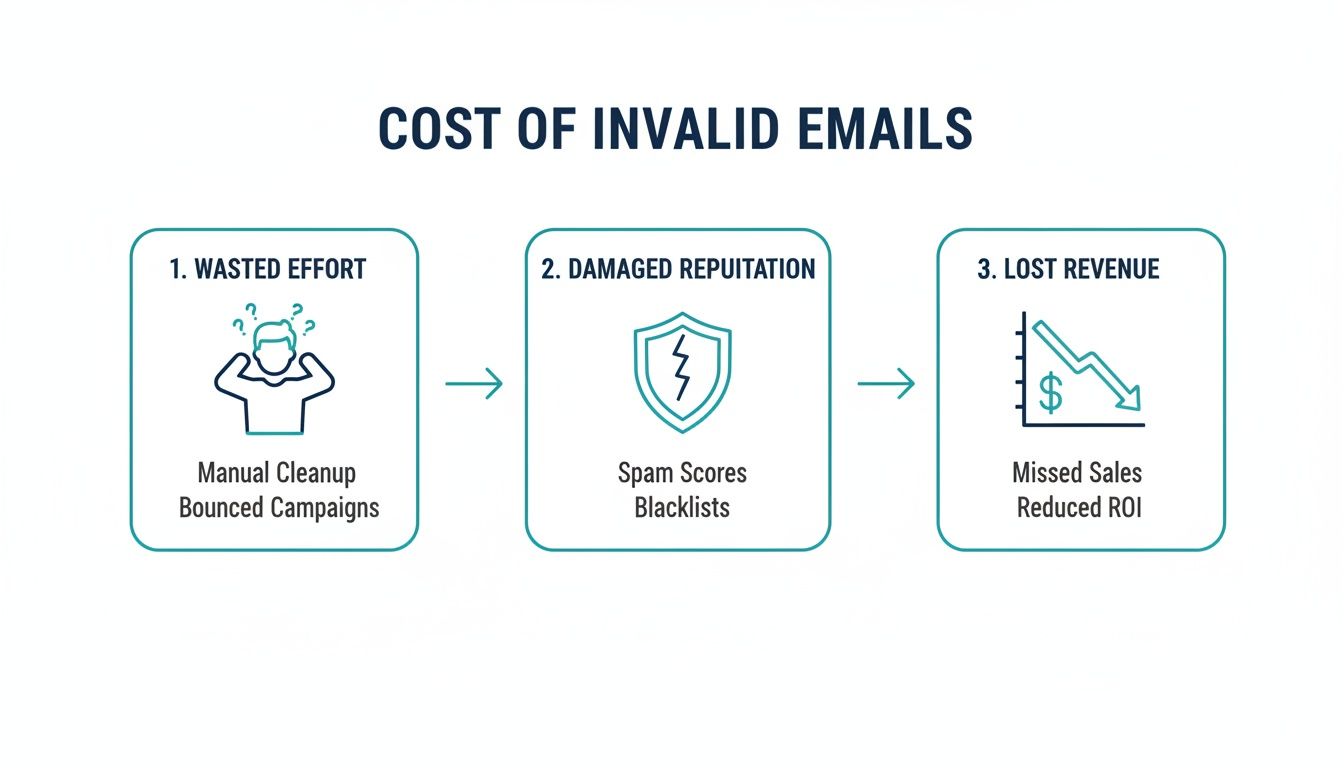
As you can see, the costs are cumulative. Wasted time leads to high bounce rates, which damages your sender reputation. A poor reputation means your emails land in spam, and you ultimately lose out on revenue.
The point of modern verification isn't just to see if an email might be deliverable. It's to know with near certainty that it will land in a real inbox, so your team can focus their energy on writing messages that convert, not fixing data errors.
When these checks are baked directly into your prospecting tools, you build a more predictable and efficient sales engine. Reps stay productive, leaders get cleaner data for forecasting, and your brand's reputation with email providers remains intact.
For any sales team serious about scaling their outreach, this is non-negotiable. To see how these tools compare, you can dive deeper into our complete guide on email validation software and find the right fit for your team.
Navigating Catch-Alls and Disposable Domains

You’ve run your list through a verifier. The syntax is good, the domain is real, and the server is active. Looks like a solid list, right?
Not so fast. This is a classic trap where sales teams get stuck. They end up wasting personalized outreach on emails that are technically deliverable but strategically worthless.
The two main culprits are catch-all servers and disposable domains. Knowing how to handle each one is what separates a clean, effective pipeline from a messy one that burns out your reps.
The Challenge of Catch-All Servers
Catch-all servers are common at large, enterprise-level companies—exactly the accounts your team is trying to land. These servers are configured to accept any email sent to their domain, whether the specific person exists or not.
This makes a standard SMTP handshake tricky. The server won't confirm or deny the specific mailbox, so your verification tool returns an "unknown" or "accept-all" status. While sending won't cause a hard bounce, you're flying blind. You could be emailing a ghost, which hurts your engagement rates and signals to email providers that your outreach is low-quality.
A catch-all doesn't mean "don't send." It means "proceed with intelligence." These are often your highest-value targets, so a different approach is needed.
Instead of deleting these contacts, your team needs to use other data to build confidence.
- Cross-Reference on LinkedIn: Does the prospect's profile match the company and title you have? This is your first and best signal.
- Identify Company Patterns: Have you already confirmed other contacts at the same company? If you know they use a
firstname.lastname@company.comformat, it's a very strong indicator. - Warm Up the Lead on Another Channel: Before sending an email, try a LinkedIn connection request or a well-crafted InMail. Verifying their role and getting a response there first makes your eventual email much more likely to land well.
If you’re regularly running into these, it's worth learning how to verify accept-all emails using more advanced techniques to sharpen your data.
Wiping Out Disposable Email Addresses
On the other end of the spectrum are disposable or temporary emails. Think of services like 10MinuteMail, which people use to grab a free resource without giving away their real contact info.
These addresses are pure poison for your CRM. They offer zero long-term value and are guaranteed to go cold almost immediately.
A modern prospecting platform automatically identifies and removes these domains from your lists. This is a non-negotiable feature. It ensures your reps aren't wasting energy personalizing messages for contacts that were never real in the first place. By separating a technically valid email address from a strategically viable one, you keep your pipeline healthy and your team focused on revenue-generating activities.
Integrating Verified Data into Your Sales Workflow
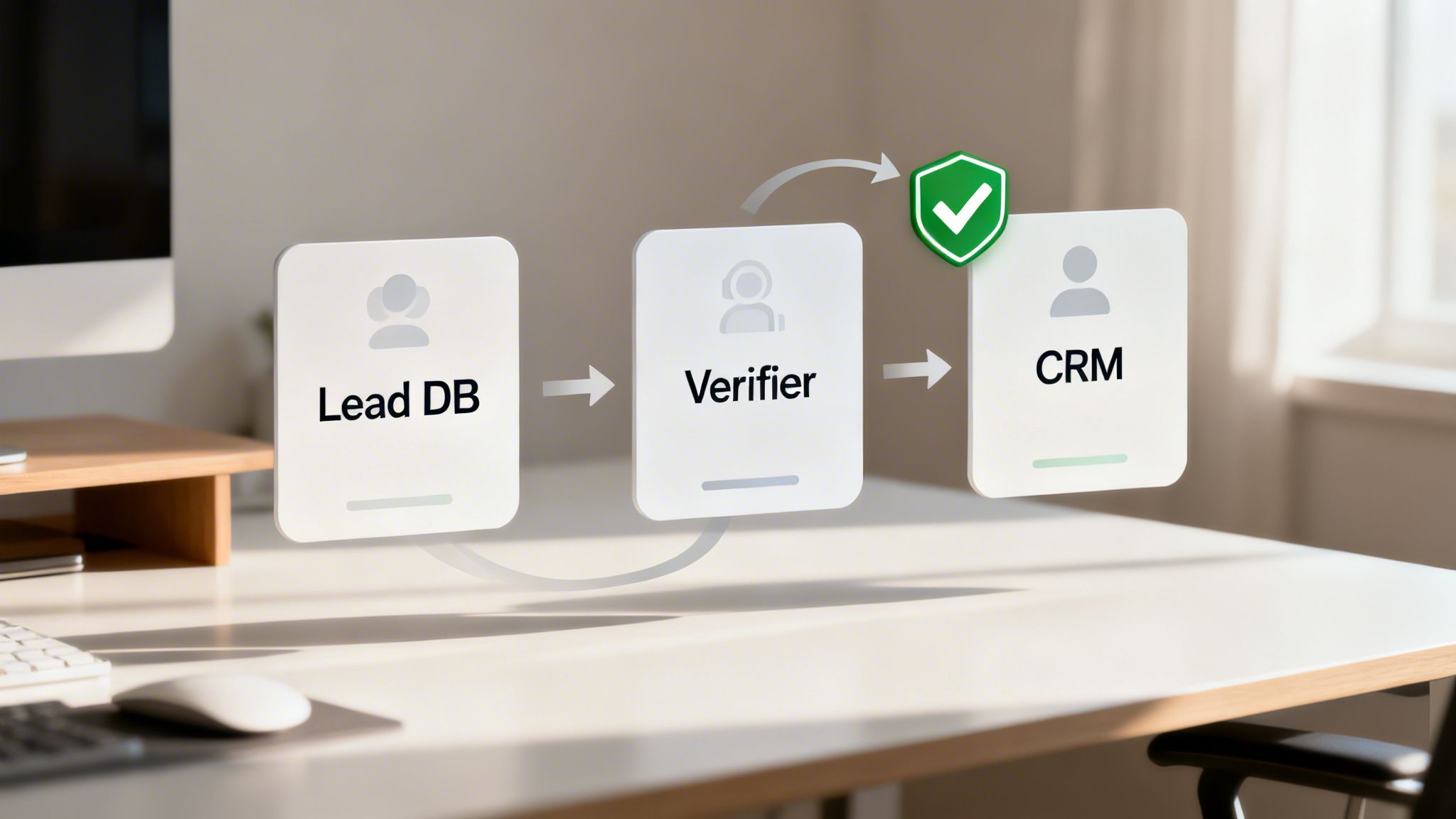
Finding a valid email address is a critical first step, but it’s only half the job. The real challenge—where most sales teams get bogged down—is getting that clean data into your daily workflow without grinding everything to a halt.
For any RevOps leader, the biggest headache is a fragmented tech stack. Reps are forced to export a prospect list, upload it to a separate verification tool, download the cleaned-up file, and then manually import it all back into their sequencer and CRM. Each step introduces friction and opens the door for costly data errors.
This manual shuffle is slow and inefficient. It drains your team's energy and kills momentum. Reps end up spending their best hours on data grunt work instead of personalizing outreach or talking to prospects. It's a process that completely undermines the goal of building pipeline efficiently.
From Friction to Flow
A modern GTM platform replaces that fragmented process entirely. Instead of data verification being a chore, it becomes an invisible, automatic part of your team's workflow. This unified approach gives top-performing sales teams their edge.
Think about how this feels for an SDR:
- They pinpoint a perfect-fit account and find the key decision-maker.
- The platform enriches the contact in real-time, automatically pulling in a verified email and phone number.
- All that clean, validated data instantly syncs to the right contact record in your CRM.
No more exporting spreadsheets. No more uploading CSVs. No more manual data entry. The verified contact is immediately ready for a multi-channel sequence powered by AI personalization.
The objective is to make clean data an effortless asset, not a tedious task. When verification is built directly into your tools, your CRM finally becomes the reliable source of truth it was meant to be, and your reps can trust the information they’re using.
The Business Impact of a Unified Platform
This integrated method does more than just save a few minutes; it directly fuels the activities that generate revenue. When your data moves automatically from verification to your outreach tools, your team operates with more speed and precision.
Here’s what that looks like on the ground:
- Eliminate Manual Data Entry: Reps get precious time back every week when they stop copy-pasting contact details between windows. That’s more time they can spend selling.
- Prevent CRM Decay: With data constantly checked and synced, your CRM stays fresh and accurate. This is the best defense against the data rot that makes most CRMs unreliable.
- Enable Faster Outreach: With a valid email address ready from the start, your reps can go from identifying a good prospect to sending a personalized email in seconds, not hours.
This shift lets your sales team get back to what they were hired for: building relationships and closing deals. By replacing a disjointed tech stack, an all-in-one platform like Willbe ensures your entire GTM engine runs on clean, verified fuel, helping your team build predictable pipeline, faster.
Having a list of clean, verified emails is the first step, but the job isn't done. Now you have to actually land in the inbox and get a reply.
This is where strategy separates high-performing teams from the rest. It’s not about how many emails you can send; it's about making sure the right messages get delivered and read.
Blasting thousands of generic emails, even to "valid" addresses, is a surefire way to destroy your sender reputation. Your team is better off sending 50 thoughtfully personalized messages than a massive, impersonal batch. To move the needle, your team needs to understand How to Verify an Email Address and Boost Deliverability as part of a bigger deliverability picture.
Don't Skip the Email Warm-Up
If you've just set up a new domain or onboarded a new SDR, you can't just flip a switch and start sending hundreds of emails. Mailbox providers like Google and Microsoft are always watching for suspicious activity, and a sudden spike in volume from a new sender is a massive red flag.
An email warm-up is essential. The process involves gradually increasing your sending volume over a few weeks. This proves to email servers that you're a legitimate sender, not a spammer.
For instance, a new SDR might start by sending just 10-20 emails on their first day, slowly ramping up to 50 or more per day over two or three weeks. An all-in-one platform like Willbe automates this, so your domain builds a positive reputation from day one without your RevOps team having to manually track sends.
Personalize Like a Human, Not a Robot
Spam filters are smarter than ever. They don’t just look at bounce rates; they analyze how people engage with your emails. If prospects consistently delete your messages without reading them—or worse, hit the spam button—your sender score will tank.
The best defense? Real, one-to-one personalization. The old {FirstName} merge tag doesn't cut it anymore.
Today’s prospects can spot a generic, AI-written template from a mile away. The key is using AI to generate outreach that sounds like you, not like a robot. The message must feel like it was written for them, referencing their unique challenges or company initiatives.
This is exactly what Willbe’s proprietary, template-free AI was built for. It creates outreach that reads as if it were written by a human, leading to more genuine replies and positive engagement. When people actually like getting your emails, it sends a powerful signal to providers that your messages are valuable, keeping you safely out of the spam folder.
If you want to go deeper on this, check out our complete guide to email deliverability best practices.
Keep a Close Eye on Your Metrics
You can't fix what you can't measure. As a sales leader, you need a clear dashboard of your team's deliverability metrics to spot problems before they spiral out of control.
Focus on these key numbers:
- Bounce Rate: Your hard bounce rate must stay under 2%. If it creeps higher, you have a serious problem with your list verification process.
- Complaint Rate: This is the percentage of people who mark your email as spam. Keep this below 0.1%, as anything more will quickly damage your domain's reputation.
- Open and Reply Rates: Consistently low engagement is an early warning sign. It tells you that your emails are either landing in spam or your messaging simply isn't connecting.
By actively monitoring these KPIs, you can make data-backed decisions—whether that means refining your prospect lists or A/B testing new messaging. This proactive approach is what keeps your domain healthy and ensures your team's outreach efforts actually turn into pipeline.
Common Questions About Finding a Valid Email Address
Even with a solid plan, a few questions always pop up around email validation. Let's tackle the most common ones I hear from SDRs, AEs, and sales leaders in the trenches.
How Often Should I Verify My B2B Contact List?
If you've been in sales for any length of time, you know how quickly a good contact list goes stale. People switch jobs, get promoted, and companies merge—some studies show that B2B data decays by over 30% per year.
For active outbound teams, verifying your list isn't a "one and done" task. It has to be constant. A static list you bought six months ago should be scrubbed at least once a quarter, minimum.
But for teams trying to build a predictable pipeline, the only real solution is a platform that provides real-time verification. It's the only way to keep your deliverability high and protect your sender reputation from getting torched by bounces.
What Is a Catch-All Email and Is It Safe to Send To?
Ah, the dreaded catch-all. This is a server configured to accept any email sent to its domain, regardless of whether the specific inbox (like jane.doe@company.com) actually exists. This means most verification tools will flag it as "risky" or "unknown" because they can't get a definitive 'yes' or 'no'.
Sending to a catch-all won't cause a hard bounce, but it's a gamble. You have no idea if a real person is on the other end, which can tank your open and reply rates and eventually get you flagged as a low-quality sender.
So, what's the play? Prioritize verified, non-catch-all addresses first. If you absolutely must target someone at a catch-all domain, warm them up on another channel like LinkedIn first. Confirm they’re still there and get on their radar before you hit send.
Can I Just Use a Free Online Email Checker Tool?
Free online checkers are fine for checking a single email here or there, but they aren't built for professional B2B prospecting.
For a sales team, they create more problems than they solve. Here’s why:
- They’re not very smart: They can't reliably handle complex scenarios like catch-all servers. They give you a simple "valid" or "invalid" without any of the nuance you actually need.
- They lack context: A free tool tells you nothing about the person, their role, or how fresh the data is. A valid email address for someone who left the company six months ago is useless.
- They’re a workflow killer: You can't plug them into your CRM or sales automation tools. It's all manual copy-and-paste, which is a massive time sink for your SDRs.
Relying on free tools gives you a false sense of security and slows your team down. An integrated GTM platform handles all this verification work behind the scenes, ensuring every contact you reach out to is not just valid, but actually valuable.
Willbe replaces this fragmented workflow with an all-in-one platform that finds, verifies, and syncs high-quality contact data automatically. See how top teams scale outbound and build predictable pipeline faster—book your personalized demo today.