


Email validation software is the gatekeeper for your outbound sales engine. It’s a critical function that checks whether a prospect's email address is real and can receive messages before your team ever hits "send." For any revenue team that depends on outreach, this isn't just a best practice—it's a non-negotiable part of a high-performance GTM motion. Launching sequences with bad data leads to high bounce rates, destroys your domain reputation, and ensures your messages never reach the people you need to engage.
The Hidden Revenue Cost of Bad Email Data
Every bounced email is more than a delivery failure—it’s a direct hit to your pipeline. For sales teams that compete on speed and precision, bad data isn't a minor annoyance. It's a silent revenue killer that clogs workflows, wastes rep time, and sabotages the very outbound engine you’ve invested in.
Imagine an SDR spending Monday morning personalizing outreach for a list of 100 top-tier prospects. By Tuesday, 15 of those emails have hard-bounced. That means 15% of their effort was completely wasted on contacts they could never reach. Worse, that spike in bounces signals to email providers like Google and Microsoft that you might be a spammer, putting your entire domain's sender reputation at risk.
The Downward Spiral of a Damaged Reputation
Once your sender reputation takes a hit, the damage cascades through your entire sales motion. It’s no longer just about those initial bounces.
- Future emails get blocked: Suddenly, even your perfectly crafted emails to warm leads and high-intent prospects start landing in spam folders or getting rejected outright.
- AE pipeline suffers: Account Executives receive fewer qualified handoffs because the SDR team's messages are struggling with deliverability. This leads directly to missed meeting targets and a less predictable pipeline.
- Forecasts become unreliable: How can sales leaders trust their pipeline numbers when a significant portion of their team's outreach is hitting a digital brick wall?
This entire downward spiral starts with a simple, solvable problem: launching campaigns with unverified contact data. Your team’s brilliant, AI-powered personalization means nothing if it never reaches an inbox. The foundation of any winning outbound strategy isn't just finding contacts; it's ensuring they're real and reachable.
The core issue is that without clean, verified data, your entire GTM engine is built on a faulty foundation. It erodes your credibility with email providers and prospects alike, all before a single conversation can begin.
From Technical Problem to Sales Bottleneck
This isn't an abstract technical issue for RevOps to solve later; it’s a daily frustration that grinds sales productivity to a halt. When SDRs consistently see high bounce rates, they lose momentum and confidence in their lists. This forces them into a reactive cycle of manually cleaning data—a low-value task that pulls them away from personalizing follow-ups and booking meetings. For a deeper dive into protecting your outreach, you can learn more about email deliverability best practices in our complete guide.
Ultimately, ignoring email validation creates friction at every stage of your funnel. It makes your team less efficient, your forecasts less predictable, and your revenue goals harder to hit. Understanding this connection is the first step toward treating data hygiene not as an IT chore, but as a critical, revenue-driving function.
How Email Validation Software Actually Works
To a sales team, email validation software can seem like a black box. You feed it a list of contacts, and it reports back on which ones are safe to email. But understanding what’s happening "under the hood" helps you understand why not all validation tools are created equal.
Think of it as a multi-point inspection for every email address. It starts with simple checks and moves to more sophisticated, definitive tests. This isn't about getting lost in technical details; it's a clear, methodical process designed to protect your sender reputation and keep your pipeline full. Even one bounced email can set off a chain reaction, hurting your reputation and blocking future sales conversations before they even start.
As you can see, a simple bounce quickly becomes a much bigger problem.
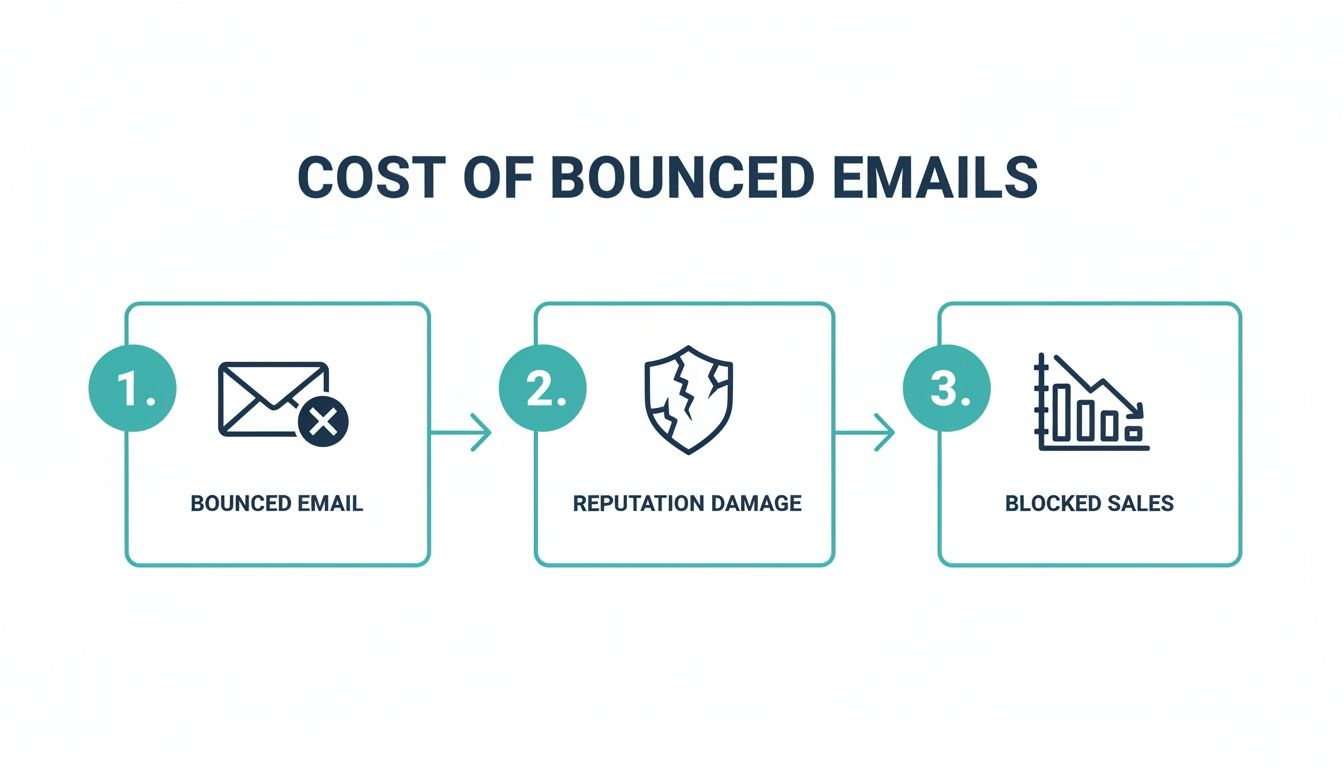
What starts as a minor delivery error can escalate, ultimately preventing your team from ever reaching perfectly good prospects.
The Foundational Layers of Verification
The validation process works like a funnel, starting broad and getting more specific with each step. Each layer is designed to filter out a different type of bad data, ensuring only the most deliverable addresses end up in your outreach sequences.
Syntax and Formatting Check: This is the first and most basic line of defense. The software scans the email address to ensure it follows standard rules. Does it have an "@" symbol? Is the domain structure (
company.com) correct? Are there illegal characters or spaces? This quick pass catches obvious typos and formatting mistakes instantly.Domain and MX Record Check: Next, the tool verifies that the domain itself (
@company.com) is real and has a Mail Exchanger (MX) record. Think of an MX record as a public directory entry that tells the internet which server is responsible for handling mail for that domain. If there's no MX record, there's literally nowhere for your email to be delivered.
The Most Critical Test: The SMTP Handshake
After an email passes the initial checks, the software moves on to the most important part: the SMTP handshake. This is a live communication with the recipient's mail server.
Here’s a simple analogy: your validation tool essentially makes a quick "call" to the company's mail server and asks, "Hey, do you have an active mailbox for jane.doe?" The server’s response—a "yes" or "no"—is what confirms deliverability. This live ping confirms not just that the company's server exists, but that a specific user inbox is active and ready to receive mail.
This SMTP verification is the core of what makes email validation software so powerful. It’s the difference between guessing if an address is real and getting direct confirmation from the source, which can slash your bounce rate to near zero.
Navigating Complex and Risky Scenarios
In the real world of B2B sales, a simple "valid" or "invalid" status isn't enough. Top-tier validation software must also identify and categorize riskier cases that can still hurt your deliverability. If you want to dive deeper into how this impacts campaign performance, check out our guide on the best cold email software.
Here are the most common scenarios your team will run into:
- Catch-All Servers: Some companies set up their servers to "catch" every email sent to their domain, even to non-existent addresses. This makes it impossible for a standard SMTP check to confirm a specific inbox. Sending to these is a calculated risk—some will deliver, but many will bounce. A good tool will flag these "accept-all" addresses so your team can make a strategic decision.
- Role-Based Accounts: These are generic inboxes like
info@,support@, orsales@. While technically valid, they rarely connect you to a decision-maker and often suffer from low engagement, which can hurt your sender score over time. - Disposable Email Addresses: These are temporary, throwaway inboxes people use to sign up for content without revealing their real identity. They're a dead end for sales and a clear sign of a low-intent lead that should always be scrubbed from your lists.
By running every contact through this rigorous, multi-stage process, a solid email validation platform ensures your sales reps spend their time on real prospects. It shifts their focus from cleaning lists to what they do best: starting valuable conversations.
Key Features a Modern Sales Team Can't Live Without
Not all email validation tools are created equal. For a B2B sales team where every minute and interaction counts, a basic typo-checker isn't enough. You're running a high-stakes operation, and every moment your reps spend wrestling with bad data is a moment they aren't selling.
The right platform needs to be more than a data-cleaning utility; it must be a core part of your revenue engine.

As you evaluate options, push past marketing claims. Focus on the capabilities that solve real-world sales bottlenecks and drive efficiency, not just check a box on a features list.
Accuracy Rate and Data Freshness
Let's start with the most critical metric: accuracy. A tool promising 99% accuracy is worlds apart from one that only hits 95%. That 4% gap might seem small, but over a single quarter, it can mean hundreds of bounced emails, frustrated internet service providers, and serious damage to your sending reputation. Always ask for clear, verifiable proof of a vendor's accuracy rates.
Data freshness is just as vital. B2B contact data decays at a rate of over 30% per year. People switch jobs, companies get acquired, and email servers change. An email address verified six months ago is already a gamble today. This is why a one-time list cleaning is like putting a band-aid on a recurring problem.
Real-Time API Validation
For any team serious about data quality, a real-time API is non-negotiable. Think of it as a bouncer at the front door of your CRM and website forms.
When a prospect fills out a demo request, the API instantly checks the email they entered. If it's invalid or has a typo, the form can prompt them to fix it before that bad data ever pollutes your system.
This single feature stops data contamination at the source. It ensures your inbound leads are clean from the start, so your reps can follow up immediately without hitting a bounce. No more chasing phantom leads or discovering a simple typo cost you a hot opportunity.
Bulk List Cleaning and Database Hygiene
While an API guards the front door, you still have to manage the thousands of contacts already in your database. This is where bulk list processing comes in. Any effective email validation software must let your RevOps team upload entire CSVs or sync your whole CRM for a deep clean.
This process needs to be fast and, more importantly, deliver clear, actionable results. It should segment your list into easy-to-understand categories:
- Valid: Green-lit for immediate outreach.
- Invalid: Must be removed to prevent bounces.
- Catch-All (Risky): Requires a strategic decision on whether to risk sending.
- Role-Based: Helps you filter out generic mailboxes from actual decision-makers.
Running these clean-ups regularly isn't just a chore; it's critical maintenance that keeps your outbound engine healthy and your sender reputation pristine.
Standalone Validator vs Integrated Platform
When evaluating tools, you’ll encounter two main approaches: a standalone validator that requires you to export and import lists, or an integrated platform where validation is built directly into the workflow. The difference in day-to-day efficiency for a sales team is massive.
While a standalone tool is better than nothing, it still treats data cleaning as a separate, tedious task. An integrated platform makes it an invisible and effortless part of the prospecting process, which is where true productivity gains are found.
Seamless Tech Stack Integrations
In a modern sales org, your tools have to talk to each other. A validation service that forces reps to live in a world of exporting and re-importing CSVs is a productivity killer. That manual back-and-forth is not only slow but also ripe for human error.
Look for a solution with native integrations for the platforms your team uses every day, especially your CRM (like Salesforce or HubSpot) and sales engagement platform. The ideal scenario is a unified platform where validation is woven directly into the prospecting workflow. For more ideas on how different tools can work together, see our guide on the best AI sales tools.
Actionable Reporting and Analytics
Finally, you can't improve what you can't see. Your email validation software should provide clear, straightforward reports on the health of your contact data. You need dashboards that visualize the breakdown of your lists—the percentage of valid, invalid, and risky emails—both before and after a cleaning.
This intelligence is gold for sales leaders and RevOps. It allows you to track data quality over time, prove the ROI of your data hygiene program, and pinpoint which lead sources are providing the cleanest (or dirtiest) contacts. Good reporting turns validation from a background task into a strategic asset for optimizing your entire go-to-market strategy.
Connecting Clean Data to Predictable Revenue
Clean data isn't just an abstract goal for the RevOps team—it's the foundation of predictable revenue. For anyone leading a sales team, the line between a verified email list and a reliable pipeline forecast is straight and clear. When your outbound engine runs on clean data, every part of your sales motion becomes more efficient, scalable, and profitable.
It all starts with the most obvious metric: deliverability. By removing invalid email addresses before you hit send, you can slash your bounce rate. This simple step is fundamental for protecting your sender reputation, ensuring your carefully crafted messages actually land in front of prospects instead of getting flagged as spam. The immediate payoff is higher open and reply rates, which means more conversations started.

The Downstream Impact on Sales Performance
But better deliverability is just the beginning. The real ROI from email validation software is visible in the ripple effects on your team's performance and pipeline quality.
- More Meetings Booked Per Rep: When SDRs trust their lists, they stop wasting time on manual data cleanup and can focus on what they do best: personalizing outreach and running sequences. With fewer bounces, their efforts have a higher chance of success, leading directly to more replies and, ultimately, more meetings booked.
- Higher-Quality Pipeline for AEs: Clean data at the top of the funnel translates to cleaner handoffs to your Account Executives. AEs can focus on opportunities with real, engaged prospects, not phantom leads from bounced emails. This improves their conversion rates and the overall health of the pipeline.
- More Accurate Revenue Forecasting: As a sales leader, when you can trust your deliverability numbers, you can build revenue models that aren't just guesswork. You gain a clear line of sight into how many emails it takes to get a meeting, how many meetings convert to qualified opportunities, and how many of those deals actually close.
This industry-wide focus on data accuracy is no accident. The global email verification software market was valued at USD 1.28 billion in 2026 and is projected to reach USD 2.46 billion by 2035. Companies that process high email volumes have shown that AI-driven validation can cut bounce rates by as much as 47%—a game-changing number for any sales team. You can dive deeper into the trends and explore the full email verification software market forecast for a more detailed analysis.
A Tale of Two Sales Teams
To see the difference, imagine two scenarios.
Team A: The Fragmented Approach
This team buys a list and immediately blasts out a campaign. They are hit with a 12% bounce rate, which damages their sender reputation. Their SDRs waste hours sifting through delivery failures and scrambling to find correct contact info. Their pipeline forecast is a shot in the dark because a huge chunk of their "outreach" never reached an inbox.
Team B: The Willbe Approach
This team uses an all-in-one prospecting platform like Willbe, where every contact is verified the moment it's found. Their bounce rate stays under 1%. SDRs spend their days focused purely on personalization and engagement, confident that every message they send will be delivered.
With Willbe, email validation isn't a separate, clunky step you have to remember. It’s a continuous, automated process running in the background, making sure every email has the best possible chance of starting a revenue-generating conversation.
The contrast is stark. Team B books more meetings, builds a healthier pipeline, and can forecast its growth with confidence. They have turned data hygiene from a manual chore into a competitive advantage.
Ultimately, email validation isn't just about avoiding bounces. It's a direct investment in sales efficiency, pipeline predictability, and faster growth. It’s about making every single touchpoint count.
Why a Consolidated GTM Platform Is the Future
Using a standalone email validation tool is far better than sending outreach into the void. It plugs a major leak, cuts down on bounces, and protects your sender reputation. But for modern sales teams built for speed and efficiency, it introduces a new problem: a clunky, fragmented workflow that wastes your team's most valuable resource—time.
Picture the process. Your reps find prospects in one tool, export a CSV, and then switch to a separate validation service. They upload the file, wait for it to process, download another CSV, and finally, import the clean list back into their outreach platform or CRM. This multi-tool shuffle isn't just slow; it’s a manual, error-prone process that pulls your best reps away from revenue-generating activities.
Every minute an SDR spends wrestling with CSVs is a minute they aren't personalizing a follow-up or building a relationship. This friction is the hidden tax of a fragmented tech stack, and it puts the brakes on your entire revenue engine.
The Problem with Disconnected Tools
A disconnected approach to data hygiene creates risks and slowdowns that only compound over time. It’s not just about the lost minutes; it’s about the lost momentum.
- Data Decays Between Steps: B2B contact data has a notoriously short shelf life. In the time it takes to export, clean, and re-import a list, a key prospect could have already changed jobs. Your "clean" data is instantly out of date before you even use it.
- The Door Opens for Human Error: Every manual export and import is a chance for something to go wrong. Columns get mismatched. The wrong file gets uploaded. A rep accidentally pollutes the very CRM you’re trying to keep clean.
- No Single Source of Truth: When your data is spread across different tools, which one do you trust? Your CRM says one thing, your outreach tool says another, and your validation report has a different timestamp. It becomes impossible to maintain a single, reliable view of your prospects.
This fragmented reality isn't sustainable for high-growth teams. The market for data validation services is expected to swell to USD 4.8 billion by 2025, growing at an annual rate of 10.2%. This isn't just about cleaning data; it's a clear signal that businesses desperately need to embed data hygiene into their daily workflows, not treat it as a painful, separate chore. You can see more on how market trends reflect this shift at datainsightsmarket.com.
The Power of an All-in-One Platform
This is exactly why we built Willbe as an all-in-one prospecting platform. Our philosophy is simple: best-in-class email validation software shouldn't be another tool you have to manage. It should be a seamless, invisible engine powering your entire go-to-market motion.
With Willbe, there is no export-import dance. Validation is woven directly into the fabric of the platform.
When your reps find prospects, their data is continuously verified in real-time. From the moment of discovery to outreach and syncing with your CRM, they are always working with accurate contact information. This isn’t a periodic deep clean; it’s a constant state of data readiness.
An integrated approach fundamentally changes how your team operates. It frees up hours of administrative work, stops data decay in its tracks, and empowers your reps to focus entirely on activities that generate revenue.
From Inefficiency to a Predictable Pipeline
Imagine your SDRs starting their day with a fresh list of accounts that perfectly match your ICP. With a single click, they can pinpoint the right decision-makers and instantly have their verified, accurate email addresses ready for outreach. No CSVs. No waiting. Just a smooth, unbroken line from finding a great account to starting a valuable conversation.
This is what high-performance sales looks like in 2026. By consolidating your tech stack, you move beyond just cleaning data and start building a more predictable GTM engine. Your reps work faster and smarter, your data integrity is protected automatically, and you, as a leader, get the visibility you need to scale what's working. It’s about swapping a fragmented, reactive process for a unified, proactive system designed for one thing: converting pipeline, faster.
Frequently Asked Questions About Email Validation
As a sales professional, you live and breathe targets. Performance is everything. So, it's natural to be skeptical of any new tool promising to make your life easier. Let's tackle some of the most common, practical questions we hear from SDRs, sales leaders, and RevOps professionals about email validation and what it actually does for them.
How Often Should I Validate My Email Lists?
For any team running outbound, real-time validation is the only way to go. B2B contact data goes stale incredibly fast. With people changing jobs, getting promoted, and leaving companies, data decays at a rate of over 30% per year. A list you cleaned just six months ago is already a minefield of potential bounces.
If you're stuck using a separate validation tool, the standard advice is to scrub your entire database at least quarterly. And critically, you must check every new list before launching a campaign. A modern approach is to use an integrated platform like Willbe, which handles verification continuously. This means your data is always accurate the moment you need it, with no extra steps.
Can Email Validation Guarantee 100% Deliverability?
No tool can promise 100% deliverability. If a vendor makes that claim, you should be skeptical. Even a perfectly valid email address can hit a snag. It might get blocked by a company's aggressive spam filter, bounce due to a temporary server issue, or even fail because the person's inbox is full.
What top-tier email validation software can do is get you to 98-99% accuracy. That level of precision is more than enough to slash your bounce rate, protect your sender reputation, and give every campaign the best possible chance of landing in the inbox. It’s not about chasing an impossible target; it’s about minimizing risk and maximizing your opportunity to connect.
The goal isn’t an unattainable 100% deliverability. It's about achieving near-perfect accuracy to ensure your reps’ time and your company’s sender reputation are always protected, campaign after campaign.
What Is the Difference Between a 'Catch-All' and a 'Valid' Email?
This is a huge point of confusion, and the difference is critical for managing risk in your outreach.
- Valid: When an email is marked "valid," it means the software performed a direct check with the mail server and received a clear confirmation. It's like asking, "Does Jane Doe have a mailbox here?" and the server responding, "Yes, she does, and it's open." This is your green light.
- Catch-All: A "catch-all" (or "accept-all") is a server-side setting. The company has configured its mail server to accept any email sent to its domain, whether the specific person exists or not. This makes it impossible for a standard check to confirm if
jane.doe@company.comis a real inbox.
Sending to catch-all addresses is a gamble. Some will get through, but many will be accepted by the server only to be rejected later, causing a hard bounce. More advanced platforms can apply other signals to give these a risk score, but they'll never be as certain as a truly "valid" email.
Is It Better to Use a Standalone Tool or an Integrated Platform?
For any modern sales team that values speed and efficiency, an integrated platform wins, hands down. A standalone tool might seem like an easy fix, but it creates significant friction in your daily workflow.
Think about the process: export a list, upload it to another service, wait, download the results, and then re-import everything. It's slow, tedious, and error-prone. It pulls your reps out of their selling motion and turns them into data administrators.
An all-in-one platform like Willbe builds validation directly into the prospecting and outreach process. Every contact is verified as you find them, saving hours of manual work, ensuring data cleanliness across your entire tech stack, and letting your team focus 100% on what they do best: starting conversations and closing deals.
Ready to see how an all-in-one prospecting platform eliminates data friction and helps your team build predictable pipeline? Willbe integrates best-in-class email validation directly into your prospecting workflow, so your team always works with clean, verified data without ever leaving the platform. See Willbe in action.