


B2B lead generation software is the system of record for modern GTM teams—the engine that helps them find the right accounts, engage the right people, and predictably build pipeline. Today's top platforms are no longer just contact databases. They are all-in-one prospecting solutions that replace fragmented tools and manual workflows, managing the entire top-of-funnel process from account discovery to booked meetings.
From Cluttered Toolbox to Intelligent Sales Engine
For too long, B2B prospecting has been a disconnected scavenger hunt. Your sales reps know the scenario: one tool to find contact data, another for email sequences, a third for LinkedIn outreach, and a clunky spreadsheet holding it all together.
This patchwork approach isn't just inefficient—it's the root cause of rep burnout, unreliable CRM data, and a pipeline that feels more like a guessing game than a predictable system. Sales leaders struggle to forecast revenue, AEs receive poor-quality handoffs, and RevOps teams are left to clean up the data mess.
This is precisely the chaos that modern B2B lead generation software is designed to eliminate. It's not just another tool for the stack; it represents a fundamental shift in how go-to-market teams operate, consolidating fragmented workflows into a single, intelligent platform.
Think of it as trading a messy toolbox of single-purpose gadgets for a unified command center. An all-in-one platform like Willbe brings the entire outbound sales workflow—from finding accounts to booking meetings—under one roof.
The Grinding Reality of Manual Prospecting
The old way forces your best reps to spend their days on tedious, low-value tasks instead of actually selling. For a sales rep working without an integrated platform, a typical day is filled with friction:
- Endless Data Hunts: Hopping between multiple databases just to find one verified email address and direct-dial number.
- Time-Sucking Research: Scrolling through countless LinkedIn profiles and company pages, desperate for a single, meaningful insight to personalize an email.
- CRM Battles: Manually logging every call and email, fixing broken data syncs, and wrestling with duplicate records.
- Flying Blind: Lacking any real insight into which messages, channels, or account segments are actually leading to booked meetings.
This manual grind doesn't scale. It crushes team morale and leaves potential revenue on the table. In a world where every buyer is bombarded with generic outreach, this disconnected process is a recipe for being ignored.
The Shift to a Unified Platform
The rapid growth of the lead generation software market tells the whole story. This technology, which powers platforms like Willbe, is on a steep upward trajectory, projected to jump from USD 8.76 billion in 2025 to USD 9.87 billion in 2026. This isn't just a trend; it's a direct response from sales teams who are fed up with manual work and fragmented tools. You can dig deeper into these market dynamics to see how fast the landscape is changing.
The table below breaks down the stark difference between the old, fragmented way and the new, integrated approach.
The Shift from Manual Prospecting to Integrated Platforms
| Activity | Traditional Manual Workflow | Modern Integrated Platform (e.g., Willbe) |
|---|---|---|
| Finding Prospects | Manually searching LinkedIn, company lists, and disparate data providers. | Accessing a built-in, verified database of contacts and companies with advanced filters. |
| Data Enrichment | Reps spend hours cross-referencing sources to find emails and phone numbers. | Contact and account data is automatically enriched and verified in real-time. |
| Personalization | Reps manually research each prospect one by one, looking for a hook. | AI analyzes prospect data to suggest relevant personalization points instantly. |
| Outreach | Juggling separate tools for email, calls, and social media, with no connection. | A single, multi-channel sequence coordinates emails, calls, and social touches automatically. |
| CRM Sync | Manually logging all activities, leading to errors, duplicates, and outdated records. | All activities are automatically logged in the CRM, ensuring clean and up-to-date data. |
| Analytics | Guessing what's working based on anecdotal evidence or basic email open rates. | Clear, actionable analytics show which channels, messages, and segments drive results. |
Ultimately, an all-in-one platform like Willbe isn't a perk; it's the essential infrastructure for any GTM organization that wants to scale. It weaves together verified data, AI-driven personalization, multi-channel orchestration, and real-time analytics to turn prospecting from a chore into a repeatable growth engine.
What a Modern B2B Lead Generation Platform Actually Does
When we talk about B2B lead generation software, we’re not just talking about a collection of features. We’re talking about a completely different way of working. It's the difference between trying to run a sales team with a dozen disconnected tools versus handing them a single, finely-tuned engine. One is chaotic and unpredictable; the other delivers speed, precision, and consistent results.
This image captures the transformation. It shows teams moving away from the frustration of a messy tech stack and toward the clarity of an integrated platform that drives predictable revenue.
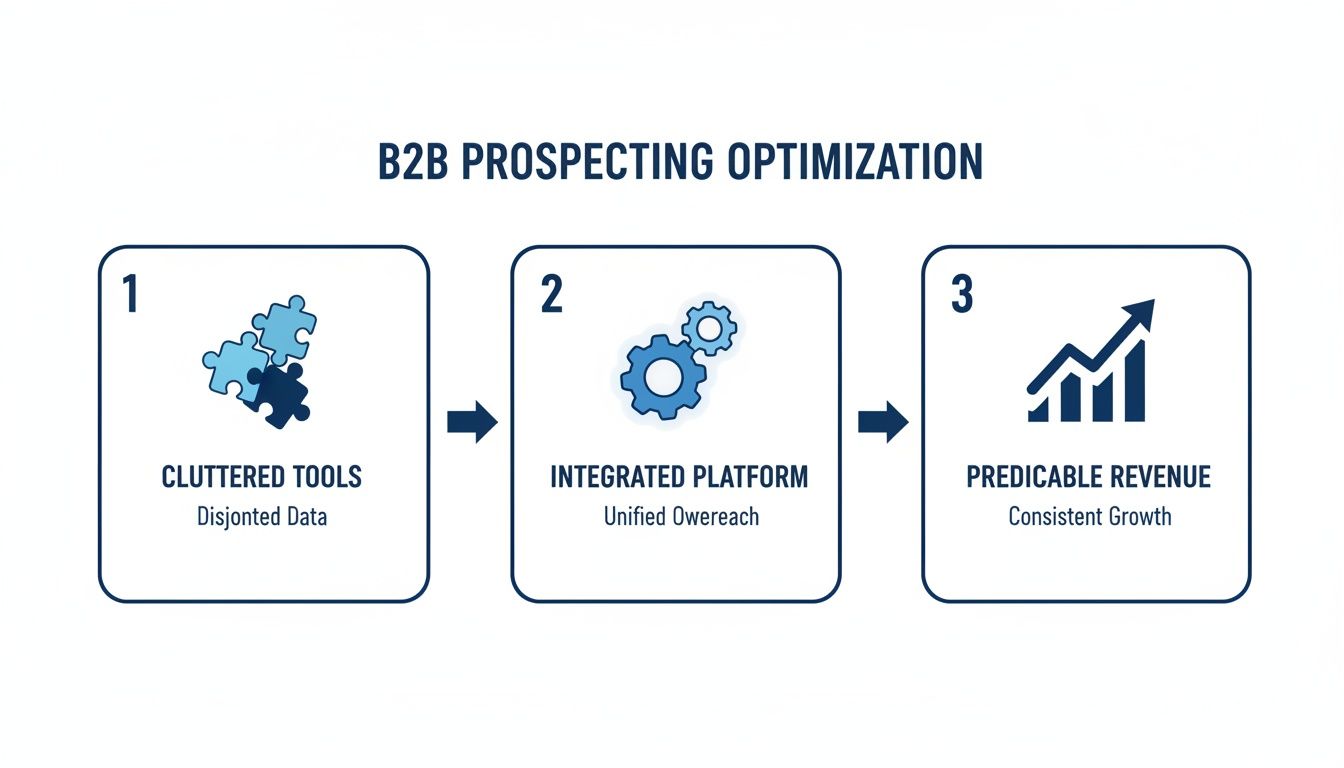
This isn't a nice-to-have. It’s a fundamental shift that connects your team's daily prospecting efforts directly to the revenue goals you need to hit. Let's break down the core components that make it happen.
Finding and Enriching Your Data
Every sales leader knows a campaign is only as good as the data it's built on. The old way? Your reps waste hours juggling multiple data subscriptions and scouring the web for contact info, often ending up with a list of stale emails that just bounce. It’s a slow, expensive grind that kills momentum.
A modern all-in-one platform like Willbe flips this on its head. It consolidates data from dozens of top-tier B2B sources into one place.
- Live, Verified Data: You’re not buying static lists that start decaying the second you download them. You get access to a living database that’s constantly updated and verified. This means more accurate emails, more direct-dials, and less time dealing with bounced messages.
- More Than Just Contact Info: A name and email are just the start. These platforms provide deep firmographic data (company size, revenue) and technographic data (what software they use), enabling truly precise targeting.
This gives your team an always-on data engine built right into their workflow. Reps can pinpoint the right accounts and find the right people inside them in minutes, not days. To see how this works, check out Willbe’s prospecting features and its approach to global data coverage.
Advanced Segmentation That Actually Works
Having a mountain of data is useless if you can't filter it effectively. Trying to segment lists in a spreadsheet is clumsy and error-prone, making it impossible to target the niche audiences that hold the most potential.
This is where advanced segmentation comes in. It gives your team the power to slice your entire market with surgical precision, building hyper-specific target account lists (TALs).
A modern platform lets you filter your total addressable market with incredible precision. You can instantly isolate companies that just received new funding, are hiring for a specific role, use your competitor's software, and are located in a new target region—all at the same time.
This level of detail is a game-changer. It ensures your reps are always working from a curated list of high-potential accounts, so they’re not burning through your best prospects with generic, one-size-fits-all outreach.
Multi-Channel Sequencing and AI Personalization
Today's buyers expect a conversation, not a generic blast. But trying to coordinate emails, LinkedIn messages, and calls manually is a logistical nightmare. Reps lose track of where they are in a sequence and end up looking disorganized.
A unified platform fixes this by orchestrating every touchpoint within a single, cohesive sequence. This ensures a consistent story unfolds across different channels, building familiarity and trust with prospects.
This is where true AI personalization—not the fake kind—makes all the difference. Instead of tired "Hi {first_name}" templates, the platform can generate genuinely relevant messages that reference a prospect's recent LinkedIn post or a key trigger event at their company. This is what makes your outreach feel human and gets a response, even at scale.
Beyond that initial outreach, a top-tier platform should also handle the next step seamlessly. Look for features like AI Actions for CRM Lead Capture that automatically push qualified leads into your pipeline, ensuring no opportunity is ever dropped.
Automated CRM Sync and Real-World Analytics
Finally, all this activity is worthless if it creates a data black hole for your RevOps team. The last piece of the puzzle—and it's a critical one—is a rock-solid, bi-directional sync with your CRM.
Every email sent, LinkedIn connection requested, and task completed should be logged automatically in real time. This frees your reps from mind-numbing data entry and keeps your CRM as the undisputed source of truth.
For leaders, this provides crystal-clear analytics on what’s actually moving the needle. You can finally see which channels, which messages, and which segments are producing the most meetings and generating the most pipeline. No more guesswork.
How AI Personalization Actually Gets Replies at Scale
Let’s be direct. Most "AI personalization" is just a high-tech mail merge. Dropping a {first_name} and {company_name} into a template isn't smart—it's just a template. Your prospects see right through it. It's the digital equivalent of a salesperson who remembers your name but has no idea what you actually need.
This is exactly why so many AI-powered outreach campaigns fall flat.
True personalization runs much deeper. It’s about making a prospect feel like you've done your homework and genuinely understand their world. This is where modern, template-free AI really changes the game. Imagine an SDR trying to break into a new account. Instead of losing hours digging for a clever opening line, the right AI can scan a prospect’s recent LinkedIn posts, company news, and even job descriptions in seconds.
It finds the hook—the one detail that matters. It might be a specific point they made in an article, a question about a challenge hinted at in a new job posting, or a timely congrats on their latest funding round. That's the difference between an email that gets instantly deleted and one that starts a real conversation.

Beyond Templates: The Power of Contextual AI
The point of AI in sales isn't just to write emails faster. It’s to write better emails—the kind your best rep would write on their best day, over and over again. Modern B2B lead generation software uses AI that's trained to sound like an expert on your team, not a generic robot.
Let’s look at a few real-world scenarios sales teams face every day:
- The Overwhelmed SDR: An SDR has a target list of 100 high-value prospects. Researching and writing a truly personal email for each could easily take all day. A contextual AI, however, can draft 100 unique, personalized messages in minutes, each referencing a different, relevant trigger for that specific person.
- The AE Reviving a Cold Account: An AE needs to re-engage a key account that went dark six months ago. The AI can instantly pull up recent company wins or new executive hires, giving the AE the perfect, timely reason to reach out now.
- The Leader Scaling into a New Market: A sales leader is building a team to enter a new country. An AI like Willbe's can generate hyper-personalized outreach in over 80 languages, ensuring the message is not only grammatically perfect but also culturally appropriate—a massive challenge to do manually at scale.
The result is outreach that makes prospects stop and think, "This person actually gets it." It proves you understand their world, which is the first and most important step to building trust and earning a reply.
Why Proprietary AI Outperforms Generic Models
Many tools just plug into general-purpose AI models like ChatGPT. While impressive, these models lack the specialized knowledge and safety rails required for effective sales outreach. They often produce vague, long-winded copy that just sounds like it was written by an AI.
A purpose-built sales AI, like the engine inside Willbe, is different. It’s trained exclusively on B2B sales messaging that converts. It understands the nuances that make a cold email work. If you want to get more replies at scale, it's worth understanding the subtleties of finding the best AI email assistant for your team's workflow.
Willbe’s platform is completely template-free. It doesn't just fill in blanks; it synthesizes multiple data points to create a unique narrative for every prospect. For sales leaders and RevOps teams, this provides a massive benefit: predictability and brand safety. The AI works within your strategic framework, ensuring every message reflects your company's tone and value. This is how top teams boost reply rates without sacrificing quality or burning their brand.
You can check out our deep-dive into the best AI sales tools to see how this focused approach separates top performers from the rest.
Unlocking Your Full Market with Multi-Channel Sequencing
Relying on a single channel like email or LinkedIn isn't a strategy anymore. To break through the noise and capture your ideal accounts, you need to use orchestrated, multi-channel sequences to start real conversations.
You’re not just spamming prospects from different angles. You're creating a single, unified dialogue. A modern B2B lead generation software like Willbe acts as the conductor for your outreach, coordinating every touchpoint across email and LinkedIn so your messages build on each other, rather than clashing. For a sales leader, this means you can finally maximize your team's reach without burning through your best accounts with clumsy, repetitive pings.
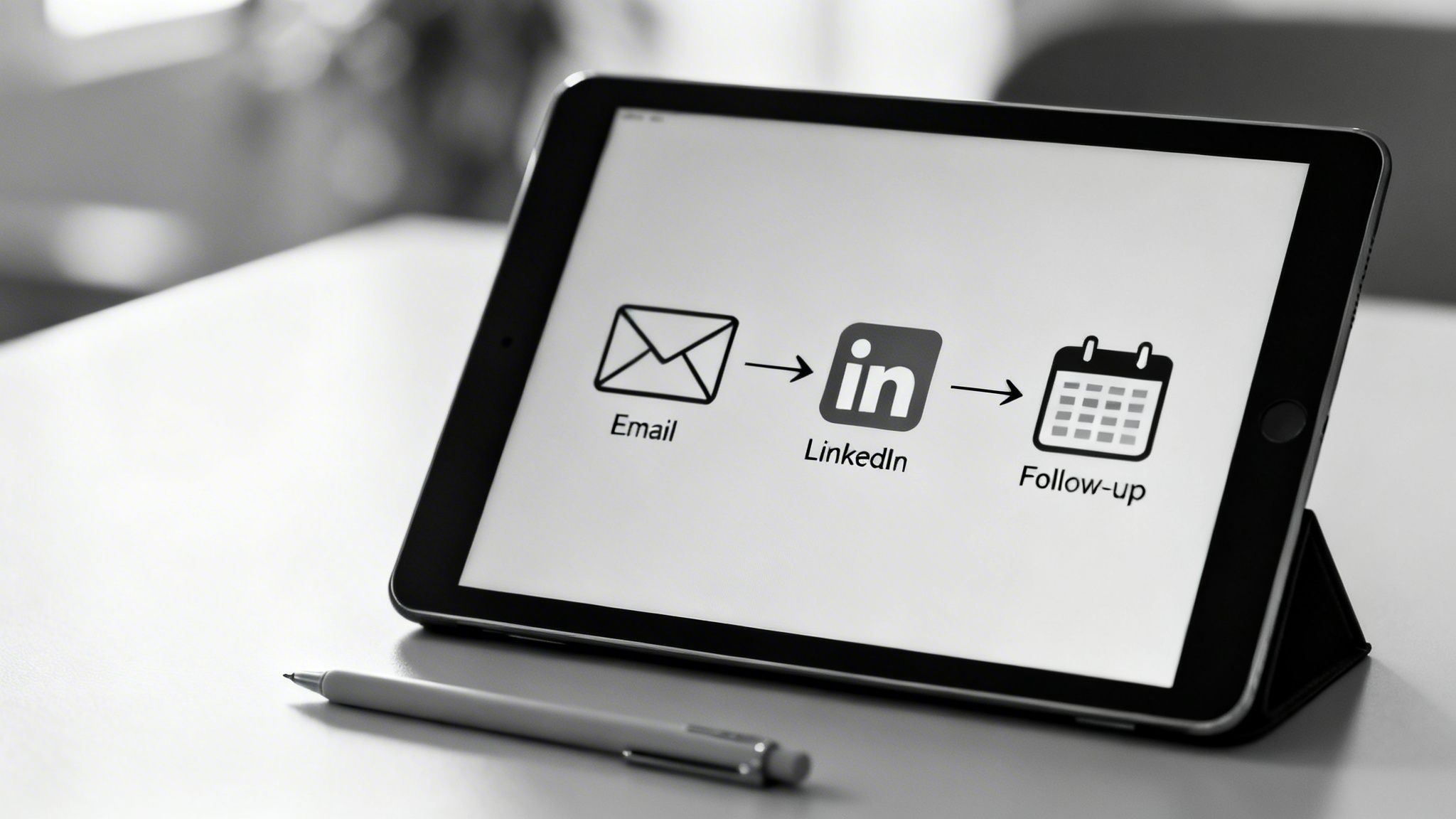
And for your SDRs? This approach gets them out of messy spreadsheets and kills the guesswork. Instead of manually tracking who to follow up with and when, they have a clear, automated playbook that feels natural. The result is simple: no high-value prospect ever falls through the cracks.
Coordinating Touchpoints for Maximum Impact
We've all seen the manual process in action. An SDR sends an email. A few days later, they remember to send a LinkedIn connection request. The two actions are totally disconnected. From the prospect's perspective, they're just getting random pings, not a coherent attempt to connect.
An integrated platform flips this dynamic. It lets you build intelligent sequences where every step is linked.
- Day 1: Send a hyper-personalized email referencing a prospect’s recent company announcement.
- Day 2: View their LinkedIn profile—a subtle way to get on their radar without being intrusive.
- Day 4: Send a LinkedIn connection request that references the email you sent, tying the conversation together.
- Day 7: Follow up with another email, this time offering a different piece of value, like a relevant case study.
This coordinated outreach feels less like a sales pitch and more like a thoughtful, professional conversation. It shows persistence and diligence, which builds trust and dramatically increases your chances of getting a reply. To nail this, you need a strong outreach motion. Our guide on sales cadence best practices is a great place to start.
Choosing the Right Channels at the Right Time
Going multi-channel doesn’t mean blasting every platform equally. It’s about using the right channels at the right time, based on what the data tells you. And the data is clear: email remains the undisputed champion for B2B engagement. A recent report confirms email is the top B2B lead generation channel, with 88% of marketers using it and an 85.59% effectiveness rating. That even edges out social media, which sits at 85.17%. For teams focused on booking meetings, this translates to a solid 2.4% baseline conversion rate from personalized email alone, according to the 2026 Dux-Soup report on B2B lead generation.
But of course, LinkedIn is a powerhouse for building relationships and social proof. An effective sequence knows how to play to the strengths of both.
The goal isn’t to simply be present on multiple channels. It’s to create a single, unified narrative that guides the prospect from initial awareness to a meaningful conversation. This is what separates high-performing sales teams from the rest.
Willbe’s platform was built specifically for this modern, AI-assisted, multi-channel world. It gives you the power to automate these complex sequences while ensuring the AI-driven personalization sounds genuinely human and adapts to the context of each channel. This is how you scale outreach globally without sounding robotic, turning a fragmented process into a predictable engine for booking meetings.
Choosing the Right Lead Generation Software for Your Team
Picking a new tool for your sales team isn't just about spending budget. It's a decision that will either accelerate your pipeline or clog it up with friction. The wrong software adds frustrating busywork and leaves your reps scrambling to hit quota. The right one becomes the engine driving predictable, scalable growth.
But the market for B2B lead generation software is a noisy, crowded space filled with tools that promise the moon. You've got point solutions that only solve one problem and platforms loaded with flashy AI features that look great in a demo but don’t actually get replies. To choose wisely, you have to ignore the hype and focus on what your GTM team actually needs to succeed.
That means asking questions about outcomes, not just checking off features on a list.
A Practical Checklist for Every Role
When you’re vetting a new platform, everyone at the table has a different priority. The Head of Sales is thinking about pipeline, the RevOps manager is worried about data integrity, and the SDR just wants to book more meetings. A truly effective platform, like Willbe, is built to solve the core challenges of the entire team.
Here's a checklist of the questions you should be asking, broken down by role:
For Sales Leaders:
- Predictability: Will this give me a clear, live view of my pipeline? Can I finally see which activities are really turning into qualified opportunities?
- Scalability: Can my team ramp up output without me doubling headcount? How quickly can we spin up campaigns for new markets or ICPs?
- Performance: Do the analytics show me exactly which reps, messages, and segments are winning? I need that insight to coach my team effectively.
For RevOps and Sales Ops:
- Data Integrity: How solid is the CRM sync? Is it a true, bi-directional sync that runs on its own, or will this create a massive data cleanup project?
- Tool Consolidation: Can this platform let us retire several single-purpose tools? Simplifying our tech stack and cutting costs is a huge win.
- Adoption: Is the team actually going to use this? Or is it so complicated that it will require months of training and hand-holding?
For SDRs, BDRs, and AEs:
- Efficiency: Will this actually make my day easier? Does it automate the mind-numbing work like data entry and list building?
- Effectiveness: Is the contact data accurate and verified? Does the AI personalization help me write emails that people actually respond to?
- Workflow: Can I run my entire prospecting process—from finding someone to running a multi-channel sequence—all in one place? I'm tired of juggling dozens of tabs.
Think of your evaluation less like a feature beauty contest and more like a rigorous stress test. You're looking for a platform that understands how a real sales floor operates and is built to solve its biggest headaches.
Avoiding Common Traps in the Buying Process
As you evaluate options, watch out for a few common pitfalls that almost always lead to buyer’s remorse.
One of the biggest traps is falling for a point solution that solves one tiny, immediate problem, like a simple email finder. It feels like a quick win, but it just pushes the core problem—a fragmented workflow—downstream. Before you know it, your reps are duct-taping even more tools together.
Another classic mistake is getting wowed by "novelty AI." An AI that writes a Shakespearean sonnet about your prospect is amusing, but it’s not going to book a meeting. A platform like Willbe, with its proprietary, template-free AI, is built for one thing: writing authentic, human-sounding outreach that drives replies at scale.
At the end of the day, you need an all-in-one platform that unifies the entire process. It should be built on a foundation of clean data, smart automation, and real efficiency that empowers everyone on your GTM team to do their best work.
Measuring Success to Build a Predictable Revenue Engine
Let's be clear: buying new B2B lead generation software isn't about giving your reps shiny new tools. It's about generating a return on investment that you can take to your CFO. Success isn't measured by logins; it's measured by tangible pipeline growth. Proving that value comes down to having a smart plan for implementation and measurement from day one.
First, you need to ensure the platform connects seamlessly with your CRM. A platform like Willbe is built for a tight, bi-directional sync, meaning your CRM remains the single source of truth. When that data flows automatically, your RevOps team can stop wasting time on manual data entry, and sales leaders get a live, unfiltered view of what’s really happening.
With that connection locked in, you can start running your first campaigns. This is the moment to stop obsessing over vanity metrics, like email open rates, and start focusing on the numbers that actually move the needle for the business.
From Vanity Metrics to Revenue Impact
It’s an easy trap to fall into—chasing metrics that look good on a dashboard but have no connection to revenue. A good platform pulls back the curtain so you can see which activities generate real results and which are just noise.
Instead of tracking fluff, you should be laser-focused on:
- Meetings Booked: This is the bread and butter for any SDR team. How many qualified first meetings are you booking now compared to before? This is your most immediate indicator of success.
- Qualified Pipeline Generated: For sales leaders, this is the metric that matters most. What's the dollar value of the new, qualified pipeline created directly from activities run through the new platform?
- Sales Cycle Velocity: Are deals moving from the first touchpoint to a signed contract faster? Clean data and richer context for your AEs should shorten sales cycles.
- Contact & Account Data Accuracy: Your RevOps team can finally quantify the impact of good data. Track the drop in bounced emails and calls to disconnected numbers to show a direct improvement in data hygiene.
When you focus on these bottom-line KPIs, you’re not just justifying a software purchase. You're building a clear business case that shows exactly how this tool contributes to a predictable revenue engine.
Building Your Measurement Playbook
Before you flip the switch, establish a baseline. What were your team’s numbers before implementation? Know your average meetings booked per rep, your pipeline generation rate, and how clean (or messy) your data was. This baseline is your yardstick for success.
Next, train your team on the workflow, not just the features. Teach them how to build smart, multi-channel sequences that blend email with LinkedIn outreach.
Speaking of which, you cannot ignore LinkedIn. For B2B, it’s a powerhouse, driving a staggering 80% of all social media leads. There’s a reason 89% of marketers use it and 62% say it works—it’s proven to be 277% more effective for lead generation than other social platforms. Considering almost half of all B2B professionals are on LinkedIn daily, it becomes an essential channel for any team moving from MQL volume toward pipeline quality. You can explore more of these powerful lead generation statistics to see why it's a non-negotiable part of modern outreach.
The ultimate goal is to move beyond simply tracking activity and start predicting outcomes. When you know which messages, channels, and prospect segments convert best, you can double down on what works and scale your success.
This is how you build a GTM motion for 2026 and beyond. Having this data empowers sales leaders to make smarter strategic bets, gives RevOps the ammo to prove the platform’s value, and instills confidence across the board that you’re building a scalable and efficient engine for growth.
Frequently Asked Questions About B2B Lead Generation Software
When sales and RevOps leaders evaluate modern B2B lead generation software, the same few questions always come up. Here are straightforward answers to common concerns about data, AI, integrations, and team adoption.
How Does a Unified Platform Handle Data?
Reps are tired of jumping between different, outdated databases. Instead of that constant shuffle, an all-in-one platform like Willbe brings data from over 30 B2B sources together into a single, live database. It's always working in the background to verify and enrich that information, serving up accurate direct-dials and work emails.
This means your team works with clean, reliable data from day one. You'll see a massive drop in email bounces and stop wasting hours on contacts that go nowhere.
The real shift is moving from buying static, decaying lists to tapping into a dynamic, always-on data engine. It ensures your reps are targeting the right people with information they can actually trust.
Will AI-Generated Outreach Sound Robotic?
That’s a fair question, as most AI writing tools plug into generic models and often produce lifeless, impersonal copy. A platform with its own proprietary AI, like Willbe’s, is different. It's been trained specifically on B2B sales messages that actually get replies.
Instead of just filling in blanks, our AI synthesizes multiple data points for every prospect—their recent LinkedIn activity, company news, or job description specifics. It then writes unique, context-aware messages that sound like they came from one of your top-performing reps. Prospects feel like you've done your homework, which is what starts the conversation.
How Does This Integrate with Our CRM?
A seamless, bi-directional sync with your CRM isn't a nice-to-have; it's essential. A modern platform must connect natively with tools like Salesforce and HubSpot. Every action—every email sent, call logged, and LinkedIn message—is automatically recorded in your CRM in real time.
This eliminates manual data entry for your sales team and closes the "data black hole" that drives RevOps teams crazy. Your CRM remains the single source of truth, giving leadership a perfectly clear and accurate view of your pipeline without anyone lifting a finger.
What Is the Typical Ramp-Up Time for a Team?
Because an all-in-one platform consolidates the entire prospecting workflow, adoption is much faster than you might think. Reps don't have to learn and juggle five different tools anymore.
With one unified place to find prospects, build sequences, and execute outreach, we see most SDR teams fully ramped and booking meetings in about a week.
Ready to see how a single platform can replace your fragmented tools and truly scale your pipeline? Willbe combines verified data, proprietary AI, and multi-channel outreach into one powerful engine for your GTM team. Explore how top teams scale outbound.