

Let's get straight to the point: What's the best time to send a cold email? The honest answer is, it depends. Anyone selling you on a universal "perfect time" is peddling a myth. Real success comes from disciplined testing and smart segmentation, not generic advice.
Debunking The Myth Of a Single Best Send Time
Every sales leader is looking for that silver bullet—the one perfect day and hour to launch a campaign and watch the qualified meetings roll in. It’s an understandable desire, but this one-size-fits-all thinking is exactly why so many outbound efforts fall flat.
The truth is, the best time to send cold emails isn't a fixed number you can look up in a chart. It’s a moving target that depends entirely on who you're trying to reach. Building a predictable pipeline doesn't come from stumbling upon a magic time slot; it comes from creating a smart, data-driven system to find what works for your specific audience.
Moving Beyond Guesswork
Relying on industry-wide "best time to send" reports is like trying to navigate London with a map of New York. Sure, they're both cities with streets, but you're going to get hopelessly lost because the context is completely wrong. The same goes for your prospects.
Think about the different people you’re trying to sell to:
- The SVP of Engineering at a startup? She's probably clearing her inbox at 10 PM after a long day of coding and meetings.
- A Director of Operations in manufacturing? He's likely online between 6 AM and 8 AM before his day on the plant floor begins.
- That marketing VP you're targeting? She might be most open to a new idea mid-morning, right after her team's daily stand-up.
Blasting all of them at 10 AM on a Tuesday is a shot in the dark that wastes good leads and, worse, can get your domain flagged as spam. For any SDR spending hours building lists, this is a painful, inefficient way to work.
For a sales leader focused on predictable pipeline, this means you have to shift from guesswork to a system. The goal isn’t to find the best time; it’s to find the best time for each of your ideal customer profiles.
This is where a modern GTM platform stops being a "nice-to-have" and becomes a competitive necessity. Instead of wrestling with fragmented tools and manual workflows, a platform like Willbe gives your team the power to segment audiences with precision.
By aggregating over 30 B2B data sources, Willbe helps you build hyper-targeted lists based on a person's role, their industry, and their location. This level of detail enables you to run clean, controlled tests to find the optimal send times for each cohort. Suddenly, timing isn't a mystery anymore—it's just another lever you can pull to turn your outbound strategy into a repeatable GTM engine.
Decoding the Data on Optimal Email Timing
Let's be clear: anyone who tells you there’s a single "best time" to send a cold email is selling you an outdated playbook. While there's no magic bullet, extensive 2026 data reveals powerful trends that can give any sales team a massive head start.
It's less about picking a time slot out of a hat and more about understanding your prospect’s daily rhythm. You want to land in their inbox when they’re actually receptive, not when they’re just trying to clear out clutter. For SDRs and BDRs on the front lines, this data provides a solid baseline to start from. For RevOps leaders, it's how you establish your initial KPIs for outbound performance before optimizing.
This is the fundamental shift in thinking you need to make. We're moving away from rigid, one-size-fits-all rules and toward a smarter, more dynamic strategy built for how sales teams operate today.
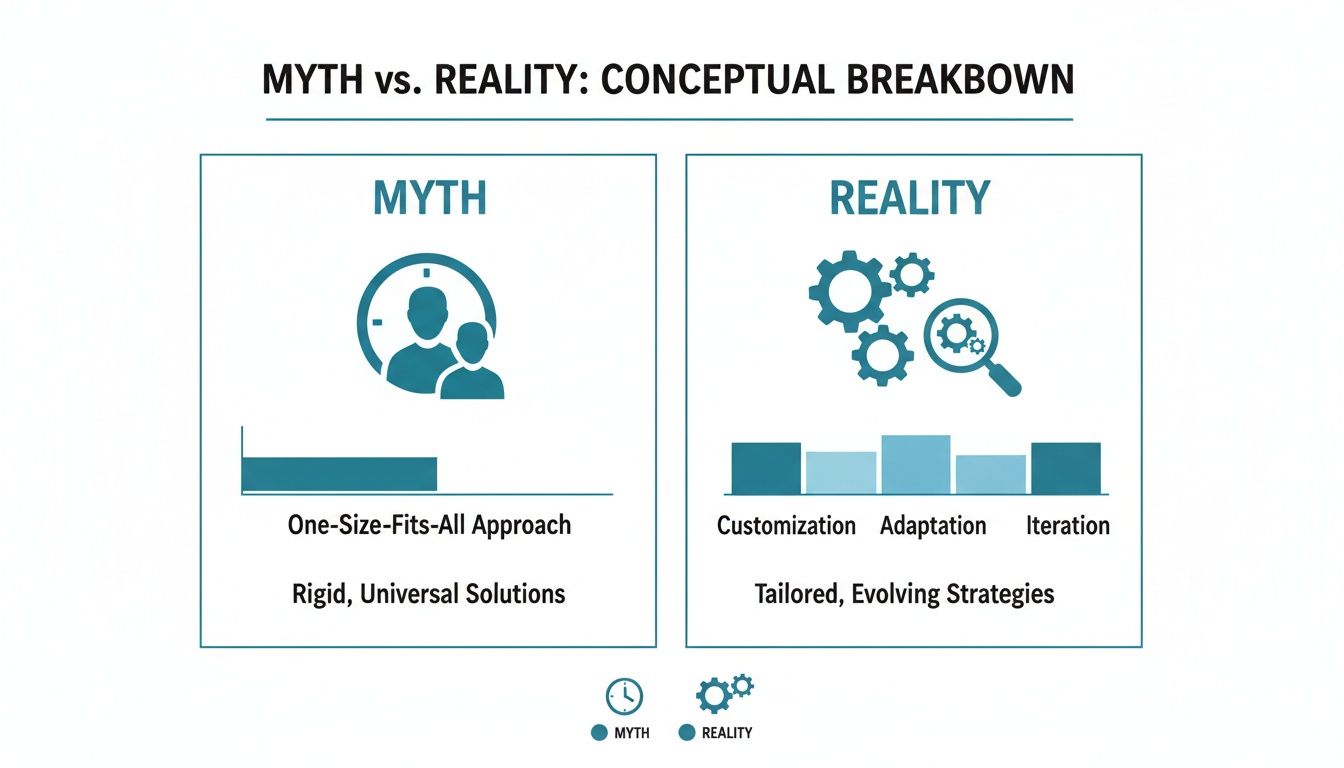
Ultimately, winning at modern outbound isn’t about a magic hour. It’s about using data and smart segmentation to find the right time for the right person, powered by a platform that can execute at scale.
Identifying the Strongest Sending Windows
When you look across multiple studies, a clear pattern emerges: mid-week mornings consistently win. This isn't just a coincidence. Think about your typical decision-maker. On Tuesday and Thursday mornings, they’re often carving out time to manage their inbox before the day’s meetings completely take over.
Mondays are for catching up after the weekend, and by Friday, everyone’s focus has shifted to wrapping up the week. This leaves a golden window in the middle.
Deep dives into billions of emails confirm that Tuesdays and Thursdays are the sweet spot for cold outreach, with engagement peaking between 8-11 AM in the recipient's local time. Some data gets even more specific, showing Tuesday at 10 AM can produce open rates as high as 48.7%, while Thursday at 9 AM can hit 49.2%. For Sales Leaders and founders, hitting these windows with highly personalized messages—the kind a platform like Willbe’s proprietary AI can create to sound just like you—is how you generate higher-quality opportunities, not just more volume.
A critical note for teams selling globally: Sending in the recipient's local time zone is absolutely non-negotiable. An email sent at 10 AM your time that lands at 3 AM for a prospect is dead on arrival. Modern sales platforms like Willbe handle this automatically, ensuring your message always arrives at the right local time without manual effort.
To really dig into this and see how it impacts your bottom line, it’s worth understanding the data-backed best time to send emails for response.
Optimal Cold Email Sending Times At A Glance (2026 Data)
To give you a practical starting point, we've pulled together the aggregated findings from recent studies. Think of this table as your cheat sheet for establishing a baseline for your own testing and optimization—a critical step for any RevOps team trying to standardize effective playbooks.
| Day of the Week | Optimal Time Window (Local Time) | Key Insight | Primary Goal |
|---|---|---|---|
| Tuesday | 8:00 AM - 11:00 AM | Prospects are settled into their week but not yet overwhelmed. This is a peak productivity window. | Securing initial engagement and opens on new sequences. |
| Wednesday | 9:00 AM - 11:00 AM | Strong performance for both initial emails and follow-ups. Catches prospects mid-stride. | Driving replies and booking mid-week meetings. |
| Thursday | 9:00 AM - 11:00 AM | Often the highest engagement day. Prospects are finalizing plans and open to new ideas. | Converting interest into scheduled calls before the week ends. |
| Monday | 10:00 AM - 12:00 PM | Can be effective, but inboxes are crowded. Best for highly relevant, problem-solving emails. | Cutting through the noise with a compelling value proposition. |
This data provides a powerful, evidence-based foundation, but remember that the real insights will come from your own experiments.
Using Data as a Foundation for Testing
Treat these time slots as your starting blocks, not the finish line. They represent the highest probability of success based on broad averages. Your job now is to use them as a control group for your own A/B tests.
For an SDR, this could be as simple as taking a list of 500 similar prospects and splitting it. Send to half on Tuesday at 10 AM and the other half on Thursday at 9 AM. Then, watch what happens. The goal isn't just to track opens; it's to see which window generates more positive replies and booked meetings for your specific offer and audience.
Of course, you can't improve what you don't measure. You can learn more about what to track by diving into our guide on essential email analytics.
Without a system to measure these tests, you're just guessing. A platform like Willbe gives you the analytics to see what's working at a glance—which sequence, which message, and which timing is actually driving revenue. This is how top teams build a predictable pipeline. They don't just follow generic advice; they build an engine that constantly learns and refines what works for them.
Building A Well-Timed Follow-Up Cadence
The first email is just the opening line. The real impact of timing comes from a thoughtfully planned follow-up sequence. A single email can easily get buried, but a persistent, well-timed cadence feels more like a natural conversation and less like an automated attack.
This is exactly where so many sales teams drop the ball. They pour all their energy into the first touch, and when a reply doesn't come, the lead goes cold. For Account Executives who depend on a steady flow of high-quality opportunities, a smart follow-up cadence is your safety net, ensuring no potential deal slips through the cracks. It's about being persistent without being a pest.
Spacing Your Touchpoints for Maximum Impact
Hitting a prospect's inbox every single day is the quickest way to earn a one-way ticket to their spam folder and burn your list. The secret is to leave breathing room between your messages. This gives your prospect time to actually see, think about, and act on your email.
You're trying to establish a rhythm. If your first email lands on a Tuesday morning, don't follow up first thing Wednesday. Instead, think in terms of business days to create a professional, patient tempo that builds interest, not annoyance.
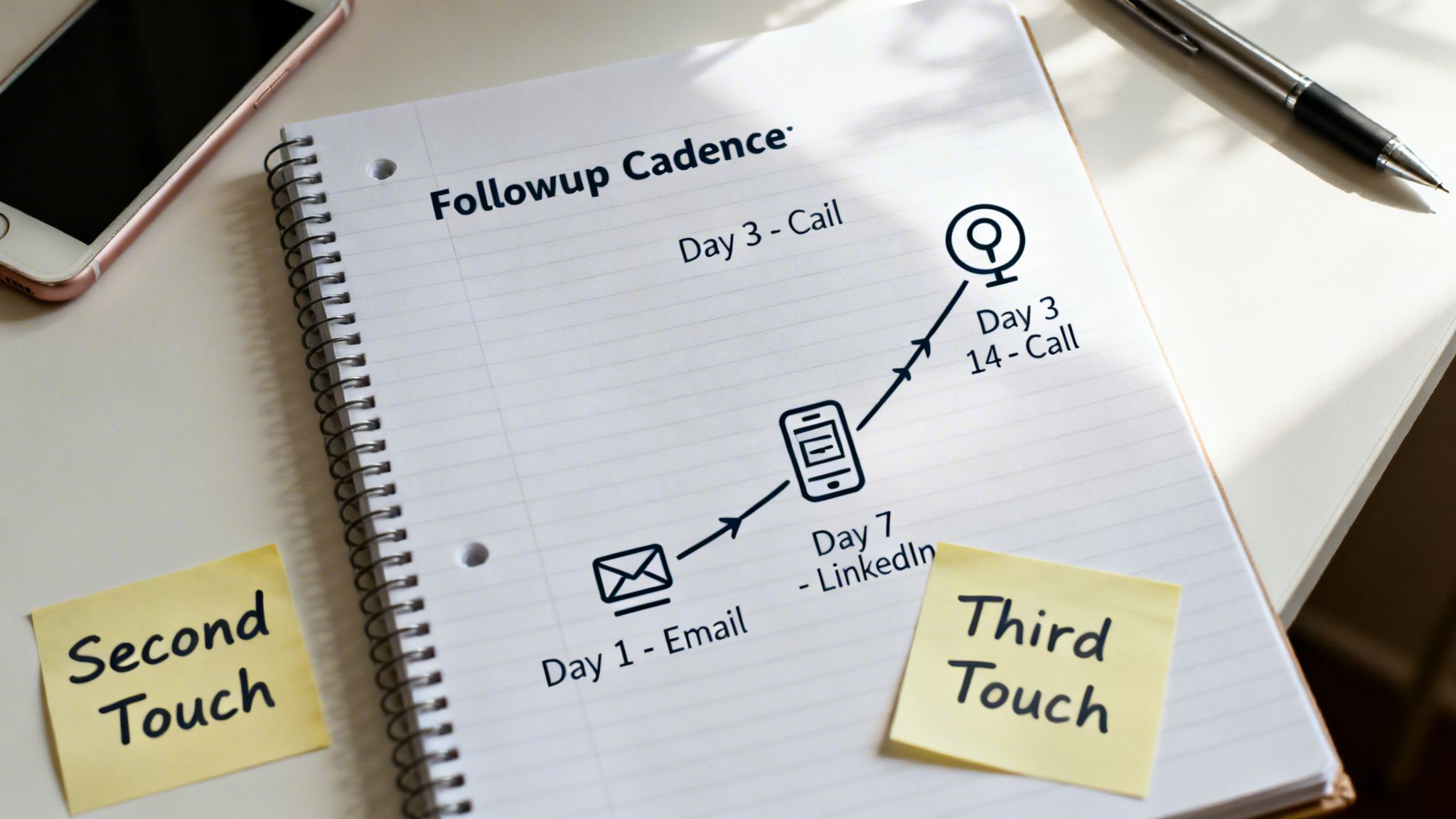
Here’s a basic framework that top-performing teams often use as their starting point:
- Day 1: The initial, highly personalized email. Aim for a Tuesday or Thursday morning to catch them at their peak.
- Day 3: The first follow-up. If the first email went out on Tuesday, this lands on Thursday. This should be a quick, contextual "bump" to your first message.
- Day 7: The second follow-up. Add more value here, perhaps by sharing a relevant case study or a helpful resource that addresses a common pain point.
- Day 12: The third follow-up. Try a different angle or go for a friendly "breakup" email.
This kind of spacing feels much more natural and shows you're being thoughtfully persistent, not just automated.
The Mid-Week Advantage for Follow-Ups
While initial emails get a great response on Tuesdays and Thursdays, our data points to a clear winner for follow-ups: Wednesday. After analyzing billions of emails, we've found that Wednesday consistently delivers the highest reply rates for subsequent messages. It makes sense—by mid-week, people have dealt with the Monday rush but aren't quite in weekend mode yet.
Sending a follow-up on a Wednesday morning around 10-11 AM hits that sweet spot. It catches decision-makers right when they're in the zone, focused and productive. Simply adding two or three follow-ups starting on day three can boost overall response rates by over 65%, proving that the real pipeline is built in the follow-through. You can explore a deep dive into these statistics by reading the full 2026 cold email benchmark report.
This is where platforms like Willbe become a game-changer for RevOps and sales leaders. You can build out these complex cadences to run automatically, triggering follow-ups only when there's no reply. This ensures every lead is nurtured with a data-backed timeline, freeing your SDRs from doing it all manually and allowing them to focus on conversations, not CRM tasks.
Integrating Multi-Channel Touchpoints
Timing isn't just about email. In 2026, an email-only strategy is one-dimensional. The best outbound plays weave in other channels, like LinkedIn, to create a more complete and human connection. And yes, the timing of these touches is just as critical.
A rookie mistake is to send a LinkedIn connection request the moment you send your first email. It feels robotic and can be overwhelming. A much smarter approach is to space these actions out to orchestrate a natural-feeling sequence.
- Day 1: Send your initial email.
- Day 2: Simply view their LinkedIn profile. It's a subtle move that puts your name on their radar without being intrusive.
- Day 4: Now, send a personalized LinkedIn connection request. You can reference your earlier email or point out a shared interest.
- Day 8: If they accept your request but still haven't replied, send a brief, friendly message on LinkedIn.
This multi-channel approach feels less like an automated blast and more like a genuine attempt to connect with another professional. For SDRs focused on booking more meetings, this thoughtful orchestration can dramatically increase the odds of getting that first reply. To really master this, check out our guide on crafting emails for when there's no response, which is packed with actionable templates and strategies that actually work.
Why Smart Segmentation Beats Generic Timing
Those industry-wide reports claiming Tuesday at 10 AM is the "best" time to send a cold email? They're not wrong, but they're definitely not the whole story. Following that advice is like using a map of the entire country to find a specific coffee shop. You're headed in the right direction, but you're missing the crucial details that actually get you to the destination.
The truth is, your Ideal Customer Profile (ICP) isn't one person. It's a collection of real people with wildly different jobs and daily routines.
Think about it. The best time to catch a CTO at a high-growth startup is almost certainly not the same as the best time to reach a VP of Operations at a Fortune 500 manufacturer. The startup CTO might be grinding through their inbox late at night, while the manufacturing VP is most likely online before the factory floor even starts buzzing. Blasting the same email to both at the same time is inefficient and shows a lack of understanding.
From Broad Strokes to a Sharper Focus
This is where top sales leaders separate themselves from the pack. Moving beyond generic timing is the key to building a predictable revenue engine. By segmenting your audience, you can tailor your send times—not just your message—to fit the actual work-life of your prospect.
Instead of a one-size-fits-all blast, you can create hyper-specific sending windows based on what you already know:
- Industry: A Director of Sales in retail has a completely different Q4 schedule than a Director of IT in the finance sector. Their priorities and "available time" are worlds apart.
- Role and Seniority: An entry-level SDR practically lives in their inbox. A C-suite executive, on the other hand, might only check email in specific, planned blocks of time.
- Geography: This is about more than just time zones. The work culture in a major tech hub like San Francisco can look very different from a secondary market, even if they're on the same clock.
When you break down your lists this way, you stop guessing and start making data-driven decisions based on your prospect’s reality.
How to Put Timing Segmentation Into Practice
Your goal is to group prospects into cohorts that share similar daily workflows. For SDRs and BDRs on the front lines, this means using your data to build smarter, more effective campaigns instead of just blasting a large, unsegmented list.
Let’s look at two distinct personas:
- Construction Project Managers: These professionals are often on-site before the sun is fully up. An email that lands between 6 AM and 8 AM their local time has a great shot of being read while they plan their day, before the real chaos begins.
- Software Engineering Leaders: These execs are known for unconventional hours. Testing a later sending window, maybe between 8 PM and 10 PM, could be incredibly effective as they're winding down and clearing out their backlog for the next day.
This is where trying to manage everything with messy spreadsheets falls apart. A modern GTM platform becomes your command center. With a tool like Willbe, you can instantly build these segments by filtering contacts from over 30 B2B data sources based on seniority, department, industry, and location.
Once your segments are defined, you can schedule unique campaign sequences for each one. This ensures your carefully written message arrives at the moment it’s most likely to be seen and considered. You’ll stop burning through your valuable lists and start turning them into a reliable source of pipeline. The orchestration engine inside Willbe automates this entire process, deploying your campaigns at the perfect time for any segment, anywhere. That’s how you build a repeatable, scalable outbound machine for 2026.
How Personalization Makes Your Timing Strategy 10x More Effective
Let's be honest. You can find the "perfect" time to send a cold email, but if the message itself is generic, it's going straight to the trash. Getting your send time right is a great start, but the quality of your message is what actually earns you a conversation.
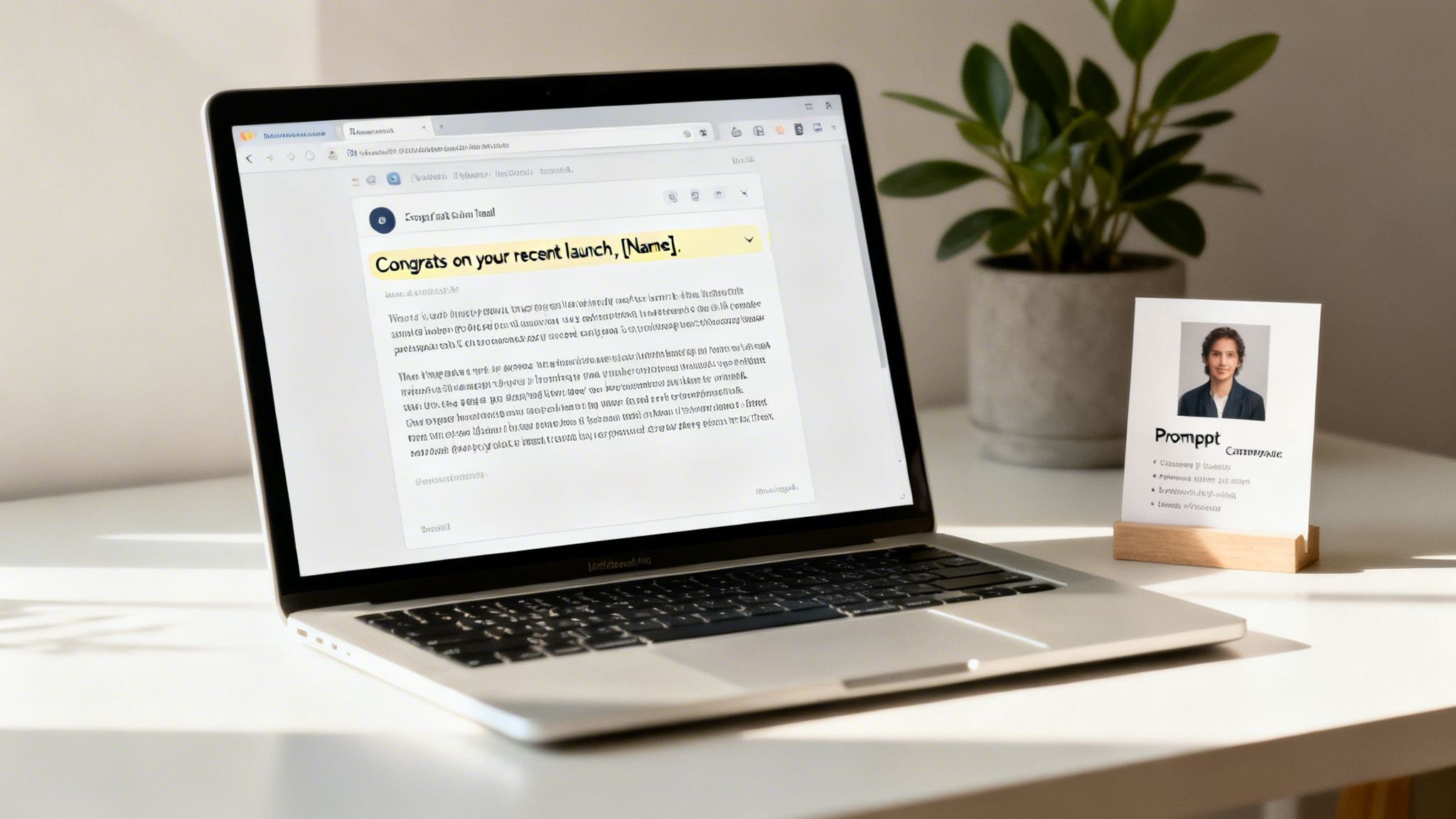
Think about it: a templated email that lands at 9:01 AM on a Tuesday might get opened out of habit, but it’s still just another piece of noise in a crowded inbox. On the other hand, a thoughtful, personalized email that mentions a prospect’s recent promotion or a new project they just launched? That email has a much wider window to make an impact because it’s relevant. It demands attention, no matter when it’s read.
Shifting from Generic Blasts to Real Conversations
The goal isn’t just to get an open—it’s to start a real dialogue that builds your pipeline. This is where you see a huge difference between old-school outreach and modern GTM. Instead of blasting out robotic copy, the best SDRs and BDRs are sending messages that sound like they were written by a human, for a human.
When an email feels like it was written specifically for the person reading it, the "best time" to send it suddenly becomes way less important. The quality of the email creates its own sense of urgency. You’re no longer just hoping to get lucky with a time slot; you’re creating an asset that works for you. The big takeaway here is that the better your message, the more effective your timing becomes.
The data backs this up. For instance, recent 2026 research shows that Monday has the highest overall reply rate at 1.96%, making it a great day to kick off new sequences. But here’s where it gets interesting: the rate for positive replies—the ones that actually lead to meetings—peaks at 10.5% on Thursdays. This tells us that while you can get a lot of responses early in the week, the real, quality conversations tend to happen later. You can read the full research on cold email statistics to see more of these trends.
The difference between a generic "Hope you're having a good week" and a specific "Congrats on the recent acquisition of Company X—I imagine integrating their tech is a top priority" is the difference between being deleted and getting a reply.
Turning Personalization into a Predictable System
As a sales leader, this means you need to give your team tools that make this kind of personalization scalable. An SDR can't spend 30 minutes digging through LinkedIn for every single prospect just to write one good email. That’s not a repeatable system, and it will burn your team out.
This is where an all-in-one platform like Willbe comes in. Its proprietary, template-free AI is designed to sound like the user, not like generic AI copy. It enables your team to tap into over 30 data sources to find relevant insights and then weave them into natural-sounding outreach, all in a fraction of the time. It frees up your reps to do what they do best: have conversations, not conduct manual research.
When you combine smart timing with genuine personalization, you build an outreach engine where every email feels valuable. This doesn't just get you more replies; it protects your brand by making sure you're never seen as just another spammer. Mastering this combination is a core part of selling today, and you can learn more by checking out our complete guide on cold email best practices.
A/B Testing Your Send Times For Maximum Impact
Industry-wide data gives you a solid starting point, but it's not the finish line. The only way to find out what really works for your audience is to stop guessing and start testing. For sales teams, this means running clean, simple A/B tests on your send times to find your own unique windows of opportunity.
This isn't some complex statistical exercise that requires a data science degree. It's a disciplined process that any SDR, AE, or sales leader can put into practice. The goal is to replace assumptions with evidence, creating a far more predictable pipeline. For RevOps teams, this process is how you ensure the entire go-to-market team is running on playbooks that are proven to work, not just relying on industry anecdotes.
Setting Up a Clean A/B Test
The golden rule of A/B testing is simple: change only one variable at a time. In this case, that single variable is the send time. If you test a new subject line and a new send time in the same campaign, your data will be noisy and completely unusable.
Here’s a straightforward framework your team can follow:
- Define Your Segment: Start by picking a uniform group of prospects. For instance, you could target "VPs of Marketing in the SaaS industry in North America." A platform like Willbe makes this incredibly easy by letting you filter its aggregated data sources to build a clean, unified list.
- Create Two Identical Groups: Split your list into two equal, randomized groups—let’s call them Group A and Group B. You need to make sure both groups are large enough for the results to be meaningful, so aim for at least 100-200 contacts each.
- Use the Exact Same Email: This is non-negotiable. The subject line, the body copy, and the call to action must be absolutely identical for both groups.
- Test Two Different Times: Send the email to Group A during a time you know performs well (like a Tuesday at 10 AM). Then, send the exact same email to Group B at your new test time (maybe a Thursday at 4 PM).
This controlled approach isolates the impact of timing. It gives you a clear, unambiguous signal about which window performs better for that specific audience.
Tracking the Metrics That Matter
Open rates are a vanity metric. A truly successful test tracks the numbers that directly tie to revenue. You need to follow the conversions all the way down the funnel to understand real business impact.
When you're A/B testing to optimize send times, it's a huge help to know how to properly interpret t-test results to confirm your conclusions are statistically sound. This helps you know for sure if the performance difference is real or just a random fluke.
Keep your eyes on these key performance indicators (KPIs) for each group:
- Reply Rate: The most basic question—how many people actually responded?
- Positive Reply Rate: This is where it gets interesting. Of those replies, how many were genuinely positive ("This looks interesting, tell me more") versus negative ("Not interested")?
- Meetings Booked: This is the ultimate goal. How many qualified meetings did each time slot actually generate for your team?
A platform like Willbe automates this entire workflow. You can set up test sequences, schedule them for different times, and watch the results roll in on a single dashboard. This gives sales leaders and RevOps teams a crystal-clear view of what’s working, so you can scale the winning strategies across the whole organization without getting lost in manual spreadsheet chaos.
Common Questions (and Straight Answers) About Cold Email Timing
Even with all the data in the world, some questions about timing just keep coming up. When you're an SDR or AE on the front lines, you need clear, practical answers. Let's tackle some of the most common ones we hear from sales teams.
Does The Best Send Time Change For Different Industries?
Without a doubt. Thinking there's a single "best time" for every industry is one of the biggest mistakes teams make. It completely ignores what your prospect's actual day looks like.
A marketing director at a software company is probably clearing their inbox mid-morning. But an operations manager in a manufacturing plant? They're likely online before the sun's up, well before 7 AM. Sending the same email at 10 AM to both is a missed opportunity. You have to segment your outreach to match their unique work rhythms.
How Important Is Sending In The Prospect's Local Time Zone?
It’s everything. It is absolutely non-negotiable for any team selling at scale.
Sending an email at 10 AM your time that lands in their inbox at 3 AM is a dead giveaway that your message is just an automated blast. It shows a lack of thought and is a fast track to the delete folder. In a world where sales teams work across the globe, doing this manually is impossible. That’s where a GTM platform like Willbe becomes essential—it automates time zone conversions, ensuring every email feels personal and timely, whether you're reaching out to London, New York, or Singapore.
Should I Avoid Sending Emails on Fridays and Weekends?
For that first cold email, yes. Our data, along with plenty of other studies, consistently shows a nosedive in engagement on Fridays. People are mentally checking out and trying to wrap up their week, not start new conversations.
By Friday afternoon, their attention is elsewhere, and your email will just get buried over the weekend. Speaking of which, weekends are even worse, with some data showing reply rates dropping by as much as 27%.
Your goal is to catch people when they're in a business mindset, actively working through their priorities. Stick to the middle of the week for your initial outreach and the first few follow-ups.
How Quickly Should I Follow Up On An Opened Email?
Hold on. I know how exciting it is to get that "open" notification, but jumping on it within minutes can feel a little creepy and desperate.
Remember, a prospect might have just opened your email on their phone while walking into a meeting, with no chance to reply right then. Give them some breathing room—at least one full business day is a good rule of thumb. This respects their schedule and lets your first message actually sink in. A patient, well-timed follow-up cadence will always win against an overly aggressive one.
Ready to stop guessing and start building a predictable pipeline with smarter timing and personalization? Willbe is the all-in-one GTM platform that replaces fragmented tools and manual workflows, helping you find better accounts, reach the right people, and convert pipeline faster.