


At its core, a sales forecast is an attempt to predict future revenue. But the methods sales teams use to get there are wildly different. Some stick to guesswork, assuming next quarter will look like the last. Modern revenue teams, however, use sophisticated AI-driven models to analyze thousands of data points in real time, building a forecast they can actually trust.
Why Your Sales Forecast Is More Than Just a Number

For too many sales leaders, forecasting is a painful, high-stakes reporting drill. It's that weekly ritual of rolling up numbers from a messy CRM, bracing for inevitable questions when the pipeline shifts. This broken process leads to familiar symptoms: unpredictable revenue, missed quotas, and relentless pressure on AEs to close deals without a clear, data-backed plan.
But a good forecast is so much more than a number to appease the board. Think of it as your company’s GTM compass.
A reliable forecast isn't about predicting the future with 100% certainty. It's about reducing uncertainty enough to make smart, confident decisions that drive predictable revenue.
Making this leap from guesswork to data-backed confidence is what separates legacy sales teams from modern revenue machines. When you have a forecast you can trust, you stop reacting to the quarter and start owning it.
From Reactive Reporting to Proactive Strategy
Imagine having a clear line of sight into future revenue before making your next big decision. That’s the true value of an accurate forecast. It’s the foundation for making intelligent, forward-looking moves that directly impact your bottom line.
A strong forecast empowers leaders to:
- Hire with Confidence: Know precisely when to bring on the next SDR or AE, basing the decision on projected pipeline needs, not just a gut feeling.
- Set Realistic Quotas: Build targets that are both ambitious and achievable, keeping your sales team motivated and focused on hitting their numbers.
- Allocate Resources Intelligently: Justify marketing spend, tool investments, and new hires with data showing their future impact on the revenue pipeline.
- Mitigate Risk: Spot deals that are stalling or identify reps who need coaching weeks before it becomes a quarter-ending problem.
By 2026, top-performing sales organizations will have zero tolerance for risky guesswork. They build predictable, scalable GTM engines on a foundation of clean data and precise forecasting. This goes far beyond just hitting a number—it’s about deeply understanding the health of your entire revenue operation. You can learn more about the metrics that matter by reviewing essential sales performance metrics in our detailed guide.
To build a revenue engine that works, you have to get the fundamentals of forecasting right. While modern platforms offer incredible precision, the classic approaches teach you the "why" behind your numbers. Think of it like learning to drive: you wouldn't jump into a race car without first understanding how a clutch and gas pedal work together. These methods are your driving lessons—they force you to understand the mechanics of your sales motion before you try to hit top speed with AI.
Understanding Foundational Sales Forecasting Methods
Let's dive into the two methods that form the foundation of almost every sales forecast you'll ever see.
Historical Forecasting: The Rearview Mirror Approach
The most straightforward way to predict the future is to look at the past. That's Historical Forecasting in a nutshell.
You simply take your sales results from a previous, comparable period—last quarter, or this same month last year—and use that figure as your baseline. It’s quick, simple to calculate, and for businesses in very stable markets, it can be surprisingly accurate. For example, if you closed $1,000,000 last Q4 and your business has been growing at a steady 5%, you might forecast $1,050,000 for the upcoming Q4. Many teams still use historical data as a baseline for their forecasts to ground their numbers in reality.
But its greatest strength—simplicity—is also its fatal flaw.
Historical forecasting is like driving a car by looking only in the rearview mirror. It works perfectly on a straight, empty road. But the moment the market throws a curve—a new competitor, a shift in buyer behavior, or an economic downturn—you're driving blind.
For any B2B company that's growing quickly or operating in a volatile space, relying solely on the past is a recipe for disaster. It completely ignores what’s happening in your pipeline right now, which gives you a dangerously incomplete picture.
Pipeline Forecasting: A Real-Time Snapshot
This is where Pipeline Forecasting (or opportunity-based forecasting) comes in. It shifts your focus from the rearview mirror to the road ahead by analyzing the deals currently working their way through your sales process.
The logic is simple: you calculate a forecast by multiplying the value of each deal by the probability of it closing, based on its current sales stage. Deals further down the funnel have a higher probability and contribute more to the final number.
For instance, your data might show your win rates from each stage look something like this:
- Discovery: 10% chance of closing
- Demo Scheduled: 30% chance of closing
- Proposal Sent: 60% chance of closing
- Negotiation: 80% chance of closing
A $50,000 deal at the "Proposal Sent" stage would add $30,000 (60% of $50,000) to your weighted forecast. If an Account Executive has five deals just like it, their individual forecast is $150,000.
This approach directly connects your forecast to the daily activities of your reps. It tells AEs which deals they need to focus on to hit their number and gives leaders a live look at pipeline momentum.
But this method isn't perfect, either. A standard pipeline forecast treats all deals in the same stage equally, which we know isn't reality. A deal that’s been stuck in negotiation for 90 days is a world away from one that just got there yesterday, but a simple model weighs them the same. It's this lack of context that pushes modern RevOps teams toward more advanced methods.
To help you decide where to start, here's a quick breakdown of these two foundational methods.
Comparing Foundational Sales Forecasting Methods
This table compares the pros, cons, and best-fit scenarios for Historical and Pipeline-based forecasting to help leaders choose the right starting point.
| Method | How It Works | Best For | Key Limitation |
|---|---|---|---|
| Historical | Uses past performance from a similar period (e.g., last quarter, same month last year) to predict future sales. | Stable, predictable markets with consistent growth and seasonal patterns. | Completely ignores current pipeline activity and market changes. It’s a lagging indicator. |
| Pipeline-Based | Calculates a weighted forecast by multiplying the value of each open opportunity by its probability of closing based on its sales stage. | Fast-growing companies in dynamic markets where past performance isn't a reliable predictor of future results. | Often over-simplistic. It can treat all deals equally, ignoring factors like deal age, rep skill, or engagement. |
Ultimately, most strong forecasting models don't use just one method. They blend the stability of historical data with the real-time insights from the pipeline to create a more complete and defensible number.
Moving Beyond the Basics: Advanced Forecasting for Today’s Sales Teams
While the classic forecasting methods give you a decent starting point, they often fall short in today's fast-moving B2B world. Simple models can't keep up with market volatility and long sales cycles. It's time to move past estimating and start truly understanding what drives your revenue.
That's where more advanced forecasting methods come in. They don't just look at last quarter's revenue or which stage a deal is in. Instead, they connect the dots between marketing spend, rep activity, and broader economic trends to paint a much clearer, more reliable picture of your future sales. Think of it as the difference between glancing at the sky to guess the weather and reading a detailed meteorological map.
This visual guide can help you figure out which forecasting approach is the right fit for your current market conditions.
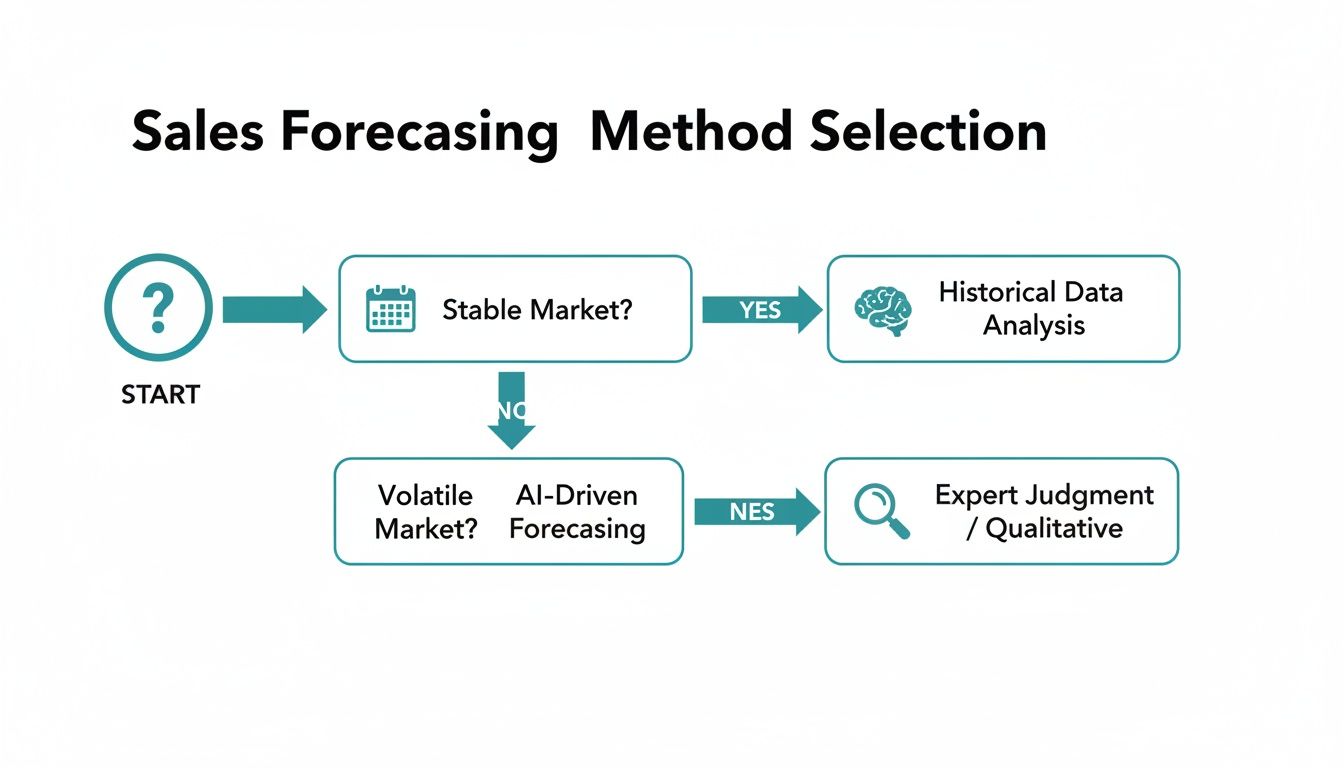
The takeaway here is simple: the more unpredictable your market gets, the more you need advanced, data-driven forecasting to stay accurate.
Multivariable Regression Analysis
What really influences whether a deal closes? Think about all the factors: where the lead came from, how many emails were exchanged, how long it sat in each sales stage, even the seniority of your buyer. Multivariable Regression Analysis is a statistical model that digs into these relationships. It identifies how all these different "independent variables" affect your ultimate goal, the "dependent variable"—your sales revenue.
Instead of just slapping a generic 20% probability on every deal in "Discovery," this method might reveal that deals from a specific webinar, handled by a top AE, actually have a 35% chance of closing. It helps you get answers to tough business questions:
- How much is our LinkedIn ad spend really contributing to the Q4 pipeline?
- Does getting more stakeholders into a demo actually lead to a faster close?
- What’s the true impact of our recent price increase on win rates in the enterprise segment?
By modeling these connections, regression analysis transforms your forecast from a static number into a dynamic tool for strategic decisions. It tells you which levers to pull to accelerate growth.
For a RevOps leader, this is a game-changer. Imagine proving that a 15% bump in personalized outreach from your SDRs consistently generates a 10% lift in qualified meetings the following month. That’s the kind of data-backed insight that justifies budgets and proves the ROI of your sales tech stack.
Time Series Analysis
While simple historical forecasting just glances at a single data point from the past, Time Series Analysis goes much deeper. It combs through your historical data to uncover complex patterns that repeat over time. It’s built to spot and model important trends, seasonality, and cycles that influence your revenue.
For instance, this is the method that can mathematically prove the "Q4 budget flush" that many B2B sales teams rely on. It can pinpoint a cyclical dip in sales that happens every summer or a steady upward trend in demand for a particular product. Time series models project revenue by dissecting these historical patterns, making them ideal for stable B2B environments where fiscal-year-end spending dictates deal flow. Research shows that 60% of businesses use these models for demand generation to better align marketing leads with sales pipeline.
Of course, these advanced methods are only as good as the data you feed them. They need clean, consistent information—the kind that’s often trapped in a messy CRM or fragmented tools. This is where a unified platform like Willbe becomes critical. By bringing prospecting data, outreach activities, and CRM updates together in one place, Willbe creates the pristine data foundation needed to run these powerful analyses. It solves the "garbage in, garbage out" problem so you can build a forecast that’s not just more accurate, but far more insightful.
The Future of Forecasting With AI and Predictive Analytics
While methods like multivariable regression offer a clearer picture than historicals alone, the real game-changer for 2026 and beyond is AI-driven predictive analytics. This isn't about letting a robot take over; it's about giving your sales leaders a data-driven superpower.
Predictive forecasting goes way beyond static probabilities. It uses machine learning to sift through thousands of data points in real time, constantly learning from everything happening in your GTM motion. Ultimately, this approach helps answer the one question every sales leader loses sleep over: which deals will actually close this quarter, and why?
From Reactive Guesswork to Proactive Insight
Let's be honest: traditional forecasting often feels like reacting to bad news. An AE’s commit looks solid on Monday, but by Friday, a key deal has gone cold, and nobody saw it coming. Predictive analytics flips the script, flagging those risks before they become emergencies.
AI models are brilliant at spotting the subtle but powerful signals that even the most experienced reps might miss:
- Engagement Quality: Is the prospect replying to emails quickly, or are you hearing crickets? Are they opening attachments and clicking links?
- Deal Velocity: How long has an opportunity been sitting in its current stage compared to similar deals you've won? A stall is a major red flag.
- Firmographics and Technographics: How closely does this account fit your ideal customer profile? Are they using tech that complements your solution?
- Rep Performance: What's this specific AE's track record with this type of deal, in this industry, compared to the team's average?
By crunching all these inputs, an AI-powered platform generates a dynamic "deal score" that gives you a true, up-to-the-minute look at an opportunity's health. This gives sales leaders incredible accuracy, helps AEs focus on deals that are likely to close, and finally lets RevOps build a truly predictable revenue model. Many of the best AI sales tools on the market are making this technology more accessible than ever.
How AI Transforms the Entire Forecasting Process
Predictive analytics isn’t just a slightly more accurate version of old methods; it’s a new way of operating. For complex B2B sales cycles, multivariable analysis really comes into its own, weaving together sales history, customer behavior, and marketing data. This becomes even more effective within a unified platform like Willbe. The proprietary, template-free AI within Willbe doesn't just craft hyper-personalized outreach; it also logs every interaction, building a rich, unique dataset that continuously fuels a self-improving forecasting engine right inside your workflow.
The real power of AI in forecasting is its ability to turn your team’s daily activities into predictive intelligence. Every email sent, every meeting booked, and every LinkedIn message replied to becomes a data point that sharpens your view of the future.
This constant feedback loop means your forecast literally gets smarter with every deal you work. It’s the key to moving away from a "spray and pray" approach toward a calculated, intelligent GTM motion. For a deeper dive, check out these insights on transitioning to predictive sales.
This shift empowers your team to be proactive. Instead of just asking reps for their "gut feel," leaders can have data-backed conversations about specific deal risks and opportunities. That's how you build a revenue engine that’s not just successful, but predictable and scalable.
How To Implement And Improve Your Forecasting Process
You know the what of sales forecasting. Now comes the hard part: building a process that delivers a number you can trust. A great forecast isn't about finding a magic model. It’s about building a repeatable, disciplined system that holds the entire revenue team accountable.
Let’s be honest, it all starts and ends with your data. We’ve all heard "garbage in, garbage out," and it's the absolute truth in forecasting. If your CRM is a messy closet full of outdated contacts and fuzzy deal stages, no algorithm can save you.
Step 1: Solidify Your Data Foundation
Before you even think about picking a forecasting model, you have to get your data house in order. This isn't a one-and-done spring cleaning; it's a daily discipline.
- Define Clear Sales Stages: Every stage in your pipeline needs concrete, non-negotiable exit criteria. What absolutely must happen for a deal to move from "Discovery" to "Demo Scheduled"? If the answer is subjective, your forecast is built on sand.
- Enforce CRM Hygiene: Make key fields mandatory. Critical information like deal value, projected close date, and key contacts can't be optional.
- Automate Data Entry: Reps despise manual data entry, and they aren't very good at it anyway. A platform that automatically syncs activities, contact details, and engagement data from email and LinkedIn straight into your CRM is no longer a nice-to-have. It's a foundational piece for clean data and an accurate forecast.
Step 2: Choose Your Method and Cadence
Once you have a cleaner data foundation, you can pick the right forecasting method for your business. A startup with zero historical data can't use a time series model, and a massive enterprise in a stable market might not need a complex AI solution. Match the method to your company’s maturity and market reality.
Next, lock in a disciplined review cadence. For teams with short sales cycles (under 30 days), a weekly forecast review is essential. For enterprise teams navigating 90+ day cycles, a bi-weekly or monthly deep dive makes more sense. Consistency is everything. For concrete strategies to sharpen your predictive muscle, check out these proven methods to improve demand forecasting accuracy.
Step 3: Run a Disciplined Forecast Call
A forecast call isn't just a number roll-up. It's a strategic inspection of the pipeline where you identify risks and get a firm commitment on a plan.
A common pitfall is accepting a rep’s "gut feeling" on a deal. A strong forecast process replaces optimistic guesses with data-backed evidence. Ask questions like, "What has the prospect done to confirm their interest?" or "What are the specific next steps and are they on the calendar?"
This is also your chance to combat "sandbagging"—where reps lowball their forecast to ensure they beat their number. Building a culture of transparency, backed by analytics that show a rep's historical forecast accuracy, keeps everyone honest. Digging into your sales pipeline management best practices will give you even more tools for this.
By focusing on a repeatable system, you'll transform forecasting from a stressful guessing game into a powerful strategic tool for getting better every quarter.
Bring Your Go-to-Market Stack and Forecast Together with Willbe
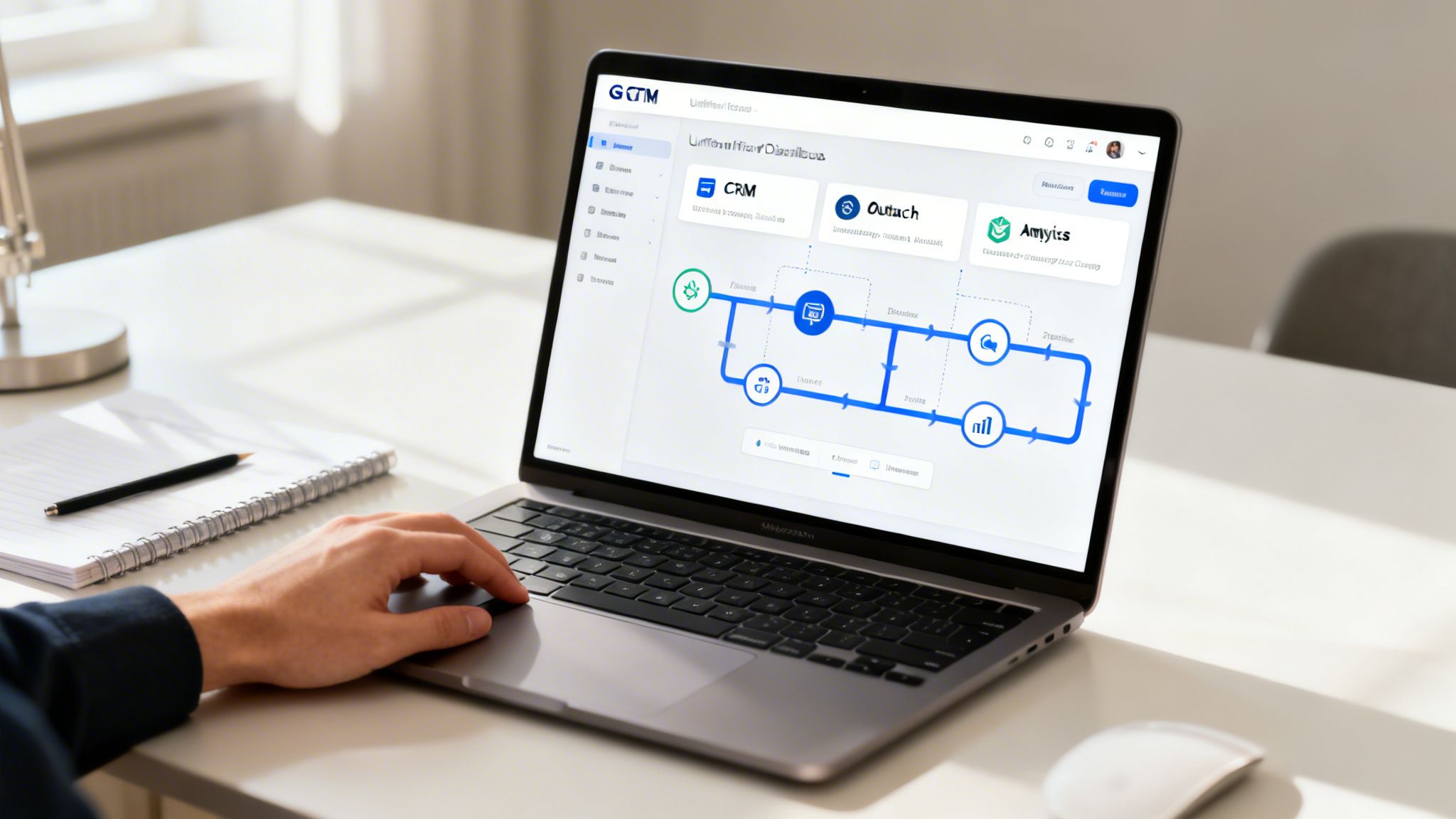
Every sales leader knows the feeling. You're staring at a forecast that just feels off, and you know why. Your team’s GTM stack is a jumble of disconnected tools—prospecting platforms, outreach sequencers, and your CRM aren't speaking the same language. This creates data silos and forces reps to spend hours on manual work, polluting the very information your forecast is built on.
Accurate sales forecasting isn't magic. It depends on clean, reliable, and real-time data. When your team is hopping between a dozen different apps, that’s just not possible. You end up with stale pipeline data, missing activity logs, and a forecast that feels more like guesswork than a strategic plan.
From a Fragmented Stack to Predictable Revenue
We built Willbe to fix this exact problem. It’s an all-in-one B2B prospecting and lead generation platform that replaces fragmented tools and manual workflows. By bringing account discovery, multi-channel outreach, and powerful analytics into a single environment, we eliminate the fragmentation that wrecks forecast accuracy.
Willbe delivers the three core ingredients for a forecast you can trust:
- Clean, Centralized Data: We aggregate and verify information from over 30+ B2B data sources to ensure your team starts with high-quality account and contact data from day one.
- Automatic CRM Sync: Every email, LinkedIn message, and booked meeting is instantly and automatically logged in your CRM. This ends manual data entry for reps and gives leaders a constantly up-to-date picture of deal progression.
- Outcome-Driven Analytics: Willbe shows you which messages, segments, and outreach channels are actually driving replies and booking meetings. This moves you beyond generic stage probabilities to a deeper understanding of what works.
A Single Source of Truth for Your Forecast
Instead of piecing together reports and chasing down reps for updates, leaders get genuine visibility into pipeline health. RevOps teams finally get the clean, structured data they need to build dependable models. And most importantly, your SDRs and AEs are freed from admin work so they can focus on what they were hired to do: generate pipeline and close revenue.
When you unify your GTM stack, you’re building a system where every prospecting activity automatically makes your forecast smarter. You turn your team's daily work into a predictable revenue engine.
When your data is clean and all your activity is captured in one place, every sales forecasting method we’ve covered becomes far more effective. You can finally trust your historical data, rely on your pipeline stages, and build predictive models that reflect what’s happening on the ground. It’s time to stop forecasting in the dark.
Common Questions About Sales Forecasting
Even with a great process, sales forecasting can feel like a moving target. Let's tackle a few of the tough questions that come up with sales leaders and RevOps pros trying to build a forecast they can count on.
What is the most accurate sales forecasting method?
Everyone wants a silver bullet, but the truth is, there isn't one. The "best" method depends on your business stage, market predictability, and data quality.
For an established company in a stable industry, historical performance can be surprisingly accurate. But that's not the reality for most high-growth B2B teams.
For most teams in dynamic markets, a multivariable or AI-driven predictive method will provide a much clearer picture. These models go beyond past sales, pulling in crucial signals like deal engagement, rep performance, and firmographics. The real magic often happens when you blend methods—using a pipeline forecast as a baseline and then layering predictive insights on top to challenge assumptions.
How often should we review our sales forecast?
The right cadence comes down to your sales cycle. What’s most important is sticking to a consistent, disciplined rhythm.
- Short Sales Cycles (Under 30 days): You absolutely need a weekly forecast review. Things move too fast, and a week is plenty of time for a deal to go sideways.
- Long Sales Cycles (90+ days): A bi-weekly or monthly review usually works fine. This gives you enough time to track meaningful progress on larger deals without getting lost in day-to-day noise.
Getting this review on the calendar and treating it as sacred is what creates real accountability. It’s your chance to spot risks and coach reps before a small problem becomes a quarter-killing disaster.
How can I improve forecast accuracy with messy CRM data?
Messy CRM data is the silent killer of accurate forecasts. If you want a number you can trust, cleaning up your data isn't optional—it's priority one.
First, treat data hygiene as a fundamental team habit, not a chore. Get crystal clear on your sales stages and define the non-negotiable exit criteria for a deal to move from one to the next. Make critical fields like deal size and close date mandatory. Then, automate as much as possible to reduce manual entry and human error.
The fastest way to fix a broken forecast is to fix the data it's built on. A platform that automatically syncs clean prospect data and every sales activity—every email, every call—into your CRM is your best bet. Get the basics right first (deal size, close date, and stage), and you will see an immediate, noticeable improvement.
A predictable forecast is born from a unified GTM motion. Willbe brings your prospecting, outreach, and analytics together in one place, giving you the clean, real-time data you need to build a forecast you can finally stand behind. Explore how top teams scale outbound and build predictable revenue.