


Ever heard of the Social Selling Index (SSI)? It’s a score LinkedIn gives you, from 0 to 100, that grades how effectively you use its platform for sales. Think of it less as a vanity metric and more as a health check for your team's ability to build a modern B2B pipeline.
A low score is a red flag. It often means your reps are invisible to your ideal customers, failing to build trust, and missing out on the conversations that turn into booked meetings. A high score, on the other hand, tells a much better story.
It signals that a rep is building a strong professional brand, finding the right people, and engaging them in ways that lead to real business. For sales leaders, it’s a direct window into which team members understand modern selling and which ones need support to hit their numbers.
Why Your SSI Score Directly Impacts Revenue
Ignoring your team’s SSI score is like ignoring pipeline coverage—it’s that fundamental. The activities it tracks are the building blocks of a predictable, modern go-to-market strategy.
LinkedIn's own research backs this up with compelling data. They found that sales professionals with high SSI scores generate measurable results:
- They create 45% more sales opportunities than reps with lower scores.
- They are 51% more likely to achieve their sales quota.
- A massive 78% of social sellers outsell peers who don't use social media. You can read more about these social selling statistics and their direct impact on the bottom line.
So, how does LinkedIn calculate this score? It comes down to four key pillars, each contributing up to 25 points.
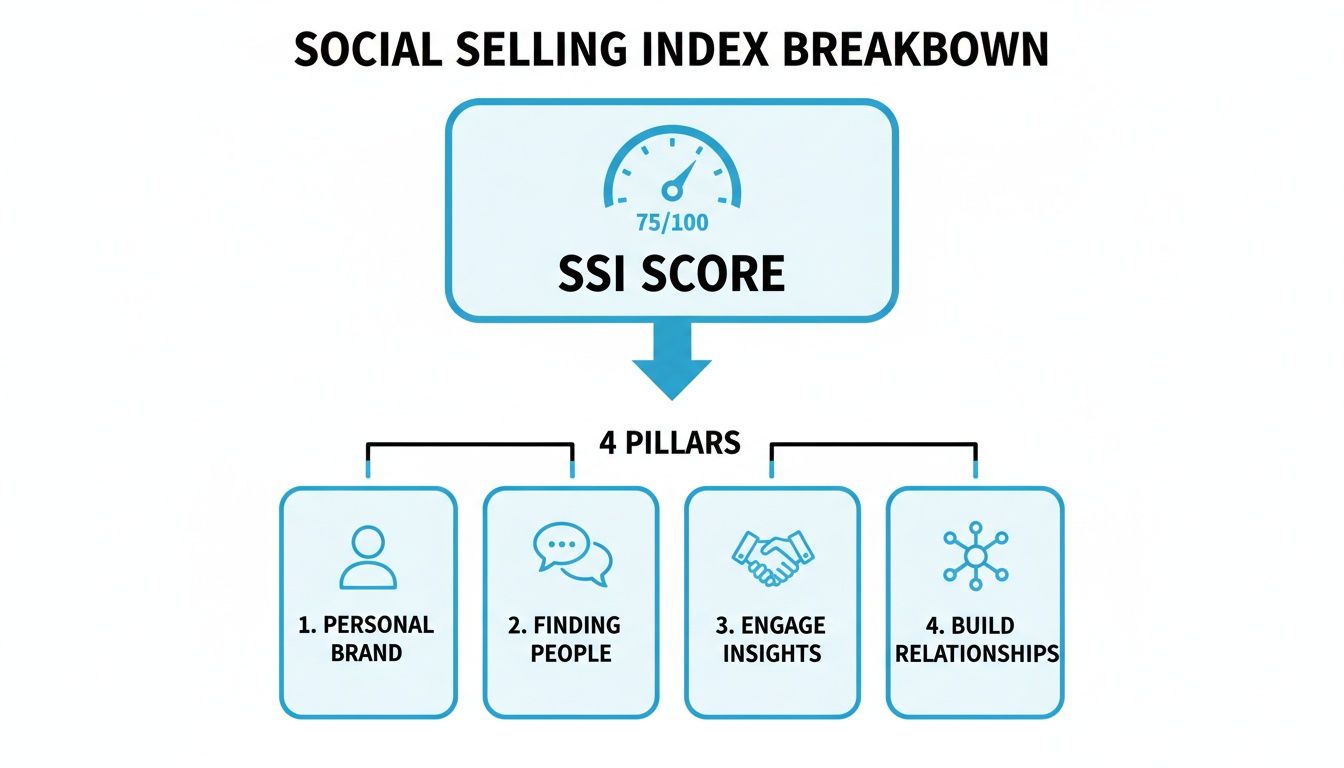
As you can see, a high score requires a balanced effort across all four pillars. Excelling in one or two areas isn't enough to drive consistent results.
Let's break down exactly what those four pillars are and why they're critical for modern sales teams.
The Four Pillars of Your SSI Score
Your total score is a combination of your performance in four distinct areas. Here’s what they mean in the real world of B2B sales.
Mastering these four pillars isn't just a "nice-to-have" for social media-savvy reps. It's a core requirement for everyone on the sales team, from SDRs booking meetings to Account Executives closing complex deals.
Your SSI score is simply the number that tells you how well your team is executing. It’s a direct measure of whether your reps are building the trust required to turn a connection request into a signed contract.
Breaking Down the Four Pillars of Social Selling
A high Social Selling Index score isn't just a number; it's the outcome of executing the right activities, consistently. LinkedIn built the SSI around four key pillars, and each one contributes up to 25 points to your total score.
Think of them less as a checklist and more as the core habits of any modern B2B seller. Getting these right is what separates top performers from the rest. It's the difference between shouting into the void and starting real conversations that fill your pipeline.
Let's break down each pillar from the perspective of an SDR or AE who’s in the trenches every day.
Pillar 1: Establish Your Professional Brand
This is about building credibility before you ever send a connection request. Your LinkedIn profile isn't a digital resume; it’s a resource hub for your ideal customers. It needs to signal expertise and immediately answer a prospect's first unspoken question: "What's in this for me?"
For a sales rep, this starts with a 100% complete profile, a professional headshot, and a headline that talks about the outcomes you deliver, not just your job title. A weak brand makes every outreach feel cold. A strong one warms up every interaction, making prospects far more likely to listen because you've already positioned yourself as someone worth their time.
Pillar 2: Find the Right People
Every sales leader knows that the most brilliant message sent to the wrong person is a complete waste of time. This pillar measures how well you can pinpoint the actual decision-makers at your target accounts.
This is where many manual sales workflows break down. Reps burn hours digging through messy CRM data or running generic LinkedIn searches, only to end up with a list of questionable contacts. Your score here is tied directly to the quality of your prospecting data. For a deeper dive, our guide on using advanced search on LinkedIn has practical strategies.
A common scenario we see is an AE getting a handoff for a prospect who left the company three months ago. That’s not just inefficient; it’s a data problem that crushes quota attainment and tanks this part of your SSI score.
This is exactly what modern GTM platforms like Willbe are built to fix. By aggregating and verifying data from multiple sources, we ensure that when your team looks for the "VP of Engineering" at a target account, they find the right person with the right contact info, every time.
Pillar 3: Engage with Insights
This is easily the most misunderstood pillar. It’s not about mindlessly liking posts or blasting out your company's latest blog. It's about starting smart, relevant conversations. LinkedIn's algorithm rewards users who share valuable content and participate in meaningful discussions.
For a sales rep, this looks like:
- Sharing a third-party article that addresses a common pain point for your ideal customer.
- Leaving a thoughtful comment on a prospect's post that adds a new perspective, not just an echo.
- Tagging a colleague or another expert to bring more value into a discussion.
This is all about demonstrating you understand your buyer's world. When you consistently share useful insights, you stop being just another seller and start becoming a trusted advisor. That’s the social capital you need to earn the right to ask for a meeting. Quality trumps quantity—one sharp, insightful comment is worth a hundred generic likes.
Pillar 4: Build Relationships
The final pillar ties it all together. It measures your ability to turn connections into a strategic network. This isn't about collecting contacts; it's about methodically building and nurturing relationships with potential buyers, champions, and influencers over time.
For sales teams, this means connecting with multiple stakeholders at target accounts and building rapport long before you need anything from them. A high acceptance rate on your connection requests is a key signal here, which is why a personalized, non-salesy invitation is so important.
This pillar is a reflection of your team's ability to build a future pipeline, not just close this quarter's deals. It’s the long game that creates a predictable revenue engine, ensuring you always have a network of warm prospects to turn to.
Turn Your Profile From a Resume into a Revenue Machine
Most sales reps make the same critical mistake: they treat their LinkedIn profile like a resume. It’s a static, backward-looking list of job duties. For a modern B2B seller, that’s completely wrong. Your profile isn't a resume; it's a dynamic, personal landing page built for one person: your ideal customer.
Every element, from the banner image to your skills, needs to be engineered to stop a scrolling prospect in their tracks and immediately answer their biggest question: “What’s in it for me?”
This mindset is the heart of the first SSI pillar, "Establishing Your Professional Brand." A weak, self-focused profile makes every outbound message feel colder and less credible. But a strong, customer-centric one acts as an inbound magnet, building trust before you even click "connect" and making every outreach more effective. It transforms your digital presence from a simple bio into a revenue-generating asset.

Nail Your Headline: It’s Your Digital Billboard
Your headline is the single most valuable real estate on your profile. It shows up everywhere on LinkedIn—in search results, connection requests, and every comment you leave. A generic title like "Account Executive at Willbe" tells a prospect nothing about how you can help them. It’s a massive, wasted opportunity.
A powerful headline doesn't describe your job; it describes the outcome you deliver for your ideal customer. It's your one-line pitch that speaks directly to their pains or aspirations.
Let's look at the difference.
Before:
Account Executive at Willbe
After:
Helping RevOps Leaders Unify Their GTM Stack & Build Predictable Pipeline | B2B Prospecting & Lead Generation
The second version instantly communicates value. Any RevOps leader who sees it knows exactly what problem you solve, making them far more likely to accept your connection or read your message.
Write a Summary That Tells Their Story, Not Yours
The "About" section is where you expand on the promise made in your headline. Stop writing it in the third person or listing skills like a job application. Instead, tell a story of transformation from your customer’s point of view.
A great summary follows a simple, effective structure:
- The Hook: Start by describing the frustrating, common challenges your ideal customer profile (ICP) faces daily. This shows you understand their world.
- The Solution: Introduce a better way of doing things. Frame it as a new approach or a shift in strategy, not a product pitch.
- The Proof: Show, don't just tell. Mention concrete results you’ve helped similar companies achieve. Use specific, quantifiable outcomes whenever possible.
- The Action: End with a clear, low-friction call to action. Tell them the next logical step—whether that's connecting, grabbing a resource, or booking a quick chat.
Think of your summary as the script for the first five minutes of a discovery call. You’re building rapport and establishing credibility by focusing entirely on the buyer’s challenges and what they stand to gain.
Use Rich Media to Showcase Social Proof
LinkedIn’s "Featured" section is one of the most underutilized tools for building a professional brand. This is your chance to move beyond text and provide tangible, visual proof of your expertise. Don't let this prime real estate sit empty.
Load it up with rich media that backs up your claims and builds trust:
- Case Studies or Testimonials: Nothing works better than showing how you've helped a company just like theirs succeed.
- Webinar Recordings or Short Videos: Let prospects see and hear you. It demonstrates your knowledge and makes you more approachable—a real person, not just a profile.
- Links to High-Value Content: Share helpful blog posts or white papers. This positions you as a valuable resource, not just another salesperson.
When you strategically combine these elements, your profile stops being a passive document and becomes an active part of your sales process. It works for you 24/7, warming up prospects and validating your outreach, which directly improves your social selling index score by proving you're a credible, customer-focused expert.
Finding and Engaging the Right Buyers at Scale
Every SDR has lived this nightmare: you get a lead list that’s supposed to be full of "high-intent" prospects, only to spend the next four hours just cleaning it. You dig through company websites and cross-reference LinkedIn profiles, all to validate that the contacts still work there. At the end of it all, you’re left with a handful of good leads.
That manual, soul-crushing grind is what kills productivity and burns out your best reps.
This exact problem is what the second SSI pillar, "Finding the Right People," is all about. It measures how well you can pinpoint your ideal buyers without wasting half your day on dead ends. A low score here is a major red flag that your team is working with outdated or fragmented data—a problem no amount of hustle can fix.
Modern GTM platforms like Willbe were built to eliminate this friction. Instead of relying on a single, aging database, Willbe pulls data from over 30 B2B sources, constantly verifying and updating contact information in real-time. This means your reps can build hyper-targeted lists of perfect-fit buyers in minutes, not hours.
From Generic Activity to Insightful Engagement
Once you’ve found the right people, the next hurdle is starting a conversation that doesn’t get immediately deleted. This brings us to the third SSI pillar: "Engaging with Insights." This is perhaps the most misunderstood part of the score.
Too many reps think "engagement" means liking a prospect’s post or dropping a generic "Great share!" comment. Let's be clear: that’s not engagement, it’s noise. LinkedIn’s algorithm, and more importantly, your buyers, reward meaningful interaction that shows you’ve done your homework.
A high score in this category comes from sharing content and starting dialogues that prove your expertise and relevance. True engagement is about delivering value before you ask for anything. It’s about becoming a trusted resource in your buyer’s feed, not just another salesperson in their inbox.
Actionable Strategies for Engaging With Insights
Moving beyond lazy likes requires a real strategy. Instead of random acts of engagement, focus on these high-impact activities:
- Share Third-Party Content with Your Take: Find an industry report or article that speaks to a pain point your ICP is dealing with. Share it, but add a 2-3 sentence summary with your unique perspective or a question that sparks discussion. This positions you as a thoughtful curator of valuable information.
- Leave Comments That Add to the Conversation: Before you comment on a prospect’s post, ask yourself: "Does this add new value?" Instead of just agreeing, offer a counterpoint, share a related statistic, or tag another expert who could contribute. A single thoughtful comment can be more powerful than an entire cold email.
- Create Simple, Relevant Content: You don't need a marketing team. Use LinkedIn’s native polls to ask a question about a common industry challenge. Or, write a short text-only post detailing how you helped a customer solve a specific problem. This type of content feels authentic and starts genuine conversations.
The goal of engagement isn't just to be seen; it's to be seen as credible. Every interaction is a chance to prove you understand your buyer’s world. When you do that consistently, your outreach feels less like an interruption and more like a welcome conversation.
Scaling Personalization Without Sounding Like a Robot
The biggest pushback from sales leaders about this level of engagement is that it doesn’t scale. How can an SDR find the right people and craft genuinely insightful messages for hundreds of prospects every week? Manually, they can’t. It creates an impossible trade-off between quality and quantity.
This is where AI-driven personalization changes the game. But not just any AI. Generic, template-based tools that spit out robotic-sounding copy will hurt your brand and your social selling index score. Prospects can spot lazy AI from a mile away. Our guide on effective prospecting on LinkedIn dives deep into maintaining a human touch at scale.
Willbe’s proprietary, template-free AI was designed to solve this problem. It's trained to sound like your best sales reps, not a machine. By analyzing a prospect’s profile, their company’s data, and their recent activity, it helps your team write outreach for email and LinkedIn that feels human, context-aware, and truly relevant.
This allows your team to master the "Find the Right People" and "Engage with Insights" pillars simultaneously, without sacrificing speed or quality. You get the precision of verified data combined with the power of authentic, one-to-one communication—even at scale. This is how top-performing teams build and convert pipeline faster.
Converting Connections into Qualified Pipeline
The first three pillars of the Social Selling Index are about laying the groundwork. You establish your credibility, find the right people, and start valuable conversations. But the fourth pillar, "Building Relationships," is where that effort turns into qualified pipeline.
This is the make-or-break moment where your digital reputation must translate into something tangible. It’s not about collecting connections. A network of 10,000 people means nothing if none of them know who you are or why they should listen to you.
Real relationship-building is a sales process. It's about nurturing a focused group of high-potential prospects and turning them from silent observers into future customers. The goal is to master the art of moving from a social chat to a sales conversation without being awkward or pushy.
A high score here shows sales leaders that their reps understand how to play the long game. It’s proof they're building trust over time, which is the only way to create a predictable revenue engine in B2B sales.
Mastering the Multi-Touch Sequence
Today's buyers are busy and skeptical; a single cold message rarely works. To build a genuine relationship, you need a thoughtful, multi-touch sequence that mixes channels like LinkedIn and email. The idea is to stay on their radar by consistently offering value, not by pestering them for a meeting.
This approach respects their time and builds the social capital you need before you make an ask.
Here’s what an effective sequence might look like:
- Touch 1 (LinkedIn): Drop a thoughtful comment on a prospect’s post. No pitch, just add to the conversation.
- Touch 2 (LinkedIn): Send a personalized connection request that references the comment or a shared interest.
- Touch 3 (Email): A few days later, send a short email about a specific pain point relevant to their role, offering a helpful resource.
- Touch 4 (LinkedIn): Follow up in their DMs by sharing a relevant third-party article related to a recent company announcement or industry trend.
This methodical process shows you’ve done your homework and have real expertise. It makes your eventual request for a meeting feel like a natural next step, not a jarring interruption.
The Art of the Non-Pushy Transition
Knowing when to shift from a friendly conversation to a sales motion is what separates top performers from everyone else. Go too early, and you sound like every other spammy salesperson. Wait too long, and the opportunity closes.
The secret is to watch for buying signals and create an opening with a message that feels perfectly in context.
Instead of the generic "Got 15 minutes for a demo?" approach, a strategic transition message draws on the trust you've already built and connects to what's happening in their world.
Example: The Pushy, Generic Message
"Hi [Name], thanks for connecting. I see you're the VP of Sales at [Company]. We help teams like yours increase their pipeline. Are you free to chat next week?"
Example: The Authentic, Context-Aware Message
"Hi [Name], really enjoyed your post on scaling SDR teams. It reminded me of a challenge a similar company in your space faced with data accuracy slowing them down. We put together a short playbook on how they fixed it. Mind if I share the link?"
The second example doesn’t demand their time; it offers value. It doesn't read like a template; it feels like a one-to-one conversation between two professionals.
This is precisely where Willbe’s template-free AI shines. It analyzes a prospect's profile and recent activity to help reps write these kinds of authentic, high-impact messages that build trust and move deals forward. For more ideas, check out our guide on crafting the perfect message for a LinkedIn connection.
Ultimately, a high social selling index score in "Building Relationships" is a direct measure of your team’s ability to run this modern sales playbook. It’s the final step in turning social activity into predictable revenue.
How Willbe Accelerates Your SSI and Drives Real Outcomes
Trying to boost your Social Selling Index score isn't about chasing a number. It’s about building a modern go-to-market engine that fills your pipeline. The problem is, manually mastering all four SSI pillars is a fast track to burnout. Your sales reps are stuck making an impossible choice between high-quality, personalized prospecting and high-volume outreach—a trade-off that kills momentum.
This is where an all-in-one platform like Willbe changes the game. It’s designed to systematically lift your team's performance across every component of the SSI score, translating their effort into measurable revenue.

Unifying Your Social Selling Workflow
Most sales teams operate with a messy collection of fragmented tools—one for data, another for engagement, and a third for analytics. Instead of that disjointed approach, Willbe provides a single, unified platform to execute your entire GTM strategy. This cohesion maps directly to the four SSI pillars, helping you get better results with far less manual effort.
The real problem isn't that your sales team isn't trying hard enough; it's the friction baked into their daily workflow. A high SSI score is the natural byproduct of a sales process that is precise, personal, and efficient from the ground up.
Willbe doesn’t just help your reps work harder; it makes them more effective. By automating the grunt work—like cleaning lists and finding intel—we give them back the time to focus on what actually closes deals: building genuine relationships and starting meaningful conversations.
Here's a practical breakdown of how our platform directly boosts each pillar, turning your team's SSI from a simple score into a reliable indicator of future pipeline.
Boosting Your SSI Pillars with Willbe
Willbe's features are purpose-built to remove the roadblocks that prevent reps from achieving a high SSI score. Here’s how the platform addresses the core challenges of each pillar.
Ultimately, a higher SSI score is the result of executing the right activities, consistently. By streamlining the entire social selling process, Willbe helps your team not only improve their score but also drive the one metric that truly matters: revenue.
Got Questions About the SSI Score? We’ve Got Answers.
Even for veteran sales pros, the Social Selling Index can seem a bit mysterious. Let's clear up the most common questions we hear from sales leaders and reps who are serious about building a predictable revenue engine.
Is the SSI Score Just Another Vanity Metric?
Not at all. While it is just a number, it directly mirrors the activities that generate revenue.
Think of it this way: a high social selling index score almost always correlates with hitting quota. Why? Because it measures the exact behaviors that build a modern sales pipeline—establishing credibility, finding the right people, and building relationships based on trust.
It's less of a score to obsess over and more of a diagnostic tool for how well your team is executing your go-to-market strategy.
How Often Does the SSI Score Update?
Your SSI score updates daily.
It's calculated based on your activity over the last 90 days. This rolling window means consistency is critical. A week of inactivity will start to drag your score down, while a steady, focused effort will lift it day by day.
Can I Improve My Score Quickly?
Yes, but it takes the right kind of effort.
The fastest way to see a jump is to completely optimize your profile (Pillar 1), which you can do in an afternoon. That alone provides an immediate boost.
After that, consistently using advanced search to find your ideal buyers and thoughtfully engaging with their content (Pillars 2 and 3) will show results within a couple of weeks. Building strong relationships (Pillar 4) is a longer-term play, but that’s where you’ll see the most lasting impact on your pipeline.
Ready to stop guessing and start building a pipeline you can count on? Willbe unifies your entire prospecting workflow, from finding verified buyers to sending hyper-personalized outreach that gets replies. See how top teams replace their scattered tools and finally scale what works.