


In 2026, the average B2B sales team is drowning in a sea of disconnected tools. A data provider here, a sequencer there, a separate AI writer, and a CRM that’s constantly out of sync. This 'Frankenstack' doesn't just drain your budget; it forces SDRs to spend hours on manual list cleaning, AEs to chase low-quality leads, and leaders to fly blind without a clear view of what’s actually working. The result is a predictable pattern of burned lists, low reply rates, and a pipeline that feels anything but stable.
This guide cuts through the noise. We’re not just listing features; we are evaluating the best B2B lead generation tools through the lens of a modern sales team that needs to scale efficiently. Each platform is analyzed based on its core strengths—data quality, outreach capabilities, AI-driven personalization, and its ability to deliver a seamless, revenue-focused workflow. You'll find direct links and screenshots for every option to see how they operate in a real-world context.
Whether you're an SDR trying to book more qualified meetings or a RevOps leader building a scalable GTM engine, this breakdown will help you make an informed choice. Our goal is to help you move from a fragmented, expensive tech stack to a unified, high-performance prospecting system that drives predictable revenue. We'll compare top solutions like ZoomInfo, Apollo.io, and 6sense, and show you exactly where an all-in-one platform like Willbe fits in to consolidate your process and replace manual workflows.
1. Willbe
Willbe is an all-in-one B2B prospecting platform engineered to solve the chronic fragmentation sales teams face. Instead of juggling separate tools for data sourcing, outreach, and analytics, Willbe centralizes the entire top-of-funnel workflow into a single, cohesive engine. This unified approach eliminates manual work and tool-switching, making it a standout choice for high-growth B2B teams focused on building a predictable and scalable pipeline.
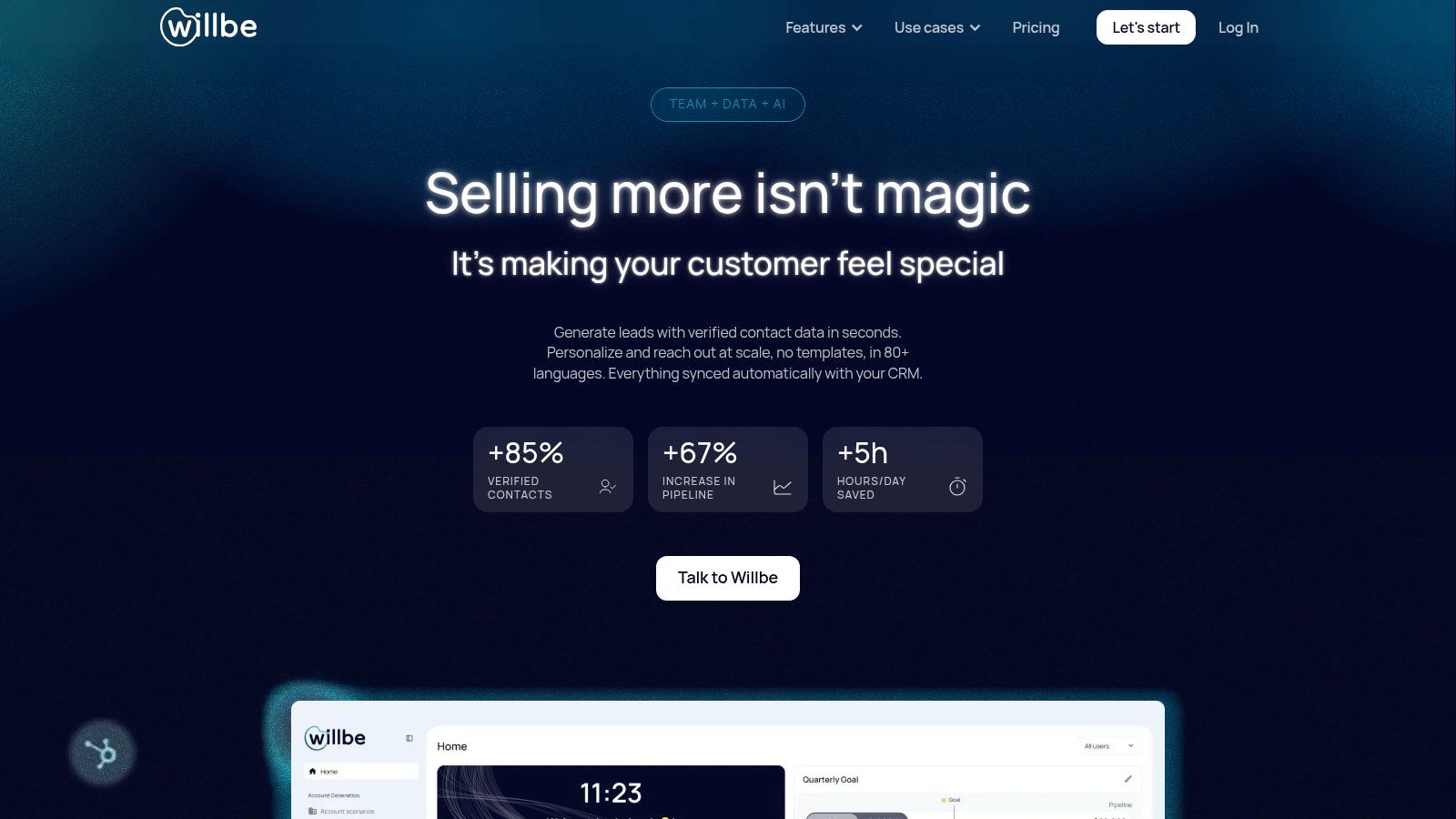
The platform’s core strength lies in its ability to connect high-quality data directly to intelligent, personalized outreach. Willbe aggregates contact information from over 30 B2B databases, continuously verifying it to ensure high accuracy and global coverage. This lets SDRs build hyper-targeted account lists without spending hours on manual research or data cleansing—a common pain point that slows down pipeline generation.
Where Willbe truly sets itself apart is with its proprietary AI orchestrator. This system generates template-free, voice-matched outreach for email and LinkedIn that sounds genuinely human, not like generic AI copy. By analyzing a user's style, it creates authentic messages that make prospects feel understood, reportedly driving response rates near 25%. This capability, available in over 80 languages, enables teams to execute personalized campaigns at scale without burning their lists.
Finally, real-time analytics dashboards provide sales leaders with clear visibility into what's working. The platform identifies the most effective channels, messaging, and target profiles, enabling teams to double down on successful strategies. Its native CRM sync automates data entry and ensures clean handoffs from SDRs to AEs, freeing up reps to focus on selling. For more insights on building a strong foundation, review their guide on B2B lead generation best practices.
Key Features & Analysis
- Aggregated & Verified Data: Combines 30+ B2B data sources with continuous verification, claiming an impressive 85% contact discovery rate. This minimizes bounce rates and wasted effort, giving sales teams a reliable foundation for outreach.
- Proprietary AI Outreach: The template-free AI personalizes messaging to match the user's unique voice, avoiding the generic feel of many AI writing tools. The outcome is breaking through the noise in crowded inboxes with messages that sound human.
- Centralized Workflow: By unifying data, multi-channel outreach (Email, LinkedIn), and analytics, it replaces the patchwork of separate tools. This reduces costs, simplifies the tech stack for RevOps, and saves reps significant time.
- Performance Analytics & Prediction: Dashboards offer clear visibility into team performance and campaign effectiveness. Its predictive models claim to improve sales forecast accuracy by over 35%, helping leaders make data-driven decisions.
Pricing & Access
Willbe does not offer public pricing tiers. Access to the platform requires scheduling a demo and receiving a custom quote, positioning it as a solution for serious teams ready to invest in a scalable GTM engine.
Pros & Cons
Website: https://www.willbe.ai
2. ZoomInfo (SalesOS)
For mid-market and enterprise sales organizations, ZoomInfo's SalesOS platform is a heavyweight contender in the B2B intelligence space. It functions as an expansive database and go-to-market suite, built to arm outbound teams with deep contact and company data, primarily focused on the U.S. market. Its core strength lies in providing high-quality, verified direct-dial phone numbers and detailed organizational charts, allowing SDRs to bypass gatekeepers and connect directly with decision-makers.
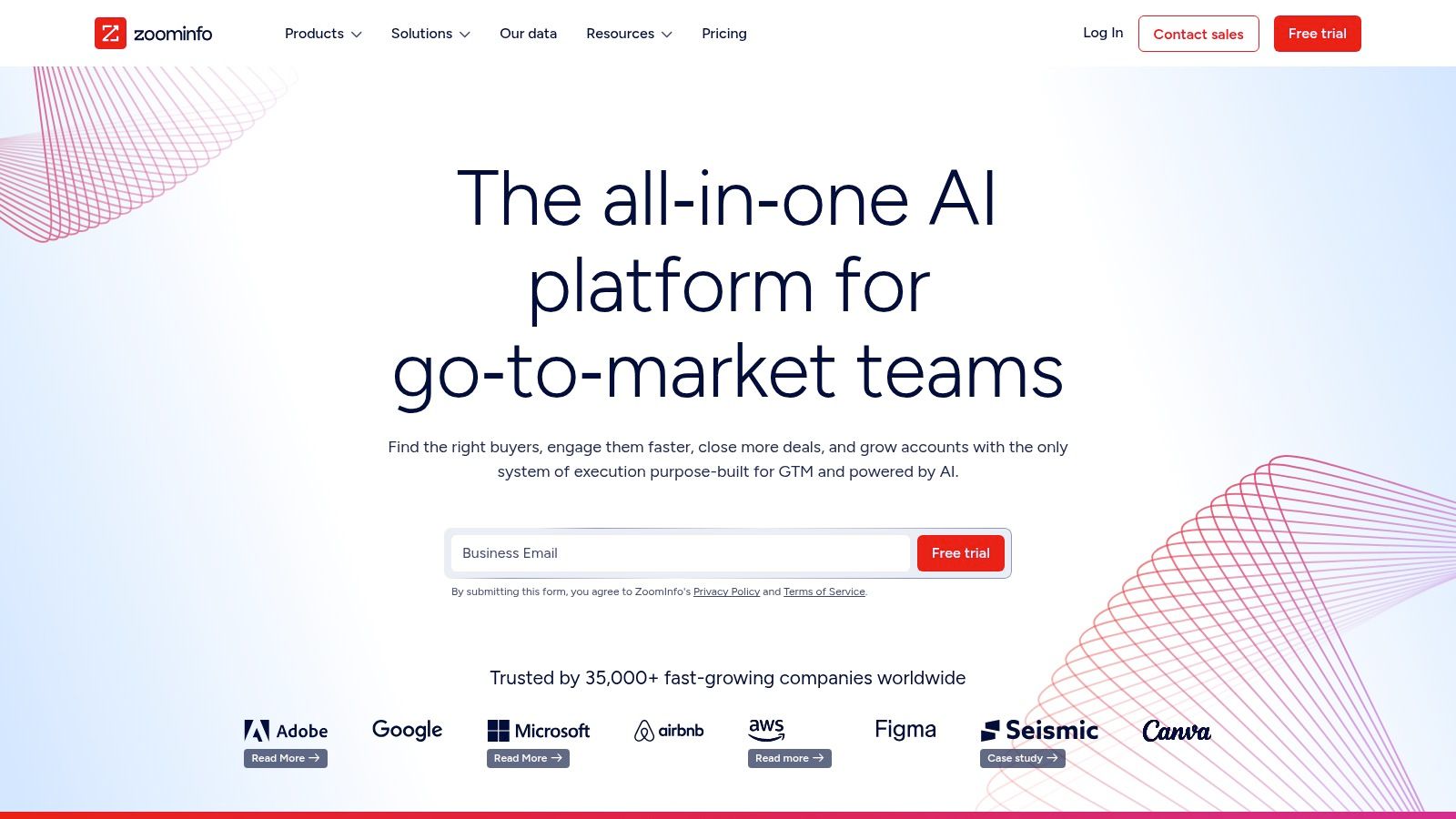
Beyond raw data, ZoomInfo layers in several critical GTM functions. Its intent data signals identify accounts actively researching solutions like yours, while "Scoops" reveal key personnel changes or funding news that create timely outreach opportunities. The platform also includes WebSights, which de-anonymizes website traffic to show which target accounts are visiting your site.
Key Features & Benefits
- B2B Contact & Company Database: Access a massive repository of firmographics, technographics, and direct contact details, including verified mobile numbers.
- Buyer Intent Signals: Uncover which companies are actively searching for keywords related to your product, signaling purchase intent.
- Organizational Charts: Visually map out company hierarchies to identify key influencers and decision-makers for multi-threaded prospecting.
- Data Enrichment & WebSights: Automatically enrich your CRM records and identify anonymous website visitors to capture inbound interest.
Limitations & Considerations
The platform's enterprise-grade power comes with a corresponding price tag. Pricing is quote-based and often requires annual contracts, with total costs escalating quickly as you add more seats, data credits, and modules. The interface can also present a learning curve for new users, given the sheer volume of features available. It is best suited for established teams with a dedicated budget and a clear outbound strategy.
Best For: Enterprise and mid-market sales teams that require deep, accurate U.S. contact data, particularly direct dials, and can support the investment in an end-to-end GTM platform.
Visit ZoomInfo's Website
3. LinkedIn Sales Navigator
For any team serious about relationship-based selling, LinkedIn Sales Navigator is the indispensable tool for tapping into the world's largest professional network. It transforms the standard LinkedIn experience into a powerful prospecting platform designed to identify stakeholders, map buying committees, and engage decision-makers directly. Its core value comes from providing real-time access to the professional graph, allowing sales teams to find the right people with unmatched accuracy.
Sales Navigator moves beyond simple profile views by equipping users with advanced search filters, lead recommendations, and critical insights into account activity. Functions like TeamLink show how your colleagues are connected to a prospect, creating a warm path for an introduction. While it doesn't provide direct-dial phone numbers or emails, its deep integration with major CRMs makes it the central hub for account intelligence and social selling workflows.
Key Features & Benefits
- Advanced Lead & Account Search: Use over 50 filters including seniority, company size, and keywords to build precise prospect lists. Learn more about how to use these with this advanced LinkedIn search guide.
- Buyer Intent & AI Insights: Identify accounts showing interest and get AI-driven lead recommendations (Account IQ/Lead IQ) to focus your efforts.
- InMail & TeamLink Introductions: Contact prospects directly through InMail messages or discover shared connections within your organization for warm introductions.
- CRM Integration: Sync lead and account lists directly with Salesforce, HubSpot, and Microsoft Dynamics to keep your GTM data unified.
Limitations & Considerations
The platform's primary limitation is its exclusion of external contact data; you won't find verified email addresses or phone numbers. This means it works best when paired with a separate data provider for multi-channel outreach. While pricing is transparent and self-serve options are available, the cost for an entire sales team on the Advanced Plus plan can be a significant investment.
Best For: Sales teams that prioritize social selling and account mapping. It is essential for SDRs and AEs who need to identify buying committees, find warm introduction paths, and build relationships on LinkedIn.
Visit LinkedIn Sales Navigator's Website
4. Apollo.io
Apollo.io has emerged as a go-to-market engine for SMBs and mid-market teams, combining a massive B2B database with built-in sales engagement and intelligence functions. It unifies prospecting, sequencing, and analytics into a single interface, allowing sales development teams to build lists, find contact data, and launch multi-channel outreach campaigns without switching between multiple tools. Its core value is providing an end-to-end outbound stack at a very accessible price point.
The platform is one of the best B2B lead generation tools for teams that need to scale outbound quickly. With its popular Chrome extension, users can find contact details directly from LinkedIn profiles or company websites and add them to automated email and call sequences on the fly. This tight integration between data acquisition and outreach execution helps SDRs build pipeline faster with less manual work.
Key Features & Benefits
- Integrated Prospecting & Sequencing: Access a large database with verified emails and phone numbers, then immediately enroll prospects into automated email and call sequences.
- Chrome Extension: Source contacts directly from LinkedIn and corporate websites, streamlining list-building and research workflows.
- Workflow Automation & Analytics: Automate manual tasks like CRM updates and use built-in analytics to track sequence performance and team activity.
- Native Integrations: Connects directly with major CRMs like Salesforce and HubSpot, plus sales engagement tools like Outreach and Salesloft.
Limitations & Considerations
While powerful, Apollo's credit-based model can become costly for teams with high-volume prospecting needs, as export credits and advanced features are gated. The sheer number of features, though a strength, can also present a learning curve for new users trying to master its full capabilities. Data accuracy can be inconsistent for international markets compared to its U.S. data.
Best For: SMB and mid-market sales teams seeking an affordable, all-in-one platform to consolidate their data, prospecting, and sales engagement stack into a single solution.
5. Cognism
For sales teams that prioritize global reach and compliance, Cognism offers a premium B2B data solution focused on accuracy and GDPR adherence. Its primary differentiator in the crowded data market is its commitment to phone-verified mobile numbers, known as "Diamond Data." This feature is engineered to give SDRs and AEs a direct line to decision-makers, significantly improving connect rates and reducing time wasted on navigating switchboards or dialing incorrect numbers.
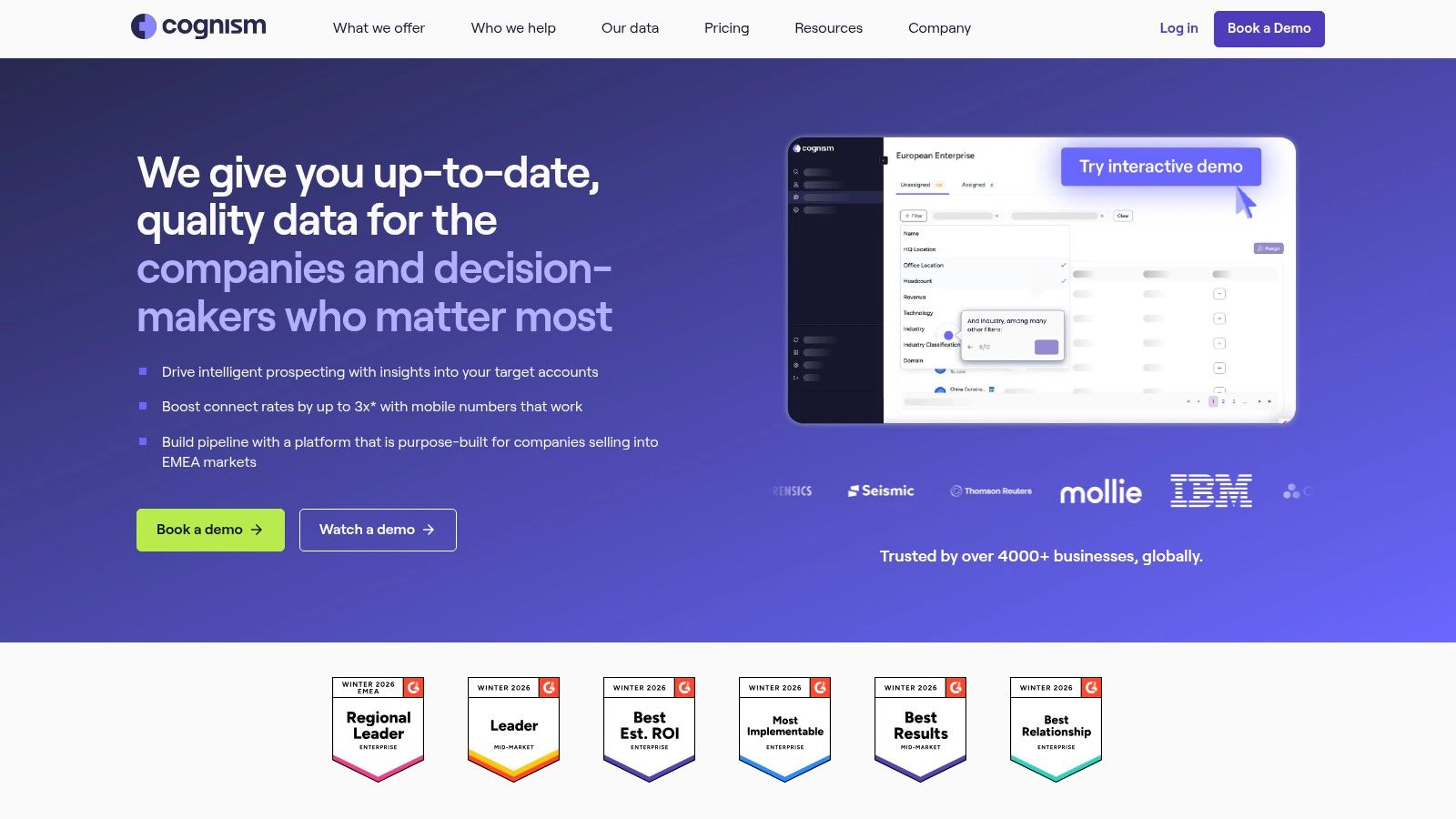
Cognism positions itself as a strong ZoomInfo alternative, particularly for organizations operating in or selling into Europe. The platform provides a robust compliance framework and extensive documentation, giving sales leaders confidence that their outbound motions meet stringent data privacy regulations. Its Chrome Extension enables reps to access this high-quality data directly within their existing workflows on LinkedIn and corporate websites, feeding contacts straight into their CRM.
Key Features & Benefits
- Diamond Data®: Access phone-verified mobile numbers for key contacts, human-validated for accuracy to boost connect rates.
- Diamonds-on-Demand®: If a contact's mobile isn't in the database, reps can request manual verification, getting a quality number within 48 hours.
- Global Compliance: Built with a GDPR-forward posture, providing a Do-Not-Call list scrubber and supporting compliance in global markets.
- Seamless Integrations: Native connections with major CRMs like Salesforce and HubSpot, plus sales engagement platforms, ensure data flows into existing systems.
Limitations & Considerations
Cognism's premium data comes at a premium price. The platform operates on a quote-based model, often with multi-year contracts, and access to the coveted Diamond Data usually requires a higher-tier package. Pricing structures and credit allowances can vary by region and usage volume, necessitating a conversation with their sales team. The platform is best suited for established teams that view high-fidelity contact data as a critical investment for their GTM engine.
Best For: Mid-market and enterprise teams, especially those in EMEA, that require highly accurate, compliant mobile numbers and are willing to invest in premium data to improve outbound performance.
6. Lusha
For individual prospectors and smaller teams prioritizing speed and simplicity, Lusha offers one of the most direct paths to B2B contact data. It operates on a straightforward, credit-based model, making it a popular self-serve tool for reps who need fast access to emails and phone numbers without navigating complex enterprise contracts. Its browser extension is a key part of the workflow, allowing users to find contact details directly on LinkedIn profiles and company websites with a single click.
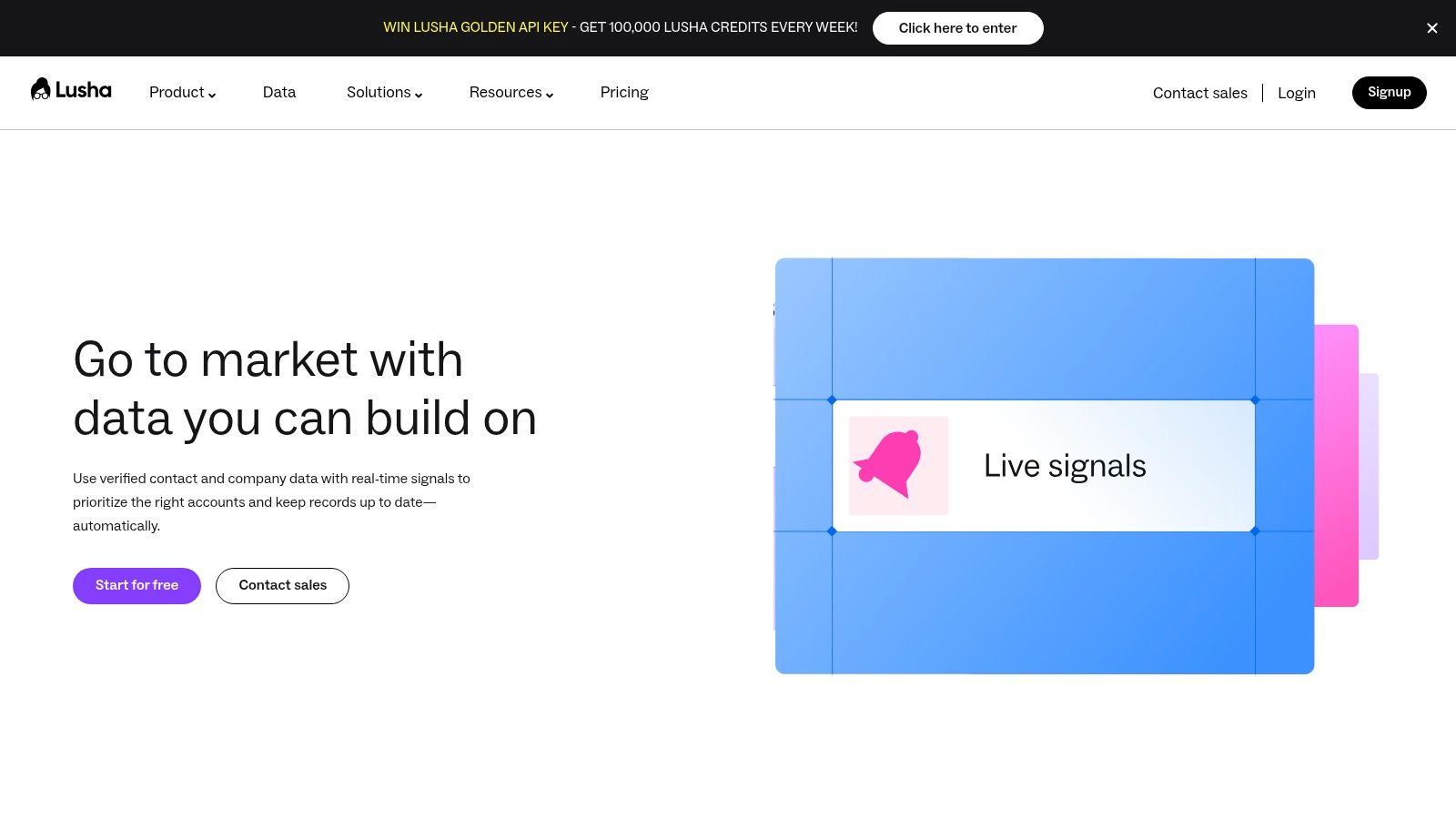
This accessibility makes Lusha a strong choice for those just starting to build an outbound function or for sales teams needing a supplementary data source. The platform provides a simple prospecting interface and basic CRM integrations, focusing on delivering its core value: accurate contact information on demand. It stands out as one of the best b2b lead generation tools for users who value ease of use and predictable spending over deep, all-in-one platform capabilities.
Key Features & Benefits
- Credit-Based System: A transparent model where users spend credits for contact reveals, with a generous free plan for getting started.
- Browser Extension: Find direct contact information instantly on LinkedIn, Salesforce, and corporate websites, speeding up manual research.
- Simple Prospecting UI: An easy-to-navigate platform for building and saving contact lists for targeted outreach campaigns.
- Basic CRM Integrations: Push contacts directly to popular CRMs like HubSpot and Salesforce to reduce manual data entry.
Limitations & Considerations
While excellent for its core purpose, Lusha's data depth and enrichment features are not as extensive as enterprise-level platforms. Its focus on individual contact lookups makes it less suited for high-volume, automated list building or complex account-level data enrichment. Teams requiring deep technographics, intent data, or advanced filtering may find it limiting as their primary GTM intelligence source.
Best For: SMBs, individual sales reps, and smaller teams that need a fast, affordable, and easy-to-use tool for finding direct-dial phone numbers and verified emails on demand.
7. Clearbit by HubSpot (Breeze Intelligence)
For GTM teams whose entire stack is built around HubSpot, the acquisition and integration of Clearbit into the native platform, now called Breeze Intelligence, is a significant development. It eliminates the need for third-party enrichment tools and messy API connections by embedding data directly within the HubSpot ecosystem. Its primary function is to enrich contact and company records, shorten lead capture forms, and de-anonymize website traffic, all operating seamlessly inside your existing CRM.
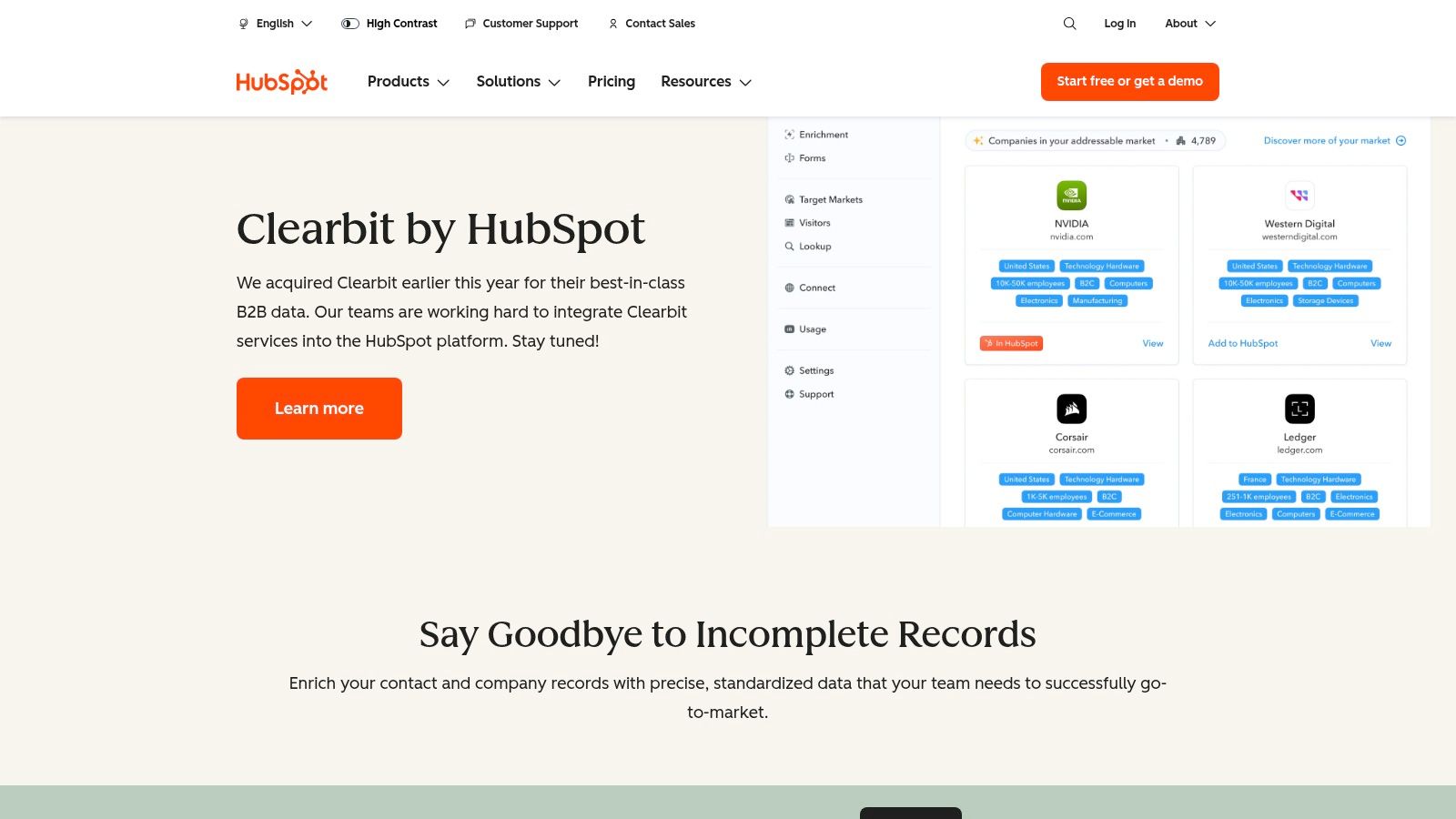
The system works on a credit-based model tied to your HubSpot subscription, making costs predictable. By automatically populating firmographic and contact data, it allows marketing teams to create shorter forms that boost conversion rates without sacrificing lead quality. For sales, this means receiving well-rounded lead profiles from the moment of creation, enabling faster and more relevant outreach.
Key Features & Benefits
- Native HubSpot Enrichment: Automatically adds over 100 data points to company and contact records directly within your HubSpot CRM.
- Form Shortening: Increases lead conversion rates by reducing the number of fields on your forms while still capturing rich prospect data.
- Website Visitor Identification: Identifies which of your target accounts are visiting your website, even if they don't fill out a form, turning anonymous traffic into actionable leads.
- HubSpot Credits Model: Operates on HubSpot's unified credit system, simplifying billing and included with certain paid HubSpot plans.
Limitations & Considerations
The platform's greatest strength is also its main limitation: it is now exclusively for HubSpot users and no longer a CRM-agnostic solution. The credit-based system requires careful management, as credits reset monthly and do not roll over, potentially leading to unused spend. A paid HubSpot plan is required to access these features, making it unsuitable for teams on the free tier or using other CRMs.
Best For: B2B companies deeply invested in the HubSpot ecosystem who want a seamless, native solution for data enrichment and inbound lead intelligence without managing separate integrations.
Visit Clearbit by HubSpot's Website
8. 6sense (Revenue AI Platform)
For B2B teams committed to an account-based marketing strategy, 6sense is a powerful Revenue AI platform that shifts the focus from chasing individual leads to engaging entire buying committees. It’s designed to identify which accounts are in-market for a solution like yours, even before they fill out a form. The platform's core strength is its ability to use AI and intent data to predict which accounts are most likely to buy, allowing marketing and sales teams to coordinate their efforts on high-value targets.
Unlike traditional databases, 6sense orchestrates engagement across multiple channels, including targeted ads, email, and sales outreach. Its predictive modeling surfaces accounts showing buying signals across the anonymous web, helping teams get in front of opportunities early. This intent-led approach is critical for effective ABM, which you can explore further in these account-based marketing best practices. The goal is to stop wasting resources on cold accounts and instead focus on those ready to engage.
Key Features & Benefits
- Revenue AI & Predictive Scores: Uses AI to score accounts based on their fit and intent, predicting where they are in the buying journey.
- Account Identification & Intent Data: De-anonymizes website traffic and captures third-party intent signals to uncover active buying research.
- Cross-Channel Orchestration: Activates coordinated campaigns across display ads, LinkedIn, email, and sales outreach to engage the entire buying team.
- AI Email Agents & Sales Intelligence: Automates routine scheduling and follow-up tasks, while providing sellers with AI-powered insights for smarter conversations.
Limitations & Considerations
The platform’s advanced capabilities come with a premium, quote-based price tag, making it a significant investment. Realizing a strong return requires a mature go-to-market team that is already aligned on an ABM framework. The system can be complex to set up and manage, often needing dedicated internal resources to connect the data, build audiences, and run orchestrated plays effectively. It is not a quick-fix tool but a strategic platform for sophisticated GTM motions.
Best For: Enterprise and mid-market marketing and sales teams with an established ABM strategy looking to use predictive analytics and intent data to prioritize and engage their most valuable accounts.
9. Demandbase (Demandbase One)
For marketing and sales teams committed to an account-based marketing (ABM) strategy, Demandbase One stands out as a powerful GTM platform. It is engineered to unify account intelligence, intent data, and advertising execution into a single, cohesive system. Its primary strength is in helping teams identify, target, and engage their highest-value accounts across multiple channels, moving beyond individual lead-based tactics to a coordinated, account-centric approach.
What makes Demandbase a top contender among the best B2B lead generation tools is its native B2B advertising DSP (Demand-Side Platform). This allows GTM teams to run highly targeted ad campaigns directly within the platform, reaching key decision-makers at target accounts showing active buying signals. The platform then orchestrates sales and marketing plays based on this account activity, ensuring reps engage with the hottest accounts at the right time.
Key Features & Benefits
- Account Identification & Prioritization: Uses AI to score and identify the accounts that are most likely to buy, based on firmographics and real-time intent signals.
- Native B2B DSP: Launch and manage targeted display and video advertising campaigns to key personas within your target account list directly from the platform.
- Personalization & Orchestration: Trigger personalized actions across channels, such as website content changes or sales alerts, when target accounts show engagement.
- Sales Intelligence Module: Equips sales reps with insights on which accounts are "in-market," what they are researching, and who the key contacts are.
Limitations & Considerations
Demandbase is a serious investment built for mature GTM motions. The pricing is quote-based and modular, meaning costs can escalate significantly as you add essential capabilities like advertising, intent data, and additional sales seats. Its focus on advertising-led ABM means it's best suited for organizations with the budget and strategy to support paid media as a core part of their pipeline generation efforts, making it a less practical fit for smaller teams or those focused purely on outbound sales.
Best For: Mid-market and enterprise marketing and sales teams that need an end-to-end ABM platform with an integrated B2B ad network to drive account-level engagement and pipeline.
10. Bombora (Company Surge Intent Data)
For GTM teams looking to prioritize their outreach with surgical precision, Bombora offers a powerful layer of intelligence. It operates as a leading B2B intent data provider, identifying which companies are actively researching specific topics related to your products or services. It works by monitoring content consumption across a massive, privacy-compliant co-op of publisher websites, giving you a signal that a target account is entering a buying cycle before they ever visit your site.
The core output is "Company Surge" data, which scores accounts based on how their research activity on a topic compares to their normal baseline. A high score indicates a timely opportunity, allowing sales and marketing teams to focus their efforts on accounts that are demonstrating real interest. This makes it one of the best B2B lead generation tools for timing and personalization, as you can tailor messaging around the exact topics an account is exploring.
Key Features & Benefits
- Company Surge Intent Scores: Pinpoint which of your target accounts are showing increased research activity across thousands of B2B topics.
- Broad Topic Taxonomy: Access a deep and granular list of business topics to align intent signals precisely with your solution's value proposition.
- Widespread Platform Integration: Activate Bombora data directly within your existing CRM, MAP, and ABM platforms for seamless workflow integration.
- Audience & Measurement Products: Build audiences for targeted advertising and measure the impact of your campaigns on accounts showing intent.
Limitations & Considerations
Bombora's data is at the company level, not the individual contact level. This means you know which company is interested but not who within that company is doing the research. It requires another tool or process to identify the right contacts at the surging account. The platform is designed to be activated through other GTM systems, so it is not a standalone prospecting tool but rather an intelligence layer that makes other tools more effective.
Best For: Marketing and sales teams running account-based strategies that need to prioritize outreach, personalize messaging, and improve the timing of their campaigns by focusing on in-market accounts.
11. Dealfront (Leadfeeder)
Dealfront, with its powerful Leadfeeder module, specializes in de-anonymizing your website traffic to identify which companies are showing interest in your brand. It works by connecting a tracker script to reverse IP lookups, converting anonymous visits into actionable company leads. This gives sales and marketing teams a direct line of sight into inbound intent, allowing them to proactively engage accounts that are already exploring their solutions instead of waiting for a form fill.
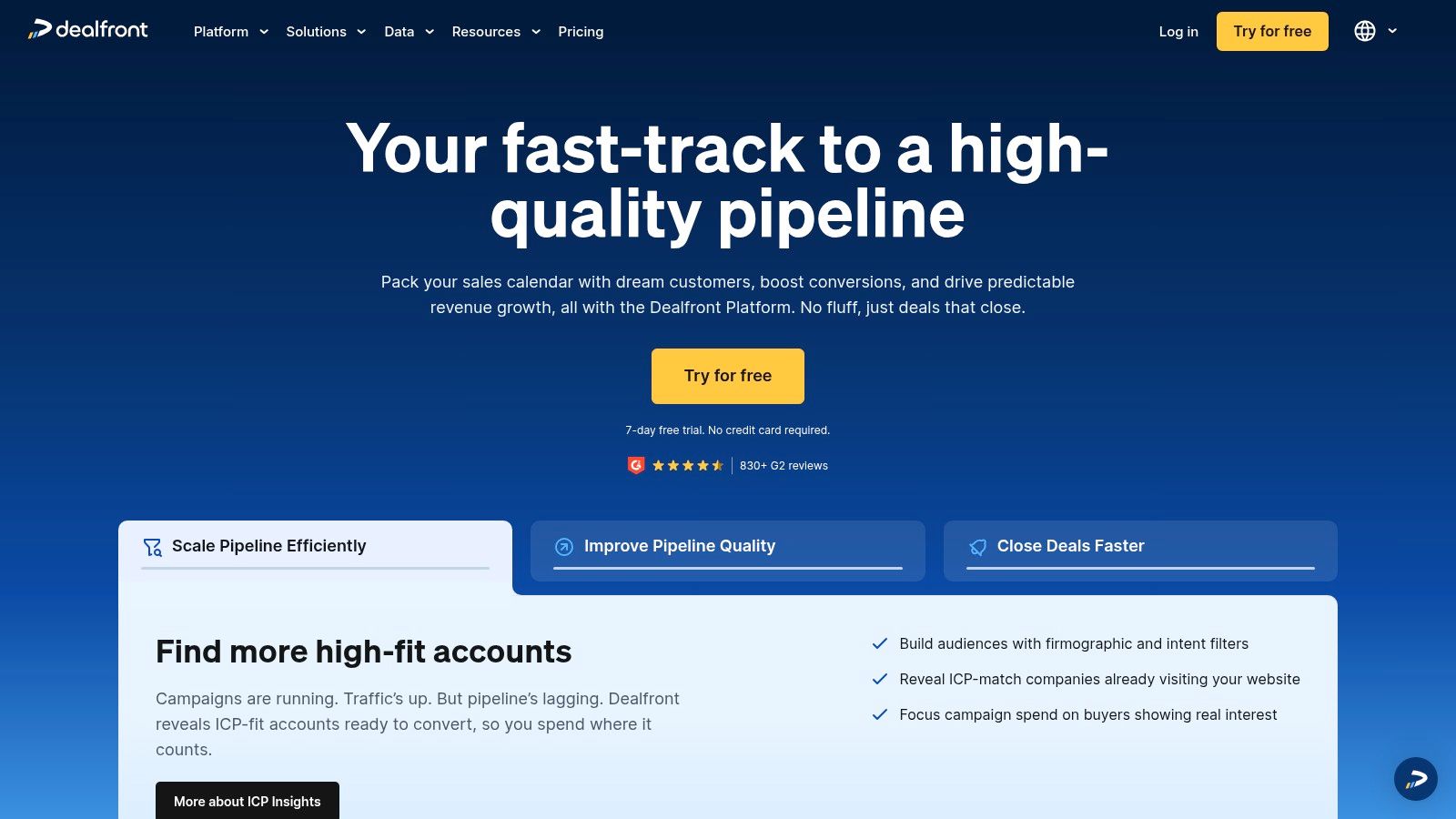
The platform is designed for simplicity and speed, making it one of the more accessible B2B lead generation tools for capturing warm interest. It integrates with Google Analytics to add behavioral context and includes features to suggest potential contacts within the identified companies. Its strength lies in turning passive web traffic into a source of qualified, high-intent leads that can be routed directly to SDRs for timely and relevant outreach.
Key Features & Benefits
- Website Visitor Identification: Reveal the company names of anonymous visitors, along with data on the pages they viewed and their time on site.
- Intelligent Lead Filtering: Automatically filter out ISPs, bots, and low-quality traffic to focus sales efforts on genuine business prospects.
- CRM & Workflow Integration: Send identified company leads directly to your CRM (like Salesforce or HubSpot) and trigger automated sales or marketing workflows.
- Unlimited Users & Clear Pricing: Paid plans include unlimited users, making it a cost-effective solution for growing teams, with pricing based on the number of unique companies identified.
Limitations & Considerations
The primary limitation is that Dealfront identifies companies, not the specific individuals visiting your site. Pinpointing the exact visitor requires additional prospecting or waiting for them to self-identify via a form. Furthermore, its ability to identify visitors is constrained by privacy laws and the technical limitations of IP lookups, meaning not all traffic can be successfully de-anonymized. It's an excellent tool for top-of-funnel awareness but relies on other processes to connect with the right person.
Best For: Marketing and sales teams in SMBs and mid-market companies that want to capitalize on inbound website traffic and create a predictable flow of warm, company-level leads for their SDRs.
12. RocketReach
RocketReach serves as a popular and accessible contact discovery tool, designed for individuals and teams that need a quick, self-serve method for finding professional and personal emails. Its core function is a massive database of contacts and companies, which users can search directly on the platform or through its widely-used Chrome extension. This makes it a go-to for rapidly finding a specific person's contact details while browsing LinkedIn or a company website.
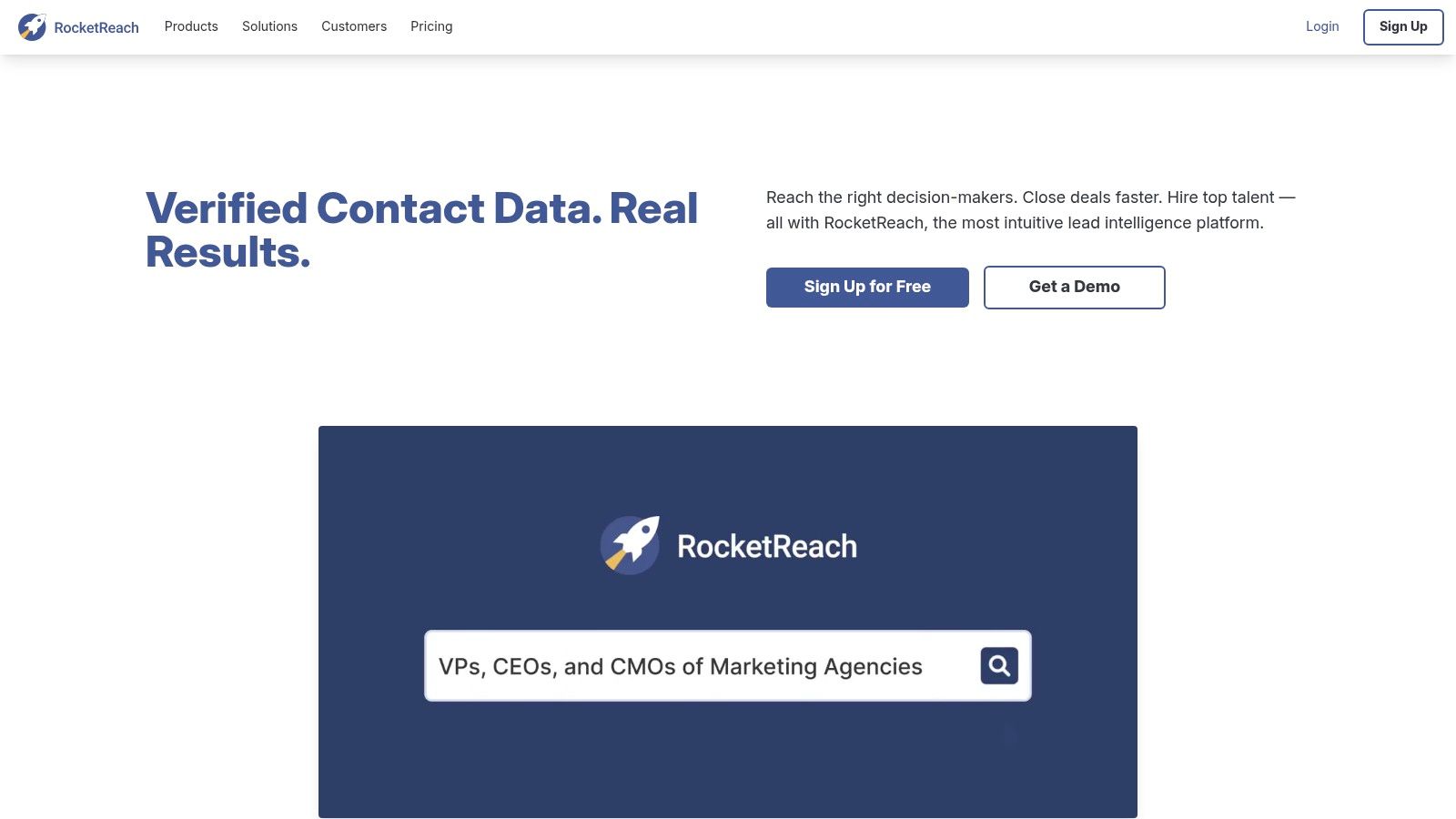
Unlike all-in-one GTM platforms, RocketReach focuses primarily on the discovery aspect of lead generation. It is particularly effective for one-off lookups and building smaller, targeted lists without the significant financial commitment required by enterprise-level data providers. Higher-tier plans expand its utility with bulk lookups, API access for automation, and integrations with common CRMs like Salesforce, allowing teams to operationalize their data gathering.
Key Features & Benefits
- Person & Company Search: Find professional/personal emails and direct-dial phone numbers from an extensive directory.
- Browser Extension: Instantly find contact information for profiles you view on LinkedIn and other professional sites.
- Bulk Lookups & API: Automate data retrieval for large lists of prospects, enriching records at scale (available on higher tiers).
- CRM Integrations: Sync contact data directly into your CRM to streamline sales workflows on team-oriented plans.
Limitations & Considerations
The platform's accessibility comes with some trade-offs. The quality and availability of direct-dial mobile numbers can be inconsistent compared to premium providers. Pricing tiers can be confusing, with lookup allowances and feature access varying significantly between plans. Critical features for sales teams, such as the API and key integrations, are typically locked behind more expensive subscription levels, which can limit its scalability for growing teams.
Best For: Individuals, freelancers, and small sales teams needing a fast, low-cost tool for email discovery and ad-hoc contact lookups, particularly via its browser extension.
Top 12 B2B Lead Generation Tools — Feature Comparison
From Fragmented Tools to a Unified Revenue Engine with Willbe
Choosing from a list of the best B2B lead generation tools isn't about finding the one with the most features. It's about finding the platform that eliminates friction and builds a predictable path to revenue. As we've explored, the market is filled with powerful point solutions: ZoomInfo and Apollo.io offer immense contact databases, 6sense and Bombora provide critical intent signals, and LinkedIn Sales Navigator remains the go-to for social prospecting. Each of these tools solves a specific, important problem.
However, stitching them together often recreates the very inefficiency you're trying to solve. SDRs spend their days jumping between tabs, exporting CSVs, and manually cleaning data instead of engaging prospects. RevOps teams fight a constant battle with broken integrations and siloed analytics, making it nearly impossible to see which activities actually drive pipeline. This fragmented workflow is the silent killer of productivity and predictability in modern sales organizations. The core challenge is not a lack of tools, but a lack of a unified system.
The Shift from Point Solutions to a GTM Platform
The true measure of a lead generation stack isn't just its ability to find contacts or identify intent. It’s about how quickly and effectively your team can turn those signals into qualified meetings. This requires a seamless flow from account discovery to multi-channel outreach and finally, to a clean handoff for AEs. When data, personalization, and execution are housed in separate systems, you create bottlenecks that cost time and burn through your total addressable market with generic outreach.
This is where a unified platform like Willbe becomes a strategic advantage over a collection of individual tools. Instead of buying a data provider, an enrichment tool, a sales engagement platform, and a separate AI writer, you get a single, cohesive system designed to orchestrate the entire top-of-funnel process. This consolidation is not just about cost savings; it's about reclaiming your team's most valuable asset: their time.
Making the Right Choice for Your Team
To select the right tool from this list, your evaluation must go beyond feature-for-feature comparisons. Consider your team's current workflow and identify the biggest points of friction.
- For high-growth teams and recently funded startups: Your priority is speed to pipeline. A fragmented stack will slow you down. A unified platform like Willbe is built to help you scale a repeatable GTM engine quickly, without needing a large RevOps team to manage integrations.
- For established sales teams: If your SDRs are bogged down in manual research and list building, your problem isn't data access, it's operational efficiency. Look for a solution that automates the non-selling tasks and uses AI to help reps personalize outreach, so they can focus on conversations.
- For RevOps and Sales Leaders: Your focus is on predictability and clean data. A collection of point solutions creates messy data and obscures performance insights. A central platform provides a single source of truth, making it easier to track what’s working, forecast accurately, and ensure your CRM remains pristine.
Ultimately, the goal is to build a revenue engine, not just a tech stack. While tools like Cognism, Lusha, and Dealfront are excellent for specific functions, the future of efficient B2B lead generation lies in platforms that connect the dots. Willbe is designed to be that central nervous system, bringing together world-class data, a proprietary AI orchestrator for genuinely human-sounding outreach, and real-time analytics. It replaces the manual tasks and tool-juggling that kill productivity, giving your team a faster, more direct path from prospect to pipeline.
Ready to stop buying point solutions and start building a scalable, efficient prospecting machine? See how Willbe unifies data, AI, and outreach to help your team generate more qualified pipeline without increasing headcount. Book a demo to see it in action.