


Every sales team knows the feeling: countless hours poured into outreach, only for reply rates to flatline. Meetings get booked with prospects who were never going to buy. The pipeline feels like a lottery.
This isn't a problem with your team's effort; it's a problem with their aim. An Ideal Customer Profile (ICP) is more than marketing jargon—it's a tactical blueprint that defines the perfect-fit company for your solution, built on data, not guesswork.
Stop Wasting Time on Unqualified Leads
In B2B sales, activity without precision is a fast track to burnout. SDRs and AEs can spend entire quarters chasing accounts that will never close. They aren't lazy; they're just focused on the wrong targets. This is where a well-defined Ideal Customer Profile shifts from a nice-to-have concept to a mission-critical tool for your go-to-market strategy.

Think of an ICP as the GPS for your entire sales engine. It points every SDR, AE, and sales leader toward the accounts most likely to not only buy but also to become your most successful, high-LTV customers. That focus is the bedrock of a scalable outbound motion built for how teams operate today.
The Cost of Poor Targeting
Without a sharp ICP, sales teams inevitably hit the same walls:
- Low Reply Rates: Outreach feels generic because it’s not speaking to a specific audience’s pains. SDRs spend hours crafting messages that land with a thud.
- Unpredictable Pipeline: Forecasting becomes a guessing game when you can't spot the common DNA of deals that actually close, leaving leaders unable to plan with confidence.
- Wasted Resources: Marketing spend and sales effort are spread thin across a wide, unfocused market, burning through budget and headcount with little to show for it.
This guide is a no-fluff playbook for building and using an ICP to generate qualified pipeline and drive predictable revenue. We're moving from a "spray and pray" mindset to surgical precision.
By defining exactly who your best customers are—based on firmographics, technographics, and buying signals—you empower your team to stop chasing dead ends. This is the first step in learning how to qualify sales leads effectively and building a repeatable revenue machine.
What Is an Ideal Customer Profile in B2B Sales?
If your sales team spends its days chasing every lead that looks remotely interested, they’re wasting time and energy. The goal isn't to sell to anyone; it's to sell to the right ones. That's where your Ideal Customer Profile, or ICP, comes in.
An ICP is a detailed blueprint of your perfect customer—the type of company that gets maximum value from your product, sticks around long-term, and expands their account. It's the strategic GPS for your entire go-to-market team, pointing them directly toward high-value accounts and away from the resource-draining detours.
A modern ICP goes beyond basic company size and industry. It’s a rich, data-driven profile that helps you pinpoint companies with the highest potential lifetime value, a low cost of acquisition, and the smallest risk of churn. It forces you to focus your firepower where it will make the biggest impact on revenue.

Core Components of a High-Impact ICP
So, what goes into building an ICP that actually moves the needle? You have to dig deeper than surface-level details. An effective profile is built from several layers of data that, when combined, create a clear picture of who to target, why they’re a fit, and when to reach out.
The table below breaks down the essential data categories for an actionable B2B sales ICP.
Each of these categories adds a critical layer of context, turning a vague target market into a set of clearly defined opportunities.
From Theory to Revenue Impact
This is where the rubber meets the road. Building a profile with these attributes separates top-performing sales teams from the pack. A well-constructed ICP isn’t just about who buys; it's about who drives real, sustainable profit.
Consider this: while your biggest logo might churn at 15%, your ideal customer segments can achieve renewal rates as high as 92%. That’s the difference between a leaky bucket and a foundation for growth. Teams that layer firmographics, technographics, and intent signals see huge productivity gains and shorter sales cycles because they've stopped guessing. You can discover more insights about these living data models and why they’ve become so critical.
Ultimately, a sharp ICP is the bedrock of predictable revenue. It gives sales leaders the clarity to build smart territories, empowers SDRs to write outreach that resonates, and helps RevOps measure what's truly working. It's the strategic compass you need to scale outbound without just throwing more money and people at the problem.
Why Your Sales Team Needs an ICP Right Now
Knowing what an Ideal Customer Profile is one thing. Understanding why it's the non-negotiable weapon for top-performing sales teams is what separates the average from the elite.
Trying to run a sales team without a sharp ICP is like flying blind. You’re busy, sure, but you have no idea if you're headed toward revenue or a dead end. You're burning fuel without a destination.
A well-defined ICP shifts your entire sales motion from guesswork to a predictable revenue machine. It’s the end of the "spray and pray" approach that torches lead lists and frustrates your reps. Instead, every bit of effort gets laser-focused on the accounts most likely to convert, stick around, and grow.
The Real-World Impact on Your Revenue Team
This isn't just theory. The benefits show up in tangible ways for everyone on the revenue team. A clear ICP is a force multiplier, making every role more efficient and successful.
For SDRs and BDRs: This is the key to higher reply rates. Knowing exactly who you're targeting allows you to stop sending generic templates and start crafting messages that hit on specific pain points. The result? More qualified meetings booked.
For Account Executives: This means higher-quality handoffs. AEs spend less time re-qualifying prospects and more time on strategic conversations that move deals forward, leading to shorter and more predictable sales cycles.
For Sales Leaders: This translates to accurate forecasting and smarter resource allocation. Once you can pinpoint the DNA of a winning account, you can build territories, set quotas, and deploy your team with confidence.
The Data-Backed Case for Precision
The proof is in the numbers. Teams that get serious about defining and using their ICP see massive performance gains. Research shows they can achieve up to 20% higher sales productivity and 15% shorter sales cycles.
Even more impressive? Companies that use customer behavioral data—a core part of any modern ICP—outperform their peers by a staggering 85% in sales growth. For a deeper dive, check out the full findings in this 2026 playbook on finding ideal customers.
Your ICP isn't just a document; it's the blueprint for a sustainable growth engine. It ensures every action your team takes is aimed at closing high-value, long-term business.
Ultimately, a rock-solid ICP is the foundation for all effective sales enablement best practices. It ensures every tool you buy, every piece of content you create, and every sales play you run serves one clear purpose: winning the customers that matter.
ICP vs. Buyer Persona: A Critical Distinction for Sales
Let's clear up one of the most common—and costly—points of confusion for sales teams: the difference between an Ideal Customer Profile (ICP) and a Buyer Persona.
People often use these terms interchangeably, but they are fundamentally different tools for different jobs. Mixing them up leads to muddled targeting and weak messaging. Getting it right is the key to a focused and effective sales strategy.
Here’s the simplest way to think about it:
Your Ideal Customer Profile (ICP) tells you which company to target. It's an account-level blueprint defining the perfect-fit organization based on firmographics, technographics, and other business-level signals.
Your Buyer Persona tells you which people to engage at that company. It’s a contact-level guide to the champions, budget holders, and end-users you need to win over.
The Strategic Difference in Your Workflow
Your ICP is about high-level strategy. It answers the question: "Where should we focus our sales efforts?" It's an account-level view that helps you build target lists and carve out territories, ensuring your team only spends time on companies with a high probability of becoming great customers.
Your Buyer Persona drives your on-the-ground tactics. It answers the practical question: "Who do I need to talk to, and what do they care about?" This person-level detail allows you to write emails and LinkedIn messages that resonate because they speak directly to the specific goals, challenges, and motivations of each individual in the buying committee.
In short: Your ICP gets you to the right account. Your personas help you win the deal. A sales team with only an ICP will find the right companies but struggle to connect. A team with only personas will have great conversations with people at all the wrong companies.
ICP vs. Buyer Persona At a Glance
Understanding this distinction is crucial for running a multi-threaded sales process where you're engaging multiple stakeholders. This table breaks down the core differences.
Ultimately, you need both. Use your ICP to build a targeted list of accounts, then use your personas to tailor your outreach to the right people within those accounts. That is how you create a predictable and scalable sales engine.
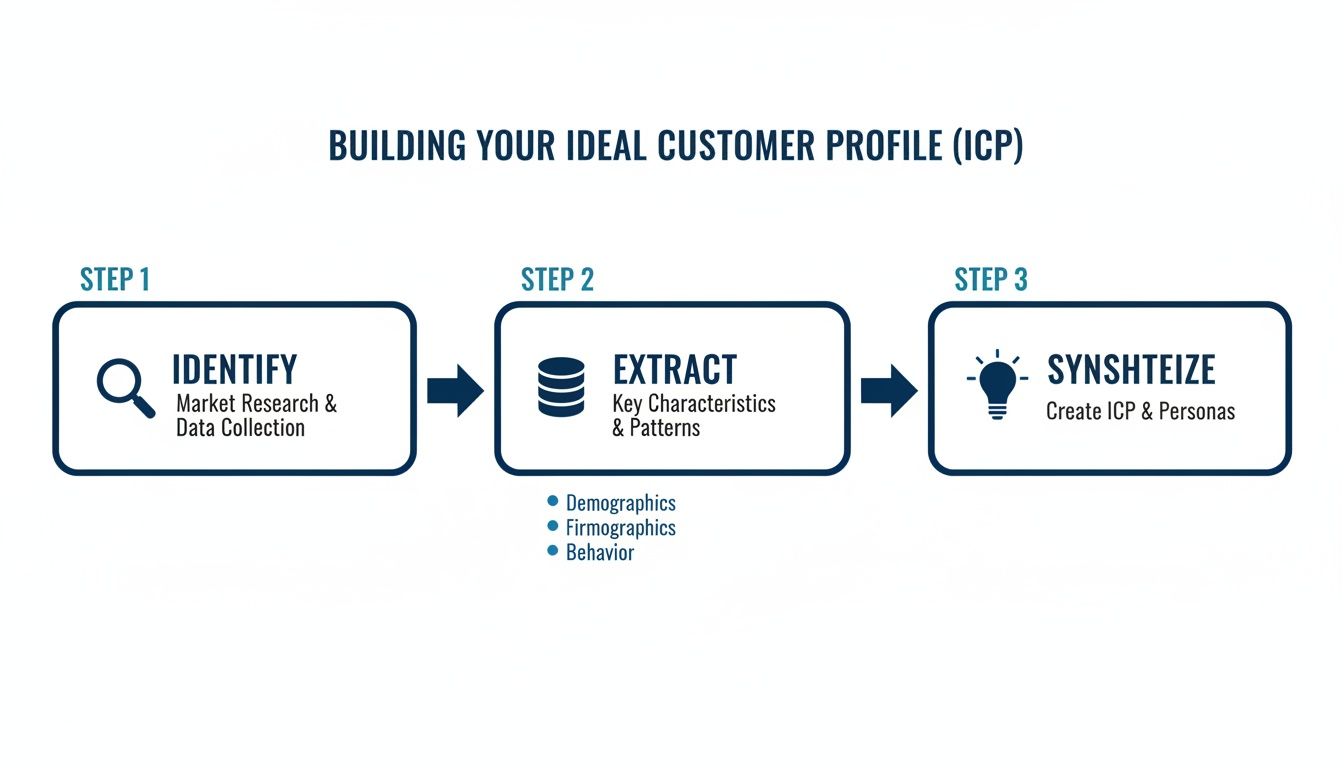
How to Build Your Data-Driven Ideal Customer Profile
Guesswork is a terrible sales strategy. Yet, that's what many teams do when they build an ICP based on gut feelings. The best ICPs aren't dreamed up in a boardroom—they're discovered by digging into your own data.
The process is about reverse-engineering your success. Instead of guessing who you should sell to, you’re going to find out who’s already winning with your product and build a blueprint to find more of them. The goal is to replace assumptions with a strategy grounded in what’s already proven to be profitable.
1. Identify Your Best Accounts
First, define who your "best" customers actually are. It's not always the one with the biggest logo. True value lies in accounts that are profitable, efficient to close, and loyal.
Pull a list of all your customers from the past 12 to 24 months. Now, score them based on a mix of these key metrics:
- High Lifetime Value (LTV): Which accounts have spent the most with you over time?
- Short Sales Cycles: Who moved from initial conversation to a signed deal quickly?
- High Expansion Revenue: Which customers are constantly adding seats, upgrading plans, or buying new products?
- Low Churn Rate: Who sticks around year after year?
- High Product Adoption: Which accounts are genuinely using your product to its fullest and getting great results?
The top 10-20% of customers who score high across these areas are your golden cohort. This is the group you want to clone.
2. Extract Quantitative and Qualitative Data
With your golden cohort identified, it's time to play detective. Gather both the hard numbers and the human stories to understand the complete picture.
Start by pulling quantitative data from your CRM. Look for common threads in their:
- Firmographics: Industry, employee count, annual revenue, and location.
- Technographics: What other tools are in their tech stack? Do they use a specific CRM or marketing automation platform? Our guide on the best data enrichment tools shows how to find this out fast.
Next, add the human element with qualitative insights. Talk to the AEs who closed these deals and the CSMs who work with them daily. Ask them:
- "What was the one problem they had to solve that led them to us?"
- "Who was our champion inside the company? What was their title?"
- "What makes them so much more successful with our product than other customers?"
This blend of data and real-world stories is incredibly effective. For instance, in today's sales environment, brands with mature personalization strategies see 71% higher customer loyalty. You can find more on building a powerful ICP and see how this dual-data approach makes all the difference.
3. Synthesize and Define Your V1 ICP
Now, bring everything together. Look for the combinations of traits that appear repeatedly in your best accounts. You aren't looking for a single data point, but a cluster of attributes that signals a perfect match.
Your goal is to create a simple, clear definition that anyone on your team can understand and act on. For example, your research might reveal your ICP is: "B2B SaaS companies in North America with 50-500 employees, using HubSpot, that have received Series A or B funding in the last 12 months."
This specific statement is your V1 ICP. It’s not permanent, but it gives your sales team a crystal-clear, data-backed target. Now you know that companies fitting this profile close 30% faster and have a higher win rate, letting you focus your entire sales effort on finding more of them.
Turn Your ICP into Predictable Pipeline with Willbe
A well-defined Ideal Customer Profile is a powerful blueprint, but it’s useless if it just sits in a slide deck. The real value is unlocked when you turn that blueprint into a living sales engine. This is where an all-in-one prospecting platform like Willbe closes the gap between theory and revenue.
Your SDRs shouldn't be spending hours stitching together lists from a half-dozen different tools. Willbe replaces that manual workflow by letting you translate your ICP directly into a list of high-potential accounts in minutes. Its filters let you carve out your specific slice of the B2B market with precision.
From Static Profile to Dynamic Targeting
Let's get practical. Imagine your ICP is “Mid-market tech companies with 100-500 employees, using Salesforce, and actively hiring for sales roles.”
Instead of a manual goose chase, you can plug those exact criteria into Willbe and get a clean, targeted list of accounts that fit perfectly. But it goes deeper than just firmographics. You can layer on technographics (the Salesforce example) and real-time buying signals (hiring trends) to get incredibly specific.
This is what it looks like to put your ICP to work, moving from raw data to a real list of targets.
The process shown here—identifying market signals, pulling target accounts, and preparing for outreach—is how you take an ICP from a concept to a daily workflow. It’s how you start building a predictable pipeline at scale, without burning lists or increasing headcount.
Bridge the Gap with AI-Powered Personalization
Once you have your list of target accounts, the next hurdle is breaking through the noise. How do you reach the right people with a message that gets a reply? This is where most outreach fails—it’s generic and easy to ignore.
Willbe tackles this problem with proprietary AI built for B2B sales teams.
First, it finds the verified contact information for key decision-makers at your target accounts. Then, its AI writes hyper-personalized messages for both email and LinkedIn that sound like they came from your best SDR, not a robot.
The AI scans a prospect’s profile and their company’s latest activities to generate outreach that feels genuine and is 100% template-free. This is the key to personalization at scale—you get higher reply rates across multiple channels and languages without burning out your team.
By bringing data, targeting, and outreach into one unified platform, Willbe transforms your ICP from a static document into a pipeline-generating machine. Your team can find the best-fit accounts, engage the right people, and close more deals—all without juggling a mess of disconnected tools.
Your Ideal Customer Profile FAQ
Once your team starts using a data-driven ICP, a few practical questions almost always come up. Here are the straight answers to the ones we see sales and RevOps leaders grapple with the most.
How often should I update my ICP?
Your ICP isn't a "set it and forget it" project. Think of it as a living guide. Markets change, new competitors emerge, and your own product evolves. A good rule of thumb is to give it a formal review at least quarterly.
But don't just wait for the calendar. You should also trigger an update after any major business shift, like a product launch, a move into a new industry, or a sudden spike in churn. These are all signals that the market—or your place in it—has changed, and your targeting needs to adapt.
Can a company have more than one ICP?
Absolutely. In fact, most B2B companies with different products or those who sell to different business types should have more than one. You might have one ICP for mid-market tech startups and a separate one for enterprise financial firms.
The key is to ensure each ICP is distinct and gives your team a clear direction. If you try to mash two different customer types into one generic profile, you water it down, and your team ends up with mixed signals. The whole point of an ICP is focus.
Don’t fall into the trap of creating a single, generic ICP to cover multiple distinct customer types. Precision is the goal; if your segments are truly different, give them their own dedicated ICP to guide targeting and messaging.
What are the biggest mistakes to avoid?
Building a solid ICP is as much about dodging common landmines as it is about following the playbook. Watch out for these three classic blunders:
- Relying on assumptions. The most powerful ICPs come from the cold, hard data in your CRM and analytics tools, not from who you think your best customers are. Let your past wins and losses tell the real story.
- Ignoring "bad-fit" data. Your worst customers are often more instructive than your best ones. Dig into the deals you lost and the customers who churned quickly. This is where you'll find the red flags to screen for in the future.
- Making it too broad. An ICP that describes half the businesses in the country isn't an ICP—it's just a demographic. The whole point is to narrow your focus. If your definition could apply to almost anyone, you need to get more specific.
A well-defined ICP is the blueprint for a predictable revenue engine, but it’s only useful if you can act on it. Willbe is the all-in-one B2B prospecting platform designed to close the gap between your ideal profile and a real, actionable list of accounts. Filter the entire B2B market by your exact ICP criteria, find verified contacts, and use our proprietary, template-free AI to write personalized outreach that gets replies.