


Prospecting on LinkedIn isn't about spamming connection requests. It's a precise process for finding the right B2B accounts, connecting with decision-makers, and building a predictable pipeline that drives revenue.
Unlike outdated cold outreach, a modern LinkedIn strategy is built on high-precision targeting and personalized engagement. The objective is to generate qualified meetings at scale without burning lists or damaging your brand. When executed correctly, LinkedIn becomes your highest-ROI channel for converting high-value opportunities.
Why LinkedIn Is Your Highest ROI Prospecting Channel
Let's be direct—traditional cold outreach is broken. Every inbox is a battleground, and generic, mass-blast campaigns no longer move the needle. For any B2B revenue team, this isn't a surprise; it's the daily reality that sales leaders and RevOps teams are trying to solve. Low reply rates and a stream of low-quality leads don't just hurt morale—they destroy pipeline predictability and inflate customer acquisition costs.
This is why a sharp, well-executed strategy for prospecting on LinkedIn is non-negotiable. It's not just another channel to check off a list. It’s the definitive platform for engaging high-value accounts where they are already active and open to professional conversations. The entire environment is built for B2B engagement, making it easier to establish credibility and start real dialogues that convert into demos.
Shifting From Volume To Value
The power of LinkedIn lies in its ability to shift your team's focus from sheer quantity to strategic quality. Success isn't measured by how many connection requests an SDR can send. It’s measured by the percentage of those connections that convert into qualified meetings. It’s about leveraging rich data to understand a prospect’s world before you send a single message.
This strategic pivot away from the "spray and pray" model solves several critical problems that sales teams constantly face:
- Lead Quality: You gain access to detailed professional data, allowing for hyper-specific targeting based on job titles, seniority, recent company news, and even content engagement. The result? AEs receive handoffs that are a perfect fit for your solution.
- Conversion Rates: Personalization is far more effective with context. Referencing a shared connection, a recent funding announcement, or a prospect’s recent post dramatically boosts reply rates compared to a sterile cold email.
- Predictable Pipeline: A repeatable, high-performing LinkedIn playbook removes the guesswork from outbound. Sales leaders can finally get clear visibility into which messages and personas drive results, making forecasting far more accurate.
LinkedIn has become the undisputed platform for B2B lead generation, responsible for 75-85% of all B2B leads from social media. But what's more important is the quality. LinkedIn's visitor-to-lead conversion rate is 2.74%, over three times higher than other major platforms. For a deeper dive, see the data at Martal.ca.
LinkedIn vs. Traditional Outreach: A Quick Comparison
When you compare LinkedIn to traditional methods, the advantages are clear. It's not just about getting more replies; it's about the quality of the entire sales interaction.
Ultimately, a well-orchestrated LinkedIn prospecting engine delivers higher-quality leads and a more reliable pipeline because it’s built on relevance and genuine connection.
Mastering LinkedIn isn't about a new hack; it's about engineering a scalable GTM engine. By focusing on precision, personalization, and smart orchestration, your team can generate more pipeline without increasing headcount or exhausting your total addressable market. This playbook shows you how to build that engine.
Nailing Your ICP for Laser-Focused Targeting

Let's be blunt: effective prospecting on LinkedIn is a precision game, not a numbers game. A vague ICP is a direct path to burning leads, getting ignored, and wondering why your pipeline is empty. This is where most outbound strategies fail—right at the start.
To build a predictable revenue engine, you need an Ideal Customer Profile (ICP) that goes beyond basic firmographics like industry and company size. That's just table stakes. High-precision targeting comes from layering in dynamic buying signals that indicate an urgent need for a solution now.
Go Beyond the Basic Filters
Every SDR knows how to filter by employee count and geography in Sales Navigator. That's the minimum. The problem? Your competitors are doing the exact same thing, flooding the same inboxes. To stand out, your ICP must be built on data that reveals intent, pain, and timing.
This means shifting from static attributes to dynamic, event-based triggers. A company in your target industry is just a name on a list. But a company in your target industry that also just hired a new VP of Sales and is actively hiring SDRs? That’s a high-value opportunity.
Think of your ICP less as a static document and more as a dynamic targeting model that reacts to market events. The goal is to focus 100% of your team's energy on accounts that have a compelling reason to engage with you right now.
Hunt for High-Intent Buying Signals
What do these game-changing signals look like? They are real-world events that show a company is ready for change or struggling with a problem you solve. Integrating these into your prospecting workflow is what separates top-performing teams from the rest. This approach is central to effective account-based marketing, which thrives on this kind of intelligence.
Here are the signals the best B2B teams track:
- Tech Stack Data: Are they using a competitor's tool? Do they have technology that integrates with your solution? Knowing their tech stack allows you to craft a hyper-relevant, irresistible pitch.
- Recent Funding Rounds: A fresh funding round is a major buying signal. It means new budgets are approved, growth targets are aggressive, and they are mandated to invest in tools that drive efficiency.
- Key Hiring Trends: A company suddenly hiring a dozen Sales Development Representatives is a huge tell. It signals a major GTM push. If you sell sales software, that's your cue to find the new Head of Sales, fast.
- Company News & Events: Are they expanding to a new region? Did they just launch a major product? These moves create new challenges and priorities—challenges your solution is perfectly positioned to solve.
Using Boolean Search for Surgical Precision
Once you have defined this multi-layered ICP, LinkedIn Sales Navigator's Boolean search becomes your most powerful tool. It allows you to combine and exclude keywords to build incredibly specific prospect lists that standard filters can't create.
Instead of a generic search for "VP of Sales," you can build a query to find the exact persona you need.
Example Boolean Search String:
("VP of Sales" OR "Sales Director" OR "Head of Sales") AND ("SaaS" OR "Software") AND ("Series B" OR "Series C") NOT ("Director of Sales Operations")
This query doesn't just find senior sales leaders. It finds them in Series B or C SaaS companies while intentionally excluding operations roles that aren't your decision-makers. This level of focus ensures every prospect is a potential perfect fit, drastically improving the impact of every personalized message your team sends.
Platforms like Willbe are built to automate this entire process, using aggregated data to build high-precision segments for you and saving your team countless hours of manual research.
Turning Your Profile into a Prospecting Magnet
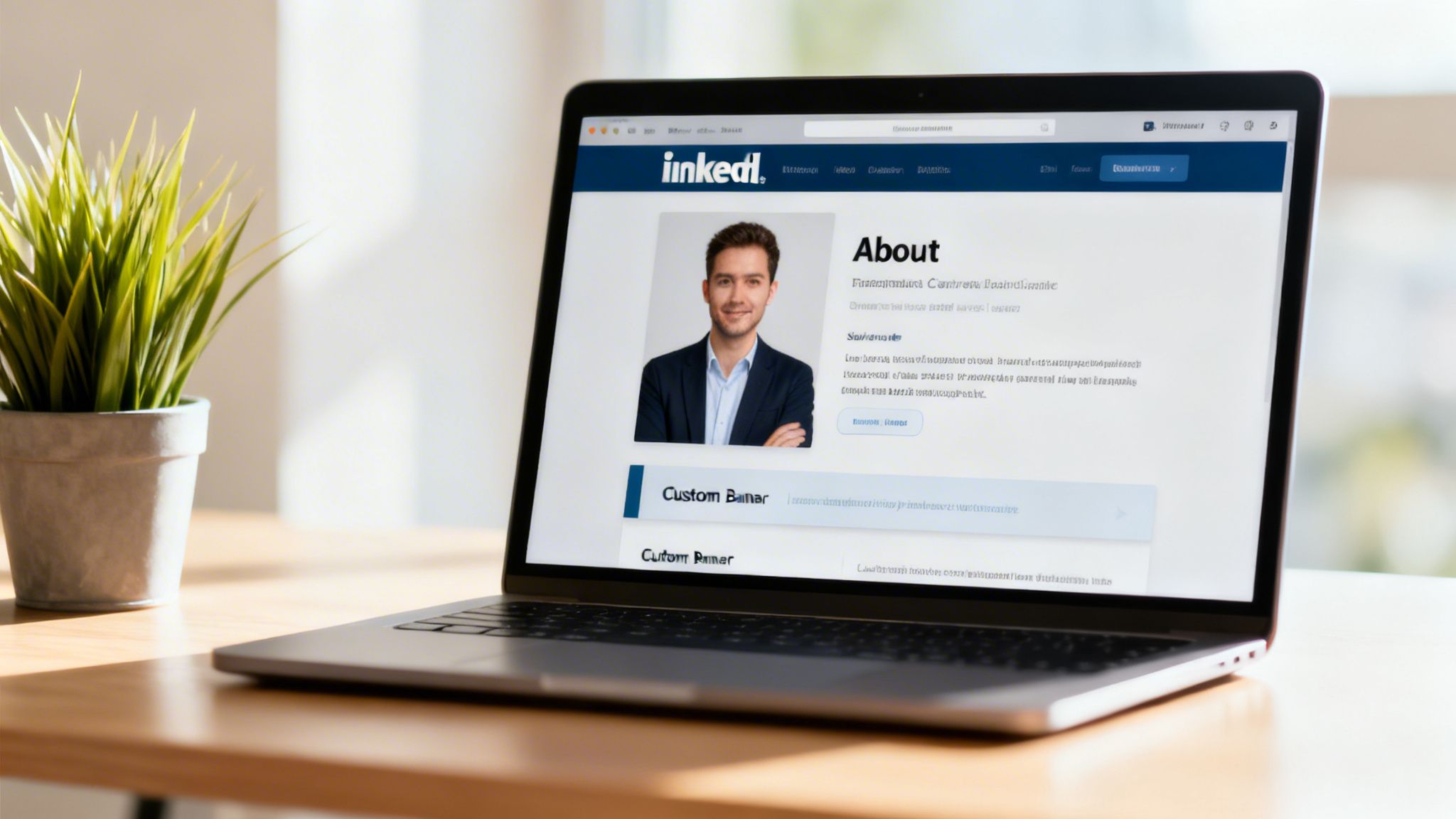
Before you send a single connection request, understand this: your LinkedIn profile is not your resume. It's a landing page. Its sole purpose is to convert a prospect's curiosity into a warm conversation.
Every time an SDR or AE sends a message, they drive traffic back to their own profile. If that profile fails to instantly build credibility and connect with your ICP, you're losing potential meetings before you even get a reply.
A weak profile is a major bottleneck in any prospecting on LinkedIn strategy. It’s like arriving at a sales pitch unprepared. Prospects will review your profile before accepting a request, and that first impression either opens the door or closes it. You want them to think, "This person understands my world."
Your Headline Is Your Elevator Pitch
Your headline is the most valuable real estate on your profile. Yet most sales reps waste it with a generic job title like "Account Executive at [Company Name]." That tells a prospect nothing about how you can help them. It's a missed opportunity to frame your value from their perspective.
Turn your headline into a sharp, outcome-focused pitch. It must answer the prospect's unspoken question: "What's in it for me?" A great headline speaks directly to their pains or aspirations.
Here’s the transformation:
Before: Sales Development Representative | Tech Solutions Inc.
After: Helping RevOps Leaders Automate Data Hygiene & Eliminate Manual CRM Updates
Before: Account Executive at Willbe
After: I Help Sales Teams Build Predictable Pipeline with AI-Powered Prospecting
The difference is clear. This simple change shifts the focus from who you are to the value you deliver. It immediately positions you as a problem-solver, not just another salesperson.
Your profile isn't a history of what you've done; it's a statement of what you can do for your next customer. Every word should be engineered to build trust and spark curiosity, turning your profile into an inbound lead magnet.
The About Section Is Your Sales Letter
If your headline is the hook, the "About" section is your mini sales letter. This is where you expand on the promise made in your headline. Do not use this space to list job duties or talk about hitting quota. Your prospect doesn't care.
A simple problem-solution framework is highly effective here. Start by describing the common challenges your ideal customers face. Show them you understand their reality. Then, briefly explain how you help companies like theirs solve those exact problems.
Keep it scannable. Use short paragraphs and bullet points to highlight key outcomes. The goal is to make it easy for a busy VP to understand your value in 30 seconds. I always recommend ending with a soft call to action, like an invitation to connect or a link to a helpful resource. This makes your profile a proactive sales tool, not a passive document.
The Non-Negotiable Credibility Builders
Finally, a few visual details are non-negotiable for building trust. Without these, even the best copy will fall flat.
- A Professional Headshot: This seems obvious, but it's often overlooked. No cropped vacation photos or blurry selfies. Invest in a clean, professional headshot where you look confident and approachable. It's the first thing people see.
- A Custom Banner Image: The default blue LinkedIn banner is a missed opportunity. Create a custom banner that reinforces your value proposition, showcases your company’s brand, or features a powerful customer testimonial. It makes your profile look polished and intentional.
- Strategic Content & Activity: Your activity feed provides social proof. Are you sharing content relevant to your industry? Are you leaving thoughtful comments on others' posts? An active profile shows you are a knowledgeable and engaged member of your professional community.
Crafting Messages That Actually Get Replies
Let’s be honest: most LinkedIn inboxes are a graveyard of terrible sales pitches. Prospects have been conditioned to ignore almost everything due to an endless stream of generic connection requests and self-serving "buy my product" messages.
If you want to succeed at prospecting on LinkedIn, you must reject the high-volume, low-quality model. It’s a race to the bottom.
The goal isn't sending more messages; it's sending better messages—messages that sound human. Every generic, robotic message you send damages your brand's reputation. It burns your market and makes it harder for the next salesperson to get a reply.
The alternative is a quality-first approach that prioritizes relevance over raw volume. When you get this right, you don't just see more replies; you start better conversations with people who are actually interested in what you have to say.
Avoiding the "Volume Tax"
The data is clear: the "more is better" approach to LinkedIn outreach no longer works. It's counterproductive. There is a real penalty for spamming prospects, which we call the "Volume Tax."
Consider this: research shows that sales reps sending fewer than 25 connection requests per week are nearly twice as likely to achieve acceptance rates of 40% or higher compared to those sending more. It’s a classic case of less is more.
And while you might see a 10-15% reply rate on a good day for direct messages, a truly well-crafted LinkedIn message can achieve a 48% reply rate. For comparison, a typical cold email gets a measly 6%. The potential is massive if you're thoughtful. You can explore more of these LinkedIn prospecting industry benchmarks to see how your efforts stack up.
The best reps treat every message as if it's the only one they'll send that day. This mindset forces you to find a genuine reason to connect, which is the secret to getting a reply.
Finding Personalization Triggers That Actually Work
Real personalization is more than just a {FirstName} tag in a template. It's about showing you've done your homework and have a legitimate reason for being in their inbox. People are far more likely to respond when they feel understood, not just like another name on a list. Many of the principles from our guide on cold email best practices apply here as well.
Your mission is to find a specific, relevant "hook" or trigger that makes your message impossible to ignore.
Here are a few high-impact triggers that work consistently:
- Recent Content Engagement: "Saw your comment on [Influencer]'s post about sales forecasting. Your point on integrating leading indicators was spot on—it's exactly how we think about building a predictable pipeline."
- Company News or Milestones: "Huge congrats on the funding round announced on TechCrunch. I know scaling the sales team is a top priority after a raise, and I had a few ideas on how other teams are tackling that."
- Shared Connections or Groups: "Hi [Name], I noticed we're both in the RevOps Co-op community. I'm reaching out because I see you're leading RevOps at [Company], and we specialize in solving the exact data hygiene issues people discuss in the group."
- Recent Job Changes: "Congrats on the new role as VP of Sales at [Company]! I've seen that when leaders step into a new role, getting a clear view of the existing pipeline is one of the first big challenges. Is that on your radar?"
A Field-Tested Message Framework
A winning message has a simple, three-part structure. It respects the prospect’s time and focuses on their world, not yours.
1. The Opener (The Hook)
Lead with your personalization trigger. This immediately proves you've done your research and aren't sending an automated message.
Example: "Hi Sarah, I saw your post yesterday celebrating your team's expansion into the EMEA market—congratulations on the huge milestone."
2. The Bridge (Connect to a Problem)
Subtly connect your observation to a common business problem that someone in their role faces, especially after an event like the one you mentioned. This shows you understand their challenges.
Example: "Scaling internationally like that often brings new headaches around managing multi-currency deals and keeping CRM data clean across different regions."
3. The Soft Ask (A Low-Friction CTA)
End with a simple, interest-based question. Do not ask for a 15-minute demo right away. The only goal here is to start a conversation.
Example: "Is that something your team has started thinking about?"
This framework turns cold outreach into a warm, relevant conversation starter. It’s what platforms like Willbe were built to do—use proprietary, template-free AI to generate this kind of hyper-personalized outreach at scale. The goal is to sound like you, not a generic AI, so you can build real connections and book more meetings without sacrificing quality for speed.
Scaling Outreach with Smart Orchestration
You've mastered high-quality, personalized manual outreach. That's a huge win. But for ambitious sales leaders or RevOps teams, the next question is always the same: how do we scale this without tanking our results, hiring more SDRs, or getting our accounts restricted?
This is where you move from individual effort to intelligent systems. We aren't just talking about speed. The goal is to build a repeatable GTM engine that turns an unpredictable manual process into a predictable revenue machine. This means leaving risky, outdated bots behind and embracing smart orchestration.
The Difference Between Bots and Orchestration
For years, "LinkedIn automation" meant clumsy bots that blasted out generic connection requests. These tools were built on simple "if this, then that" logic, lacked any real intelligence, and became notorious for getting accounts restricted. They are a relic of the old volume-at-all-costs era.
Smart orchestration, in contrast, is about creating sophisticated, multi-step sequences that blend actions across different channels. It’s not about automating a single task; it’s about managing the entire prospecting journey for a lead.
True orchestration amplifies your best reps, not replaces them. It takes proven manual plays and scales them with precision and safety, ensuring every prospect receives a high-quality, relevant touchpoint, whether it's the first or the fifth.
An orchestration platform enables powerful workflows:
- Run multi-channel sequences: Imagine a sequence that starts with a LinkedIn profile view, follows with a personalized connection request, sends a targeted email two days later, and then likes a prospect's recent post—all without manual intervention.
- Maintain clean data: All activity is logged and synced directly to your CRM in real-time. This eliminates the manual data entry reps hate and provides RevOps with the clean, reliable data needed for accurate reporting.
- Ensure safety: Smart platforms understand LinkedIn's boundaries. They manage activity to protect your account's health by mimicking natural human behavior, not by blasting out requests like a machine.
This flow is all about a repeatable, personalized process.
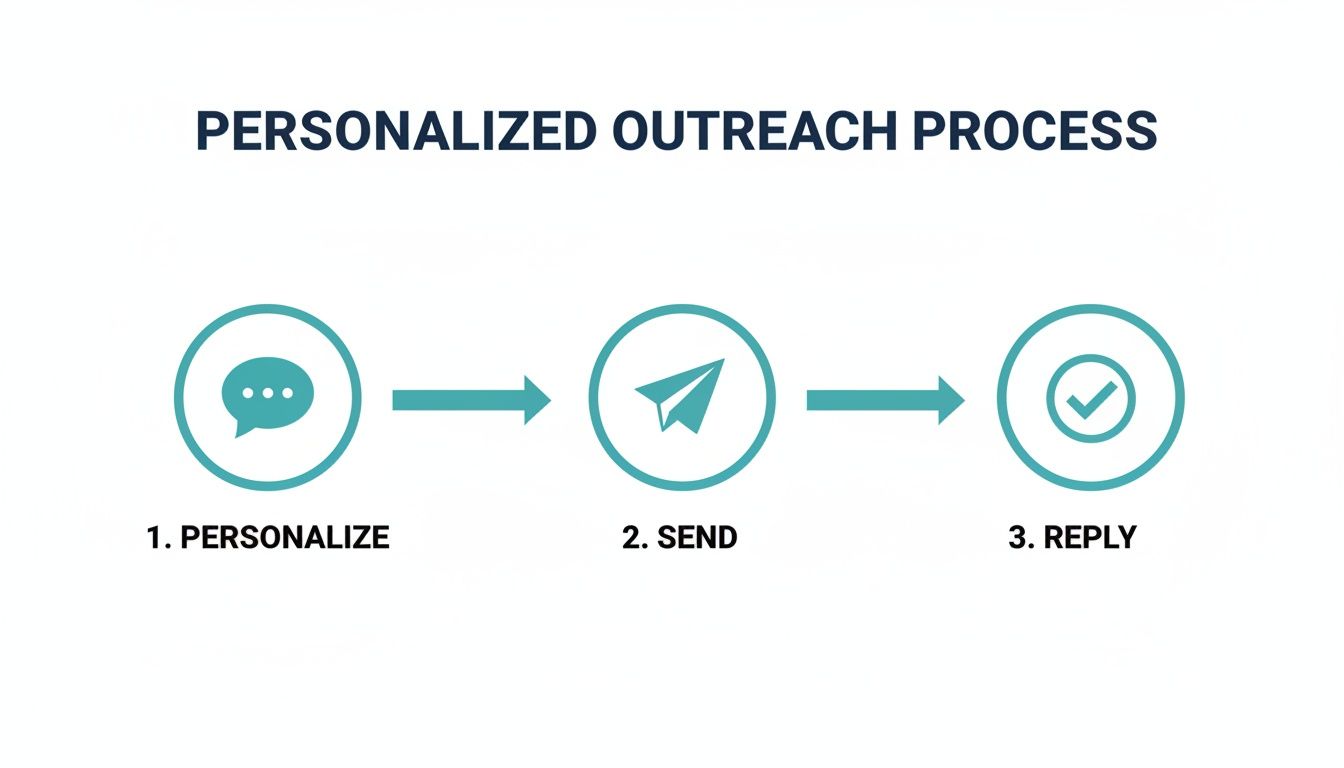
As you can see, successful scaling depends on a consistent loop of personalization, delivery, and engagement—something an intelligent platform can execute flawlessly.
Best Practices for Safe and Effective Scaling
Scaling your prospecting on LinkedIn requires a strategic mindset, not just a powerful tool. Launching a massive campaign without warming up your account is asking for trouble. The best teams treat their LinkedIn presence as a valuable asset and scale activity gradually and intelligently.
Here are the non-negotiables for scaling safely:
- Warm Up Your Account: Don't go from sending five connection requests a day to 50 overnight. Gradually ramp up daily activity over several weeks. A good platform will automate this warm-up process, mimicking natural human behavior to build trust with LinkedIn's algorithm.
- Set Realistic Daily Limits: Even after a warm-up, operate within reasonable boundaries. LinkedIn has official weekly limits, but smart platforms often recommend staying well below those to prioritize account health. It’s about quality engagement, not hitting a vanity number of invites.
- Mix in Email: The most effective outreach programs don't rely on LinkedIn alone. By weaving email into your sequences, you create more touchpoints without overloading a single channel. This multi-channel approach significantly boosts response rates. You can explore these sales cadence best practices to learn how to combine channels effectively.
Platforms like Willbe centralize this entire workflow. Instead of juggling fragmented tools for data, personalization, and multi-channel outreach, it provides a single source of truth for your GTM engine. The result is a system that lets your team run sophisticated, personalized campaigns at scale, turning prospecting from a chaotic art into a predictable science.
Tracking Performance to Optimize Your Strategy
Prospecting on LinkedIn without tracking performance is just guessing. You're investing time and effort, but you have no real idea if you're getting closer to your goals or just spinning your wheels. For any sales or RevOps leader, this lack of visibility is a major problem—it makes forecasting impossible.
To build a prospecting engine that scales, you must look past vanity metrics like profile views. You need to focus on the KPIs that predict and influence revenue. The right data shows you exactly what's working, what's not, and where to double down your efforts.
Key Metrics That Actually Matter
Forget the noise. The only way to prove the business impact of your LinkedIn prospecting is to track the entire funnel, from the first touchpoint to a closed deal.
Your performance dashboard should be focused on these core metrics:
- Connection Acceptance Rate: What percentage of your connection requests are accepted? If this number falls below 20-25%, it's a strong indicator that something is wrong with your targeting or your profile.
- Reply Rate to First Message: Of those who connect, how many reply to your first message? This is the most direct feedback on whether your opening message is effective.
- Positive Reply Rate: This is critical. You must distinguish genuine interest from polite "no, thank yous." This metric filters out the noise and shows how many conversations are actually moving forward.
- Connection-to-Meeting Rate: This is the metric that matters most to leadership. What percentage of new connections ultimately lead to a booked demo or discovery call? This KPI directly ties your daily LinkedIn activity to pipeline.
Piecing together performance data from five different tools is a RevOps nightmare. A unified platform that automatically syncs all LinkedIn activity into your CRM provides a single source of truth and finally closes the loop on what’s driving revenue.
Running A/B Tests to Iterate and Improve
Once you know your baseline metrics, the real optimization begins. The best sales teams constantly experiment, running small, structured tests to fine-tune their approach. This isn't random guessing; it's systematic experimentation.
Start A/B testing different elements of your outreach strategy:
- Messaging: Test different value propositions. Pit one pain point against another. See what happens when you change your call-to-action.
- Personas: Does your pitch resonate better with VPs of Sales or Directors of RevOps? Run two parallel campaigns and let the data reveal which persona is more receptive.
- Cadence: Experiment with the timing and frequency of your follow-ups. Does a quick, three-step sequence over five days outperform a longer, five-step sequence over two weeks?
Adopting this systematic approach is how you move from "I think this will work" to "I know this works." An analytics-driven platform like Willbe can surface these insights for you, showing exactly which messages and profiles are converting so you can replicate wins across the team.
Let's not forget the financial impact. The economic efficiency of LinkedIn is hard to dispute. The platform’s cost per lead is often 28% lower than Google AdWords, making it an incredibly effective channel for B2B growth. With 40% of B2B marketers citing LinkedIn as their number one source for high-quality leads, the numbers speak for themselves. You can dive deeper into these LinkedIn statistics and their impact on sales to see just how powerful this channel can be for generating qualified meetings.
Got Questions? We've Got Answers
Let's address some of the most common questions sales teams face when they get serious about prospecting on LinkedIn.
How Many Connection Requests Can I Safely Send Per Day?
There is no single magic number, and sending hundreds is the fastest way to get your account restricted. The smart approach is to warm up your account gradually.
If your account is new or has low activity, start small with 10-15 requests per day. Over several weeks, you can slowly increase that to a sustainable 25-40 per day. The key is to mimic natural human behavior. Quality engagement will always outperform hitting an arbitrary daily limit.
Is Sales Navigator Really Worth the Money?
For any serious B2B sales professional, yes, absolutely. It's not even a question. The free version of LinkedIn is too blunt an instrument for the precise targeting needed to build a predictable pipeline.
Sales Navigator unlocks powerful filters—like company headcount growth, tech stack details, and recent job changes. This is how you find companies with a timely need for your solution. Prospecting without it is like trying to find a needle in a haystack with a blindfold on.
What Are the Biggest Mistakes People Make with LinkedIn Prospecting?
Most failed LinkedIn strategies come down to a few classic mistakes. I see them constantly.
- The Robotic Request: Sending a generic, unpersonalized connection request. It screams "I'm automated" and is ignored 99% of the time.
- The Immediate Pitch-Slap: Connecting with someone and then immediately hitting them with a sales pitch in the first message. This destroys any chance of building rapport or starting a real conversation.
- The Neglected Profile: Forgetting that your own profile is a critical part of the process. Before anyone accepts your request or replies to a message, they will check you out. Your profile needs to be a compelling resource that builds credibility, not just a digital resume.
Ready to stop guessing and start building a predictable revenue engine on LinkedIn? See how Willbe uses smart orchestration and proprietary AI to find you better accounts, craft messages that get replies, and scale your pipeline.