


With recent privacy updates, it’s fair to ask: is open email tracking worth paying attention to anymore? The short answer is yes, but its role in your sales process has fundamentally changed. It's no longer the reliable green light it once was, but it's still a valuable signal for teams who know how to interpret it.
Is Open Email Tracking Still a Relevant Sales Metric?
Let’s be direct: if your team is still celebrating open rates as a core KPI, you're building your outbound strategy on shaky ground. Chasing opens means chasing ghosts, leading your reps to make decisions based on incomplete and often misleading data. It's a classic scenario: SDRs waste hours following up on phantom signals while truly interested accounts go cold.
But ignoring opens entirely is just as risky—it’s like flying blind when you could have some visibility. The key is to stop treating an open as proof of interest and start seeing it as a directional hint. For SDRs and AEs, an open isn't a declaration of intent; it's a subtle clue that an account is warming up or a subject line is resonating.
Redefining Opens for Modern Sales Teams
Instead of just asking, "Did they open my email?" your team should be asking, "What pattern does this cluster of opens suggest?" This shift in perspective moves you from counting vanity metrics to interpreting meaningful buying signals.
Think of it this way: a single, isolated open is noise. It could be an automated security scanner, a misclick, or a fleeting glance. It means very little on its own.
But what about a flurry of opens from three different people at your target account within a few hours of your email? That’s a signal. Even with a margin of error from privacy bots, that pattern indicates your message is getting forwarded internally. It’s the perfect trigger for a timely LinkedIn connection request or a strategic call, turning a weak signal into a real conversation.
The State of Email Engagement Today
Despite the noise around privacy, email isn't dead—it's more active than ever. Global benchmarks for 2026 point to an average email open rate of 55.4%, with the unique open rate sitting at a healthy 37.3%.
These numbers are climbing, which tells us that prospects will open emails when the message is relevant and well-targeted. You can dig deeper into these email engagement trends and what they signal for sales teams.
This proves your outreach is getting seen. The real challenge is no longer just getting into the inbox; it's understanding what happens next. A modern, all-in-one prospecting platform like Willbe helps you connect these dots, turning directional hints into actionable pipeline intelligence without the manual guesswork of a fragmented tech stack.
How Email Tracking Works Under the Hood
To understand what an "open" notification can—and can't—tell you, you need to look at the mechanics. The system hinges on one tiny, invisible element hidden inside your email.
The technology behind most open tracking is a simple 1x1 tracking pixel. Think of it as a microscopic, transparent image—a single pixel wide and tall—that your sales platform embeds in the email's HTML code. It's completely invisible to your prospect.
When their email client, whether it's Gmail or Outlook, loads the email's content, it must also load that hidden pixel. To do so, it sends a request back to the server where the pixel is hosted—your sales engagement platform's server.
That request is the tripwire. The moment the server gets the ping for that specific pixel, it logs the email as "opened."
This simple, behind-the-scenes action is what turns a prospect's glance into a signal you can use to inform your next move.
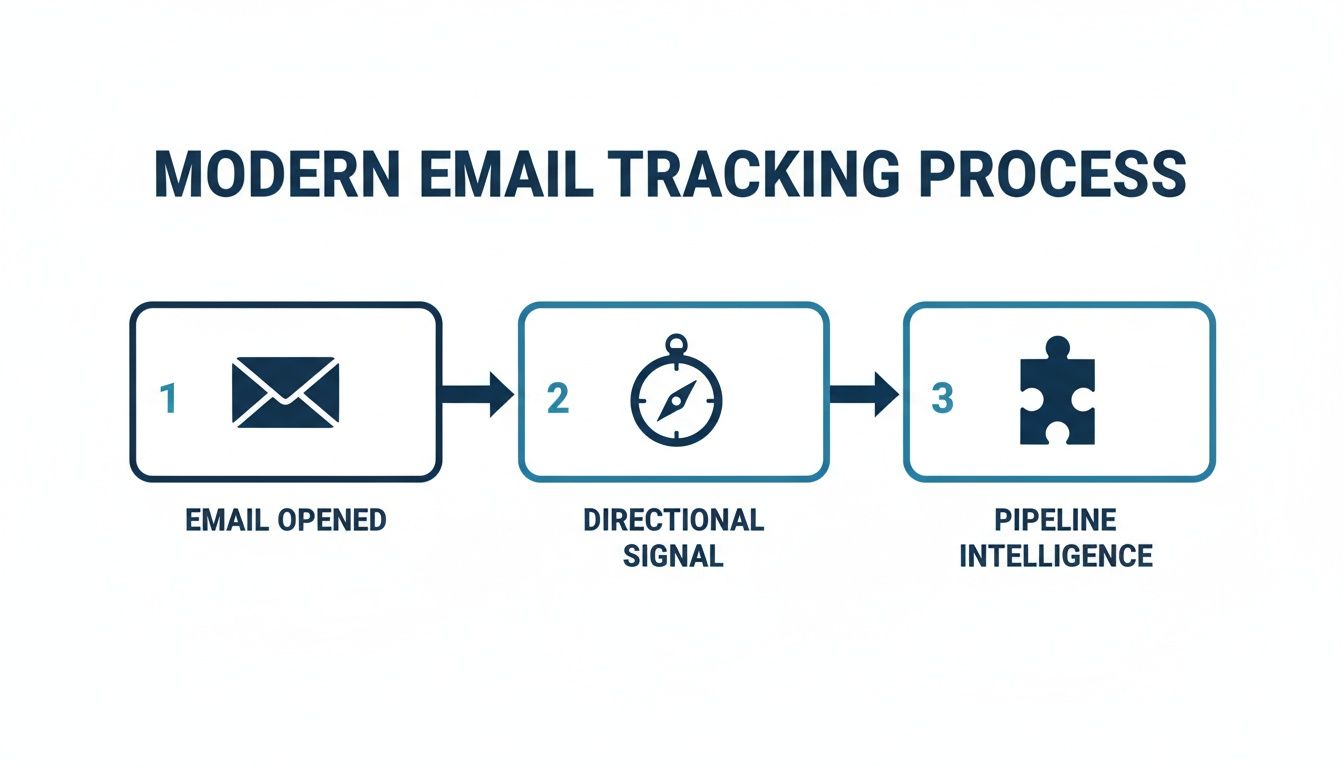
As you can see, what starts as a simple open can become a piece of intelligence that helps you prioritize efforts and decide on the next best action in your sales playbook.
What About Link Tracking?
Link tracking operates on a similar principle but is far more direct and reliable. Instead of an invisible pixel, the software wraps every link in your email with a unique redirect URL specific to that recipient.
When your prospect clicks the link, they are first sent to that tracking URL for a fraction of a second. The system instantly records the click and then immediately forwards them to the final destination page. The prospect never notices the detour.
This is why a click is a much stronger buying signal than an open:
- It’s an intentional action. A prospect must consciously decide to click a link.
- It’s far more reliable. Clicks are not accidentally triggered by privacy tools or automatic image-loading features the way opens are.
Understanding the difference is critical. While open tracking provides a general sense of activity, it only works for HTML emails where images load. For a deeper dive, check our guide on HTML vs. plain-text emails and see how your format choice impacts your entire outreach strategy.
The Accuracy Problem with Privacy Changes and False Positives

The biggest headache with open email tracking today isn’t the technology itself—it's the privacy-first world it operates in. Features from major tech companies have created a massive accuracy problem that every sales and RevOps leader must account for.
Here’s a scenario your team has likely experienced: your dashboard shows a 90% open rate on a critical campaign, but the reply rate is zero. Your reps see the "opens," trigger their follow-up cadences, and are met with silence. They're chasing ghosts, wasting time and burning credibility on accounts that never showed real interest. This isn’t a fluke; it's the new reality of "false positives."
How Privacy Features Create Phantom Opens
The main culprit is Apple’s Mail Privacy Protection (MPP), but other email clients and security tools are following suit. In simple business terms, here’s what happens: instead of waiting for your prospect to open the email, these systems now pre-load all its content—including your invisible tracking pixel—through a proxy server.
This automatic download triggers your sales tool to log an "open" before a human has even glanced at the message. The email could be sitting unread or be instantly deleted, but your system will still report it as a success.
What you’re seeing is not prospect engagement. It's the signature of an automated privacy bot, which means your open rate metric is artificially inflated and fundamentally unreliable for measuring intent.
That’s a critical distinction, especially for RevOps teams tasked with building a predictable pipeline model based on clean data.
The Real-World Impact on Sales Teams
The rollout of MPP and similar features has thrown open rate accuracy into chaos. Since Apple launched Mail Privacy Protection in September 2021, open rates have been artificially inflated by as much as 30-50%. In markets like the US, where over 50% of iOS users have enabled MPP, this has made traditional open tracking a shaky foundation for any sales strategy. You can read the full research about these open rate changes to grasp the scale of this shift.
For sales teams, acting on this flawed data leads directly to wasted effort:
- Chasing Ghost Signals: Reps burn hours following up on automated opens, pulling focus from leads who are genuinely engaged.
- Burning Valuable Lists: Pestering prospects with follow-ups triggered by false opens damages your sender reputation and gets your domain flagged.
- Flawed A/B Testing: If you’re testing subject lines based on open rates, your results are polluted by bots, leading to poor conclusions and weaker messaging.
This accuracy problem demands a change in strategy. Modern sales teams can't afford to treat opens as a primary KPI. The only path forward is to see them for what they are: one small signal in a much larger, more meaningful picture of engagement.
How to Use Opens as Smart Signals in Your Sales Strategy
If open rates are flawed, should we just throw them out? No. That would be like discarding a compass because it isn't a GPS. The key is to stop treating open email tracking as gospel and start using it as a directional signal.
Instead of obsessing over every single open, top-performing sales leaders coach their teams to look for patterns. A lone open is likely a privacy bot. But a flurry of opens from several people at the same company? That suggests your message is resonating and being shared internally.
That’s your cue to act—not with another automated email, but with a well-timed, human touchpoint, like a personalized LinkedIn request that references the pain point from your email.
A Practical Guide to Using Directional Data
Think of opens as a tool for prioritizing your team's time. Your reps can't chase every ghost in the machine, but they can use engagement patterns to focus their energy on accounts showing signs of life.
Here’s how high-performing teams use opens to guide their outreach:
- A/B Testing Subject Lines: While the absolute numbers are skewed, the relative performance still holds value. If Subject Line A consistently generates more opens than Subject Line B across a similar audience, you've found a directional winner. It’s a clear signal about what language grabs attention.
- Fine-Tuning Send Times: Noticing more activity on Tuesday mornings or late Thursday afternoons? Use these patterns to adjust your cadences and reach prospects when they are most likely to be in their inbox.
- Spotting Deliverability Problems: If your open rates suddenly plummet across all campaigns, don't assume your messaging failed. This is a massive red flag for a technical deliverability issue. It’s your signal to check for blacklisting or authentication errors before your domain reputation is seriously damaged.
Treat an open as a sign of potential warmth, not a confirmation of interest. This mindset shift helps reps work smarter by focusing follow-up efforts on accounts that are genuinely warming up.
When your team learns to interpret this data correctly, you build a more efficient and effective outbound engine. To learn more about building these multi-touch approaches, check our guide on high-performing sales cadence best practices.
A platform like Willbe is built to surface these patterns automatically. It helps your team cut through the noise to see the clear, actionable signals that lead to more meetings and a faster pipeline—all without more manual work or another tool to manage.
Moving Beyond Opens to Metrics That Drive Pipeline
While open email tracking gives you a directional hint, it's time to focus on what actually drives revenue. The goal isn't to be seen; it's to start conversations and create qualified sales opportunities.
In modern sales, this means elevating clicks, replies, and booked meetings to the top of your KPI dashboard. An open is passive—like someone glancing at your storefront. A click is them walking in the door to look around. They are actively showing intent. A reply is even better; it's the start of a real sales conversation.
Ultimately, every action your sales team takes should be measured by its ability to generate the one outcome that matters most to the business: a booked meeting. That's how you build a predictable pipeline.
From Vanity Metrics to Revenue Impact
To build a high-performing sales engine, your team must be obsessed with the numbers that lead directly to closed-won deals. This means shifting focus from metrics that feel good to metrics that have a tangible business impact.
The table below breaks down this critical shift, showing how to reinterpret common metrics to focus on what generates pipeline.
Shifting from Vanity Metrics to Revenue Metrics
Focusing on clicks, replies, and meetings is how you move from guessing what works to knowing what works. These are the metrics that reveal which messages and cadences are creating revenue, not just noise.
While average B2B email open rates are around 21%, the numbers that signal real intent are what matter. A good benchmark for a unique click-through rate (CTR) is 1.4%. Even better is the click-to-open rate (CTOR), which can hit 6.8% and shows how compelling your content is to those who actually saw it. You can see how your own email engagement benchmarks stack up to set realistic targets.
Here are the metrics that truly matter:
- Clicks and Click-Through Rate (CTR): This proves your message and call-to-action were compelling enough to provoke an action. It's the first real sign of interest.
- Replies and Reply Rate: This is your gateway to a conversation. Tracking positive reply rates tells you which messages resonate enough to get people talking.
- Meetings Booked: This is the North Star for any SDR or BDR team. It’s the most direct measure of an effective outbound program.
A unified platform gives you a single source of truth to track these vital KPIs, so you can see what’s actually building a predictable GTM engine. Instead of piecing together reports from fragmented tools, you see exactly how your team's activities translate into pipeline. To get a better grasp of what to measure, see our guide on critical email analytics.
Integrating Tracking into a Unified Sales Workflow

Knowing someone opened your email is interesting. Turning that flicker of interest into a sales conversation is where the real work—and friction—begins. The biggest drag on a sales team's momentum isn't a lack of data; it's data scattered across a dozen browser tabs.
Every sales and RevOps leader knows this headache. Your reps jump between their sales engagement tool, the CRM, LinkedIn, and a data provider. An open notification pops up, and the scramble begins: switch tabs, find the contact in the CRM, log the activity, then jump to LinkedIn to craft a follow-up. Every context switch kills momentum and introduces errors.
Connecting Data to Action, Instantly
Modern, all-in-one platforms like Willbe were built to eliminate this chaos. By bringing the entire prospecting workflow under one roof, email engagement data is tied directly to your CRM records and outreach channels. This isn't a nice-to-have; it's about making your team faster and more precise.
Here’s what this looks like in practice for an SDR:
- An SDR sends a personalized email to a high-value prospect using a pre-approved playbook.
- Willbe flags a series of opens and, more importantly, a click on a case study link.
- This activity instantly appears on the prospect’s record within Willbe—no manual logging required.
- The platform then prompts the rep with the next logical move from their cadence—a personalized LinkedIn connection request that references the content the prospect just viewed.
What was once a weak, passive signal has been automatically converted into a perfectly timed, multi-channel touchpoint.
When you unify tracking, data, and outreach, your reps can focus on selling, not on fighting their software. The platform orchestrates the 'what' and 'when,' freeing your team to nail the 'how'—building relationships and starting conversations.
The Power of an All-in-One Workflow
Folding email tracking into a single system solves this frustrating bottleneck. When engagement data, CRM records, and outreach channels speak the same language, your team gains a massive efficiency boost. Reps can act on buying signals the moment they happen, not ten minutes later after finishing their admin work.
This is how you build a repeatable go-to-market engine, not just an email-sending machine. By eliminating tool-switching and automating tedious tasks, you give your team the bandwidth to do what they're best at: engaging prospects, booking meetings, and driving revenue. It’s the difference between a fragmented process and a truly predictable pipeline.
Frequently Asked Questions About Email Tracking
Even the best sales teams run into practical questions about open email tracking. Let's tackle the most common ones that sales leaders, SDRs, and RevOps teams face.
Can a Prospect Block Email Tracking?
Yes, absolutely. Prospects can block tracking pixels in several ways, often without realizing it.
Modern email clients like Apple Mail have built-in features that automatically block pixels or load them in a way that obscures user activity. Beyond that, many corporate security filters and personal browser extensions are designed to strip these pixels before an email even lands.
There's also a simpler method: anyone can configure their email client to not download images by default. Since the tracking pixel is an invisible image, this single setting renders it useless. This is exactly why you should never treat a 0% open rate as proof of non-engagement. Clicks and replies are always your most trustworthy signals.
Is Open Email Tracking Legal Under GDPR?
This is a gray area where context matters. For B2C marketing to a general list, using a tracking pixel typically requires clear, opt-in consent.
However, in B2B sales, the rules are often interpreted differently. Targeted outreach to a specific individual at a company can fall under "legitimate interest," as long as your outreach is relevant and the tracking isn't overly invasive. The rationale is that you have a valid business reason for contacting them and for wanting to know if your message was received.
The smartest approach is transparency. Ensure your company's privacy policy is clear about data usage. Use open signals to help prioritize follow-ups, not for surveillance. We strongly recommend consulting a legal expert for advice tailored to your specific business and geography.
How Should We Adjust Our Sales KPIs After Reading This?
The single biggest change you should make is to stop using raw open rate as a core performance metric for your reps. It's too unreliable to build a target around and encourages the wrong behaviors.
Instead, shift focus to metrics that have a direct line to pipeline and revenue. The real value is in actions, not views. Start tracking and setting goals for:
- Click-Through Rate (CTR)
- Click-to-Open Rate (CTOR)
- Positive Reply Rate
- Meetings Booked
Coach your team to see open rates as a directional signal—great for A/B testing subject lines or spotting deliverability issues, but that's it. For example, set a new team goal to achieve a CTOR above 10% on key campaigns. A unified sales platform makes this easy by putting these meaningful, revenue-centric metrics front and center on your dashboards.
Ready to replace fragmented tools and empower your sales team with a truly unified workflow? See how Willbe helps top teams find better accounts, send messages that sound human, and scale a predictable pipeline—all in one place. Explore how top teams scale outbound.