


Tracking website visitors is about seeing which companies are evaluating your solution and turning that anonymous traffic into actionable sales intelligence. It’s the process of using a modern platform to de-anonymize those visitors, connect their on-site behavior to a company profile, and alert your sales team to engage at the precise moment of intent.
Your Hidden Pipeline Is Hiding in Plain Sight
Your pipeline feels flat, but your website analytics show traffic is climbing. What gives? For most sales leaders, this is a maddeningly common problem. You know high-value prospects are on your site right now, evaluating your solution, but they're ghosts. They browse your key pages and then vanish without filling out a form.
Think about this scenario—it happens every day. An Account Executive just wrapped up a demo with a prospect from "Acme Corp." An hour later, three more people from that same account land on your pricing page. They spend twelve minutes comparing your top-tier plan. The buying signals are flashing red, but because no one raised their hand, your team is completely blind to this critical activity.
Meanwhile, your SDRs are burning through a cold list that went stale weeks ago. This gap between clear website intent and your team's daily sales actions is exactly where revenue opportunities die.
From Vanity Metric to Revenue Engine
For too long, website traffic has been dismissed as a marketing vanity metric. But in 2026, knowing how to track website visitors is a core sales intelligence function. The hard truth is that a staggering 96% of your website traffic remains anonymous, slipping right through your fingers.
This isn't just about chasing clicks; it’s about surgical precision. Modern B2B platforms can now reveal over 75% of these anonymous visitors by matching behavioral data with firmographic information. Suddenly, those shadows have names. It’s about getting a real-time alert when a VP of Engineering from a target account downloads a technical whitepaper, letting your AE send a perfectly timed, context-aware message moments later.
The goal is to stop guessing and start knowing. When you can see which accounts are actively evaluating you, your team can prioritize outreach, personalize their messaging based on real-time behavior, and engage buyers when their intent is highest.
By tying anonymous browsing to real accounts, you transform your website from a static brochure into a dynamic revenue engine. This shift is fundamental to building a predictable go-to-market motion. It's the foundation for a more efficient and effective sales process, something we explore further in our guide on how to build a sales pipeline.
With an all-in-one platform like Willbe, this intelligence doesn't just sit in a siloed dashboard. It's fed directly into your prospecting workflow, fueling AI-driven personalization and automated outreach that converts pipeline faster—all without burning out your team or increasing headcount.
Building Your Modern B2B Visitor Tracking Stack
To understand who’s visiting your website, you can't rely on fragmented tools. You need a connected system that transforms anonymous website clicks into actionable sales intelligence. This isn't about getting lost in technical weeds; it's about building a seamless flow of data that tells your team not just what's happening on your site, but who's doing it.
This process is how you turn a "ghost" visitor into a "revealed" account, giving your sales team the context they need to start a relevant conversation.
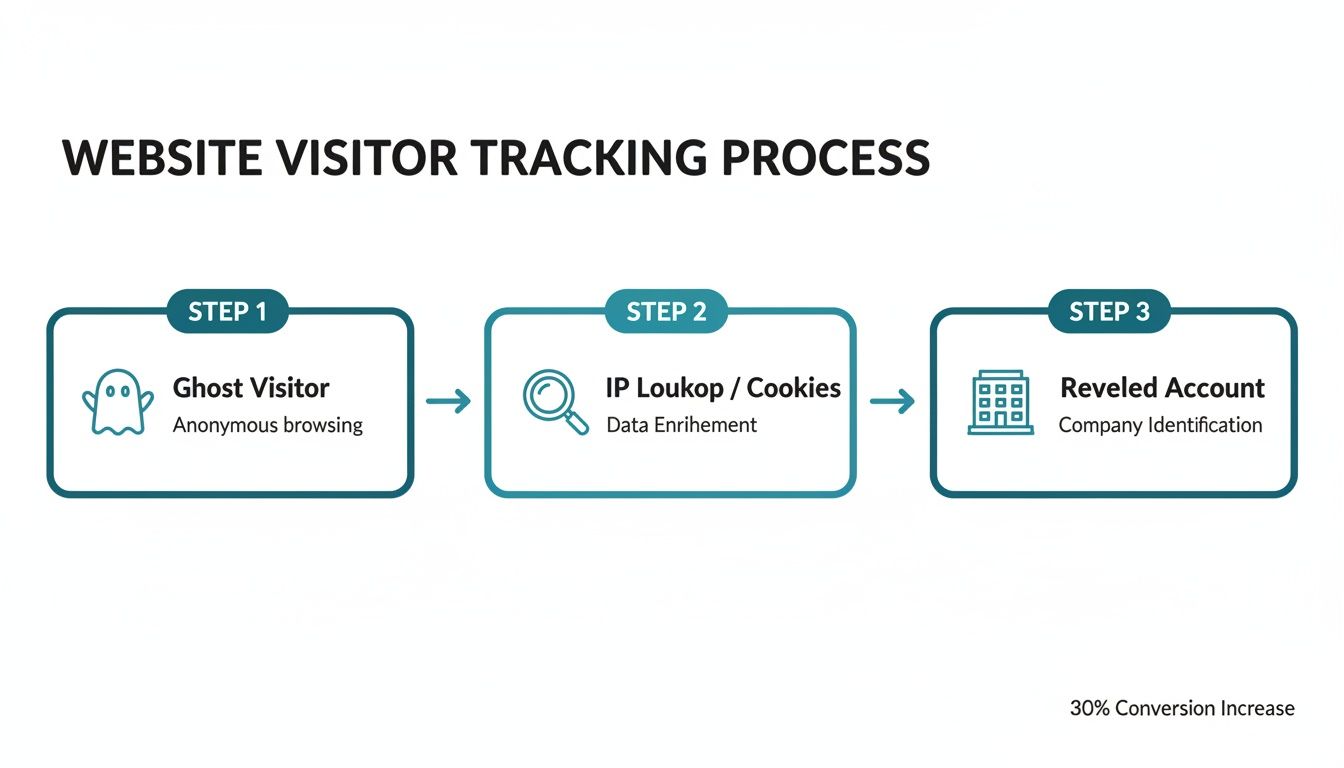
As you can see, it’s a clear progression: an unknown visitor becomes an identified company, ready for strategic engagement. This isn't just a technical workflow; it's a direct path to building your pipeline.
Essential B2B Visitor Tracking Tool Stack
To get this done right, you'll need to assemble a few key tools. Each one plays a critical role in turning anonymous traffic into qualified leads for your sales team.
This stack works together to provide a complete picture, moving from broad behavioral trends to specific, high-value accounts that your team can act on immediately.
The Foundational Layers: Tracking What Happens
Your tracking stack starts with two core components that work hand-in-hand to map out visitor behavior. Think of these as the foundation you’ll build all your sales intelligence on top of.
- Google Analytics 4 (GA4): This is your eye in the sky. GA4 is essential for seeing the big picture of user behavior—how people find your site, the paths they take, and where they tend to leave. It answers the anonymous "what" and "where" of your traffic.
- Google Tag Manager (GTM): Think of GTM as your mission control. Instead of begging developers to add a new tracking script, your RevOps or marketing team can use its simple interface to deploy, test, and manage all your tracking tags (like the GA4 tag or a reverse-IP script). This agility is huge—it means you can adapt your tracking strategy on the fly.
These tools are the bedrock. They give you the map, but for B2B, they don't tell you who the travelers are.
Unmasking The Visitor: Identifying Who They Are
Here’s where B2B visitor tracking diverges from standard web analytics. You have to connect all that anonymous behavior to real companies.
The market for these tools has exploded, now valued at over $121 million globally, for a simple reason: B2B buying behavior has changed. With remote work driving a 60% spike in online research, sifting through traffic from 1.13 billion websites to find your buyers is impossible without smart tech. You can see more details on these trends in this website visitor tracking market report.
At their core, these tools de-anonymize your website traffic at the company level. They work by matching a visitor's IP address to a massive database of company IP ranges, instantly revealing the organization behind the clicks.
This technique is called reverse IP lookup. It’s the crucial bridge between anonymous on-site activity and a tangible account your sales team can actually pursue. But just getting the company name is only the first step.
Adding Context: Understanding Fit and Intent
Once you've identified a company, the next question is simple: are they a good fit? This is where firmographic enrichment tools come into play, adding the necessary context.
- Firmographic Enrichment: These services automatically append critical data to the company name you just uncovered. Think industry, employee count, annual revenue, and even their tech stack (technographics). This data lets you instantly qualify or disqualify an account against your Ideal Customer Profile (ICP).
- Behavioral Intent Scoring: A truly powerful setup also tracks the quality and intensity of the visit. Did someone from the target account visit your pricing page three times? Did a few of their colleagues read the same case study? These are strong buying signals that should immediately trigger an alert for your sales team.
By combining reverse IP identification with deep data enrichment, you get the full story. You don’t just know who is on your site; you understand their fit and their intent. To dive deeper, check out our guide on the best data enrichment tools to see which might be right for your stack.
Platforms like Willbe are designed to unify this entire process. Instead of juggling separate tools for analytics, identification, enrichment, and sales alerts, Willbe brings it all under one roof. It automatically de-anonymizes visitors, enriches them with firmographic data, and flags high-intent accounts directly within your team's workflow, so reps can act instantly on the absolute warmest opportunities.
Turning Anonymous Clicks Into Actionable Accounts
Getting your tracking stack in place is a great first step, but it's just the beginning. The real value is created when you start turning those anonymous website clicks into clear, actionable signals your sales team can actually use to start conversations and close deals. This is where we move from raw data to real revenue opportunities.
Let's be honest: not all website visits are created equal. A visitor who bounces off your homepage is mostly noise. But a visitor who spends ten minutes digging into your integrations page? That's a signal.
The goal is to connect the dots between behavior (what they did) and firmographics (who they are). It’s one thing to know someone is interested. It’s a game-changer when you can tell your sales team that three engineers from a target account are poring over your API documentation.
Defining and Tracking High-Intent Behaviors
First, you need to map out the digital breadcrumbs that show a prospect is shifting from casual browsing to serious evaluation. If you were genuinely considering a purchase, what pages would you visit?
Your list of high-intent actions will likely include things like:
- Pricing Page Visits: A classic, but still incredibly powerful signal. Multiple visits or significant time spent here often means they're thinking about budget.
- Case Study Downloads: When someone downloads a story about a company just like theirs, they're trying to picture what success looks like for them.
- Product Tour or Demo Engagement: Deep interaction with a product tour or repeated visits to your demo request page shows a real desire to see your solution in action.
- Technical Documentation Views: Visits to pages covering integrations, security, or API access are strong indicators of a technical evaluation, which often involves key decision-makers.
With a tool like Google Tag Manager, your RevOps team can set up event tracking for these specific actions without needing a developer. This lets you measure meaningful interactions—like video plays and PDF downloads—not just page views.
Here’s a glimpse of what your analytics dashboard can look like once you're tracking these events. It gives you a clear view of engagement across your most important pages.
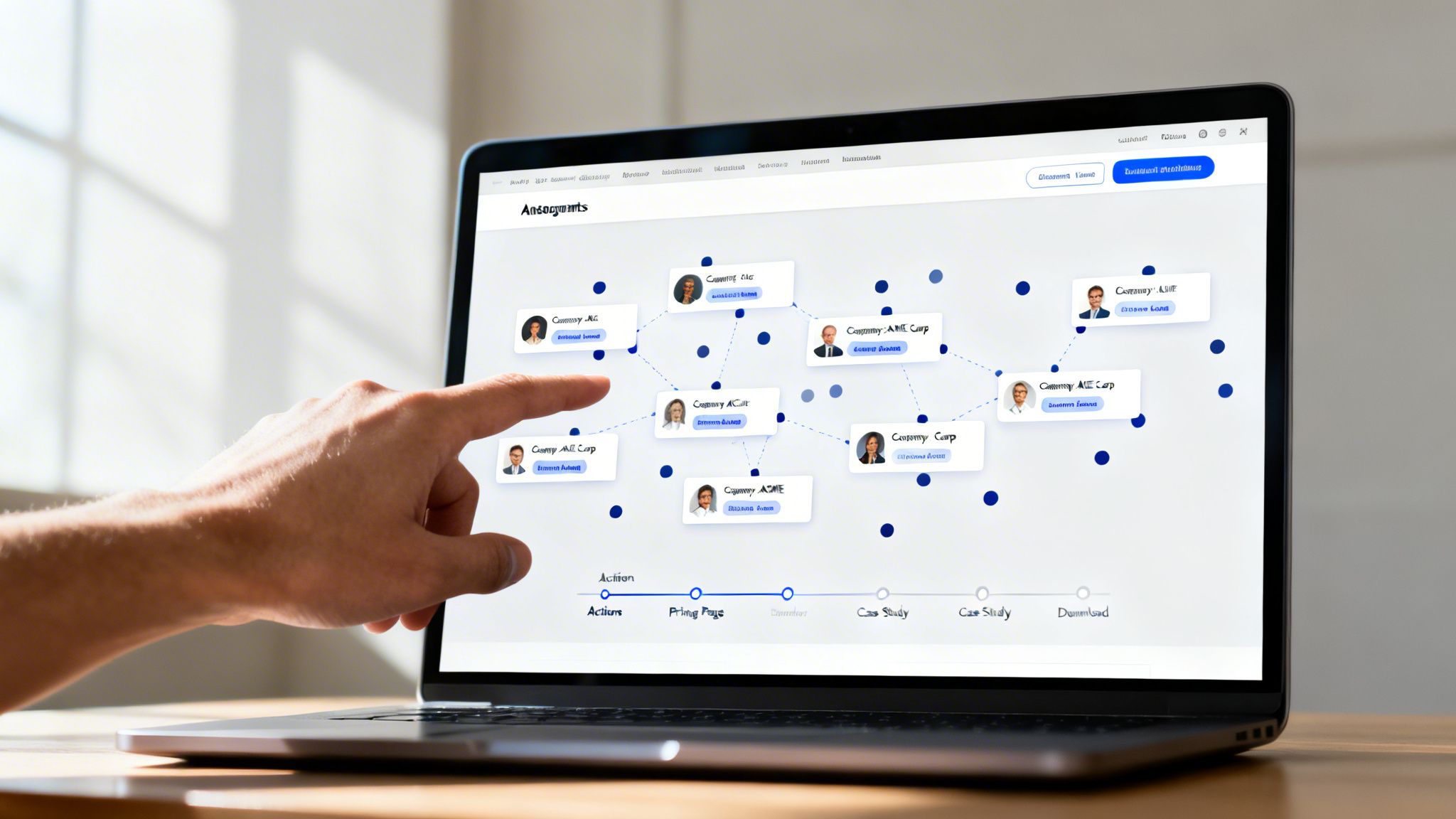
A report like this helps you see which content is really grabbing attention, so you can point your sales team toward the accounts showing the strongest intent. It's how you start seeing patterns long before anyone fills out a form.
The Non-Negotiable Role of UTM Parameters
As you track these behaviors, you have to know which marketing efforts are bringing these high-value visitors to your site. This is where UTM parameters become completely non-negotiable.
UTM parameters are simple tags you add to the end of a URL that tell your analytics tools precisely where a visitor came from. They answer critical questions:
- Did that target account click through from a LinkedIn ad?
- Was it from the email campaign we sent last Tuesday?
- Or did they find us through an organic search for a specific feature?
Without them, all your traffic gets lumped into broad, unhelpful categories. You're left guessing which channels deliver high-fit accounts versus just empty clicks. For any sales leader focused on building a predictable pipeline, knowing your best-performing channels is fundamental to allocating your budget and effort wisely.
Connecting Behavior to Firmographics: A Real-World Scenario
This is where all the pieces come together. Imagine an SDR on your team, Sarah. She’s been trying to break into "Global Tech Inc.," a key target account, but her cold outreach has been met with silence.
Suddenly, she gets an alert: "3 visitors from Global Tech Inc. just spent 12 minutes on the integrations page and viewed the Salesforce integration guide."
This changes everything. Sarah now has the perfect opening for a hyper-relevant, context-aware message. Instead of another generic "checking in" email, she sends this:
"Hi [Prospect Name], saw some of your team was looking into how we connect with Salesforce. If you're exploring ways to sync your GTM data more efficiently, I have a few specific examples of how other enterprise tech companies are using our integration to do just that. Worth a quick chat?"
This message doesn't just cut through the noise; it sidesteps it entirely. It’s not a cold guess; it's a warm, informed conversation starter based on real-time behavior. You’re meeting the buyer exactly where they are in their journey.
This is precisely how top-performing teams use platforms like Willbe to identify ideal prospects and engage them effectively. The platform connects these behavioral dots automatically, serving up actionable insights that help sales reps convert pipeline faster. You can explore how Willbe helps you discover high-intent leads and turn those insights into meetings.
The data supports this approach. By 2026, it's expected that over 75% of anonymous website visitors can be identified using advanced B2B tracking software. And considering that 61.19% of all web traffic now comes from mobile devices, the ability to cross-reference IPs, cookies, and behavioral signals across devices is crucial for unmasking these hidden opportunities. You can find more insights on website visitor tracking software to dig deeper.
Activating Buyer Intent in Your Sales Workflow
Website intelligence is useless if it sits siloed in a dashboard. Data on its own doesn’t book meetings. This is the critical step where you connect the dots, turning passive visitor tracking into an active revenue engine by embedding these insights directly into your sales team's daily workflow.
The whole point is to make acting on buyer intent a reflex, not a research project.

This means getting all that rich visitor data flowing into your CRM and a unified platform like Willbe. By syncing everything, you can create automated, real-time alerts that ping your reps the moment a high-fit account shows interest. They can follow up in minutes, not days. In this game, speed is your biggest advantage.
Creating a Practical Lead Scoring Model
Not every identified visitor is ready for a sales call. You need a way to filter the signal from the noise and surface the accounts that actually matter.
Many teams get bogged down trying to build an overly complex scoring model. It just needs to do one job well: weigh an account's fit against its recent behavior.
This simple model protects your team’s most valuable asset—their time—and focuses it on accounts with the highest likelihood of converting.
The Firmographic Fit Score (Who They Are)
This first score answers the basic question, "Is this the right kind of company for us?" It’s all about measuring an account against your Ideal Customer Profile (ICP) using firmographic data.
- Industry: Is this a core vertical you win in? (+20 points)
- Company Size: Does their employee count hit your sweet spot? (+15 points)
- Geography: Are they in a region your sales team actively covers? (+10 points)
- Technographics: Do they use tech that pairs well with your solution, like a specific CRM or marketing automation platform? (+15 points)
The Behavioral Intent Score (What They Did)
This second score is dynamic and answers, "How interested are they right now?" It tracks their recent on-site actions to gauge the intensity of their interest.
- Pricing Page Visit: A classic sign they’re thinking about budget. (+25 points)
- Case Study Download: They're moving past features and into outcomes. (+20 points)
- Demo Request Page Visit (but no form fill): Huge intent signal, but they hesitated. A perfect reason to reach out. (+15 points)
- Multiple Visitors from the Same Account: This is a big one. It suggests a buying committee is forming and they're talking internally. (+30 points)
Combine these two scores, and you get a crystal-clear priority list. A company with a high firmographic fit and high-intent behavior is a top-priority lead that needs immediate, personalized outreach.
From Alert to Actionable Outreach
Knowing how to track website visitors is one thing, but making that data actionable in seconds is where the value is created. In a modern GTM team, this isn't a manual task. It's an automated workflow.
When a target account crosses a combined score threshold—let's say 75 points—an instant alert should fire. This shouldn't just be a company name. It needs to deliver the full context directly to the account owner in their main workspace, whether that's Slack, email, or right in the CRM.
A great alert gives a rep everything they need to act fast:
- The Company Name (linked to the CRM record)
- The Specific Pages they visited ("Viewed pricing and the Salesforce integration page")
- Key Firmographic Data (Industry, Size, etc.)
- The Number of Unique Visitors from their company in the last 7 days
This is the moment an SDR or AE can drop what they're doing and craft a message that feels almost psychic. They aren't guessing; they are responding to a clear, real-time signal.
Powering Human-Sounding AI Outreach
This is also where AI stops being a buzzword and becomes a genuinely useful sales assistant. When you feed it rich, real-time context, an AI-driven platform can generate outreach that’s truly personalized because it’s based on what a prospect just did.
Think about it: an alert triggers Willbe's AI to instantly draft an email for the rep to review and send.
"Noticed your team was checking out our Salesforce integration. We see a lot of fintech companies use it to sync revenue data in real-time, which usually saves their RevOps team about 10 hours a week. Is that a challenge you're dealing with?"
That’s not generic AI fluff. It’s hyper-relevant. It references their industry, hits on a common pain point, and ties directly to the content they just consumed. This is how top teams use Willbe to scale personalized outreach that actually sounds human, boosting reply rates because prospects feel understood, not just targeted. It’s about replacing a clunky stack of tools and manual research with one unified system that turns intelligence into pipeline. Faster.
Mastering Compliance and Optimizing for Growth
Unlocking who’s on your website is a massive advantage, but that power comes with responsibility. For sales and revenue leaders, navigating privacy rules like GDPR and CCPA isn't just about ticking a legal box—it’s about earning the trust of your future customers from their very first visit.
The good news is you don't have to choose between getting smart insights and doing the right thing. It all comes down to a crucial distinction: identifying a company versus an individual. While tracking a specific person's data requires their clear consent, using tools like reverse IP lookup to see which company is browsing your site is generally accepted as a legitimate business interest in the B2B world.
A properly configured visitor identification platform is built for this reality. It focuses on company-level identification, not personal surveillance. This gives your team the firmographic data they need to qualify an account without stepping over a privacy line.
Navigating the Essentials of Privacy Compliance
To build a tracking system that's both effective and ethical, you have to get two things right: consent management and data minimization. These aren't just legal terms; they’re the guardrails that keep your go-to-market strategy on the right track.
Consent Management: This is all about transparency and control. A clear, easy-to-understand cookie banner is non-negotiable. It needs to explain what you're tracking and why you're tracking it, giving visitors a simple way to opt in or out.
Data Minimization: The principle here is simple: only collect the data you actually need for a specific, clear purpose. For B2B sales, this means focusing on firmographics (company name, industry, employee count) and high-intent behaviors, not scooping up every piece of personal data you can find.
When you bake these practices into your process from the start, you create a sustainable system that delivers powerful sales intelligence while respecting user privacy. It’s about being smart, not sneaky.
Ongoing Optimization: Your Key to Sustained Growth
Setting up visitor tracking isn't a "set it and forget it" task. Markets change, your ideal customer profile evolves, and buyers find new ways to research solutions. The teams that see lasting results are the ones that are constantly optimizing their setup.
Think of it as a living part of your sales strategy, not a one-and-done IT project. The goal is to keep refining your approach so that your website intelligence consistently feeds your pipeline with qualified opportunities.
The real objective isn't just to track visitors; it's to create a feedback loop. You use website intent data to inform sales outreach, and then you use the results of that outreach—good or bad—to refine your tracking and engagement strategies.
For example, maybe you spot a trend where visitors from the fintech industry who download a particular case study have a 30% higher meeting-booked rate. That’s a huge signal. You can immediately adjust your scoring to prioritize this behavior or even spin up targeted ad campaigns to get that case study in front of more fintech prospects.
Troubleshooting and Refining Your Tracking
No tracking setup is perfect right out of the box. You're going to hit snags like data discrepancies or gaps in your tracking. The trick is having a simple process for finding and fixing them.
A classic problem is seeing a mismatch between your website analytics and your CRM. This often points to a tracking script that isn’t firing on every page or a CRM integration with rules that are too narrow. A quick audit of your Google Tag Manager container usually reveals the culprit.
But it’s not just about fixing what’s broken. True refinement is about proactively making things better. Use the data you're collecting to A/B test different parts of your website. If you see that target accounts are bouncing from your solutions page, try testing a new headline or embedding a customer testimonial video. Then, measure how that change impacts engagement time for that specific audience segment. This is how you turn good data into a better customer journey—and more closed deals.
Common Questions About Tracking Website Visitors
When you're ready to move past theory and actually identify the companies on your site, some tough, practical questions always come up. We hear them all from sales and RevOps leaders. Let's get right to the no-fluff answers.
Is This Even Legal Without Asking for Consent?
This is always the first question, and for good reason. The short answer is: it depends on what you're tracking and where your visitor is.
If you’re identifying a specific person (what regulations like GDPR call Personal Data), you absolutely need their explicit consent. There's no gray area there.
However, identifying the company someone works for by using their IP address (Firmographic Data) is a different story. For B2B marketing, this is widely considered a legitimate interest. The key is to use a B2B-focused tool that is built for compliance and to be transparent about this practice in your privacy policy.
Good visitor identification platforms are designed specifically to navigate these rules. They focus on identifying the account, not the individual, giving your sales team the intel they need without straying into personal surveillance.
We Already Have Google Analytics. Isn't This the Same Thing?
I get this one a lot. Think of it this way: Google Analytics is fantastic for understanding the "what" and "where" of your website traffic in broad strokes. It shows you which pages get the most views and how people move through your site. It’s essential for a high-level view.
But GA is built to be anonymous. It can't answer the most important question for any B2B sales team: who are the actual companies behind those clicks?
That’s the gap a B2B visitor tracking tool fills. It de-anonymizes your traffic, turning vague analytics into a hot list of actionable accounts.
Here’s the practical difference:
- Google Analytics tells you: 20 anonymous users visited your pricing page today.
- B2B Visitor Tracking tells you: Three of those users were from a major target account you've been trying to break into for months.
Suddenly, you're not just looking at data; you're looking at a real opportunity. It connects the dots between marketing activity and sales action.
How Fast Can We Expect to See Real Results?
You'll start seeing identified companies show up in your dashboard almost immediately—often within hours of the tracking script going live.
But the real results, the ones that impact pipeline, depend on how quickly you put that information to work. The value is created when you connect this data to your CRM and set up real-time alerts for your sales team.
Teams that do this well start engaging high-intent accounts the same day they show up. Within the first 30 days, you should have a data-driven list of which target accounts are actively checking you out. This isn't about waiting for a quarterly report; it's about giving your reps the power to act on buying signals the moment they happen.
Ready to stop guessing and start knowing exactly which accounts are exploring your solution? Willbe unifies visitor identification, data enrichment, and AI-powered outreach into a single platform. Turn anonymous traffic into your fastest-growing pipeline.