
In 2026, the old 'spray and pray' model is officially dead. Buyers are more informed, more guarded, and less patient than ever. A successful sales cadence is no longer a rigid schedule of touches; it's a dynamic, intelligent system designed to deliver the right message on the right channel at precisely the right time. But what separates a cadence that consistently books meetings from one that burns your list? It comes down to a strategic blend of personalization, timing, channel mix, and data-driven iteration.
This guide moves beyond generic advice to provide a definitive roundup of the 10 sales cadence best practices that top-performing SDR, BDR, and AE teams are using to break through the noise and generate predictable pipeline. We will provide a clear, actionable framework for building and optimizing your outreach, ensuring every touchpoint adds value and moves a conversation forward.
You will learn how to:
- Structure multi-channel sequences using the proven 3-7-3 model for email, phone, and social engagement.
- Personalize outreach at scale using AI, moving beyond simple mail-merge templates.
- Segment cadences by persona and account tier to increase relevance and response rates.
- Orchestrate team-based cadences for engaging multiple stakeholders within a target account.
- Implement data-backed rules for timing, frequency, and message variation to avoid prospect fatigue.
Whether you're building your first outbound sequence or refining a mature sales engine, these strategies will equip you with the sales cadence best practices needed to create systems that prospects actually respond to, driving more qualified opportunities and revenue.
1. The 3-7-3 Touch Cadence Model: Email, Phone, Social
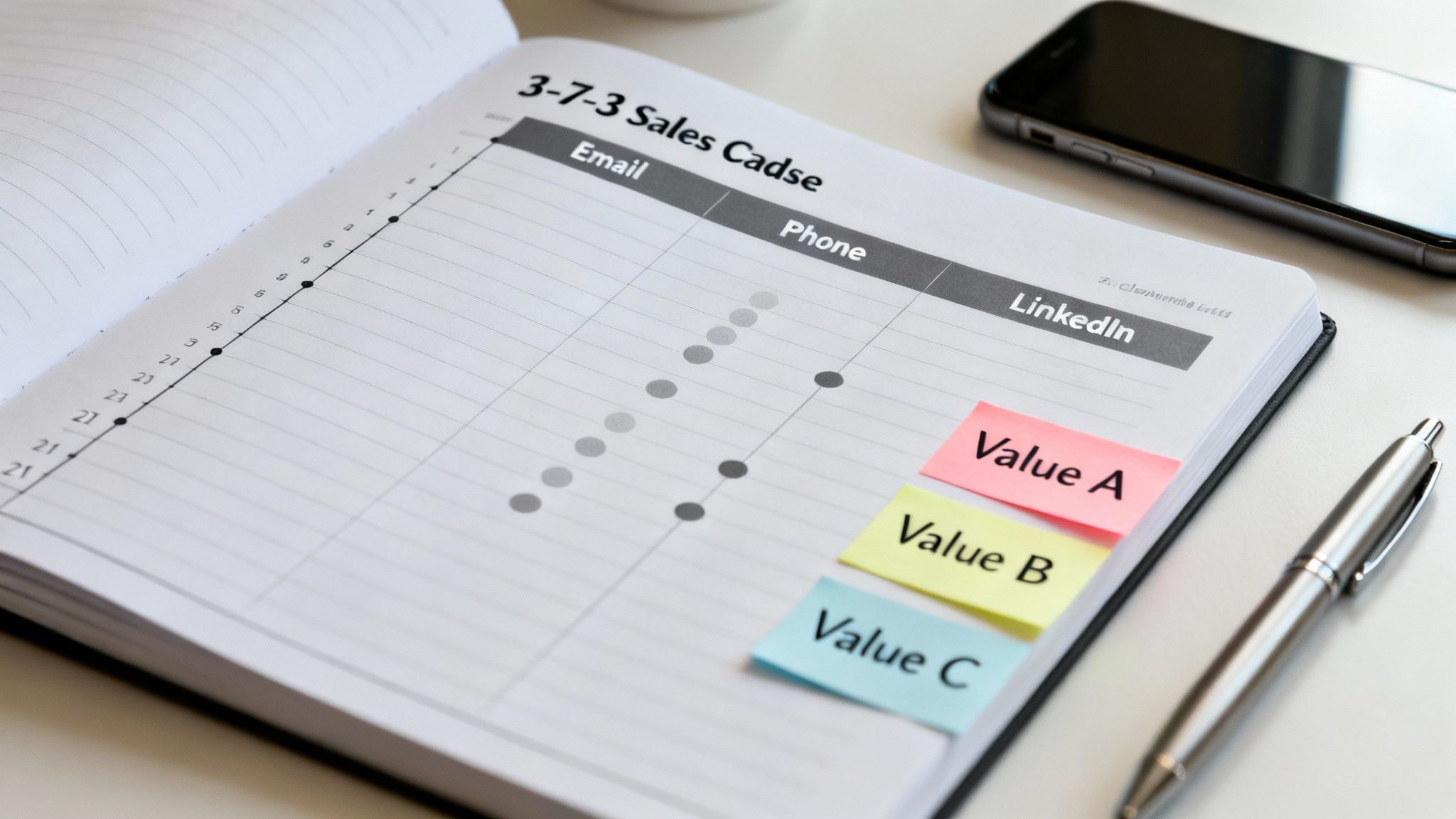
One of the most effective and scalable sales cadence best practices is the 3-7-3 model. This structured sequence is designed for SDRs targeting mid-market or enterprise accounts and focuses on maintaining visibility without causing prospect fatigue. It provides a clear, repeatable framework that balances automation with personalization, making it a favorite for high-growth SaaS teams.
The model is built on three core components: 3 distinct value propositions, 7 total touchpoints, and a 3-channel approach (email, phone, social). Over a period of about three weeks, you engage prospects with varied messaging across different platforms, ensuring your outreach feels fresh and relevant each time. Instead of repeating the same "just checking in" line, each touchpoint offers a new angle or insight related to the prospect's pain points.
How to Implement the 3-7-3 Cadence
This model’s power lies in its structured-yet-flexible design. Companies like Gong and Salesloft have successfully adapted it for their enterprise SDR programs, seeing significant lifts in meeting booking rates. A typical 3-7-3 sequence might look like this:
Week 1:
- Touch 1 (Day 1): Personalized email with Value Prop #1.
- Touch 2 (Day 2): LinkedIn connection request (no message).
- Touch 3 (Day 4): Phone call referencing the first email.
Week 2:
- Touch 4 (Day 8): Second email with Value Prop #2 (e.g., a case study).
- Touch 5 (Day 10): LinkedIn comment or message.
Week 3:
- Touch 6 (Day 15): Third email with Value Prop #3 (e.g., a tactical insight).
- Touch 7 (Day 17): Final phone call or a breakup email.
This structure provides consistent engagement while respecting the prospect's time. By tracking which touchpoints generate the most replies, you can optimize your team's efforts and focus on what works, ensuring your sales cadence is both efficient and effective.
2. Personalization at Scale: Template-Free Outreach Using AI
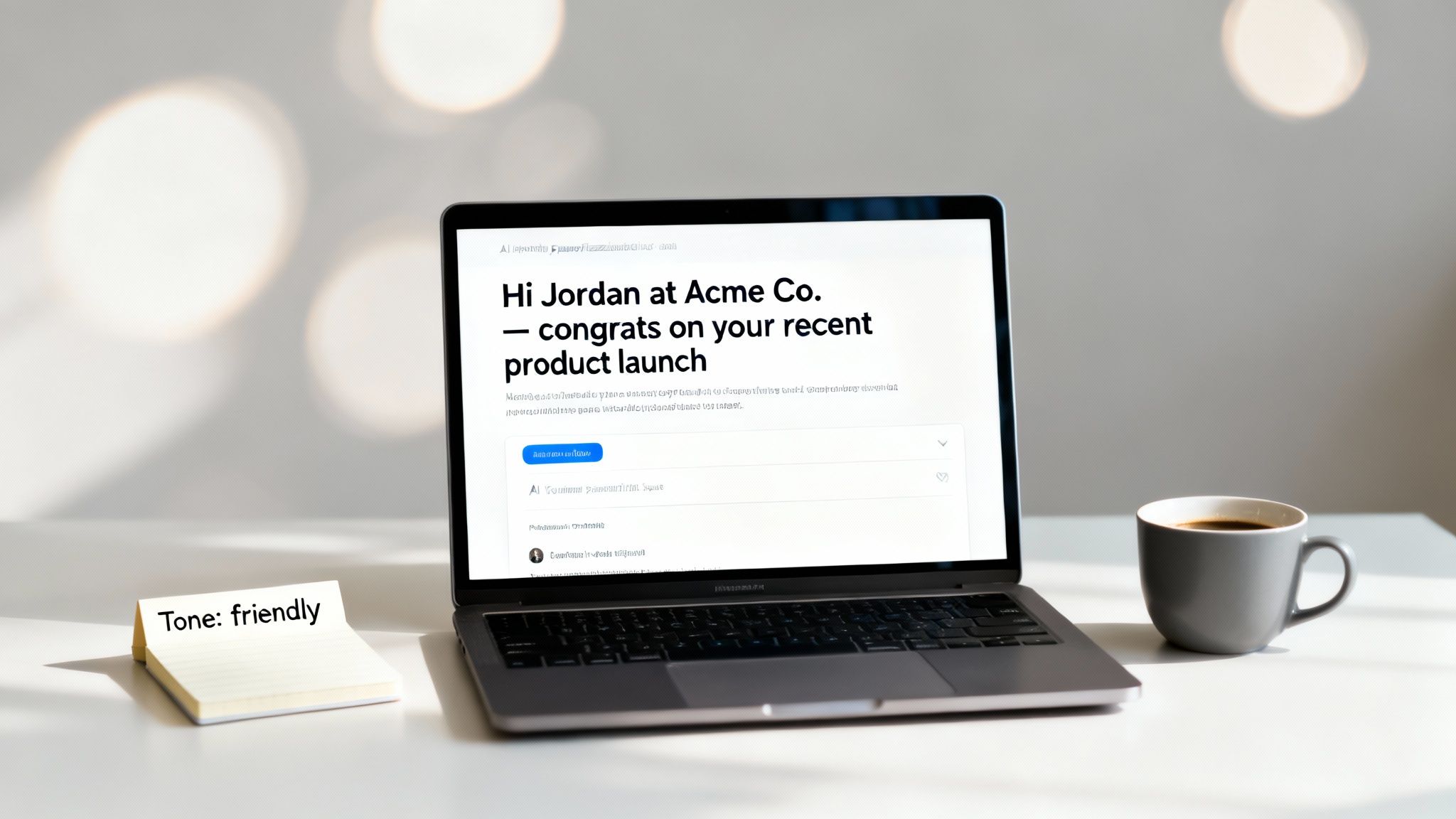
One of the most powerful sales cadence best practices is moving beyond static templates to embrace AI-driven, dynamic personalization. This approach uses proprietary AI to generate unique outreach for each prospect, referencing real-time context like company news, job changes, or specific business challenges. It allows SDRs to maintain an authentic, human voice while personalizing messages at a scale previously impossible, solving a critical bottleneck for teams with high outreach volumes.
The core idea is to let an AI engine handle the heavy lifting of research and drafting. By analyzing data points about a company and individual, the AI can create relevant subject lines and email body copy that resonates far more than a generic template. This method bridges the gap between manual, time-consuming personalization and ineffective, high-volume automation. It provides a system for creating genuinely tailored touchpoints within a structured sales cadence.
How to Implement AI-Powered Personalization
The key to success is training and guiding the AI to match your team’s voice and strategy. Companies using this technology report significant lifts, with some B2B SaaS firms seeing a 25-35% increase in meeting booking rates. Enterprise teams also reclaim 5-10 hours per rep each week, time that can be reinvested into higher-value sales activities.
Establish a Baseline: Feed your AI engine with 10-15 of your best-performing historical emails. This helps it learn your specific tone, style, and value propositions.
Enrich Your Data: Use verified contact data combined with a company intelligence layer. The more relevant the data inputs, the higher the quality of the personalized output.
Test and Validate: Before a full rollout, A/B test AI-generated outreach against manual personalization on small cohorts of about 50 prospects each to measure performance.
Review and Refine: Manually review the first 20-30 AI-generated messages before sending them. This allows you to catch any tone mismatches and fine-tune the engine.
Keep Data Fresh: Update your company data feeds weekly to ensure the AI is referencing the most recent news, funding announcements, or personnel changes.
By systematically implementing AI, your outreach remains relevant and impactful. This practice transforms your sales cadence from a rigid sequence of templates into a dynamic, intelligent system that adapts to each prospect, dramatically improving engagement and conversion rates.
3. Segment-Based Cadence Design: Different Sequences for Different Buyer Personas
One of the most impactful sales cadence best practices is moving away from a one-size-fits-all approach. Instead of using a single sequence for every prospect, segment-based design involves creating distinct cadences tailored to different buyer personas, company sizes, industries, or buying stages. This strategy dramatically increases relevance and boosts response rates by speaking directly to a prospect’s specific role, pain points, and motivations.
The core principle is simple: a CFO at a Fortune 500 company cares about different outcomes than a marketing manager at a high-growth startup. By segmenting your outreach, you can tailor your value propositions, channel mix, and messaging urgency for each group. This level of personalization at scale is what separates top-performing sales teams from the rest, ensuring your message lands with maximum impact.
How to Implement Segment-Based Cadences
Leading sales organizations like HubSpot use this method effectively, deploying separate cadences for C-suite executives, managers, and individual contributors. For example, a fintech company saw a 45% response rate from a sequence tailored to compliance officers, compared to just 28% from their general outreach.
- Map Your Buyer Personas: Start by defining 2-4 key personas. Document their title, seniority, primary pain points, and preferred communication channels. A VP of Sales is more likely to respond to a concise email, while a marketing director might engage with a LinkedIn comment.
- Create a Cadence Decision Tree: Build a simple framework for assigning leads to the right sequence. For example: a VP-level title at a company with over 1,000 employees gets the "Enterprise C-Suite" cadence, while a manager at a sub-500 employee company gets the "Mid-Market Manager" sequence.
- C-Suite Cadence: 4-5 touches, heavily focused on email and high-level ROI.
- Manager Cadence: 7-9 touches, using a mix of email, calls, and LinkedIn with tactical insights.
- Warm Intro Cadence: 3 touches, direct and focused on booking a meeting quickly.
By starting with a few core segments, you can prove the lift in engagement before adding more complexity. This strategic approach ensures your sales cadence is not just a series of random touches but a targeted, effective communication strategy that drives predictable pipeline growth.
4. Multi-Account (ABM-Lite) Cadences: Team-Based Sequences for Target Accounts
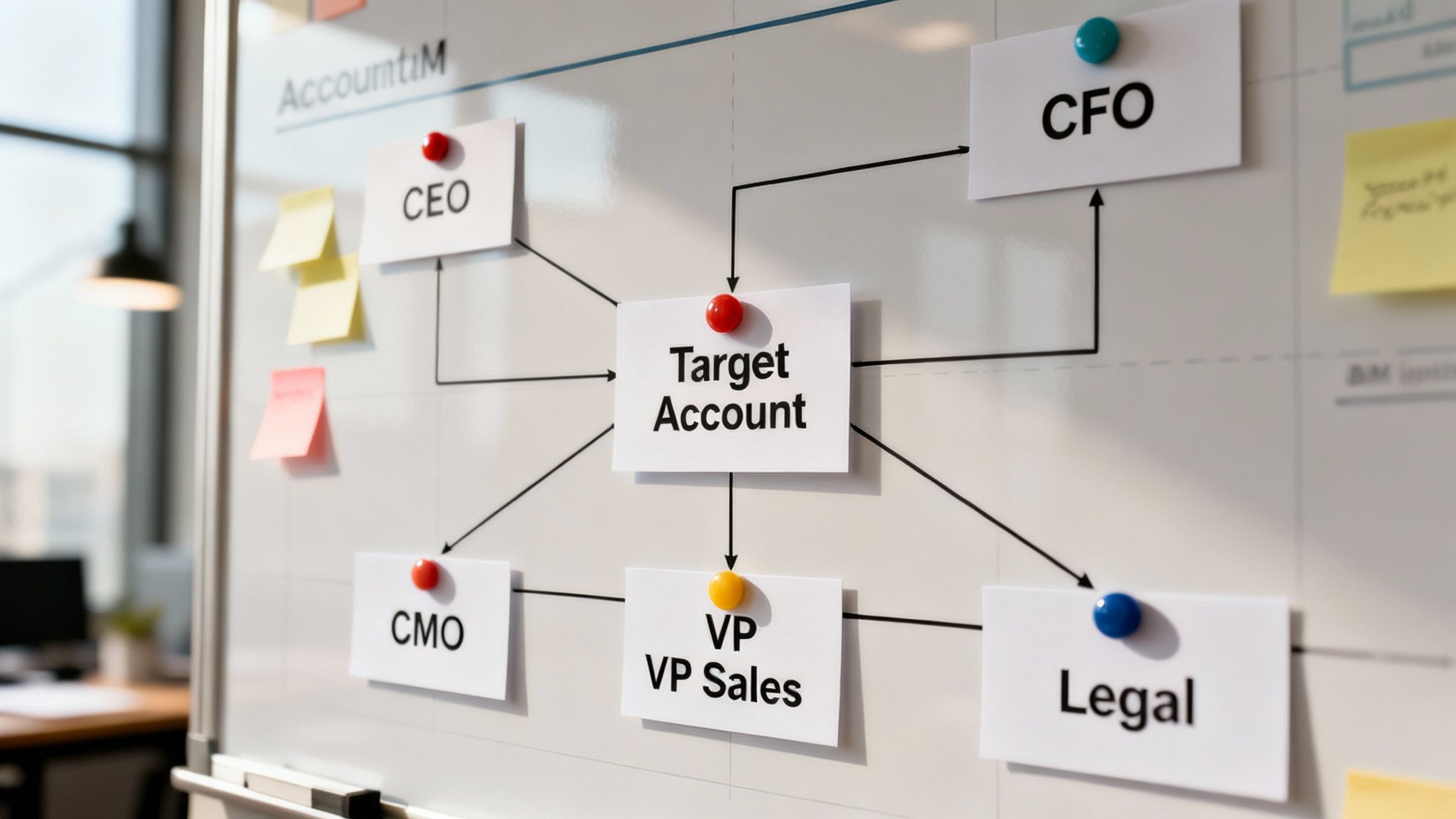
Instead of targeting one person and hoping they are the right contact, one of the most impactful sales cadence best practices is to orchestrate a team-based sequence. This "ABM-Lite" approach involves engaging 5-10 decision-makers and influencers within a single high-value account simultaneously. The goal is to create surround sound, increasing visibility and the probability of booking a meeting by engaging the entire buying committee.
This strategy shifts the focus from individual leads to the account as a whole. Each contact receives personalized messaging relevant to their role, but the outreach is coordinated across the team over a 2-3 week window. This creates internal momentum and ensures your solution is discussed from multiple angles. Companies using this method report booking rates as high as 50-70% on target accounts, a massive leap from the 10-15% seen with single-contact cadences.
How to Implement Multi-Account Cadences
The key to ABM-Lite is orchestration, not just volume. Pioneered by ABM platforms like 6sense and Demandbase, this approach requires careful planning to avoid appearing disorganized. Research from Pavilion shows that over 60% of enterprise deals involve five or more stakeholders, making this coordinated outreach essential.
Week 1:
- Day 1: Personalized email to the primary decision-maker (e.g., VP of Sales) with a role-specific value prop (revenue impact).
- Day 2: LinkedIn connection requests sent to 3-4 other stakeholders (e.g., Sales Director, RevOps Lead).
- Day 4: Phone call to the primary decision-maker and a personalized email to a secondary stakeholder (e.g., RevOps Lead) focused on their pain points (efficiency, data).
Week 2:
- Day 8: Follow-up email to the primary contact with a relevant case study. Engage with secondary contacts' LinkedIn posts.
- Day 10: Phone calls to the secondary stakeholders, referencing your outreach to their VP.
Week 3:
- Day 15: Group email or LinkedIn message to the top 2-3 contacts, summarizing the shared value proposition.
- Day 17: Final calls to all engaged contacts, aiming to secure a group discovery call.
This method shortens sales cycles and increases deal size by building consensus early. Start with your top 20-30 target accounts, assign a clear "account owner" to orchestrate the cadence in your CRM, and document each stakeholder's role and influence before launching.
5. Frequency and Spacing Rules: Cadence Timing That Avoids List Fatigue
One of the most critical yet overlooked sales cadence best practices is establishing strict rules for touchpoint frequency and spacing. Aggressive, back-to-back outreach is the fastest way to burn your list, trigger spam complaints, and damage your domain reputation. A thoughtful approach to timing ensures you remain persistent and visible without overwhelming or irritating your prospects, leading to higher engagement and lower attrition.
This practice moves beyond random "check-ins" and enforces a data-driven rhythm. The core idea is to define the minimum time between touches, the maximum touches per channel per week, and the ideal total sequence length. Platforms like Outreach and Salesloft have built these spacing rules into their default settings because they know that quality engagement outperforms sheer volume. Adopting this discipline prevents prospect fatigue and keeps your pipeline healthy for the long term.
How to Implement Frequency and Spacing Rules
Setting clear, enforceable guidelines in your sales playbook is the key to success. This strategy is less about a single sequence and more about a universal principle that governs all outreach. According to HubSpot's research, the optimal spacing between touches is 2-3 days, a finding that dramatically reduces unsubscribe rates compared to daily follow-ups.
- Set Minimum Spacing: Enforce a rule that no prospect receives more than one touch in a 48-hour period. This gives them time to see and consider your previous message.
- Establish Channel Caps: Limit outreach to a maximum of two touches per channel (e.g., two emails, two calls) within a single week. Gong's data shows that two touches per week drive 30% better outcomes than three or more.
- Monitor Deliverability Metrics: Track your unsubscribe rate per cadence; if it rises above 0.5%, you are likely too aggressive. Similarly, keep spam complaint rates below the industry standard of 0.1%.
- Build in Pauses: Implement "quiet periods" within longer cadences. For example, pause for a week after three initial touches before re-engaging. This prevents your outreach from feeling like a continuous automated barrage.
By codifying these rules, you protect your sender reputation and ensure your sales cadence remains a tool for building relationships, not for burning bridges. This is a foundational element of scalable and sustainable prospecting.
6. Value Prop Rotation and Message Variation: Evolving Your Ask Across Touches
One of the most powerful sales cadence best practices is to stop sending the same message over and over. Prospects ignore repetitive outreach, so rotating your value proposition across different touches is critical to capture their attention. This strategy involves presenting 2-4 distinct angles or benefits of your solution, increasing the odds that one will resonate with a prospect's specific, timely need.
This approach prevents message fatigue and turns your cadence into a discovery tool. Instead of one monolithic pitch, each touchpoint becomes an opportunity to test a different angle, such as revenue growth, operational efficiency, or competitive differentiation. Data from companies like SalesLoft shows that sequences using multiple value props see significantly higher response rates, sometimes by as much as 40-55%, compared to single-angle cadences.
How to Implement Value Prop Rotation
The key is to map different value propositions to different buyer motivations and then build them into your sequence. For example, a prospect in finance may respond to a cost-saving angle, while a sales leader might be more interested in revenue impact. A well-structured rotation ensures you cover multiple bases.
- Touch 1 (Email): Lead with Value Prop #1: Operational Efficiency. "I noticed you're hiring three new analysts; our platform automates 80% of their manual reporting tasks."
- Touch 3 (Email): Pivot to Value Prop #2: Revenue Growth. "Companies like [Competitor] use our insights to identify new market opportunities, boosting pipeline by 20%."
- Touch 5 (LinkedIn): Introduce Value Prop #3: Risk Mitigation. Share a third-party report on compliance challenges in their industry and how you help solve them.
- Touch 7 (Email): Rotate the Call-to-Action (CTA). Instead of asking for a demo again, offer a relevant resource. "Would you be open to seeing a case study on how we helped [Similar Company] de-risk their expansion?"
By tracking which value proposition generates the most engagement, you can refine your messaging for different personas and industries. This transforms your outreach from a monotonous monologue into a dynamic, value-driven conversation that adapts to what your prospects care about most.
7. Channel-Specific Timing: Optimizing Send Times and Days for Maximum Engagement
One of the most overlooked yet impactful sales cadence best practices is optimizing when you reach out. Sending a perfectly crafted email at 8 PM on a Friday is far less effective than sending it at 10 AM on a Tuesday. Channel-specific timing involves scheduling your touches based on the optimal engagement windows for each platform, dramatically increasing the odds of getting a response.
This practice moves beyond a one-size-fits-all schedule and acknowledges that prospects engage with different channels at different times. A well-timed phone call is more likely to be answered, just as a well-timed email is more likely to be opened. By aligning your cadence with your prospect’s local business hours and proven engagement peaks, you enhance visibility and respect their workflow, making your outreach feel less intrusive and more professional.
How to Implement Channel-Specific Timing
The key is to leverage data, both from industry benchmarks and your own performance history. Sales engagement platforms like Salesloft and Outreach have built their default settings around massive datasets showing peak answer rates. For example, HubSpot’s research consistently shows that emails sent Tuesday through Thursday see significantly higher open rates than those sent on Monday or Friday.
- Analyze Your Own Data: Review the last three months of your team's open, reply, and answer rates. Identify the days and times that consistently yield the best results for your specific audience.
- Emails: Tuesday to Thursday, 9 AM to 11 AM local time.
- Phone Calls: 10 AM to 12 PM or 2 PM to 3 PM local time.
- LinkedIn: Mid-week, during common break times like lunch.
By systematically testing and applying optimal send times, you ensure your carefully constructed messages actually get seen. This small adjustment is a powerful lever for improving connect rates and booking more meetings, making it an essential component of any high-performing sales cadence.
8. Responsive Cadence Design: Adjusting Sequences Based on Prospect Engagement and Behavior
Static, one-size-fits-all cadences are a relic of the past. One of the most impactful sales cadence best practices is adopting a responsive design, where sequences dynamically adjust based on a prospect's real-time behavior. Instead of pushing every contact through the same predetermined path, this approach uses engagement signals like email opens, link clicks, or website visits to trigger different actions, ensuring your outreach is always timely and relevant.
This intelligent automation, popularized by platforms like Salesloft and Outreach, allows sales teams to focus their energy where it matters most. Highly engaged prospects can be accelerated into a high-touch, personalized track, while unresponsive contacts are paused or moved to a low-touch nurturing sequence. This prevents SDRs from wasting time on cold leads and ensures warm prospects never slip through the cracks, ultimately reducing the time-to-meeting by 20-30%.
How to Implement a Responsive Cadence
The key to a responsive cadence is defining clear rules that link prospect actions to specific sales tasks. By setting up workflows in your CRM or sales engagement platform, you can automate these adjustments and empower your team to act on buying signals instantly. High-growth SaaS companies often see 35-50% higher conversion rates on engaged prospects using this logic.
Start with simple rules:
- Rule 1 (Accelerate): If a prospect opens an email 3+ times or clicks a link, automatically create a high-priority phone call task for the SDR.
- Rule 2 (Pause/Pivot): If a prospect shows zero engagement after 10 days and four touches, automatically pause the sequence and flag them for review or entry into a different, long-term nurture cadence.
- Rule 3 (Re-Engage): If a previously unengaged prospect revisits your pricing page, automatically re-enroll them in an active, high-intent sequence.
Define engagement tiers: Categorize prospects as "cold," "warm," or "hot" based on a scoring system. A "hot" prospect might get an immediate call and a personalized video message, while a "cold" one remains in an automated email track.
By monitoring these signals, you create a feedback loop that continually optimizes your outreach. This data-driven approach not only improves efficiency but also respects the prospect's journey, making your sales cadence a powerful tool for building relationships, not just booking meetings.
9. Cadence Measurement & Analytics (Aggregated Best Practices)
A sales cadence without measurement is just guesswork. The best sales teams treat their outreach sequences like a science, constantly analyzing performance data to refine their approach. Implementing a robust measurement and analytics framework is one of the most critical sales cadence best practices because it transforms your outreach from a set of disconnected activities into a predictable revenue engine. This means tracking what works, what doesn’t, and why.
This practice involves using your CRM and sales engagement platform to monitor key metrics and attribute success back to specific actions. Instead of just looking at the final meeting booked rate, you dig deeper to understand which email template, call script, or value proposition drove the most engagement. By tracking every touchpoint, you gain the insights needed to optimize sequences iteratively, ensuring your team’s effort is always focused on the most effective strategies.
How to Implement Cadence Measurement & Analytics
Building a data-driven culture around your sales cadences requires a systematic approach to tracking and review. Companies that excel at this, like HubSpot and Outreach, tie every sales activity to a performance metric, enabling them to quickly scale winning tactics across the entire organization. Here’s how to get started:
Establish Key Metrics: Define what success looks like before launching a cadence. Key metrics should include:
- Activity Metrics: Emails sent, calls made, LinkedIn touches.
- Engagement Metrics: Open rates, reply rates, click-through rates.
- Outcome Metrics: Meetings booked, opportunities created, pipeline generated.
Set Up Attribution: Use your CRM to capture which touchpoint, channel, or value proposition led to a positive outcome. Create custom fields to track "Winning Touch Number" or "Winning Channel" to pinpoint what works best.
Conduct Regular Reviews: Dedicate time each week or month to analyze cadence performance. Look for trends, such as drop-off points in a sequence, high unsubscribe rates on a specific email, or certain times of day that yield higher connect rates.
A/B Test Systematically: Don't change everything at once. Isolate one variable at a time, such as the subject line, the call-to-action, or the timing between steps. Test it on a small cohort of prospects before rolling out the winning version to the rest of the team.
10. Compliance & Data Hygiene (Aggregated Best Practices)
A high-performing sales cadence is built on a foundation of clean data and strict compliance. Ignoring these elements not only risks legal penalties but also erodes brand reputation and wastes SDR resources on dead-end outreach. Effective sales cadence best practices demand a proactive approach to data integrity and adherence to regional communication laws like GDPR, CASL, and CAN-SPAM.
This practice involves integrating compliance checks and data cleansing processes directly into your cadence workflows. It means ensuring every prospect interaction is legally sound, every piece of data is accurate and up-to-date, and every system is configured to automate suppression and record-keeping. This prevents your team from engaging with bad-fit leads, burning through your total addressable market with bounced emails, or violating do-not-call regulations.
How to Implement Compliance & Data Hygiene
Integrating this practice requires a combination of automated tooling and team training. Companies with strong RevOps functions often build these checks directly into their CRM and sales engagement platforms, creating guardrails that protect both the company and its reps. A robust hygiene and compliance framework includes:
Automated Suppression & Unsubscribes:
- Rule #1: All unsubscribe requests must be processed instantly and automatically synced across all platforms.
- Rule #2: Configure your system to automatically place a hold on or remove any contact that hard bounces. This protects your domain reputation.
Regional Segmentation & Legal Adherence:
- Rule #3: Segment your outreach lists by geographical region to apply the correct legal framework (e.g., opt-in requirements for GDPR).
- Rule #4: Train your team on legally permissible calling hours and the specific language required for opt-outs in different jurisdictions.
Data & AI Governance:
- Rule #5: Implement weekly or bi-weekly data enrichment cycles to update contact and company information, ensuring personalization remains relevant.
- Rule #6: Store all AI-generated outreach (emails, scripts) within the CRM for quality assurance and compliance auditing.
By treating data hygiene and compliance as core components of your strategy, you build a sustainable and scalable outbound engine that respects prospects and delivers more predictable results.
10-Point Sales Cadence Best-Practices Comparison
From Best Practices to Best Performance: Building Your Cadence Engine
We've explored a comprehensive set of strategies designed to transform your prospecting efforts from a series of disjointed activities into a powerful, predictable revenue engine. The journey from good to great in sales development doesn't happen by accident; it's the direct result of implementing and refining a system built on proven sales cadence best practices. The core theme uniting all these tactics is a strategic shift away from rigid, one-size-fits-all sequences toward a more dynamic, buyer-centric, and data-driven approach.
Gone are the days of blasting generic templates and hoping for a response. Today's top-performing teams understand that a successful cadence is an orchestrated conversation, not a monologue. By mastering the principles we've discussed, you equip your team to engage prospects with the right message, on the right channel, at precisely the right time.
Key Takeaways: From Theory to Action
To truly operationalize these concepts, focus on three fundamental pillars that will drive the most significant impact on your pipeline generation:
Systematize Your Approach: Move beyond ad-hoc outreach. The true power of a cadence lies in its structure and repeatability. By implementing frameworks like the 3-7-3 touch model and establishing clear rules for frequency and spacing, you create a scalable system that every SDR and AE can execute flawlessly. This consistency is the bedrock of predictable performance.
Prioritize Relevance Over Volume: Personalization at scale is no longer an oxymoron. Leveraging segment-based cadence design, value proposition rotation, and AI-powered messaging tools allows you to tailor your outreach to specific buyer personas and their unique pain points. This focus on relevance dramatically increases engagement and ensures you're not just creating noise, but delivering real value in every interaction.
Embrace Data-Driven Iteration: Your first cadence will not be your best cadence. The most crucial practice is to treat your outreach as a living system that requires constant measurement and optimization. By diligently tracking key metrics, running structured A/B tests on your messaging and timing, and using engagement signals to trigger responsive actions, you create a powerful feedback loop. This iterative process is what separates stagnant teams from those who consistently outperform their goals.
Your Next Steps: Building Momentum
Implementing all ten of these best practices at once can feel overwhelming. Instead, adopt a phased approach to build sustainable momentum and secure early wins.
- Start with the Foundation: First, audit your existing sequences. Are you using a multi-channel approach? Is your timing optimized for different channels? Solidify your basic structure and frequency rules before moving to more advanced tactics.
- Layer in Segmentation: Your next step should be to segment your cadences. Create distinct sequences for your top two or three buyer personas. This single change can yield immediate improvements in reply rates by making your outreach inherently more relevant.
- Introduce Advanced Personalization: Once you have a solid, segmented foundation, begin experimenting with more advanced personalization and responsive triggers. Use engagement data to move prospects into different sequences, and leverage AI tools to help reps craft unique messages without sacrificing speed.
Mastering these sales cadence best practices is more than just an operational exercise; it’s a strategic imperative. It empowers your sales team to work smarter, not just harder. It transforms your CRM from a simple database into an intelligent engagement platform. Most importantly, it builds a scalable, predictable pipeline that fuels business growth, turning your outbound function into a true competitive advantage.
Ready to stop juggling spreadsheets, CRMs, and separate outreach tools? See how Willbe consolidates this entire workflow into a single, intelligent prospecting platform. From sourcing verified data and generating AI-personalized outreach to automating multi-channel sequences, Willbe provides the engine your team needs to turn these best practices into repeatable revenue.