
That follow-up email you send after getting radio silence? It needs to land in their inbox 2-3 business days after your first message. The goal isn't just to be persistent; it's to be smart. This is about offering a new angle or a fresh piece of value to stay on their radar without becoming a nuisance.
Why Your Follow-Up Strategy Is Broken
We’ve all been there: staring at a sent folder filled with unanswered emails. But that silence isn't a hard "no." For high-performing sales teams, it's the biggest overlooked opportunity to generate pipeline.
The hard truth is most sales teams give up way too early, leaving a staggering amount of revenue on the table because their follow-up game is weak.
The problem isn't a lack of effort; it's a broken, manual approach. Firing off generic "just checking in" or "bumping this up" emails is the fastest way to get exiled to the spam folder. A follow-up strategy that actually drives revenue is methodical. It adds real value with every single touch and uses multiple channels to build a presence that’s persistent, yet professional. This is exactly where modern GTM platforms are rewriting the rules for outbound success.
The Real Cost of Giving Up Too Soon
The numbers don't lie: your first email is just the opening move. A staggering 70% of cold outreach campaigns stop after a single unanswered email, according to an analysis from GrowthList. This means the vast majority of reps are quitting before the conversation even has a chance to begin—a massive, self-inflicted wound to your pipeline.
A "no response" is not a "no." It's an invitation to be more relevant, more valuable, and more persistent than your competitors. Your follow-up is where the real selling begins.
Data consistently shows that the bulk of replies come from later touchpoints, not the initial email. Giving up after one attempt is like leaving the game after the first inning.
Why Your First Email Is Just the Beginning
As you can see, abandoning a prospect after the first email means you’re potentially walking away from 70% of your possible replies. A structured, multi-touch sequence is non-negotiable for maximizing your outreach effectiveness.
When your follow-up process is unstructured and manual, the failures are painfully predictable for any sales leader:
- Wasted Leads: You burn through perfectly good contact lists because your prospect was busy or missed your first message in a crowded inbox.
- Inconsistent Performance: Some reps are diligent about follow-ups, others aren't. This creates wild, unpredictable swings in the pipeline that make forecasting a nightmare.
- Manual Overload: Without a system, SDRs and AEs waste countless hours trying to manually track who to email, when to call, and what to say next. It's a massive productivity killer that slows down the entire revenue engine.
By treating a "no response" as the real starting point, you can turn that silence into a healthy, predictable pipeline. The first step is creating a solid process—understanding how to build a sales pipeline is foundational. The rest of this guide provides the playbook to make it happen, showing you how to operationalize persistence at scale.
Designing a Follow-Up Cadence That Actually Works
Success in outbound sales isn’t about sending more emails. It’s about sending the right message at the right time, consistently. A well-designed follow-up cadence provides a reliable framework to stay on a prospect's radar without becoming noise. For SDRs, AEs, and their leaders, it's the operational playbook that turns random outreach into a predictable pipeline-generating machine.
This rhythm is critical for any rep breaking into a new account. It removes the guesswork. Instead of wondering "what do I do next?", you have a proven process that RevOps can measure, optimize, and scale across the entire sales floor. The goal is a professional, persistent presence that feels intentional, not desperate.
This simple flow chart breaks down the crucial decision point: what happens after you send that first email and get nothing but silence? It's the trigger that kicks off your entire follow-up sequence.
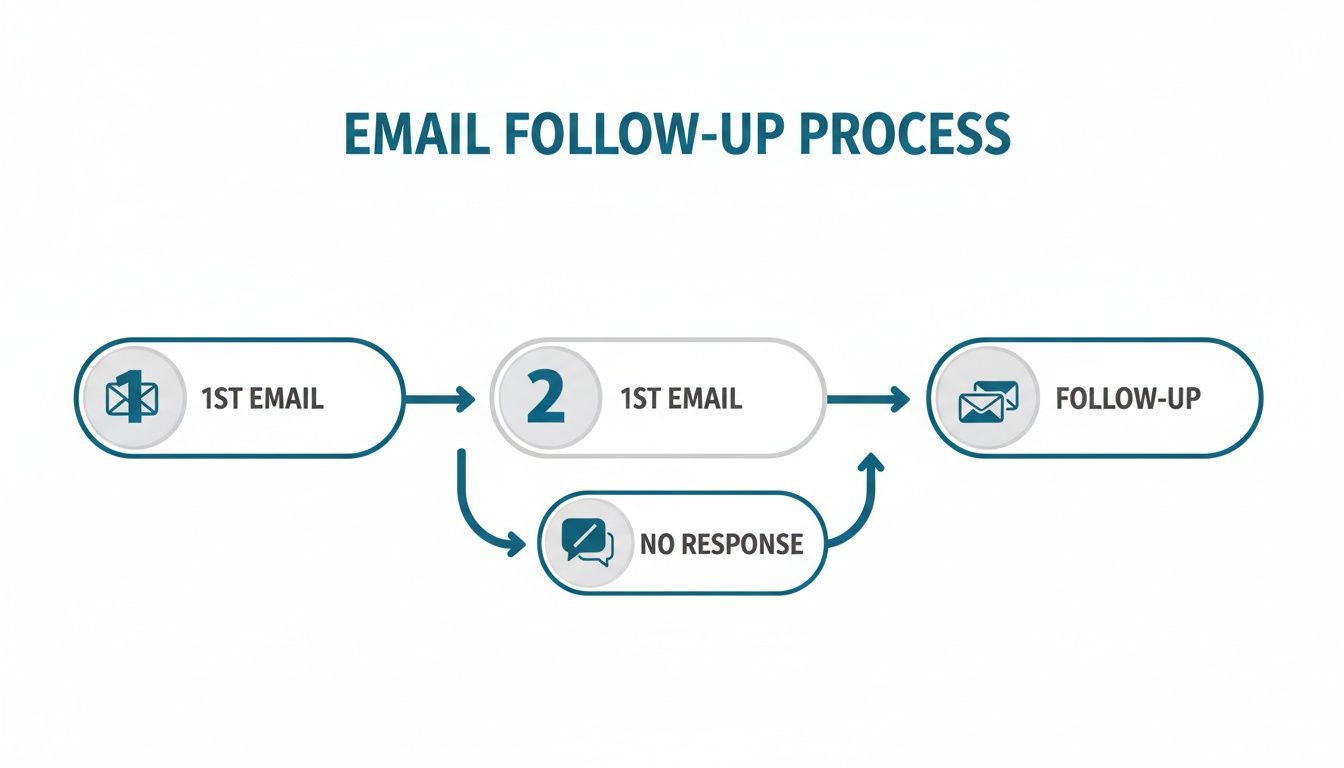
As you can see, a lack of response isn't a dead end. It’s a signal to execute a structured plan.
Finding the Right Timing and Frequency
The two variables that make or break your cadence are timing and frequency. Follow up too quickly, and you come off as aggressive. Wait too long, and any initial interest or context you built is gone.
Data from billions of B2B interactions provides a clear roadmap for what works.
- First Follow-Up (Email #2): Send this 2-3 business days after your initial email. This is the sweet spot—enough time for them to see your first message, but not so much that they’ve forgotten you.
- Second Follow-Up (Email #3): Wait an additional 3-5 business days. Widen the gap between touchpoints to avoid fatiguing your prospect.
- Subsequent Follow-Ups: For later touches, stretch the interval to 5-7 business days. This strategy maintains a light, professional presence over a longer period.
The most effective B2B sequences have 4 to 7 total touchpoints spread over 2-4 weeks. Anything less is leaving money on the table. Anything more, without any engagement, often leads to diminishing returns and a burnt-out list.
Orchestrating Your Cadence at Scale
Manually tracking these intervals for hundreds of prospects is a surefire way to let high-value deals slip through the cracks. This is where a B2B prospecting platform like Willbe replaces fragmented tools and manual workflows. It’s not just about scheduling emails; it’s about orchestrating the entire engagement sequence across multiple channels.
An AE targeting enterprise accounts can build a multi-channel cadence in Willbe that automates the heavy lifting:
- Sends the initial, hyper-personalized email on Day 1.
- Triggers a LinkedIn profile view on Day 2.
- Sends the first follow-up email on Day 4.
- Creates a task to engage with the prospect's latest LinkedIn post on Day 7.
The platform handles the timing and execution, ensuring every prospect gets the right touch at the right moment. Crucially, it automatically stops the sequence the second a prospect replies, preventing embarrassing mistakes.
This level of orchestration frees up your reps to focus on what they do best: having meaningful sales conversations, not getting buried in manual tracking. For a deeper look, check out these proven sales cadence best practices top-performing teams rely on.
How to Write a Follow-Up Email That Actually Gets a Reply
Let's be direct: the generic "just checking in" email is a waste of everyone's time and a guaranteed trip to the trash folder. To break through the silence, your follow-up has to feel like a real conversation, not an automated nudge.
Every message is a fresh opportunity to bring value, prove your relevance, and make it incredibly easy for your prospect to engage.
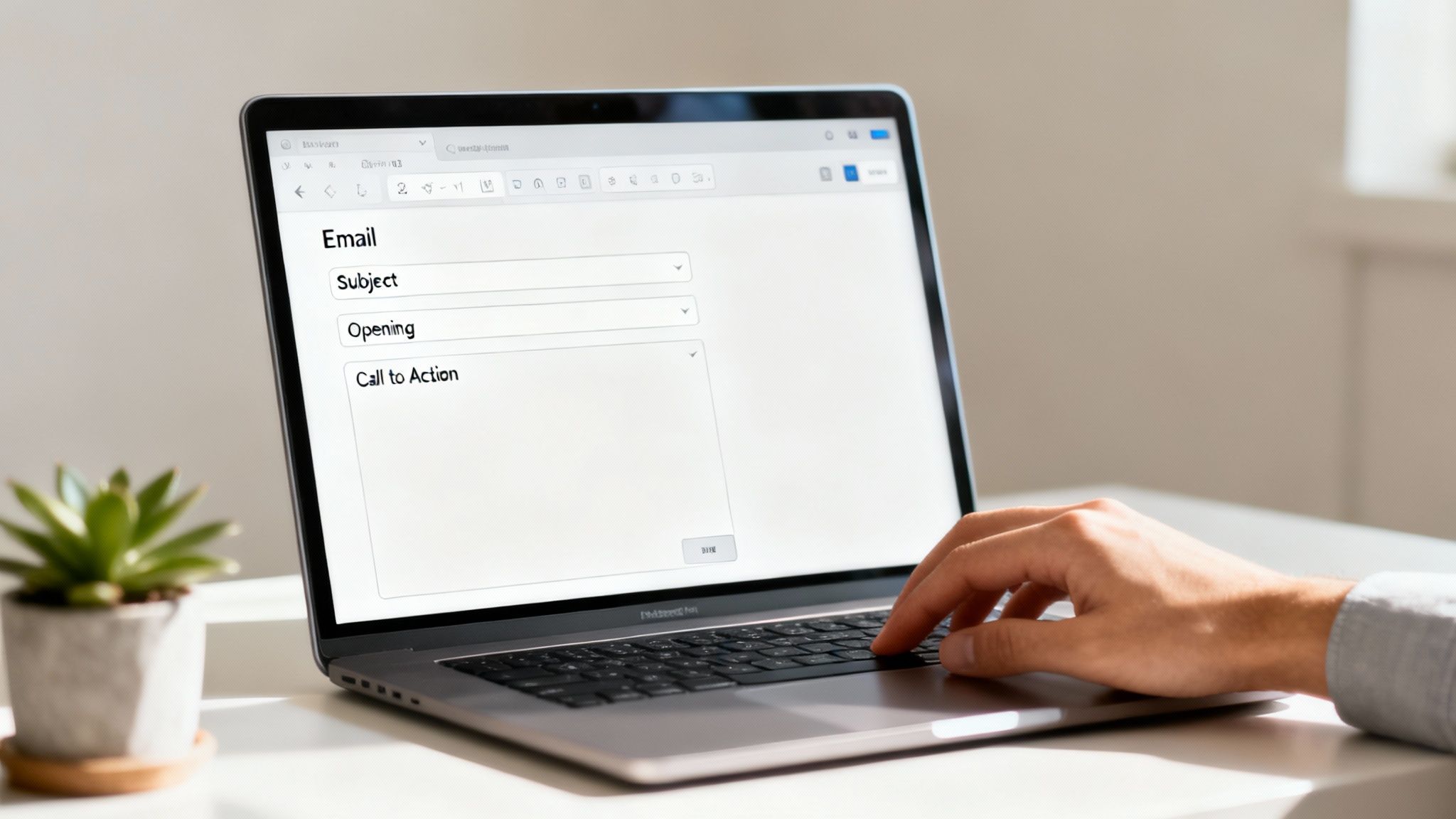
Great follow-ups boil down to three components: the subject line, the opening line, and the call to action. Each one must be sharp and contextual, whether you’re an AE chasing a warm demo request or a BDR re-engaging a cold prospect.
Nail the Subject Line
Your subject line has one job: get the email opened. Ditch generic phrases and get specific. Keep it short, direct, and easy to read on a phone.
Here are a few battle-tested approaches:
- For a warm lead: "Next steps re: our chat about [Topic]"
- For a cold lead: "A thought on [Their Company Goal]"
- The simple reply: Often, the best move is to simply reply to your last email. It keeps the thread going, which instantly jogs their memory and provides all the necessary context.
The point is to signal that this isn't a mass email blast. It’s a direct message intended for them.
The Art of the Opening Line
They opened it. You have three seconds to earn their attention. Your opening line must immediately show you’ve done your research and this message is specifically for them. A generic opener signals a generic email.
Reference something new and specific. An SDR could open with: "Saw your team's recent announcement about the new integration—congrats. It got me thinking about how you're handling [Related Challenge]."
This is where a platform like Willbe fundamentally changes the game for sales reps. Its proprietary, template-free AI scans a prospect's real-time activity—like a new LinkedIn post or a company press release—and crafts a genuinely relevant opening line that sounds exactly like the rep would write it. This enables personalization at scale, ensuring outreach feels meticulously researched without the hours of manual work.
Provide New Value with a Clear CTA
Your call to action needs to be the path of least resistance. Stop asking vague questions like, "Let me know your thoughts." Propose a clear, low-effort next step.
Your mission with every follow-up is simple: add new value. Share a different case study, a relevant article, or a fresh insight. Never send a follow-up that just asks if they saw your last email.
The data confirms this. A recent benchmark report found that 42% of all replies in cold campaigns come from follow-ups. Top performers achieve over a 10% reply rate by perfecting their cadence and content. This shows that persistence pays off, but only when it’s valuable.
Your CTA should make it easy for them to engage with the new value you just offered. For a deeper dive, review these cold email best practices.
Don't Just Email—Use LinkedIn to Create a 360-Degree Follow-Up
If your follow-up strategy lives and dies in the inbox, you're leaving a massive amount of pipeline on the table. Your prospects are active across multiple channels, and an effective outreach plan meets them where they are. Email is a workhorse, but pairing it with strategic touches on LinkedIn creates a professional persistence that’s hard to ignore.
This isn't about spamming people from every angle. It's about orchestrating a series of well-timed, complementary interactions that build familiarity. When a rep knows how to follow up on a no-response email by also engaging on LinkedIn, they transform a flat, one-dimensional message into the start of a real conversation.
How to Weave Email and LinkedIn Together
The key here is orchestration. Every touchpoint should feel like a natural part of a single, coherent outreach. Manually tracking these steps across hundreds of leads is a nightmare and a colossal waste of a rep's time. This is where an all-in-one GTM platform becomes a sales leader's best asset for executing at scale.
For example, a sequence in a platform like Willbe can intelligently move between channels:
- Day 1 (Email): Send the initial, highly personalized email.
- Day 2 (LinkedIn): Trigger a simple profile view—a quiet, low-key way to signal you’ve done your homework.
- Day 4 (Email): Send your first follow-up, referencing a new insight.
- Day 6 (LinkedIn): Send a connection request with a short, contextual note that ties back to your email thread. Avoid the generic connection message at all costs.
- Day 8 (LinkedIn): Find a recent post they shared and add a thoughtful comment—not just a "like" or "great post!"
This layered approach keeps you on their radar without feeling pushy. Each step builds on the last, creating a consistent presence that makes your next email feel less like a cold interruption and more like a note from a familiar professional.
By bringing LinkedIn into the mix, you’re doing more than just sending another follow-up; you're building social proof and genuine rapport. A prospect is infinitely more likely to open an email from someone they recognize from their professional network.
InMail: Your Strategic Alternative
If your emails are still met with silence after a few attempts, you can strategically deploy LinkedIn InMail as a powerful alternative. Keep it brief and directly reference your prior emails for context.
For instance: “Hi [Name], I sent a couple of emails about [topic] but figured I might have better luck catching you here. My thought was…”
This tactic respects their inbox while showing you're committed to connecting. Using a platform like Willbe to manage this entire workflow ensures every interaction is tracked, timed, and personalized—transforming a chaotic, fragmented process into a predictable, revenue-generating engine.
How to Measure and Scale Your Follow-Up Strategy
A great follow-up strategy isn’t just a folder of well-written emails; it's a predictable engine for generating pipeline. But you can't optimize what you can't see. To turn your outreach from a guessing game into a repeatable playbook, you must track the right metrics and have a system for scaling what works.
This is where most teams get stuck. They focus on vanity metrics like open rates, which don’t tell the full story. An open is nice, but it doesn't translate to revenue. The only question that matters is whether your follow-ups are starting conversations and driving qualified pipeline.
Moving Beyond Basic Analytics
To get a real handle on performance, sales leaders and RevOps teams need to look deeper. The goal is to draw a straight line from specific outreach activities to tangible business outcomes. Without that visibility, you're flying blind.
Focus on these KPIs to measure the health of your follow-up process:
- Meeting Booked Rate Per Sequence: This is your north star. It tells you exactly which cadences are turning cold outreach into qualified meetings.
- Positive Reply Rate: Not all replies are created equal. Track the percentage of positive responses—the "Yes, I'm interested" or "Can you send more info?" replies—to identify messaging that truly resonates.
- Conversion Rate by Touchpoint: Are most of your meetings coming from the second email or the fifth? Knowing this helps you optimize the length and intensity of your sequences. You might be giving up too early or annoying prospects with too many touches.
For sales leaders, this isn't just data—it's clarity. When you know that Sequence B has a 2x higher meeting booked rate than Sequence A, you can immediately equip the entire team with a winning play. That’s how you scale performance without scaling headcount.
A Framework for Continuous Optimization
The best sales teams are never satisfied; they constantly test and iterate. A simple A/B testing framework is crucial for refining your strategy. The key is to make small, controlled changes and measure the impact.
For instance, you could test:
- Subject Line A vs. Subject Line B: Does a question-based subject line outperform one that mentions a mutual connection? Run them side-by-side and let the data decide.
- Cadence Timing: What happens if you wait four days for the first follow-up instead of two? Test it with a segment of your list.
- The Call-to-Action: Does offering a valuable case study generate more replies than asking for a 15-minute call?
Running these tests manually isn't realistic for a busy sales team. This is where a unified platform like Willbe is a game-changer. It provides real-time analytics dashboards that surface these insights automatically.
Instead of spending hours in spreadsheets, a sales leader can instantly see which plays are driving results, share best practices, and provide data-backed coaching to lift the entire team’s performance.
Common Questions (and Real Answers) About Following Up
Even with the best playbook, you'll encounter tricky situations. Here are direct, no-fluff answers to the most common questions sales teams have about following up on an email with no response.
How Many Follow-Ups Is Too Many?
Based on extensive B2B interaction data, the sweet spot is between 4 and 7 total touchpoints, including your initial email. Stop before four, and you're leaving conversations on the table. Push past eight with zero engagement, and you risk diminishing returns and damaging your domain reputation.
The number itself isn't the whole story. What matters is the value you bring with each touch. Every message must offer something new—an insight, a different resource, a fresh angle—not another "just checking in." A modern GTM platform like Willbe helps by automatically pausing a sequence the moment someone replies, so you never bombard an engaged prospect.
The goal is to be professionally persistent, not a pest. If you're seeing zero engagement—no opens, no clicks—after 5 or 6 attempts across multiple channels, it's time to pause that sequence. You can always re-engage them in a future campaign with a different value proposition.
What's the Best Way to Automate Follow-Ups Without Sounding Like a Robot?
This is where many teams fail. They equate automation with blasting out generic messages faster. Effective automation enables personalization at scale, not repetition. Prospects can spot a basic mail-merge template from a mile away, and it kills your credibility.
To maintain a human touch, you need a platform built for it. For example, Willbe’s AI is template-free. It analyzes real-time data for each prospect—like a recent LinkedIn post or a new company announcement—and crafts a unique, relevant follow-up from scratch. The result is outreach that sounds like you wrote it specifically for them, maintaining that critical one-to-one feel even at scale.
Should I Hit Them Up on LinkedIn and Email at the Same Time?
No. Hitting a prospect with an email and a LinkedIn message at the exact same moment comes across as aggressive and desperate—a classic move that often backfires.
A much smarter play is to orchestrate a multi-channel sequence with staggered touchpoints. This creates a more natural, layered effect, keeping you top-of-mind without making the prospect feel cornered.
A simple, effective cadence might look like this:
- Day 1: Send your first email.
- Day 2: View their LinkedIn profile (a subtle signal).
- Day 4: Send your second follow-up email.
- Day 6: Send a LinkedIn connection request with a short, personalized note.
Managing this manually is a logistical nightmare. An all-in-one platform is the only way to keep it straight, ensuring every touchpoint is perfectly timed and tracked, turning a chaotic workflow into a smooth, automated process.
A systematic follow-up strategy drives a predictable pipeline. But it's only as good as the data, automation, and human-sounding messages that power it. Willbe consolidates your entire prospecting workflow, replacing a messy stack of fragmented tools with a single platform to help you find better accounts, connect with the right people, and convert pipeline faster.
See Willbe in action and discover how top-performing teams are scaling their outbound GTM engine without increasing headcount.