

Building a sales pipeline isn't just about tracking deals. It's about creating a predictable, repeatable system that turns potential interest into actual revenue. You're essentially mapping out your customer's buying journey and then managing every opportunity as it moves along that path.
Laying the Foundation: Your Pipeline Blueprint
Before you can start filling your pipeline, you need a solid blueprint. Think of it this way: you wouldn't build a house without architectural plans. A sales pipeline is the same; it's a structured process that mirrors how your ideal customer buys, moving them from initial awareness all the way to a signed deal.
Without this structure, your team is flying blind. Sales reps rely on gut feelings, forecasts are a guessing game, and the whole process feels chaotic and inconsistent.
The very first step is to define your pipeline stages. These can't be generic labels like "Lead" or "Opportunity." To be truly effective, your stages need to reflect specific, tangible milestones in your sales cycle. The best way to do this is to name them after the buyer's actions, not just your own.
Align Your Stages With the Customer's Journey
Your pipeline stages should tell a clear story of where a deal is and what needs to happen next. Instead of a vague stage called "Qualified," try something more concrete like "Discovery Call Completed" or "Solution Demo Scheduled." This simple shift brings incredible clarity to your team.
A typical B2B pipeline often looks something like this:
- Prospecting: This is ground zero. You're identifying and researching potential companies that fit your Ideal Customer Profile (ICP).
- Qualification: Here, you're making initial contact to confirm the prospect has a real need, the budget to solve it, and the authority to make a decision. Frameworks like BANT or MEDDPICC are your best friends at this stage.
- Needs Analysis: This is the deep-dive discovery call. The goal is to fully unpack the prospect's pain points, challenges, and what they hope to achieve.
- Solution Presentation: Time to shine. You're presenting a tailored demo or proposal that connects your solution directly to the needs you uncovered earlier.
- Negotiation: You're in the final stretch, hammering out the details on pricing, terms, and implementation with the key decision-makers.
- Closed-Won/Lost: The deal is done. You either have a signed contract or you've marked the deal as lost, making sure to document why for future learning.
This process lays the groundwork for a pipeline that works.
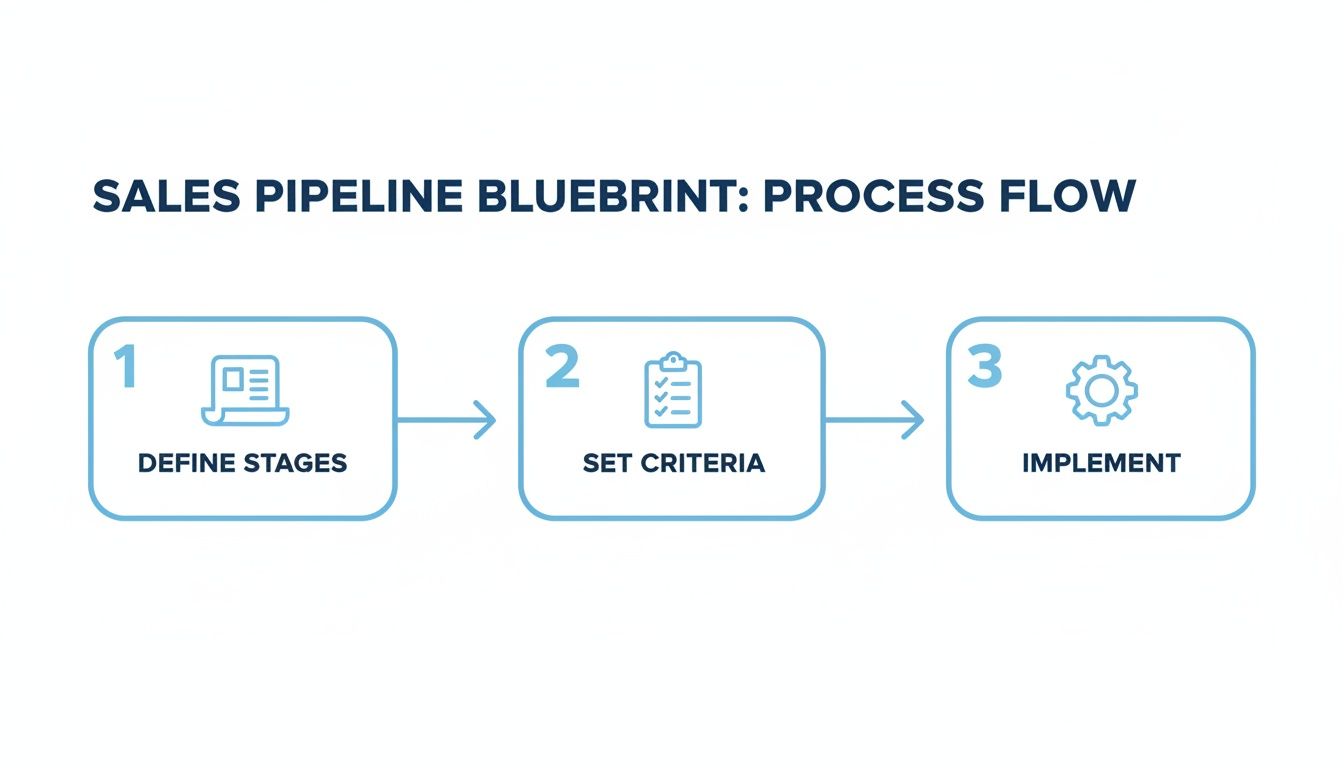
As you can see, defining the stages and the rules for moving between them is the essential foundation you have to build first.
Set Concrete Exit Criteria for Every Stage
This is the part that separates the amateurs from the pros, and it’s where most teams stumble. For every single stage in your pipeline, you must define non-negotiable exit criteria. These are the specific, black-and-white conditions that must be met before a deal can advance.
This isn't just about organization; it's about creating a data-driven process that leads to reliable forecasts. Knowing how to build a sales pipeline that actually predicts revenue starts right here.
Your pipeline should be the single source of truth for your entire sales organization. When defined correctly, it eliminates guesswork and empowers everyone—from the newest SDR to the most senior AE—to know exactly what a qualified opportunity looks like and what it takes to move it forward.
Here’s a practical example of how you can structure these stages and their corresponding exit criteria. This table provides a clear model for what activities happen where and what it takes to earn a promotion to the next stage.
Example B2B Sales Pipeline Stages and Exit Criteria
Having this level of specificity is a game-changer. For instance, an SDR can't just toss a lead over the fence. The exit criteria—"confirmed budget and scheduled a discovery call"—acts as a quality-control gate. It ensures that your Account Executives are spending their valuable time on opportunities that are truly ready for a serious conversation, not wasting cycles on unqualified leads.
Ultimately, this precision is what transforms your pipeline from a simple tracking sheet into a powerful strategic asset.
Filling Your Pipeline with High-Quality Leads
 Once your pipeline stages are mapped out, the real work begins: filling it. It's so tempting to chase volume by buying generic lists and blasting out emails, but that's a surefire way to burn out your sales reps and tank your response rates.
Your pipeline is only as good as the leads you put into it. The modern playbook isn't about casting a wide net; it’s about throwing a spear. This means getting way more specific than just company size and industry.
Go Deeper Than Standard Firmographics
Your Ideal Customer Profile (ICP) has to be more than a static description. To really get an edge, you need to segment your market based on dynamic, real-time buying signals—clues that a company isn't just a good fit, but is ready to talk now.
So, what does that look like in practice? Think about filtering your market with more powerful criteria:
- Buying Intent Signals: Who’s actively researching solutions like yours? You can track companies visiting review sites or searching for keywords related to your product, giving you a massive head start.
- Tech Stack Data: Does a prospect use a specific CRM, like HubSpot, or other software that complements your solution? This is a huge indicator of fit and gives you a perfect angle for personalization.
- Company Trigger Events: Has a target account just landed a new round of funding? Did they recently hire a new VP of Sales? Events like these often signal new budgets and strategic shifts.
Layering these data points helps you build hyper-targeted lists of accounts that are far more likely to convert. You’re shifting your focus from "who could buy" to "who is ready to buy." If you're looking for more ways to source these types of leads, check out our guide on B2B lead generation best practices.
Prioritize Precision in Your Segmentation
Let's walk through a real-world example. Say you sell a project management tool that integrates seamlessly with HubSpot. The old way would be to target every B2B tech company with 50-200 employees. That's a huge, generic pool.
A much sharper strategy would be to target B2B tech companies with 50-200 employees that also meet these criteria:
- They already use HubSpot.
- They recently posted job openings for project managers.
- They have shown increased web traffic to your competitors' sites.
Suddenly, your outreach is no longer a cold interruption. It's a timely, relevant conversation.
The goal isn't just to find qualified accounts; it's to find qualified accounts at the right moment. By focusing on triggers and intent, you ensure your sales team's effort is spent on conversations with the highest probability of success.
This level of precision is becoming essential. Gartner projects that by 2025, a staggering 80% of B2B sales interactions will happen on digital channels. This isn’t just a trend; it's a fundamental shift in how people buy.
Prospects now do most of their research on their own—across an average of 10 channels—before they even think about talking to a sales rep. That self-guided journey means you have to get good at identifying their needs based on their digital footprints, long before they ever reach out.
Crafting Outreach That Actually Gets a Response
Alright, you've got your list of high-intent targets. Now for the hard part: actually getting them to listen. Let's be honest, a generic, one-size-fits-all email blast is a one-way ticket to the spam folder.
If you want to build a sales pipeline that actually converts, your outreach has to feel personal, timely, and valuable from the very first hello. That means ditching the single-channel mindset. Modern sales is all about creating a carefully orchestrated sequence that weaves together different platforms into a single, cohesive conversation.
Building a Multi-Channel Outreach Sequence
A powerful sequence isn't just about repeating the same message on email, LinkedIn, and the phone. Each touchpoint should build on the last, creating a narrative that gently guides the prospect toward a conversation. The goal here is to be persistent without being a pest.
Think of it as a strategic dance combining automated and manual touches. It can take anywhere from five to twelve points of contact just to get a response. If you're only sending one email and a lazy follow-up, you're setting yourself up for failure.
Here’s what a smart, multi-touch sequence might look like in the wild:
- Day 1: Start with a highly personalized email. Reference a specific trigger, like a recent funding announcement or a key new hire. On the same day, send a connection request on LinkedIn.
- Day 3: Follow up on LinkedIn with a quick message. Don't sell—just offer a valuable insight related to their role or a recent industry trend.
- Day 5: Send a follow-up email with a relevant case study or a short video that tackles a common pain point for their role.
- Day 7: Make a brief, professional cold call. The goal isn't a long pitch; it's to ask one key question to gauge interest and prove you're a real person.
This approach dramatically increases the odds of being seen and, more importantly, shows you’ve done your homework. It turns your outreach from an unwelcome interruption into a relevant, helpful interaction.
Personalization Is More Than a Mail Merge
True personalization goes way beyond just dropping {{FirstName}} and {{CompanyName}} into a template. Everyone can spot a generic, automated message from a mile away. You have to make every single message feel like it was written specifically for the person reading it.
This is where all that hard work on your ICP and segmentation really pays off. Instead of just rattling off your product's features, anchor your message in the prospect's world. We dive much deeper into this in our guide to successful appointment setting for B2B.
The best outreach doesn't sell a product; it solves a problem. Your opening line has one job: prove you understand the prospect's challenges and have a damn good reason for reaching out. It’s the difference between asking "Can I have 15 minutes?" and earning it.
Let's look at two opening lines. First, the generic, forgettable one: "My name is John from XYZ, and we help companies like yours increase efficiency." Deleted.
Now, compare that to a value-driven alternative: "Saw your recent LinkedIn post about the challenges of scaling your support team. When SaaS companies we work with hit that growth stage, they often tell us ticket backlogs become a major headache." See the difference? It immediately establishes relevance, empathy, and authority.
Focus on Pain Points, Not Product Features
Remember, your initial outreach has one primary goal: starting a conversation. You are not trying to close a deal in the first email. Because of this, your call-to-action (CTA) needs to be as low-friction as possible.
Stop using hard-sell CTAs like "Book a demo now." Instead, use interest-based language that invites a simple, easy response.
Here are a few low-friction CTAs that actually work:
- "Is solving this a priority for you right now?"
- "Would a brief outline of how we helped [Similar Company] with this be useful?"
- "Are you open to exploring how this might apply to your team?"
These questions make it incredibly easy for someone to reply with a "yes" or "no," which is all you need to open the door for a real discussion. This subtle shift in your ask can make a massive difference in response rates, helping your team consistently book the qualified meetings that actually move deals forward.
Making Your CRM a Pipeline Powerhouse
Look, a beautifully designed sales pipeline on a whiteboard is a great starting point. But if it doesn't live and breathe inside your CRM, it’s just a theoretical exercise. The reality is, without the right tech and workflows, your perfect pipeline will crumble under the weight of manual data entry, messy handoffs, and reps doing things their own way.
Your CRM needs to be more than just a digital rolodex. It should be the engine driving every single deal forward. For those of us in sales and revenue operations, our job is to build a system where reps can actually sell, not spend their days buried in administrative busywork. That all starts with clean data and workflows that just work.
First things first: your CRM stages must be an exact mirror of your documented sales process. If you call a stage "Solution Presentation" in your playbook, that's precisely what it needs to be called in the CRM. This isn't just about being neat; it’s about creating one source of truth so there’s zero ambiguity about where any deal actually stands.
Building Workflows That Give Reps Their Time Back
With the basic structure in place, you can get to the good stuff: automation. Manual tasks are the silent killers of sales productivity. I've seen countless reports, and they all say the same thing: reps spend as little as one-third of their time on activities that actually generate revenue. Automation is how you reclaim that lost time.
Think about all the repetitive, low-value tasks your team gets stuck with every single day. Those are your prime targets for automation.
- Lead Rotation: Stop having a manager play air traffic control with new leads. Set up rules in your CRM to assign them automatically. You can do a simple round-robin, or get more sophisticated and assign based on territory, company size, or industry vertical.
- Logging Activities: Manually typing up call notes or logging emails is a soul-crushing waste of time. Connect your sales engagement tools directly to your CRM so every email, call, and social touchpoint is captured on the right record, instantly.
- Smart Task Triggers: Let the CRM tell your reps what to do next. For example, you can create a workflow that automatically generates a high-priority follow-up task for a rep the moment a prospect opens the pricing email for the third time.
These aren't just minor time-savers. They build a system of accountability. Important follow-ups don't slip through the cracks, and your deal data stays fresh, giving you an accurate, real-time picture of your pipeline's health.
The "Single Pane of Glass" Dream
The best sales teams I've worked with operate from a single, unified command center. When your reps are constantly bouncing between their inbox, LinkedIn, a dialer, and the CRM just to work one deal, you're bleeding productivity and losing critical context along the way.
Your goal should be to build a CRM environment where your reps can live and breathe all day. When you integrate their essential tools and automate the data sync, the CRM stops being a chore and becomes their most valuable asset—the central hub for every single selling motion.
Imagine this: your SDR can run an entire multi-channel sequence—emails, calls, social touches—without ever leaving the CRM. Every action is logged automatically. When that lead becomes a qualified opportunity, the AE gets the handoff with a perfect, complete history of every interaction.
This means the prospect doesn't have to repeat their story, and the AE walks into the conversation armed with the context needed to make it strategic. That seamless flow of information is the absolute foundation for building a sales pipeline that can scale predictably.
Using Data to Optimize Your Pipeline and Predict Revenue

A well-structured pipeline is a great start, but it’s only half the battle. If you aren't measuring what’s happening inside it, you’re flying blind. You simply can't improve what you don't measure. This is where data transforms pipeline management from a gut-feel art form into a repeatable science for scaling revenue.
To get predictable growth, you have to look past surface-level numbers like your total lead count. The real insights are found by tracking how deals flow—or don't flow—through each stage. This data-driven view helps you spot bottlenecks, coach your team more effectively, and forecast with actual confidence.
Monitoring the Health of Your Pipeline
The right Key Performance Indicators (KPIs) act like a health check for your entire sales process. They don’t just tell you what is happening; they start to reveal why it's happening, giving you the power to make smart, strategic adjustments instead of just reacting.
To get started, here are a few of the most important metrics to keep a close eye on:
- Stage-to-Stage Conversion Rates: What percentage of deals successfully move from one stage to the next? This is ground zero for finding leaks in your process.
- Average Sales Cycle Length: How long does it take, on average, for a deal to go from creation to close (won or lost)? If this number starts creeping up, it’s a sign of friction.
- Pipeline Velocity: This is a fantastic compound metric that tells you how much revenue you're closing per day. It combines your number of opportunities, average deal size, and win rate, all divided by your sales cycle length. It's a real-time pulse on your revenue engine.
Think of these numbers as your diagnostic toolkit. For example, a massive drop-off between "Discovery" and "Solution Presentation" is a huge red flag. It might mean your team isn't qualifying leads properly or is struggling to connect your product's value to the prospect's pain points.
Pinpointing Leaks with Conversion Data
Let's dig into conversion rates. Analyzing the percentage of deals that advance from stage to stage is absolutely crucial for optimization. If you look at B2B pipeline data, you'll see that a lot of momentum gets lost at specific handoff points, like the transition from a Marketing Qualified Lead (MQL) to a Sales Qualified Lead (SQL). That's often where unvetted leads clog up the works. MarketJoy’s data on B2B conversion rates shows just how important it is to nail these transitions.
Imagine you pull up your dashboard and notice your conversion rate from "Solution Presentation" to "Negotiation" is only 15%, but you know the industry benchmark is closer to 30%. That’s not just a number; it’s a bright, flashing signal. It tells you exactly where to start digging. Are the demos falling flat? Are you failing to get the key decision-makers in the room? The data points you directly to the problem you need to solve.
Your CRM data is a treasure map. It shows you where deals are getting stuck, where your top reps are excelling, and which outreach strategies are actually working. Use it to double down on what works and provide targeted coaching where it's needed most.
A healthy sales pipeline is a predictable one. The table below outlines the essential metrics every sales leader should be tracking to move from guesswork to data-driven forecasting.
Essential Pipeline Health Metrics You Should Be Tracking
Tracking these KPIs consistently gives you a clear, objective view of your sales engine's performance, helping you spot issues before they derail your entire quarter.
From Reactive to Predictive Forecasting
As you build this historical data, your ability to forecast revenue gets exponentially better. You can finally stop relying on a rep’s gut feeling about a deal. Instead, you can apply your actual, historical conversion rates to your current pipeline value.
This creates what’s called a weighted pipeline, and it gives you a far more realistic projection of what’s likely to close. For instance, if you know that deals in the "Negotiation" stage have historically closed at a 70% rate, you can confidently forecast $70,000 in revenue from every $100,000 sitting in that stage.
This data-driven approach turns forecasting from a guessing game into a reliable tool for business planning. With the right real-time analytics tools, you can even surface these critical insights automatically.
By consistently tracking, analyzing, and acting on these core pipeline metrics, you create a powerful feedback loop. You stop reacting to missed quotas and start proactively steering your sales process, ensuring your pipeline isn't just full—it's healthy, efficient, and built to drive predictable growth.
Common Questions We Hear About Building a Sales Pipeline
Even when you have a solid plan on paper, building and managing a sales pipeline in the real world throws curveballs. Honestly, navigating these common sticking points is often what separates the teams that consistently crush their numbers from those left scrambling at the end of the quarter.
Let's dig into some of the most frequent questions I hear from sales leaders. I'll give you the straight, actionable answers to help you build a process that actually works.
How Many Stages Should Our Pipeline Actually Have?
This is the classic question, and the only honest answer is: it depends. There’s no magic number that works for every single business. The right number of stages is simply the number that accurately mirrors how your customer buys.
A huge mistake I see teams make is going to one of two extremes. Either they have too few stages, leaving them blind to where deals are really stalling, or they have too many, turning the pipeline into a bureaucratic nightmare that reps hate updating.
As a general rule of thumb, aim for somewhere between five and eight stages. That's usually the sweet spot for capturing the key milestones in a typical B2B sale without getting bogged down in unnecessary detail.
Your stages should mark significant progress, not just busywork. Think of them as major gates a deal has to pass through. Each one should require a clear action from either your team or the buyer to move forward. If a stage doesn't signal a real shift in the deal's momentum, you probably don't need it.
For example, a stage like "Sent Follow-Up Email" is way too granular. A much better stage is "Decision Maker Meeting Scheduled"—that's a tangible step forward that tells you something important about the deal.
What's the Best Way to Handle Stalled Deals?
Deals that go quiet are the silent killers of a healthy pipeline. They clog up your forecast, eat up your reps' time and mental energy, and create a false sense of security. The first step is to get crystal clear on what "stalled" actually means for your team.
A deal should be flagged as stalled if it's been sitting in one stage for longer than your average sales cycle for that stage. For instance, if deals typically spend 10 days in your "Needs Analysis" stage, any deal that hits day 15 needs immediate attention.
Once a deal is flagged, you need a clear playbook:
- Re-engage with Value, Not a Nudge: The first move should never be a weak, "just checking in" email. Coach your reps to go back in with something valuable—a new case study, an insight about a competitor, or an offer to connect them with a technical expert on your team.
- Confirm Their Priorities Haven't Changed: It's entirely possible their world has shifted. The rep needs to tactfully ask if the problem they initially discussed is still a top priority.
- Lock In a Concrete Next Step: If the prospect is still in the game, the goal is to get a firm date on the calendar for a specific next step, like a call to review the proposal with their CFO next Tuesday.
If those attempts get nothing but crickets, it’s time to be decisive. The "break-up" email is surprisingly effective. It’s a final, polite message that acknowledges their silence and closes the loop, basically saying you assume the timing isn’t right and you'll move on. You'd be amazed how often this prompts an immediate response and brings clarity, one way or another.
How Do I Keep My Pipeline Data From Becoming a Mess?
Bad pipeline data isn't just an annoyance; it leads to disastrous forecasting and terrible strategic decisions. Keeping your data clean is an ongoing discipline, not a one-time cleanup project. It comes down to a mix of clear standards, smart automation, and team accountability.
The absolute foundation of clean data is enforced exit criteria for every single stage. We've talked about this, but it's worth repeating: a deal cannot move from one stage to the next unless specific, non-negotiable actions have been completed and logged in the CRM. This stops reps from advancing deals based on "happy ears" or a vague gut feeling.
Automating activity logging is another game-changer. When your reps' emails, calls, and meetings are automatically synced to your CRM, you take human error and forgetfulness out of the equation. This ensures every opportunity record tells the true story of engagement, giving you a much more accurate read on deal health.
Finally, you have to run consistent pipeline reviews. These meetings aren't just for forecasting; they're for inspecting the data. As a manager, you should be asking tough questions:
- "What's the concrete evidence that this deal belongs in this stage?"
- "What are the specific next steps, and who owns them?"
- "Why has this deal been sitting here for X days?"
This kind of regular inspection builds a culture where reps understand that clean, accurate data isn't optional—it's a core part of their job.
Ready to build a pipeline that not only looks good but also drives predictable revenue? Willbe gives you the tools to find high-intent leads, personalize your outreach at scale, and keep your CRM data pristine with automated workflows. See how our all-in-one platform can help you build and manage a healthier sales pipeline by visiting https://www.willbe.ai.