


In today's crowded B2B landscape, the old playbook of high-volume, generic outreach is obsolete. Buyers are more informed, markets are more competitive, and cutting through the noise requires a smarter, more surgical approach. The most successful revenue teams have shifted their focus from raw lead quantity to pipeline quality, leveraging precise strategies to engage the right accounts at the right time with the right message. This isn't just about sending more emails; it's about building a system that predictably generates high-value opportunities.
This guide breaks down the essential B2B lead generation best practices that modern sales organizations use to build scalable revenue engines. We've moved beyond surface-level advice to provide a comprehensive framework that connects strategy with execution. You won't find generic tips here. Instead, you'll get actionable blueprints for implementing systems that drive real results.
Inside, we will cover critical topics including:
- Intent-Based Targeting & Account Selection to focus efforts exclusively on active buyers.
- Hyper-Personalized Multi-Touch Outreach that scales meaningful conversations across email and LinkedIn.
- Buying Committee Mapping & Multi-Threading to navigate complex deals and build consensus.
- Data Quality & List Hygiene Automation to ensure your foundation is clean, accurate, and reliable.
- Sequence Optimization & A/B Testing to continuously improve engagement and conversion rates.
Whether you're building an outbound function from scratch or optimizing an existing one, these practices provide a clear roadmap to generating more qualified meetings, accelerating growth, and creating a sustainable competitive advantage in your market.
1. Intent-Based Targeting & Account Selection
Traditional B2B lead generation often feels like shouting into the void. You build a list based on firmographics (company size, industry) and hope your timing is right. Intent-based targeting flips this model by prioritizing accounts that are actively showing buying signals. This approach leverages data to identify companies researching solutions like yours right now, dramatically improving engagement and conversion rates.
Instead of guessing who might be interested, you focus your energy on those who have already raised their digital hand. This is a cornerstone of modern B2B lead generation best practices because it shifts the focus from quantity to quality, ensuring your sales team spends time on prospects most likely to convert.
How Intent Data Works
Intent data platforms aggregate billions of online activities to pinpoint accounts in a buying cycle. These signals can be first-party (your own website visits, webinar sign-ups) or third-party (competitor comparisons on review sites, relevant keyword searches, content consumption across the web).
Examples of High-Intent Signals:
- Surges in Web Traffic: An account suddenly visits your pricing page or case studies.
- Competitor Research: Key decision-makers from a target account are comparing your solution on G2 or Capterra.
- Relevant Hiring: A company posts job descriptions for roles that would use your software (e.g., "Head of Demand Generation").
- Funding or Expansion News: A press release announces a new funding round, signaling budget for new tools.
Actionable Tips for Implementation
- Layer Your Data: Combine intent data with your Ideal Customer Profile (ICP). An account showing intent is only valuable if it also fits your firmographic and technographic criteria.
- Act with Speed: Timing is critical. Set up automated alerts to notify your sales team within 24-48 hours of a new intent signal. This allows for timely, relevant outreach while you're still top of mind.
- Prioritize Compound Intent: An account visiting your blog is a weak signal. The same account also viewing your pricing page and a competitor comparison review is a strong, compound signal. Prioritize these opportunities.
- Segment by Intent Stage: Tailor your messaging. An account in the "awareness" stage (reading general industry content) needs educational material, while one in the "decision" stage (viewing pricing) is ready for a demo offer. By using tools to automate this research, you can build smarter, more effective prospecting lists. For a deeper dive on this, you can learn more about how to refine your prospecting.
2. Hyper-Personalized Multi-Touch Outreach (Email + LinkedIn)
Generic, one-size-fits-all cold outreach is dead. Hyper-personalization moves beyond simple mail merge tags like {{first_name}} and {{company}} to craft unique messages based on deep prospect research. This approach leverages company context, recent news, and individual buying intent to create authentic, relevant communication that stands out in a crowded inbox.

By combining this tailored messaging with an orchestrated, multi-touch sequence across email and LinkedIn, you maximize visibility without being repetitive or spammy. This strategy is a crucial B2B lead generation best practice because it dramatically lifts response rates and builds genuine rapport, separating quality outbound from generic blasts that burn through your lists.
How Hyper-Personalization Works
Instead of relying on a single template, modern outreach uses AI and strategic research to generate messaging that references specific details about the prospect's company, role, and challenges. The goal is to show you've done your homework and understand their world before asking for their time. This is then deployed across multiple channels in a logical sequence.
Examples of Hyper-Personalization Hooks:
- Recent Achievements: Referencing a prospect's recent LinkedIn post, promotion, or a project they shared.
- Company News: Tying your message to a recent funding announcement, new product launch, or expansion into a new market.
- Role-Specific Pain Points: Mentioning a specific challenge or goal relevant to their title (e.g., "Noticed you're hiring three new SDRs, which often means scaling onboarding is a priority...").
- Shared Connections or Content: Acknowledging a mutual connection or referencing an article they recently commented on or shared.
Actionable Tips for Implementation
- Focus on 3-5 Data Points: For each prospect, gather a few key research points. This could be one company-level insight (like a recent acquisition) and two individual-level insights (like a recent post and a podcast appearance).
- Orchestrate Your Channels: Build sequences that chain email and LinkedIn touches together. For example, send an email on Day 1, a LinkedIn connection request on Day 2, and a LinkedIn message referencing the email on Day 4.
- Keep Openers Concise: Your personalized opening line should be powerful but brief. Aim for one to two sentences that immediately demonstrate relevance and capture attention.
- Use Video for High-Value Accounts: For tier-one prospects, a short, personalized video message (using a tool like Loom or Vidyard) can have a massive impact and significantly increase meeting booking rates.
- Track What Works: Use your CRM to tag which personalization angles generate the most replies and conversions. This data is invaluable for coaching your team and refining your outreach strategy.
3. Account-Based Marketing (ABM) & Account-Based Selling (ABS)
Where traditional lead generation casts a wide net, Account-Based Marketing (ABM) uses a spear. This strategic approach treats individual high-value accounts as markets of one, coordinating marketing and sales efforts to land and expand them. It’s a complete shift from generating volume to creating targeted, personalized engagement with the companies that matter most.
ABM flips the funnel, focusing resources on a curated set of accounts that fit your Ideal Customer Profile (ICP) perfectly. Account-Based Selling (ABS) is the execution arm of this strategy, where sales teams use coordinated, multi-channel outreach to engage key decision-makers within those target accounts. This synergy makes it one of the most effective b2b lead generation best practices for companies targeting mid-market and enterprise deals.
How ABM & ABS Work
Instead of waiting for individual leads to come in, marketing and sales teams collaborate to build a target account list (TAL). They then work together to map out the buying committee, create personalized messaging for different personas, and execute coordinated multi-channel campaigns. The goal is not just a single MQL, but to warm up the entire account and secure qualified meetings.
Examples of ABM/ABS in Action:
- Targeted Events: Inviting key stakeholders from a target account like Salesforce to an exclusive dinner or webinar.
- Coordinated Outreach: A marketing campaign warms up an account with targeted ads while an SDR uses personalized video and LinkedIn messages to engage a specific buyer.
- C-Suite Targeting: Using tools like LinkedIn Sales Navigator to identify and engage the entire C-suite buying committee at a Fortune 500 company.
- Personalized Content: Creating a bespoke landing page or case study that speaks directly to a target account’s specific pain points.
Actionable Tips for Implementation
- Start Small and Pilot: Begin with a pilot program of 20-50 high-value accounts. Prove the model and create repeatable playbooks before attempting to scale company-wide.
- Map the Entire Buying Committee: Don't stop at one contact. Identify the 4-7 key decision-makers and influencers within each target account and tailor your outreach to their specific roles and priorities.
- Align Sales and Marketing: Schedule weekly alignment meetings between sales and marketing to review account engagement, share insights, and coordinate the next wave of outreach.
- Track Account-Level Metrics: Shift your focus from lead-based metrics (like MQLs) to account-based metrics. Track account engagement, pipeline influenced, and meetings booked per target account. This method redefines the core of what is lead generation in sales from a numbers game to a strategic pursuit.
4. Data Quality & List Hygiene Automation
Sending outreach to a dirty list is like trying to build a house on a foundation of sand. No matter how brilliant your messaging or strategic your sequence, your efforts will collapse if your data is inaccurate. Data quality and list hygiene automation are the processes that ensure your contact data is accurate, verified, and up-to-date, forming the bedrock of successful outbound campaigns.
Instead of manually checking contacts or discovering bad emails after a campaign fails, this best practice involves using automated systems to continuously validate and enrich your data. This preemptive approach protects your sender reputation, improves deliverability, and ensures your sales team invests their time only on reachable, relevant prospects.
How Data Hygiene Automation Works
Automated data hygiene platforms integrate with your prospecting tools and CRM to continuously clean your contact lists. They work by cross-referencing multiple data sources to validate information, flag invalid entries, and enrich profiles with current details, preventing data decay before it impacts your outreach.
Examples of Automated Hygiene Actions:
- Email Verification: A platform like ZeroBounce checks email syntax, domain validity, and SMTP responses to confirm an address is active and can receive mail.
- Job Change Updates: When a contact moves to a new company, tools like Apollo.io or Clearbit can automatically flag the old record and help find their new role.
- Duplicate Removal: Systems automatically identify and merge duplicate contact or company records within your CRM, preventing redundant outreach.
- Data Enrichment: Missing data points like phone numbers or job titles are automatically appended, providing a more complete profile for personalization.
Actionable Tips for Implementation
- Validate Upstream: Always clean a new list before uploading it to your sales engagement platform or CRM. This prevents bad data from ever entering your core systems.
- Implement Automated Suppression: Set up rules to automatically add contacts who bounce, unsubscribe, or mark your emails as spam to a suppression list. This is crucial for long-term deliverability.
- Monitor Your Bounce Rate: A core KPI for list health is your hard bounce rate. Consistently keep this metric below 2% to protect your domain's sending reputation.
- Schedule Regular Audits: Data decays at a rate of over 20% per year. Schedule automated weekly or monthly scrubs of your existing database to catch outdated job titles and invalid emails. Platforms like Willbe integrate over 30 databases to provide continuous updates, ensuring your lists remain fresh.
5. Buying Committee Mapping & Multi-Threading
The days of selling to a single decision-maker in B2B are over. Modern deals involve a buying committee of 4-7+ stakeholders, each with their own priorities and influence. Ignoring this reality is a direct path to a stalled deal. Multi-threading is the practice of building relationships with multiple people within the target account, turning a single point of contact into a network of internal champions.
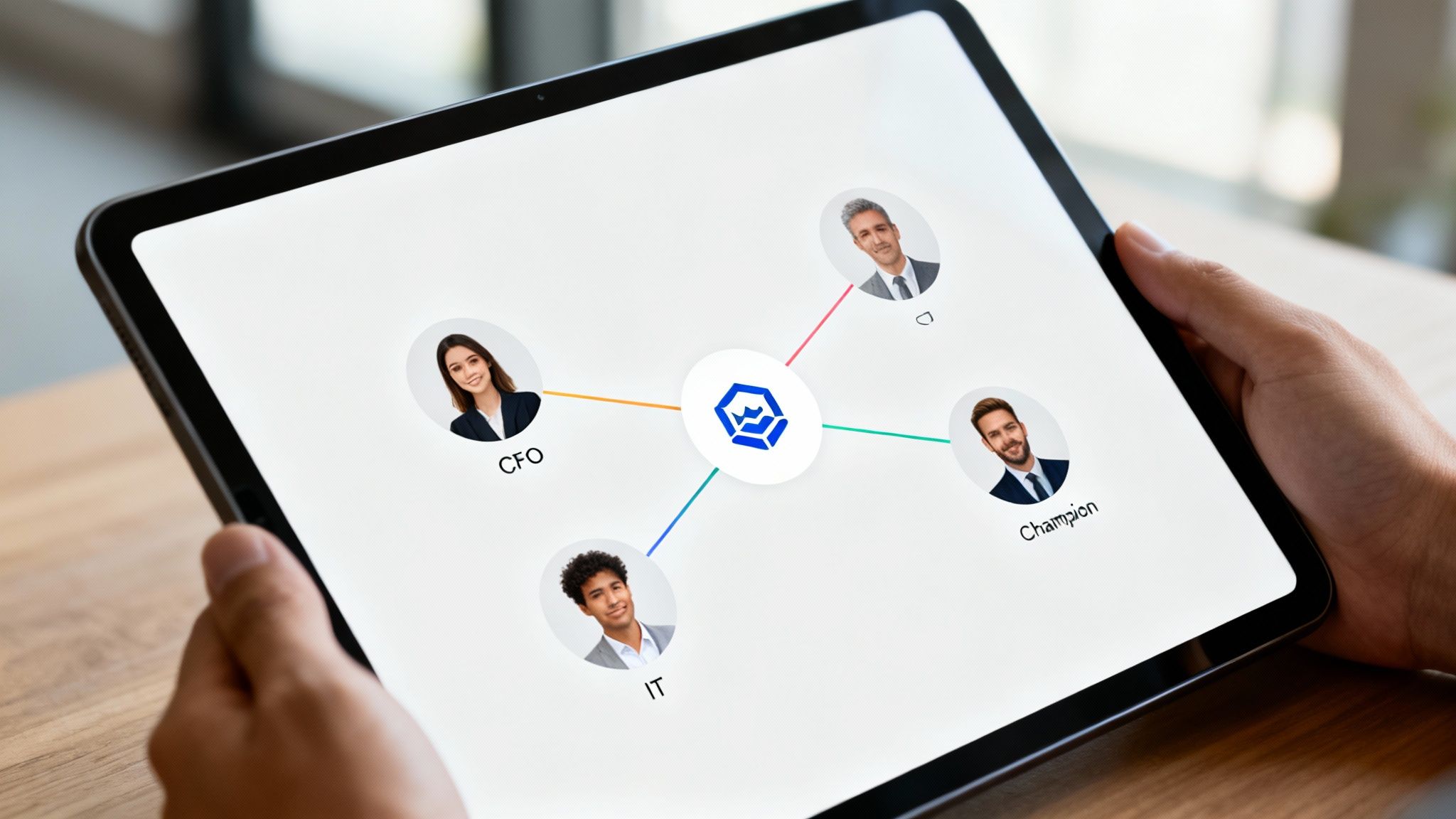
Mapping this committee early on is a crucial B2B lead generation best practice because it de-risks the sales process. If your primary contact leaves the company or goes dark, you have other advocates to keep the momentum going. This approach increases win rates and deal velocity, especially in complex mid-market and enterprise sales cycles.
How Buying Committee Mapping Works
Mapping involves identifying and engaging the key personas involved in a purchasing decision. This isn't just about finding names; it's about understanding their roles, motivations, and how your solution impacts their specific goals. A well-executed strategy coordinates outreach across these individuals to build broad consensus.
Examples of Key Committee Members:
- Economic Buyer (e.g., CFO): Cares about ROI, total cost of ownership, and business impact.
- User Buyer (e.g., Sales Rep, Product Manager): Focuses on daily usability, features, and workflow efficiency.
- Champion (e.g., IT Director, Head of Ops): Believes in your solution and will advocate for it internally.
- Influencer (e.g., Procurement, Legal): Doesn't make the final decision but can create roadblocks or provide critical input.
Actionable Tips for Implementation
- Identify Your Champion First: Start by finding the person most likely to benefit directly from your solution. This individual will often help you navigate the internal landscape and introduce you to other stakeholders.
- Leverage LinkedIn and Org Charts: Use tools like LinkedIn Sales Navigator to research team structures and identify potential committee members. Look for titles that align with common buyer personas for your industry.
- Tailor Messaging Per Persona: Do not send the same generic email to everyone. Craft role-specific value propositions: talk ROI with the CFO, efficiency gains with the user, and strategic advantage with leadership.
- Explicitly Ask for Introductions: Don't be afraid to ask your current contact, "Who else from your team will be involved in evaluating this decision?" This is the most direct way to map the committee.
- Divide and Conquer: Coordinate outreach between SDRs and AEs. The SDR can focus on engaging user buyers and influencers, while the AE builds a strategic relationship with the economic buyer and champion.
6. Sequence Optimization & A/B Testing
Sending a single cold email and hoping for the best is a recipe for failure. Modern outbound effectiveness is built on structured sequences, a series of 5-8 automated and manual touches across multiple channels (email, phone, LinkedIn) over several weeks. However, even the best sequence design is just a starting point. Sequence optimization and continuous A/B testing transform this process from guesswork into a data-driven science.
This practice is essential because it allows you to systematically discover what actually resonates with your audience. Instead of relying on assumptions, you use real-world data to refine your messaging, timing, and channel mix, which dramatically lifts engagement rates and makes your pipeline more predictable. It's a core component of B2B lead generation best practices for scaling what works and eliminating what doesn't.
How Sequence A/B Testing Works
A/B testing involves creating two or more variations of a single element within your outreach sequence and sending them to different segments of your audience to see which performs better. The goal is to isolate one variable at a time to definitively measure its impact on key metrics like open rates, click-through rates, and, most importantly, positive reply rates.
Examples of High-Impact A/B Tests:
- Subject Lines: Testing a direct, benefit-driven subject line (e.g., "[Company Name] + [Your Product]") against a curiosity-driven one (e.g., "Idea for your team").
- Opening Hooks: Comparing an opening sentence focused on a prospect's pain point versus one highlighting a recent company achievement.
- Call-to-Action (CTA): Measuring the performance of a high-commitment ask ("Book a 15-min call") against a low-commitment offer ("Watch this 2-min demo").
- Channel Order: Running a sequence that starts with a LinkedIn connection request versus one that leads with a personalized email.
Actionable Tips for Implementation
- Isolate One Variable: To get clean data, only test one element at a time. If you change the subject line and the CTA simultaneously, you won't know which change drove the result.
- Ensure Statistical Significance: Don't declare a winner too early. Aim for a sample size of at least 100-200 sends per variation to ensure your results are not due to random chance.
- Track Full-Funnel Metrics: Look beyond open rates. A subject line might get more opens but fewer replies. The ultimate goal is qualified meetings, so track reply rates and conversions.
- Document and Iterate: Create a "playbook" of winning variations for different segments (e.g., SMBs might respond to a different value proposition than enterprise accounts). Continuously test and refine these "champion" formulas, as what works today may not work next quarter.
7. Predictive Lead Scoring & Prioritization
Manual lead scoring relies on assigning arbitrary points based on fixed rules (e.g., +5 for "Director" title, +10 for visiting the pricing page). Predictive lead scoring replaces this rigid system with machine learning, creating a dynamic model that identifies prospects most likely to convert based on historical data. It analyzes thousands of data points to surface opportunities that mirror your most successful customers.
This data-driven approach allows sales teams to stop guessing and start focusing their efforts on leads with the highest probability of closing. It's one of the most impactful b2b lead generation best practices because it directly boosts SDR productivity and pipeline quality by prioritizing the right accounts at the right time.
How Predictive Scoring Works
Predictive models analyze your historical "won" and "lost" opportunities to identify common attributes and behaviors. The system then scores new inbound and outbound leads based on how closely they match the profile of your best customers. It combines firmographic, technographic, behavioral, and intent signals for maximum accuracy.
Examples of Predictive Scoring in Action:
- High-Fit Profile: A lead from a 500-person SaaS company (firmographic) using Salesforce and Marketo (technographic) gets a high score because your best customers fit this profile.
- Behavioral Triggers: An account that fits your ICP visits your pricing page and downloads a case study within 24 hours, signaling active buying intent.
- Similarity Matching: LinkedIn Sales Navigator identifies prospects with similar job titles, skills, and engagement patterns as your existing champions.
- Revenue Optimization: A model from a tool like Gong identifies conversational patterns from winning sales calls and scores leads based on their similarity to those successful interactions.
Actionable Tips for Implementation
- Train with Quality Data: Start with a clean dataset of at least 100-200 historical wins and losses. The more high-quality data you provide, the more accurate the model will be.
- Optimize for Revenue, Not Volume: Include both conversion data and deal size (ACV) in your model. This ensures you prioritize leads that not only convert but also generate the most revenue.
- Combine Quantitative and Behavioral Signals: The best models use a mix of static data (company size, industry) and dynamic data (email engagement, website visits, content downloads).
- Prioritize Outreach by Score: Instruct your SDRs to focus their primary efforts on leads scoring 8/10 or higher. Leads scoring 5-7 can be placed in a parallel sequence, while lower-scoring leads should enter an automated nurture stream. For more on organizing these efforts, you can find details about managing your leads.
8. Channel Diversification & Strategic Sequencing
Relying on a single outreach channel, like email or LinkedIn alone, is one of the quickest ways to hit a wall in B2B prospecting. Effective lead generation best practices now demand a multi-channel approach where you layer email, social, phone, and even direct mail into a cohesive, strategic sequence. This diversification dramatically increases your chances of being seen and heard by the right people at the right time.
Instead of blasting the same message everywhere, strategic sequencing uses each channel for its unique strength. A LinkedIn connection warms up a cold email, a phone call adds urgency to an unanswered message, and a video follow-up re-engages a quiet prospect. This orchestrated approach respects the prospect's attention and breaks through the noise more effectively than any single-channel effort.
How Strategic Sequencing Works
A multi-channel sequence is a pre-defined series of touchpoints that guides a prospect through a journey of awareness and engagement. The goal is not just to reach them, but to do so in a way that feels natural and helpful. Modern sales engagement platforms like Outreach and Salesloft automate this orchestration, eliminating manual coordination.
Example of a Multi-Channel Sequence:
- Day 1: Connect on LinkedIn with a personalized, non-pitchy note.
- Day 3: Send the first email, referencing the recent LinkedIn connection to add context.
- Day 5: Engage with a prospect's recent LinkedIn post (comment or share) to stay top-of-mind.
- Day 7: Place a phone call, using the prior email as a reason for your outreach.
- Day 10: Send a follow-up email with a personalized video thumbnail to stand out.
Actionable Tips for Implementation
- Map Channels to Personas: Analyze where your ideal buyers are most active. C-suite executives may respond better to concise emails, while marketing managers might be more active on LinkedIn.
- Space Out Your Touchpoints: Avoid appearing desperate or spammy. A 2-3 day gap between touchpoints on different channels gives your message time to land without overwhelming the prospect.
- Warm Up Before You Call: Use email and LinkedIn activity as a precursor to a phone call. Instead of a "cold call," it becomes a "warm call" referencing your previous, unanswered attempts to connect.
- Adapt Your Message: Your message should fit the medium. Keep LinkedIn messages short and conversational, emails more detailed and value-driven, and voicemails brief and direct.
9. CRM Integration & Workflow Automation
Disconnected sales and marketing tools create data silos, manual work, and a broken view of the customer journey. Effective B2B lead generation relies on a tightly integrated tech stack where data flows seamlessly between your CRM and outbound engagement platforms. This creates a single source of truth, eliminating duplicate data entry and giving your entire team full pipeline visibility.
Automating these connections ensures that every touchpoint, from an email reply to a booked meeting, is logged correctly without manual effort. This practice is essential because it frees reps from administrative tasks, provides clean data for reporting, and enables sophisticated, trigger-based workflows that accelerate the sales cycle.
How Integration Works
Modern sales engagement platforms offer deep, often bi-directional, integrations with CRMs like Salesforce and HubSpot. When a rep enrolls a prospect in a sequence, the activity logs automatically. When a prospect replies, the sequence pauses, a task is created, and the lead status updates in the CRM. This creates a closed-loop system where actions in one platform trigger reactions in another.
Examples of High-Impact Automations:
- Auto-Logging & Syncing: Automatically log all outbound calls, emails, and social touches to the correct contact record in the CRM.
- Reply & Status Syncing: When a lead replies to an email, the outbound sequence is automatically paused, and their lead status is updated in the CRM to "Engaged."
- Task Creation: A lead visiting the pricing page can trigger a high-priority follow-up task for the assigned AE.
- Cross-System Nurturing: If a prospect declines a meeting, they can be automatically added to a long-term marketing nurture campaign in your marketing automation platform.
Actionable Tips for Implementation
- Map Your Data Fields: Before integrating, document exactly which fields need to sync between systems (e.g., Lead Status, Last Activity Date, Custom Fields). A clear map prevents data conflicts.
- Establish Rules of Engagement: Define the triggers and actions clearly. For example, determine which specific email replies should pause a sequence versus which ones should not (like out-of-office replies).
- Monitor Sync Health: Set up alerts for integration failures. A broken sync can quickly lead to outdated data and missed opportunities, so proactive monitoring is crucial for successful b2b lead generation best practices.
- Ensure Opt-Outs Propagate: Make sure that when a contact unsubscribes in one system, that status is immediately reflected across all connected platforms to maintain compliance with GDPR and CAN-SPAM.
10. Reporting, Analytics & Attribution
Effective B2B lead generation isn't about just being busy; it's about being effective. Reporting, analytics, and attribution are the practices that separate high-performing teams from those just spinning their wheels. This approach involves systematically tracking and analyzing your outreach efforts to understand exactly which activities, channels, and messages are generating pipeline and revenue.
Without accurate data, you’re flying blind, relying on gut feelings to make critical decisions about resource allocation and strategy. By implementing a robust analytics framework, you can connect your team's daily actions to high-level business outcomes. This is a crucial component of B2B lead generation best practices because it provides the proof needed to double down on winning strategies and eliminate wasteful tactics.
How Analytics & Attribution Work
Modern attribution isn't just about last-touch clicks. It involves stitching together multiple signals from a prospect's journey (email opens, LinkedIn engagement, website visits) into a coherent, account-level story. Analytics platforms then visualize this data, allowing leaders to see what truly influences outcomes, from the first touchpoint to a closed-won deal.
Examples of Key Performance Indicators (KPIs):
- Pipeline Influenced by Sequence: A dashboard showing that "Sequence B" has generated 3x more qualified pipeline than "Sequence A," despite having a lower reply rate.
- Channel Performance: A report revealing that LinkedIn outreach generates fewer meetings but a higher average deal size compared to cold email.
- Funnel Conversion Metrics: Analyzing the conversion rate from a "meeting booked" to a "qualified opportunity" for different SDRs or personas.
- Activity-to-Outcome Ratios: Tracking how many emails, calls, and social touches it takes on average to secure one qualified meeting.
Actionable Tips for Implementation
- Define Core KPIs First: Before you track anything, agree on 3-5 critical metrics that matter most (e.g., Meetings Booked, Qualified Pipeline Sourced, Conversion Rate). Ensure these definitions are consistent across sales and marketing.
- Instrument Everything: Use UTM parameters on links in emails and social posts, and configure event tracking in your CRM and automation tools. This creates the data foundation for accurate cross-channel attribution.
- Use Control Groups: When testing a new sequence or messaging, run it against a control group of prospects receiving your standard outreach. This is the only way to scientifically validate that the new tactic is actually causing an uplift.
- Automate Stakeholder Reporting: Set up automated weekly or monthly reports to be sent to sales leadership and marketing. This maintains alignment, demonstrates the team's impact, and fosters a data-driven culture.
10 B2B Lead-Gen Best Practices Comparison
Putting It All Together: Building Your Modern Lead Gen Engine
We've explored the essential pillars of modern B2B lead generation, moving from foundational strategy to tactical execution. The journey from defining your ideal customer with intent-based targeting to optimizing outreach with rigorous A/B testing can seem complex. However, the core principle is simple: success is no longer about brute force. It's about building an intelligent, integrated, and sustainable system.
The days of blasting generic emails to purchased lists and hoping for a response are definitively over. Today's top-performing teams understand that each of the b2b lead generation best practices we've covered is not an isolated tactic but a crucial component of a larger engine. High-quality, hygienic data (Practice #4) is the fuel that powers effective hyper-personalization (Practice #2). A deep understanding of the buying committee (Practice #5) makes your Account-Based Marketing efforts (Practice #3) exponentially more impactful. Every element supports and amplifies the others.
From Disjointed Tactics to an Integrated Flywheel
The critical shift is moving from a collection of siloed activities to a cohesive, automated flywheel. Your lead generation process shouldn't feel like a series of disconnected sprints but rather a continuous, self-improving loop.
- Data Informs Strategy: Clean, enriched CRM data and real-time intent signals tell you who to target and when.
- Strategy Guides Outreach: This intelligence allows you to craft highly relevant, multi-threaded sequences across email and social channels.
- Outreach Generates Feedback: Engagement metrics, response rates, and meeting conversions provide raw data for optimization.
- Feedback Refines the System: Analytics and attribution (Practice #10) close the loop, helping you refine your lead scoring models (Practice #7) and adjust your sequences (Practice #6) for better results tomorrow.
This virtuous cycle is what separates high-growth organizations from those stuck in a cycle of list burnout and inconsistent pipeline. It transforms lead generation from a guessing game into a predictable science.
Key Takeaway: The goal is not to simply "do" lead generation. The goal is to build a scalable, data-driven engine that consistently produces qualified opportunities by orchestrating people, processes, and technology in harmony.
Your Actionable Path Forward
Mastering these B2B lead generation best practices is an iterative journey, not a one-time setup. To begin building your modern engine, focus on these immediate next steps:
- Conduct a Data & Process Audit: Start with your foundation. Where are the biggest gaps in your data hygiene? Which manual prospecting tasks are consuming the most time? Identify the one or two areas-like CRM integration or list quality-that will deliver the biggest impact first.
- Standardize One Playbook: Don't try to boil the ocean. Select one target segment and build a single, multi-channel outreach sequence based on the principles we've discussed. Document the triggers, messaging, and follow-up cadence.
- Measure, Iterate, and Scale: Launch your pilot playbook and obsess over the data. Track open rates, reply rates, and meeting-booked rates. Use A/B testing to validate your assumptions, then codify what works and scale it across the team.
The future of B2B sales belongs to teams that are not just strategic but also agile, data-driven, and relentlessly focused on creating value at every touchpoint. By moving beyond isolated tactics and embracing an integrated systems approach, you empower your team to stop chasing leads and start building a predictable pipeline that fuels sustainable growth. This strategic alignment is the ultimate competitive advantage.
Ready to stop juggling disconnected tools and start building a unified lead generation engine? Willbe consolidates data enrichment, multi-channel sequencing, and CRM automation into a single platform designed to implement these best practices at scale. See how you can build a predictable pipeline by visiting Willbe and unifying your go-to-market strategy today.