


Let's be honest—the term "best cold email software" has changed. It's no longer about a simple tool that just blasts out emails. For modern B2B teams, it’s about having an all-in-one GTM platform that fuels your entire sales engine. The leading solutions now consolidate verified contact data, proprietary AI personalization, and multi-channel orchestration to build predictable pipeline, not just run one-off campaigns.
What Defines the Best Cold Email Software Today

For too long, sales teams have been stuck duct-taping their tech stack together. You've felt the pain: one tool to find contacts, another to verify emails, a third for writing sequences, and a fourth to juggle LinkedIn messages. This fragmented workflow is slow, inefficient, and clogs your CRM with messy data.
The result? SDRs waste hours cleaning lists instead of talking to prospects, and sales leaders are left guessing what’s actually driving revenue.
This is why the definition of "best" has evolved. High-performing sales teams need more than an email auto-sender. They need a single platform that solves the entire outbound puzzle—from identifying best-fit accounts to engaging decision-makers with messages that sound human.
The market is shifting to meet this demand. The global cold email software market was valued at USD 2.4 billion in 2023 and is expected to soar to USD 8.51 billion by 2033. This growth isn't just about sending more emails; it's about the need for platforms that automate manual work, freeing up reps to do what they do best: sell. You can explore the full market analysis on The Brainy Insights to see how this trend is reshaping B2B sales.
Moving Beyond Simple Automation
The new breed of GTM platforms operates on a different philosophy. They aren't just about sending messages; they’re about building a scalable and repeatable revenue engine. This means seamlessly connecting every step of the prospecting workflow within a single system.
So, what are the core capabilities that separate a strategic platform from a basic tool?
Core Capabilities of Modern GTM Platforms
This table summarizes the essential features that differentiate top-tier B2B prospecting platforms from basic sending tools.
Simply put, a modern platform should handle the entire outbound process—from sourcing contacts to syncing meeting data—all under one roof.
The objective isn't just sending more emails. It’s about creating more qualified pipeline with the same headcount. That requires a system that delivers speed, precision, and predictability—not just volume.
Ultimately, choosing the right software is a strategic decision. It's about empowering your team to find their ideal accounts, reach decision-makers with messages that connect, and convert pipeline faster—all without burning your market with generic outreach.
The Non-Negotiable Features Your Sales Platform Needs
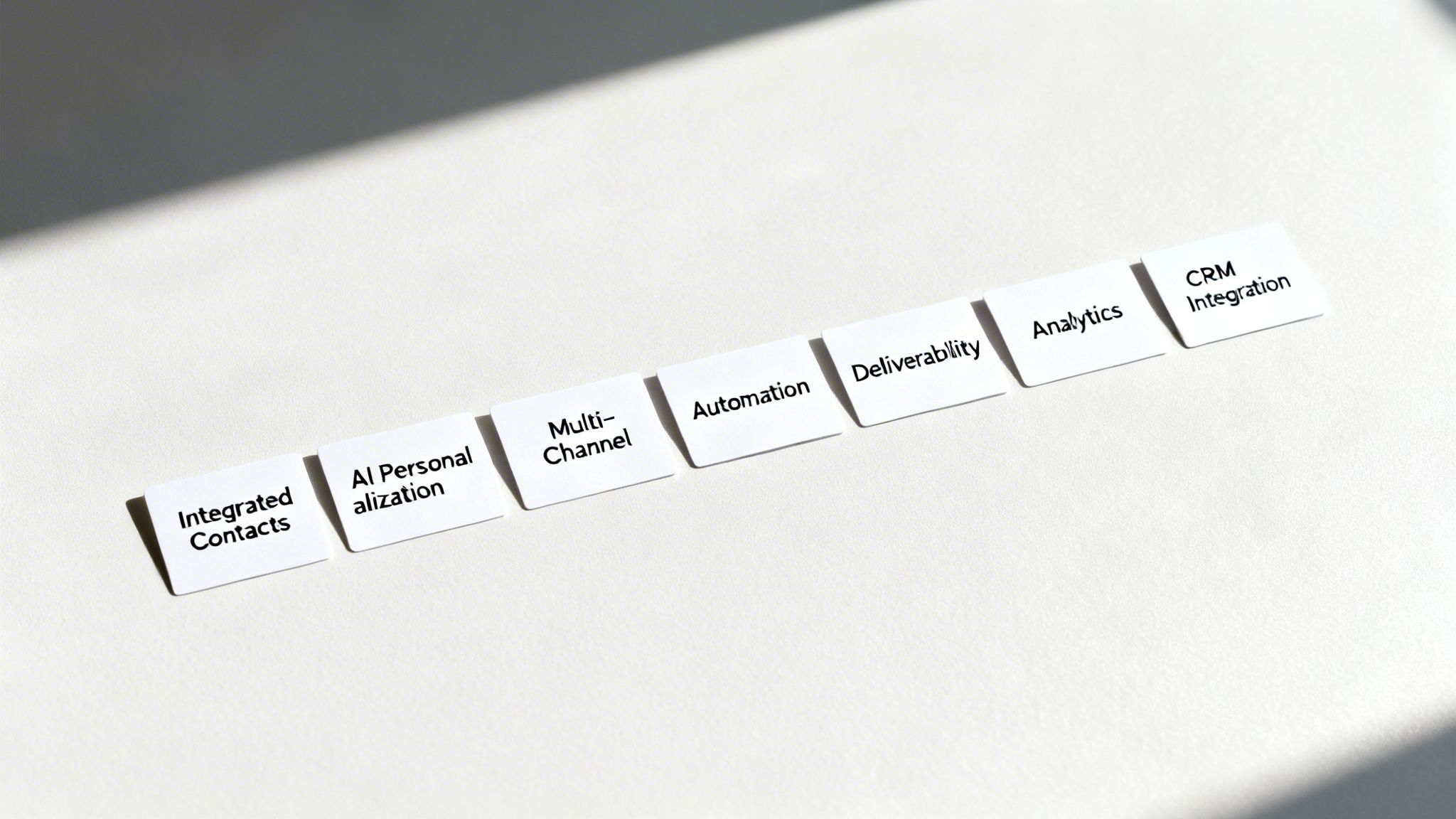
When you're evaluating the best cold email software, it's easy to get lost comparing sending limits and pricing plans. But for a modern sales team, the real test is whether a platform can consolidate your entire outbound workflow into one efficient system. It’s about ditching a fragmented collection of point solutions for a unified platform that delivers speed and precision.
The right features aren't just nice-to-haves; they transform how your team operates. They eliminate the manual tasks that consume your SDRs' day and give leaders the clear visibility they need to build a predictable revenue engine.
Here are the non-negotiable capabilities that separate a basic email tool from a true B2B GTM platform.
1. Integrated and Verified Contact Data
Your outreach is only as good as your contact list. A platform with a built-in, continuously verified B2B contact database isn't a luxury—it's essential. This feature replaces the painful routine of buying static lists, wrestling with CSVs, and watching high bounce rates destroy your domain reputation.
With data baked right in, your team can build hyper-targeted account lists in minutes, not hours. That means less time spent on manual research and more time engaging high-value prospects.
2. AI Personalization That Sounds Human
We all know generic templates are a one-way ticket to the spam folder. The key to booking more meetings is personalizing at scale, but not all AI is created equal. Most tools churn out robotic copy that prospects spot a mile away.
Look for a platform with proprietary, template-free AI that learns your team's unique voice and writing style. It should generate messages that pull in specific details—like a recent LinkedIn post or a company funding announcement—to make every email feel like it was written just for that person.
3. Multi-Channel Orchestration
Your buyers don’t just live in their inboxes. They’re active on LinkedIn and engaging with content across multiple channels. The best platforms let you build intelligent sequences that weave together emails, LinkedIn connection requests, and profile views into a single, automated workflow.
This orchestration means you’re meeting prospects where they are, which dramatically increases your chances of getting a reply.
4. Advanced Automation and Sales Plays
Automation should do more than just send emails on a schedule. It should empower your team to build and run repeatable sales plays for different customer segments, industries, or use cases.
A top-tier platform will let you:
- Create dynamic sequences that adapt based on prospect actions (like opening an email or clicking a link).
- Set up rules to automatically enroll new leads from your CRM into the right campaign.
- Automatically pause outreach the moment a prospect replies, so you avoid awkward overlapping messages.
This is the kind of automation that builds a predictable pipeline without requiring manual intervention from your team.
5. Built-In Deliverability and Warm-Up
Even the most well-crafted email is worthless if it lands in spam. That's why the best platforms make sender reputation a top priority, with built-in tools for email warm-up and deliverability monitoring.
A dedicated warm-up feature is mission-critical. It gradually builds your sending reputation with email providers, giving your messages the best possible chance of hitting the primary inbox. It's the foundation of any successful outbound strategy.
To go deeper on this, read our guide on email deliverability best practices.
6. Actionable Analytics and Reporting
"What's actually working?" Every sales leader needs to answer this, and vague dashboards don’t cut it. You need clear, actionable analytics that show you exactly which messages, sequences, and segments are driving meetings and creating pipeline.
The best tools provide transparent reporting on team performance, making it easy to identify top performers and process bottlenecks. This data-driven feedback loop is how you scale what works.
7. Native and Deep CRM Integration
A clunky or broken CRM sync is a nightmare for RevOps teams and sales leaders. Your prospecting platform must offer a deep, native integration with your CRM, ensuring data flows seamlessly in both directions.
This means contacts, activities, and meeting outcomes are logged automatically, with zero manual data entry. The result is a clean, reliable single source of truth that improves forecast accuracy and gives you a clear view of your pipeline's health.
When you bring all these features together, the impact is huge. Top-performing teams are seeing reply rates of 40-50%—a massive jump from the industry average of 1-5%. The data shows that simply fixing deliverability can boost responses by 30.5%, while AI-powered subject lines can increase open rates by 50% and replies by an incredible 140%. You can explore more sales statistics on Martal.ca to see how these elements combine to transform outreach.
Why Generic AI and Templates Are Killing Your Reply Rates
In the rush to scale outbound, it's tempting to think that any AI is good AI. Many sales teams fall into this trap, adopting the nearest tool and assuming automation alone is the answer. This is a critical mistake.
The reality is, not all AI is built the same. There's a world of difference between a generic AI writer and a specialized AI orchestrator, and that difference directly impacts your reply rates and your brand's reputation.
Most generic AI tools are built on public models. They're designed to produce text that sounds plausible, not text that sounds like you. They rely on predictable patterns and sales clichés, spitting out messages that feel robotic. Prospects are sharp—they can spot a templated, AI-generated email instantly, and it’s a direct trip to the trash folder.
This isn't just a missed opportunity. When you send robotic outreach, you burn through contact lists, damage your company’s reputation, and train your market to ignore you. You're teaching prospects to see your name and immediately think "spam."
The Problem with "AI-Powered" Templates
Here’s the secret: most AI sales tools are still just fancy template machines. They claim to be revolutionary, but under the hood, they’re just taking a basic structure and swapping out a few keywords. This approach completely misses the authenticity that starts a real conversation.
Let's say a sales leader you want to reach just appeared on a popular podcast. A generic AI might draft something like: "I saw you were a guest on the [Podcast Name] podcast and enjoyed your insights." It’s correct, but it's also flat and impersonal. Worse, dozens of other SDRs are likely sending the exact same line.
An advanced AI orchestrator, like the one built into Willbe, goes much deeper. It doesn't just note the event; it understands the context and, crucially, learns your specific tone of voice to generate a message that sounds like it came straight from you.
The difference in the output is night and day. It might draft something like this instead: "Heard your take on the RevOps Daily podcast about scaling data teams—your point about prioritizing process over tools was spot on. It's something we see a lot of teams struggle with."
This message is authentic. It references a specific idea and connects it to a shared business challenge. It’s a conversation starter, not a template filler. That’s how you get a reply.
Personalization That Actually Works
Real personalization is more than just dropping in {{first_name}} and {{company_name}}. It’s about showing you’ve done your homework and understand your prospect’s world. This is where a proprietary, template-free AI gives you a massive advantage, especially at scale.
An effective AI should help your team:
- Sound Human: Generate a genuinely unique, context-aware message for every prospect, without a hint of robotic language.
- Maintain Your Voice: Analyze your team’s past writing to ensure every AI-assisted email sounds authentic to your brand and your reps.
- Operate Globally: Write compelling messages in over 80 languages, naturally adapting to cultural nuances for international outreach.
The impact is impossible to ignore. Data shows that this level of AI-driven personalization is a game-changer. Tailored subject lines can boost open rates by 50% and replies by a staggering 140%. The best campaigns using this precision can hit reply rates as high as 35%—a full seven times the industry average. For a deeper dive, discover more insights about cold email response rates on Mailforge.ai.
Ultimately, the best cold email software doesn't just help you send more emails. It helps you send better emails—messages that connect with people, build trust, and create pipeline. When you move beyond generic templates and embrace AI built for authentic communication, you can finally scale outreach without losing the human touch that closes deals.
For more strategies on this, check out our guide on cold email best practices.
How to Cut Through the Noise and Pick the Right Platform
Choosing a cold email platform isn't just buying software; it’s a strategic move that can make or break your ability to generate predictable revenue. To get past the marketing hype and find what truly works, you need a solid evaluation plan. This is especially true for sales leaders and RevOps teams seeking a platform that streamlines the entire go-to-market motion.
A standard demo only shows you the highlight reel. You need to get under the hood and ask the tough questions that reveal how a platform performs in the real world. Let's walk through the key areas to investigate so you can make a decision that moves the needle on your revenue goals.
It All Starts with Data Quality
Bad data is the silent killer of outreach campaigns. It leads to bounced emails, a damaged sender reputation, and SDRs wasting time on dead-end leads. Your evaluation must start here, with a hard look at the platform's contact data.
Here’s what to ask during the demo:
- "Show me your process for sourcing and verifying contacts." A vague answer is a major red flag. A credible vendor like Willbe can explain exactly how they aggregate data from 30+ B2B sources and run continuous checks to keep it fresh.
- "What's your verified email rate for my ideal customer?" Don't settle for a generic number. Make them run a live search for your ICP in the demo. This is the only way to see if they have quality data for the accounts you actually target.
- "How often do you refresh your data?" B2B contact info goes stale fast. You need a platform that updates its database in near real-time, not one that refreshes quarterly.
AI That Sounds Human, Not Robotic
Next up is personalization. If the platform's AI just spits out generic copy, your reply rates will suffer. You're not looking for a simple mail merge tool; you need an AI that can learn to write like your best sales rep.
Dig into the AI's real capabilities:
- "How does the AI learn to replicate my team's unique voice?" The goal is an AI that analyzes past emails to adopt your specific tone and style. It should feel like an assistant that enhances your rep's personality, not a replacement.
- "Is your AI truly template-free?" Ask them to generate a few different emails for the same prospect. If they all sound suspiciously similar, the AI is likely just filling in blanks on a template.
- "Can it personalize for different languages and regions?" This is non-negotiable for global teams. Effective outreach requires cultural nuance, so ensure the AI can handle more than just standard American English if you're selling internationally.
Does It Actually Work with Your Tech Stack?
Even the most powerful platform is useless if it doesn't seamlessly connect with your other tools, especially your CRM. A clunky integration just creates more manual work—the exact opposite of what you want.
The depth of a CRM integration is a direct indicator of its value. A great integration goes beyond just logging activities; it provides a bidirectional sync that keeps your entire GTM stack clean and aligned, giving you a single source of truth for performance.
Focus on how the platform plays with your core systems:
- "How deep is your native CRM integration?" Does it just log emails, or does it automatically sync contact statuses, account updates, and meeting outcomes?
- "Can we build automation rules using our CRM data?" Imagine automatically enrolling new leads from a specific Salesforce campaign into a tailored outreach sequence. That's the power a deep integration unlocks.
- "How do you help us maintain data hygiene?" Does the platform have safeguards to prevent duplicate contacts? Does it ensure every touchpoint is logged correctly without RevOps having to clean up the mess later?
Choosing the right platform requires a methodical approach. Use this checklist to stay organized and ask the right questions.
Cold Email Software Evaluation Checklist
This checklist is your guide to looking beyond the sales pitch. Use it to pressure-test each platform and ensure you're investing in a partner that can truly support your growth.
Calculating the Real ROI
Finally, don't get stuck on the sticker price. The true return on investment comes from calculating the cost of not consolidating your tools. Start by adding up the subscription fees for all the separate tools you're currently juggling—data providers, email verifiers, and sequencing software.
But the real savings are in the soft costs. How many hours do your SDRs waste every week on manual list building? What's the business cost of a burned domain or a CRM full of inaccurate data? When you quantify that wasted time and risk, a unified platform becomes a clear financial win.
Building a Predictable Outbound Engine
The best cold email software does more than just send messages. It’s the engine for a repeatable, scalable outbound system. Getting from messy, one-off campaigns to a reliable GTM motion takes more than technology—it takes a deliberate strategy to predictably fill your pipeline with high-quality opportunities.
This boils down to three core pillars: knowing exactly who you're selling to, engaging them like a human across multiple channels, and creating a tight feedback loop to scale what works. When your platform supports this entire process, you stop guessing and start engineering growth.
Define Your ICP and Build Hyper-Targeted Segments
Predictable outreach starts with an obsessive focus on your Ideal Customer Profile (ICP). A vague target like "tech companies in North America" is a surefire way to get low reply rates. Your team must dig deeper, carving out precise segments using firmographic, technographic, and buying signal data.
For instance, instead of a broad target, a hyper-targeted segment looks more like this:
- Industry: B2B SaaS
- Company Size: 50-250 employees
- Technology Used: Salesforce and Marketo
- Recent Activity: Hired a new VP of Sales in the last 90 days
A modern GTM platform like Willbe makes this level of targeting possible by combining a massive contact database with smart filters. Your SDRs can build these granular lists in minutes, not hours, so every sequence is aimed at prospects with the highest probability of converting.
The goal isn't to reach everyone. The goal is to reach the right people with a message that proves you understand their specific challenges. This level of segmentation is what separates top-performing teams from the rest.
Craft and Orchestrate Multi-Channel Sequences
Once you know who you're targeting, the next step is planning how you'll engage them. Relying only on email is a missed opportunity. Today’s buyers are active across multiple channels, and your outreach needs to meet them where they are. The most effective campaigns blend automated and manual steps across both email and LinkedIn.
This is where orchestration comes in. It’s about creating a connected journey for the prospect. A solid multi-channel sequence might look like this:
- Day 1 (Manual): View their LinkedIn profile to appear on their radar.
- Day 1 (Automated): Send a personalized email referencing a specific trigger or pain point.
- Day 3 (Automated): Send a LinkedIn connection request with a short, relevant note.
- Day 5 (Automated): Follow up by email with a different angle or valuable content.
- Day 7 (Manual): Like or comment on a recent LinkedIn post.
This approach makes your outreach feel more natural and persistent without being annoying. The best tools automate the repetitive steps, freeing up your reps to focus on the high-touch, human interactions that build connections.
Here is a simple way to think about the evaluation process for finding software that can power this kind of engine.
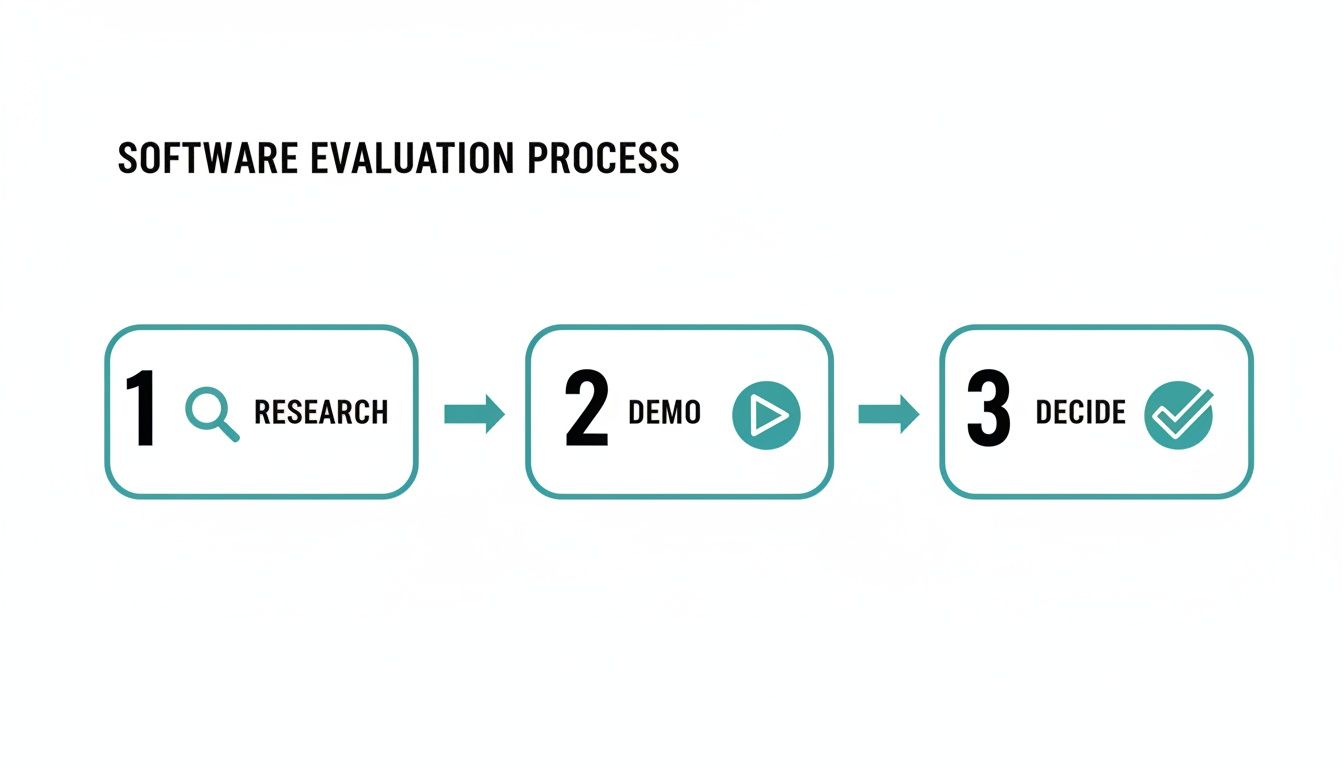
Following a clear path from research to a final decision is key to finding a platform that can run your entire outbound strategy, not just one part of it.
Create a Continuous Feedback Loop with Analytics
The final piece is building a system for constant improvement. You simply can't scale what you can't measure. This means looking beyond basic open and reply rates to understand what actually drives meetings and creates pipeline.
Your platform's analytics should answer mission-critical questions:
- Which messaging angles are resonating with our key personas?
- Which sequences are booking the most qualified meetings?
- Are our LinkedIn touches impacting our email reply rates?
- Which SDR is most effective at converting a specific market segment?
By tracking performance at this granular level, sales leaders can spot winning plays and roll them out to the entire team. This data-driven feedback loop turns outbound prospecting from an art into a science. Your sales floor becomes a lab where every campaign makes the next one smarter. That's how you build a GTM engine that lasts.
When to Consolidate Your Sales Tech Stack
Your sales tech stack rarely starts out complex. It usually grows one tool at a time. You add a data provider here, a verification service there, and a sequencing app to tie it all together. Before you know it, your team is juggling a tangled mess of software that creates more problems than it solves.
So, when do these frustrations signal that it’s time for a major change? The signs often hide in plain sight as daily headaches for your team. Reps get stuck doing manual work, leaders can’t get a clear view of performance, and your CRM turns into a graveyard of messy data. Moving to a single platform isn't just a tech upgrade; it's a strategic move to build a more predictable GTM motion.
The Tipping Point for Your Sales Team
If the following scenarios sound familiar, your team has likely outgrown its fragmented stack. These red flags impact everyone, from SDRs on the front lines to the RevOps team trying to maintain data integrity.
Telltale signs you’ve outgrown your current setup:
- SDRs spend hours cleaning lists: Instead of engaging prospects, your reps are drowning in spreadsheets, manually verifying emails, and trying to piece together contact information. It’s not just inefficient—it’s a morale-killer.
- RevOps is constantly fixing broken syncs: Your revenue operations team is always putting out fires—dealing with duplicate contacts, missing activity logs, and data that won't sync correctly with the CRM. This undermines your single source of truth.
- Sales leaders lack clear visibility: Can you confidently answer, "What's working right now?" When performance data is scattered across five different dashboards, it's impossible to connect your team's effort to pipeline.
When your tech stack forces your team to spend more time managing tools than engaging buyers, you’re not just losing efficiency—you're losing revenue. The cost of a fragmented system is measured in missed quotas and stalled growth.
The Business Case for a Unified Platform
For any B2B team serious about growth, consolidating tools under one roof is the logical next step. The benefits go beyond convenience; they impact your bottom line and give your team the firepower it needs to win. For a closer look at how tool consolidation impacts rep output, explore our guide on how to improve sales productivity.
A single, unified platform delivers immediate and long-term value:
- Significant Cost Savings: You’re replacing 3-5 different tools—for data, verification, sequencing, and analytics—with one subscription. This adds up to a much lower total software spend.
- Improved Team Efficiency: Your reps get hours back every day. By eliminating manual data entry and list building, they can focus on what they were hired to do: sell.
- Cleaner, More Reliable Data: A native, bidirectional CRM sync means every touchpoint and meeting is logged automatically and accurately. This provides a clean data foundation for forecasting and strategic decisions.
- Faster Revenue Cycles: When the entire workflow is seamless—from finding an account to closing a deal—your team moves faster. They find better-fit companies, reach the right people with the right message, and convert pipeline into revenue more quickly.
Ultimately, consolidating your stack is a decision to run your sales team like a modern, high-growth machine. It’s about giving your people a system built for speed and precision, so you can scale your outbound motion without scaling headcount.
A Few Common Questions
Diving into the world of cold email software can feel overwhelming. Let's clear up some of the most common questions that pop up for sales leaders, RevOps pros, and SDRs as they weigh their options.
What's the One Feature I Absolutely Can't Live Without?
While automation is critical, the real game-changer is integrated, high-quality contact data. The most brilliantly written email is useless if it never reaches the right person.
A platform that bundles a powerful B2B database directly with its outreach tools provides a massive advantage. It eliminates the friction of importing and cleaning lists, ensures your team is always using the freshest data, and protects your sender reputation from the damage of high bounce rates.
How Do I Keep My Cold Emails Out of the Spam Folder?
Great deliverability isn't about one magic trick; it's about a few core best practices. First, always use a platform with a built-in email warm-up tool. This slowly builds a positive sending reputation with providers like Google and Microsoft.
Next, make data quality a top priority to keep your bounce rate low—anything above 2-3% is a red flag. Finally, use smart AI to create unique message variations for every prospect. Blasting out identical templates at scale is one of the fastest ways to get flagged as spam. The best tools also let you control sending volumes and add human-like delays between emails.
The secret is finding AI that helps you sound more like yourself, not just another generic salesperson. That's what gets replies and starts actual conversations.
Can AI Really Write Cold Emails That Don't Sound Like a Robot?
Yes, but it depends entirely on the AI. Most generic AI writers produce stiff, formulaic copy that prospects can spot and delete from a mile away.
The difference lies in proprietary AI that's specifically trained for sales outreach. Instead of just plugging in a {{FirstName}} tag, this kind of AI learns your team’s unique voice and value props. It then generates completely original, context-aware messages that feel personal and one-to-one, even when you’re reaching out to hundreds of people a day.
Ready to see how an all-in-one platform can replace your scattered tools and build a predictable revenue engine? Explore how top teams scale outbound with Willbe and book a personalized demo to see it in action.