


A sales quota is a specific, time-bound target a sales rep or team must hit. Think of it as the destination you plug into your GTM strategy. It translates a high-level company goal into a clear, measurable finish line for each person on your sales team. A quota isn't about arbitrary pressure; it's about creating a clear path to predictable revenue.
What Is a Sales Quota and Why It Matters for Revenue
A sales quota is what translates a vague corporate ambition like "grow revenue" into a concrete, actionable target, such as "close $150,000 in new business this quarter." That clarity connects an individual rep’s daily grind to the company's bottom line. It’s how sales becomes a repeatable engine for growth, not just a string of lucky breaks.
When designed well, quotas are incredibly powerful. They do three things exceptionally well:
- Create Clarity and Focus: Quotas give reps a crystal-clear picture of what success looks like, helping them prioritize high-value activities instead of getting lost in the busywork of manual research and list cleaning.
- Improve Predictability: By tracking quota attainment across the team, sales leaders can forecast revenue with far greater accuracy. This lets you spot pipeline gaps early, before they become a fire drill at the end of the quarter.
- Motivate Performance: Let's be direct—compensation drives behavior. When tied directly to a rep's pay, an achievable quota is a powerful motivator that encourages reps to push their limits and rewards their wins.
The Problem with Outdated Quota Setting
The challenge of setting fair quotas is anything but new. Way back in March 1926, H.G. Weaver of General Motors complained about the common practice of just slapping 5-20% on top of last year's numbers. He called it "using the thing to be measured as the measuring stick of itself"—a trap many teams still fall into today.
It's almost shocking, but research shows that nearly 65% of companies still rely on these outdated historical methods. This approach often ignores critical differences in territory potential, market shifts, or a rep's actual capacity. You can see a great rundown of this century-old problem and its modern context in this overview of sales quotas.
Today's best sales leaders know that setting fair, motivating quotas is a science, not simple arithmetic. A good quota is built on a deep understanding of territory potential, rep capacity, and your ideal customer profile. Ultimately, getting quotas right is a fundamental piece of effective Revenue Growth Management, driving sustainable and profitable growth.
Choosing the Right Sales Quota Type for Your Team
Figuring out the right sales quota for your team isn't a simple copy-and-paste job. What works for a team of veteran account executives won't fly for a group of brand-new SDRs. The key is to pick a quota type that directly encourages the exact behaviors you need to hit your company’s goals. Get this right, and you’re on your way to building a truly predictable revenue machine.
Most people immediately think of a Revenue Quota. It's the most common for a reason—it ties a salesperson's target directly to the company's bottom line. Think of an Account Executive who needs to close $200,000 in new ARR each quarter. It’s clean, direct, and perfect for experienced closers who know their market inside and out.
But if you only focus on the final dollar amount, you risk ignoring all the crucial work that happens before a deal even gets to the closing stage. That’s where other quota types come into play.
Forging Pipeline with Activity and Volume Quotas
Your sales development reps (SDRs) or business development reps (BDRs) aren't there to close deals; their mission is to generate high-quality opportunities for the closers. Their quotas must reflect that. This is where activity-based targets are invaluable.
Activity Quota: This quota focuses on the specific inputs that lead to pipeline. You’re measuring actions like making 50 calls per day or booking 15 qualified meetings per week. It’s an excellent way to guide new reps or to keep momentum going in businesses with long, complex sales cycles where a signed contract might be months away.
Volume Quota: Instead of dollars, this quota is all about quantity. The goal might be to sign 10 new logos in a quarter, regardless of deal size. This is a powerful strategy when you’re breaking into a new market or trying to gain traction with a new product, as the main priority is building a solid customer base.
To help you visualize what a good quota strategy looks like, here’s how old-school thinking compares to a modern, data-driven approach.
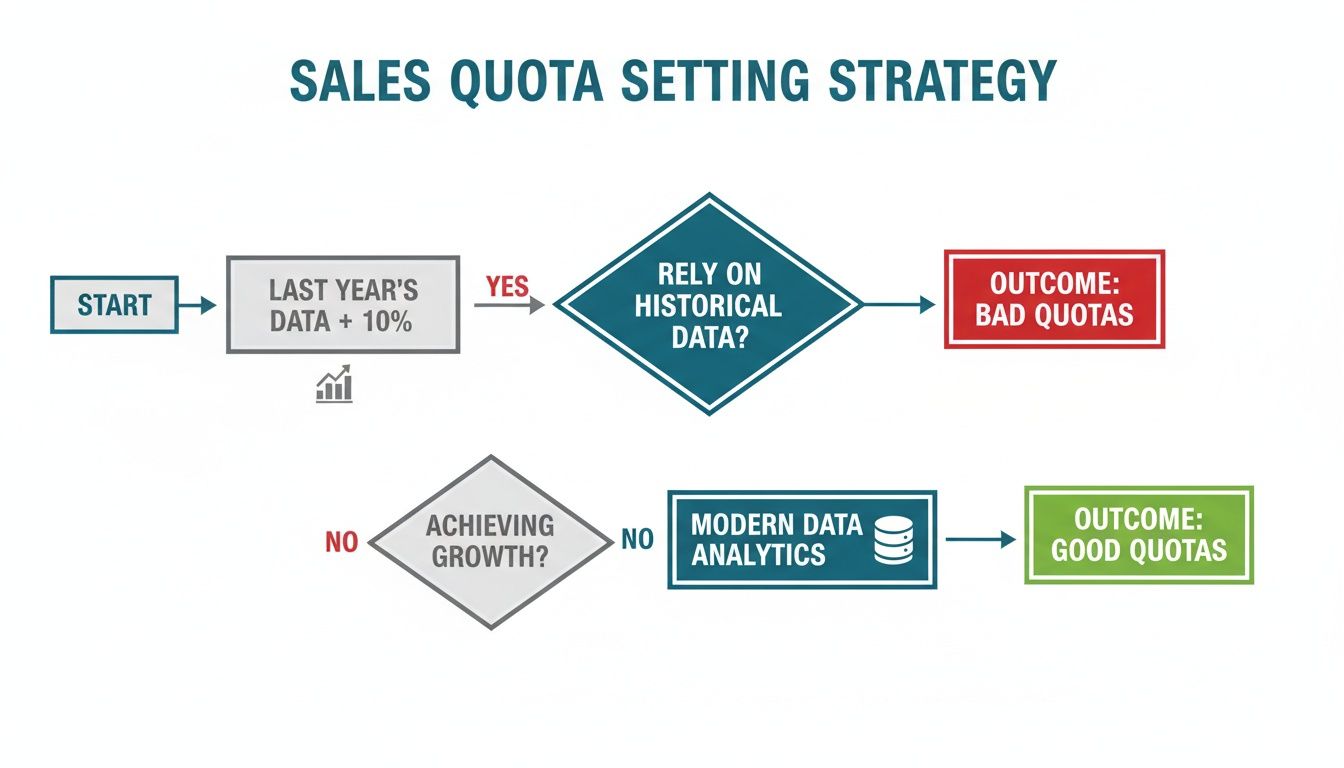
The old way of just slapping a 10% increase on last year’s number is a recipe for missed targets and frustrated reps. The right way involves digging into real, current data to set goals that are both ambitious and achievable.
To make it even clearer, this table breaks down the different quota types and where they fit best.
Comparing Sales Quota Types and Their Best Use Cases
| Quota Type | Primary Focus | Best For (Sales Role / Scenario) |
|---|---|---|
| Revenue Quota | Total sales dollars (ARR/MRR) | Account Executives (AEs) in established markets; roles focused on closing deals. |
| Activity Quota | Daily/weekly sales actions | Sales Development Reps (SDRs), new hires, or teams with long sales cycles. |
| Volume Quota | Number of units or new customers | Market penetration strategies, launching new products, or transactional sales models. |
| Combination Quota | A mix of revenue, profit, or activity | Senior AEs, Strategic Account Managers; complex sales where multiple behaviors are critical. |
As you can see, the role and the strategic goal dictate the quota. There's a right tool for every job.
The Best of Both Worlds: Combination Quotas
In a sophisticated sales organization, a single metric is rarely enough. A Combination Quota offers a more complete and balanced way to measure performance by blending different targets. This prevents reps from chasing short-term wins at the expense of long-term pipeline health.
For instance, a senior AE’s quota might be weighted 70% on hitting their revenue number and 30% on self-sourcing a specific amount of new pipeline. This makes them accountable for not just closing what’s in front of them but also for creating future opportunities.
This hybrid approach encourages reps to think like business owners. You could pair a revenue quota with a profit quota to stop reps from offering deep discounts just to get a deal across the line. By mixing outcomes (like revenue) with activities (like prospecting), you align daily effort with both immediate targets and the bigger picture of building a sustainable sales engine.
How to Calculate Sales Quotas Realistically
Setting a sales quota often feels like a balancing act between ambitious company goals and on-the-ground reality. You can’t just pull a number out of thin air. Getting it right means moving away from guesswork and adopting a data-driven approach.
Let’s walk through the two most common methods for setting quotas: top-down and bottom-up. The best strategy always involves a blend of both.

The Top-Down Approach
The top-down method is the classic way most companies operate. It starts in the boardroom, where executives set a high-level revenue target for the entire organization.
From there, that big number gets broken down. If the company-wide goal is $20 million in new business, it might be split among four sales teams, giving each a $5 million target. That team number is then divided among the individual reps. While this keeps everyone aligned with the company's financial goals, it can sometimes feel disconnected from what's actually achievable in a specific territory.
The Bottom-Up Approach
The bottom-up method starts with the sales rep. Instead of looking at a massive corporate number, you build the quota based on what a typical, fully-ramped salesperson can realistically produce. This approach is grounded in your team's historical performance and sales cycle data.
A bottom-up calculation looks at a rep's individual sales metrics. It provides a data-driven baseline for what's possible, making quotas feel more attainable and fair.
The formula itself is straightforward:
Quota = Average Deal Size x Deals Closed Per Month x Months in Quota Period
For example, say your average rep closes 2 deals a month, and the average deal is worth $15,000. Over a quarter (3 months), their capacity-based quota would be $90,000 ($15,000 x 2 deals x 3 months). Because this number is built on real-world rep performance, it instantly has more credibility with the team. To get a handle on what to measure, check out these key sales rep productivity metrics.
Finding the Sweet Spot: The Hybrid Model
The sharpest sales leaders don't just pick one method—they use both to cross-check each other. Start with the top-down corporate target, but then build a separate bottom-up model to see if that goal is even possible with your current team.
If there’s a massive gap between the top-down number and what your bottom-up model says you can hit, that’s your red flag. It tells you something has to give. You might need to hire more reps, invest in better enablement to improve efficiency, or even go back to leadership with data to argue for a more realistic revenue target.
This is where having clean data becomes non-negotiable. An all-in-one GTM platform like Willbe gives you the accurate inputs needed for a reliable bottom-up forecast. It helps you build a bridge between corporate ambition and frontline reality, so you can set quotas that motivate your team, not burn them out.
Using Quota Attainment to Measure Sales Health
Once you've set your sales quotas, the real work begins: tracking how your team is actually performing against them. This is where quota attainment becomes your most trusted metric. At its core, it’s a simple calculation—the percentage of a target a rep or team achieves in a given period.
But don't let the simplicity fool you. Quota attainment is the ultimate pulse-check for your entire sales organization.
For example, if a rep brings in $120,000 on a $150,000 quarterly quota, their attainment is 80%. That single number gives you a powerful report card, not just on that individual, but on the health of their territory, the effectiveness of your coaching, and the fairness of the goal itself.

What Attainment Levels Signal
As a sales leader, you have to read the story behind the numbers. Widespread low attainment is rarely a "rep problem"—it's a leadership and strategy problem.
- Low Attainment (Below 60%): When most of your team is missing their number, something is fundamentally wrong. Your quotas are probably unrealistic, territories are unbalanced, or your reps don't have the right tools or support to build a healthy pipeline.
- Healthy Attainment (70-80%): This is the goldilocks zone. It means your goals are tough but fair, fostering a motivated environment where the majority of your team feels they have a real shot at winning.
- Very High Attainment (95%+): It feels great, but be wary. If everyone is blowing past their quota every single quarter, your targets are almost certainly too low. You're likely leaving money on the table and under-forecasting.
This isn't just theory. Teams with attainment below 70% can see pipeline leakage of 20-30%, and many experts point to 75% attainment as a key benchmark for diagnosing problems early. You can find more data on how top teams use attainment benchmarks to stay on track.
Moving Beyond Lagging Indicators
Here’s the catch with quota attainment: it’s a lagging indicator. It tells you what already happened. By the time you realize you're behind, it might be too late to save the quarter.
The smartest sales teams focus on leading indicators—the daily and weekly inputs that predict future results.
A modern sales performance dashboard doesn't just show quota attainment. It tracks metrics like email reply rates, meetings booked, and pipeline created this week. This visibility lets leaders see if the inputs are strong enough to produce the desired output.
For instance, if you notice an SDR’s meeting booking rate has dropped off a cliff, you can jump in right away. Is it the messaging? The call list? This real-time insight allows for immediate course correction.
Platforms like Willbe are built for this, connecting prospecting activities directly to pipeline and quota goals. To learn more, check out our guide on building a powerful sales performance metrics dashboard.
This proactive approach shifts sales management from being reactive to strategic, helping you ensure the team is on the right path long before the final days of the quarter.
Best Practices for Setting Motivating Sales Quotas
Getting sales quotas right is less about complex math and more about smart leadership. A good quota feels like a challenge—it pushes reps to grow and rewards their hard work. But get it wrong, and you’ll create a culture of burnout, stress, and a revolving door of talent.
The real goal is to find that sweet spot where a quota feels tough but fundamentally fair. Let's walk through how to build targets that inspire your team, rather than crush their motivation.
Make Quota Setting a Team Sport
Nothing breeds distrust faster than a quota handed down from the executive suite with zero context. While you need to start with a top-down company goal, that number has to be tested against the reality on the ground. This is where you bring in your frontline sales managers and even your senior reps.
When your team sees that their on-the-ground insights—like the nuances of a territory or the true potential of an account list—are actually part of the equation, they feel a sense of ownership. That transparency turns a disconnected number into a shared goal, and it makes all the difference.
Use Historical Data, but Don't Be Lazy About It
Simply tacking 10-15% onto last year’s numbers isn't a strategy. It's a lazy habit that ends up punishing your best performers and setting up the rest of your team for failure. Historical data should be your starting point, not your final answer.
Dig deeper than just last quarter's results. A smart analysis should account for:
- Seasonality: Does your business always have a huge Q4? A flat quarterly quota is completely unfair if 40% of your revenue comes in the last three months of the year. Adjust for those predictable peaks and valleys.
- Territory Potential: Let's be honest—not all territories are created equal. Some are greenfield opportunities ripe for the picking, while others are mature, saturated, and hyper-competitive. Your quotas have to reflect that reality.
- Rep Ramp Time: You can't expect a new hire to perform like a seasoned vet on day one. New reps need a ramped quota that scales up over their first few months as they get their footing with the product, the market, and your sales process.
Connect Quotas Directly to Compensation
A quota without a clear payout attached is just a suggestion. For a quota to have any real teeth, reps need to see a direct line between their effort and their bank account. This requires a transparent comp plan and a clear understanding On-Target Earnings (OTE), which is the engine driving their motivation.
A well-designed plan shows reps exactly how their performance translates into their paycheck. If hitting 110% of their quota unlocks a juicy accelerator, you can bet they’ll push hard to blow past their number instead of coasting once they hit it.
Ditch the Impossible "Stretch" Goals
There's a massive difference between a challenging goal and a demoralizing one. It’s always tempting to set wildly aggressive targets to please the board, but if only 20% of your team ever hits their number, you don't have a performance problem—you have a quota problem.
You know you've found the sweet spot when 70-80% of your team is achieving quota. This is the "Goldilocks zone": the target is hard enough to feel like a real accomplishment but attainable for most of a competent, hard-working team.
How Modern Platforms Drive Quota Attainment
Setting accurate sales quotas feels impossible when you’re working with messy data and a patchwork of different tools. Predictable pipeline is a pipe dream. You need a crystal-clear picture of territory potential and rep capacity to set fair targets, but that clarity vanishes when your team is toggling between five different apps just to find and contact a single prospect.
This is precisely where modern go-to-market platforms come in.
Instead of just guessing what a territory can produce, you can build your quotas on a solid foundation of verified, up-to-the-minute data. It stops being an art form and starts becoming a science.
Building Predictability from the Ground Up
The first step to actually hitting a quota is making sure reps have enough high-quality accounts and contacts to begin with. When your database is a minefield of bounced emails and outdated job titles, any activity quota you set is just a shot in the dark. Your reps end up spending more time cleaning lists than actually selling.
An all-in-one prospecting platform like Willbe tackles this head-on by consolidating data from over 30 different B2B sources into one reliable, unified view. For sales leaders, this unlocks a few powerful capabilities:
- Define Fair Territories: You can segment markets with incredible precision using firmographics, technographics, and buying signals to carve out truly balanced patches. This ensures quotas are tied to real opportunity, not just geography.
- Improve Rep Efficiency: Give your reps instant access to verified mobile numbers and emails. This simple change eliminates hours of manual research and data validation, freeing them up to do what they do best: sell.
- Increase Speed to Lead: The platform automates the tedious work of finding the right people in your target accounts. Reps can engage decision-makers faster, which means they build pipeline more quickly. Find out more in our guide to sales automation.
From Raw Activity to Revenue Outcomes
Meaningful quota attainment isn't just about hitting activity numbers—it’s about making sure those activities produce tangible results. Sending 1,000 generic emails that get ignored does nothing for your bottom line. This is where AI-driven personalization becomes absolutely essential.
Willbe’s proprietary AI goes far beyond basic mail-merge templates. It actually analyzes prospect data to help reps generate messages that sound human and feel genuinely relevant, which dramatically boosts reply rates across both email and LinkedIn.
Higher engagement leads directly to more qualified meetings. Suddenly, your activity quotas become a true leading indicator of future revenue, not just a measure of busywork.
Ultimately, a modern platform makes your entire revenue engine more predictable. It creates a clear, visible line connecting top-of-funnel activity directly to pipeline creation and quota attainment. You get a real-time view of what's working, so you can stop guessing and start building a sales process that truly scales.
Frequently Asked Questions About Sales Quotas
Even with the best planning, sales quotas always spark a few practical questions. Let's tackle some of the most common ones that come up for sales leaders, RevOps pros, and even the reps on the ground.
What Percentage of the Sales Team Should Hit Quota?
You're looking for a sweet spot. In a healthy, high-performing sales organization, you should expect 70-80% of your team to consistently hit their quota. This range is the hallmark of targets that are challenging enough to be motivating but are still seen as achievable.
If your attainment numbers fall much lower than that, it’s a major red flag. Your quotas are likely too high, your territories might be unbalanced, or your team needs more support. On the flip side, if 100% of your reps are crushing their number every single time, your goals are probably too low. That might feel good, but you're leaving money on the table.
How Often Should Sales Quotas Be Adjusted?
The standard approach is to set quotas annually and then break them down into quarterly or monthly targets. The key is to avoid constantly moving the goalposts, which is a surefire way to kill motivation.
That said, you shouldn't set them in stone for a full year and ignore what's happening in the real world. A quarterly review is a great practice. It gives you a chance to make small, calculated tweaks to account for big market shifts, new product launches, or a territory that's suddenly gotten hotter (or colder). The goal is flexibility, not instability.
What Is the Difference Between a Sales Quota and a Sales Goal?
This is a crucial distinction. Think of it this way: the goal is the destination, and the quota is the roadmap to get there.
A sales goal is a big-picture business objective. It’s strategic and aspirational, like “increase market share in the EMEA region by 10%.”
A sales quota, on the other hand, is the specific, time-bound, and measurable target given to a rep or team, and it's directly tied to their pay. For example, “close $150,000 in new ARR this quarter.” Quotas are the tangible activities and results your team must deliver to make the larger company goals a reality.
Hitting quotas starts with a predictable pipeline. Willbe replaces fragmented tools and manual work with a unified platform that gives your team the verified data and AI-powered personalization needed to book more meetings and close deals faster. Explore how top teams scale outbound with Willbe.