


Value-based selling is a simple idea at its core: stop selling your product’s features and start selling the tangible business outcomes your customer achieves. It’s the critical shift from saying, “Here’s what our tool does,” to proving, “Here’s how our solution solves your revenue problem.” This approach cuts straight to what buyers actually care about—hitting their pipeline goals, slashing operational costs, or getting a handle on risk.
Why Value Based Selling Is Your New GTM Engine
In a market flooded with look-alike products and generic outreach, buyers are exhausted by feature-led pitches. They don’t care about your new dashboard or the specific AI algorithm you use; they care about hitting their own targets. This is where a value-based selling motion transforms your team from just another vendor into a strategic partner they can’t ignore.
It reframes the conversation entirely. Instead of haggling over price, you’re discussing investment and return.
The old playbook of pushing features no longer works. We see the fallout every day on teams that haven’t adapted:
- SDRs can't get meetings because their emails sound identical to the 50 others a prospect just deleted.
- AEs watch deals stall because buyers can't connect the dots between your product's functions and their own P&L.
- Sales leaders miss forecasts because their pipeline is clogged with low-intent opportunities that were never truly aligned with a business need.
- RevOps teams see deal velocity grind to a halt as prospects get stuck in an endless loop of feature comparisons.
This isn't just a small tweak to your sales process. It's a complete go-to-market reframe that aligns everything you do—from the first cold email to the final signature—with what your customer actually values. It’s how you turn your solution from a 'nice-to-have' into a 'must-have.'
To see this in action, let's contrast the two approaches directly.
Value Based Selling vs Traditional Selling
The difference is stark. One path leads to commoditization and price wars, while the other builds long-term, profitable partnerships.
This isn't just a trend; it's a fundamental shift. Gartner predicts that by 2026, 60% of B2B organizations will move from price-focused tactics to data-driven selling that emphasizes demonstrable value.
Of course, to make this work, your team needs the right resources. This is where What Is Sales Enablement? comes in, equipping your sellers with the content, training, and tools to have these value-centric conversations effectively.
Ultimately, a value-based GTM requires tight coordination. For more on this, check out our guide on sales and marketing alignment best practices. An all-in-one platform like Willbe helps teams operationalize this entire strategy. Instead of juggling fragmented tools and manual workflows, you get a single engine built to find the right accounts, engage them with messages that resonate, and convert pipeline faster. It’s all about building a repeatable system for revenue growth, driven by customer value.
Start with Data: Building a Rock-Solid Value Hypothesis
You can't do value-based selling right by guessing what prospects care about. The entire approach hinges on a strong value hypothesis for every account, built on cold, hard data. It’s how you prove you’ve done your homework before you ever reach out.
For sales and RevOps teams, this means breaking free from broad, static Ideal Customer Profiles (ICPs). Targeting "SaaS companies with 50-200 employees" is too vague. You need to get specific: "SaaS companies that just hired a new CRO, are using a competitor's legacy software, and have open SDR roles." That level of precision separates a deleted email from a booked meeting.
This is a fundamental shift in how your go-to-market engine operates. You must move your team's focus from tactical things like price and features to the strategic outcomes you deliver.
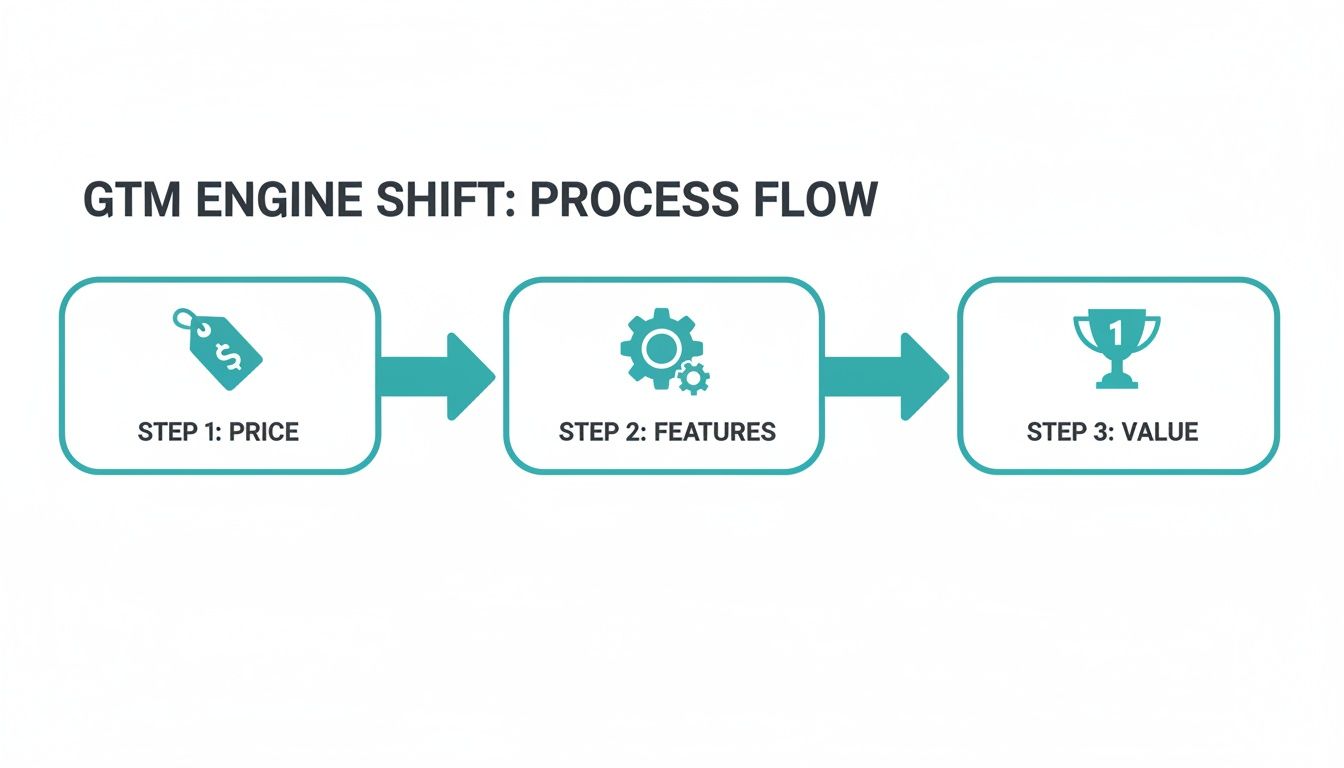
Think of it as a maturity curve. The best sales organizations obsess less over what they sell and more over the tangible results their customers get.
From Broad Strokes to Sharp Segments
So where do you get the data to build this value hypothesis? It comes down to layering three types of information. When combined, you can spot high-fit accounts that aren't just a good match on paper but are also primed to recognize the specific value you deliver.
- Firmographic Data: Your starting point—the basics like company size, industry, revenue, and location. It's great for defining your total addressable market but too general to act on alone.
- Technographic Data: This is where things get interesting. This layer tells you what’s in a company's tech stack. Knowing they use a direct competitor, a tool that integrates with yours, or an old system you can replace is a perfect way to start a value-led conversation.
- Intent and Trigger Data: The real game-changer. These signals scream "opportunity!"—a recent funding round, a spike in searches for a problem you solve, a key executive hire, or a sudden hiring spree for a specific department.
Picture this: your SDR sees that a target account just brought on a new VP of Sales and, at the same time, notices they’re stuck on an outdated CRM. That’s not a cold call anymore. It's a strategic, highly relevant touchpoint. The script flips from, "Can I get 15 minutes?" to, "I saw you just came on board to scale the sales team. Given your old CRM, you're likely running into issues with X. We help leaders in your exact spot achieve Y."
The goal is to arm your team with enough insight to confidently say, “Based on our data, companies like yours typically achieve this outcome.” That instantly builds credibility and cuts through the noise.
Putting the Data to Work for Your Sales Team
The challenge isn't a lack of data; it’s that the data is scattered, and asking reps to piece it all together manually is a massive productivity killer. No SDR or AE should spend hours toggling between LinkedIn, company websites, and tech look-up tools just to build a list. That’s a surefire way to kill momentum.
This is why a modern prospecting platform is essential for value-based selling. A centralized system like Willbe, which aggregates data from over 30 B2B databases, gives your team this level of precision without the painful manual research. It replaces fragmented tools with a single, unified prospecting and lead generation platform.
Instead of fighting with stale spreadsheets and a dozen browser tabs, your reps can:
- Define Hyper-Specific Segments: Use advanced filters to combine firmographic, technographic, and real-time trigger data to find accounts with active, pressing needs.
- Find the Right People: Instantly get verified contact info and LinkedIn profiles for decision-makers within those target accounts.
- Keep Your CRM in Sync: Automatically push rich account and contact data directly into your CRM, so AEs have the full story for every meeting without manual data entry.
When you operationalize data this way, you shift your team's focus from low-value list-building to high-impact conversations. It starts with defining a sharper customer profile. For a deeper dive, explore our guide on how to create an ideal customer profile that drives results. This data-first approach gives your sellers the confidence and context to articulate real value from the first touchpoint.
Translating Value into Personalized Outreach That Converts
You’ve built a data-driven value hypothesis. Now comes the moment that makes or breaks the strategy: turning that insight into an email or message someone will actually respond to.
This is where most value-selling initiatives stumble. Teams get caught between writing hyper-generic templates that get ignored and spending hours on manual research that doesn't scale.
The secret isn't talking about your product's features. It's communicating the potential gain for their business. Every line of your outreach needs to answer the prospect's silent, immediate question: "Why should I care?" This means going beyond simple personalization tokens like {company_name} and weaving a story that shows you understand their world.
It’s about proving you’ve done your homework. You know their role, you have an informed hypothesis about their challenges, and you have a solid reason to believe you can help.
Crafting Messages That Resonate with Personas
A powerful value-led message is never one-size-fits-all. The angle you take must change depending on who you're contacting. What a Head of Sales cares about is worlds away from what keeps a RevOps leader up at night.
Let's break down a couple of real-world examples.
Scenario 1: SDR Reaching Out to a Head of Sales
- Weak (Feature-Led): "Hi Alex, I saw you’re the Head of Sales at Acme Corp. Our platform offers AI-powered prospecting and automated outreach sequences. Can we book 15 minutes?"
- Strong (Value-Led): "Hi Alex, saw your team is growing, with three new AE roles posted this month. Leaders I work with in your position are often focused on ramping new reps quickly without a drop in pipeline generation. Is that a priority for you right now?"
The second version lands because it starts with a specific observation (hiring) and immediately connects it to a high-level business outcome—maintaining pipeline while the team expands. It shows you understand their goals before you mention a product.
Scenario 2: AE Connecting with a RevOps Leader
- Weak (Feature-Led): "Hi Sarah, our tool syncs with your CRM and provides real-time analytics dashboards."
- Strong (Value-Led): "Hi Sarah, noticed your team uses Salesforce alongside three separate prospecting tools. RevOps leaders often tell me that managing this fragmented stack creates data silos and makes it impossible to get a clean view of pipeline health. We help teams centralize their GTM tech to ensure data flows seamlessly and forecasts are actually reliable."
This approach works by zeroing in on a classic pain point for the RevOps function—a messy tech stack leading to unreliable data. It speaks their language and frames the solution as a strategic fix, not just another tool.
The key is to connect a specific data point (a trigger event, a piece of technographic info) to a business problem that your solution is uniquely positioned to solve for that specific persona.
Social selling on LinkedIn is a huge piece of this puzzle. It's more than just firing off connection requests; it's about paying attention to a prospect's content, understanding their professional focus, and using that context to open a valuable conversation. LinkedIn’s own research shows that sales pros who lean into social selling are 51% more likely to hit their quota.
Scaling Authenticity with Template-Free AI
The million-dollar question is, how do you do this for hundreds of prospects without burning out your reps? Manually crafting every message is a non-starter, and traditional automation just blasts out robotic templates that prospects spot a mile away.
This is the gap modern AI is designed to close. I'm not talking about generic AI that just rephrases sentences, but purpose-built technology designed to sound like your best sales rep.
This is what Willbe’s proprietary AI was engineered for. It doesn't use rigid templates. Instead, it ingests all the rich data you have on an account and persona, understands your value hypothesis, and then generates genuinely authentic outreach that sounds human—in over 80 languages. When prospects feel genuinely understood, reply rates increase across email and LinkedIn.
With this approach, sales teams can finally:
- Personalize at Scale: Generate thousands of unique messages that reflect a real understanding of each prospect's situation, without manual work.
- Maintain Brand Voice: The AI learns your team's specific tone and style, ensuring every message sounds like your user, not like generic AI copy.
- Dramatically Increase Replies: When prospects feel you've done your research, they're exponentially more likely to engage. For a deeper dive, check out our guide on cold email best practices.
By marrying precise data with intelligent, template-free AI, you can finally put value-based selling into practice at scale. Your outreach becomes personal and relevant, your reps get hours back in their day, and your pipeline fills with qualified opportunities.
Framing Demos and Pitches Around Customer Value
This is where the rubber meets the road. All the hard work your team put into prospecting and discovery culminates in the demo—and it's easy to get it wrong. A great demo isn't a product tour. It's a preview of the customer's better future.
The most common mistake AEs make is falling into the "feature parade." They get excited and start showing off every bell and whistle, forcing the prospect to connect the dots. A value-based demo does that work for them. It shifts the entire conversation from what your product is to what their business becomes.

From Feature Tour to Value Story
Instead of a generic product walkthrough, your AEs should tell a story. Frame the demo around a "day in the life" of the person you're speaking with, showing them exactly how your platform solves their specific headaches and helps them hit their goals.
A simple but effective way to structure this is the PISV framework:
- Problem: Start by reconfirming a major challenge they brought up in discovery. This shows you were listening and the demo is for them.
- Implication: Briefly remind them of the business pain this problem causes. What's the real cost in wasted time, missed revenue, or a frustrated team?
- Solution: Now you introduce the relevant part of your platform that directly addresses that problem.
- Value: Tie it all together by explaining the tangible, positive outcome they get.
Applying the PISV Framework
Let's say you're demoing Willbe to a VP of Sales who’s struggling with inconsistent forecasting and a burned-out SDR team.
A typical, feature-led approach sounds like this:
"Okay, here's our main dashboard. You can see it tracks activities, and you can filter everything by rep and date. It gives you a lot of data."
It’s not wrong, but it’s weak. The buyer is left thinking, "So what?"
Now, here's the value-led version:
"During our last call, you mentioned forecasting is a constant headache because you're flying blind on pipeline generation, which leads to some tense board meetings. This is how our analytics dashboard solves that. You get a live, real-time view of your pipeline, so you can finally forecast with confidence."
See the difference? We connected a feature (the dashboard) directly to their stated problem (forecasting) and the desired outcome (confidence). The purchase feels less like an expense and more like a strategic investment.
The rule is simple: Every click and every screen you share must directly answer a problem the customer has. If a feature doesn't solve one of their top three pains, save it for later. It doesn't belong in the main demo.
To get this right, you need to master advanced solution selling techniques, because you’re not selling a product; you’re selling an outcome.
This requires your team to have more than surface-level product knowledge. They need to be fluent enough to pivot any feature into a customer-specific value point. It transforms your AEs from presenters into trusted consultants guiding the buyer to a better reality. When a prospect sees a clear, believable path from their current pain to their desired success—powered by your solution—the conversation naturally shifts from "How much does this cost?" to "When can we get started?"
Measuring Success in a Value-Led Sales Motion
If you're not measuring the right things, you're just guessing. When you shift to a value-based selling motion, old scorecards become misleading. Chasing metrics like call volume or email open rates only tells you how busy your team is, not if they're being effective.
To build a predictable revenue engine, you have to track the KPIs that connect directly to business impact. It’s about shifting your focus from raw activities to real outcomes. When your team leads with value, the quality of each conversation trumps the sheer quantity of outreach every time.

Beyond Vanity Metrics
For sales leaders and RevOps teams, this means building a new dashboard. The goal is to get a clear, unfiltered view of what's driving revenue, not just what's keeping people busy. Your analytics should be set up to answer the tough questions about your value-led strategy.
You need to be able to ask your data things like:
- Which of our value propositions are landing with which customer segments?
- Are the meetings we're booking converting into qualified opportunities?
- How is our value messaging impacting deal velocity?
- Is our focus on value bringing in larger, more strategic deals?
Getting answers to these questions creates a powerful feedback loop. It lets you double down on what’s working and quickly pivot away from what isn't.
Key Metrics for a Value Based Selling Motion
So what should you track? Here are the essential KPIs that matter in a modern, value-driven sales organization. This isn't just a list of metrics; it's a way to measure the health of your go-to-market strategy.
A breakdown of essential KPIs for a value-based selling strategy, moving beyond activity metrics to focus on revenue impact.
These metrics tell a story about the quality of your revenue and the health of your customer relationships—the entire point of a value-first approach.
A focus on value attracts the right kind of customers—the ones who become partners, not just transactions. Research shows that organizations with a strong value-driving focus see 90% year-over-year revenue growth, compared to just 72% for those who don't.
Putting Your Analytics into Action
Collecting this data is one thing, but making it actionable is where the magic happens. Your reps shouldn't have to dig through complex spreadsheets or wait for a quarterly review to know if their messaging is landing.
This is where a real-time platform becomes critical. An all-in-one system like Willbe surfaces these insights inside your team's daily workflow. It gives you immediate visibility into which channels, outreach sequences, and ICPs are driving the most pipeline. As a sales leader, you can spot trends as they happen. Is a new value prop for the finance persona suddenly outperforming everything else? You'll know in days, not months.
This data-driven approach fosters a culture of constant improvement. Every SDR and AE can see a direct line from their activities to revenue, empowering them to refine their approach with every interaction. It turns your sales motion from a guessing game into a predictable, scalable GTM engine.
Common Questions About Value-Based Selling
Switching to a value-based selling model is a fundamental shift in mindset that asks reps, leaders, and RevOps to leave old habits behind. Naturally, it brings up practical questions. Let's walk through the ones we hear most often.
How do I start implementing value-based selling today?
The key is to start small. Don't try to boil the ocean. Your goal is to get a specific, measurable win to build momentum and prove the concept internally.
Pick one customer segment or persona to start with. For instance, target mid-market SaaS companies that just hired a new CRO and are stuck using a competitor's clunky, legacy software. Get hyper-specific.
Next, get your SDRs and AEs in a room for a workshop. The only agenda item? Mapping out this segment’s top three business challenges and what they actually want to achieve. What’s keeping that new CRO up at night?
From that conversation, you can craft a single, powerful value hypothesis. It might sound like this: "We see that mid-market SaaS companies with a new CRO often struggle to ramp reps on a fragmented tech stack. Our platform can cut their new hire ramp time by 30%."
This focused pilot is your proof of concept. It gives you tangible results and builds the internal buy-in you'll need for a full-scale rollout across the sales floor.
Finally, you have to operationalize it. A platform like Willbe is built for this. You can find a hyper-targeted list of those exact accounts and run a focused campaign built entirely around that value hypothesis. Then, measure the results—specifically, look for a jump in positive reply rates and meetings booked.
My reps are used to talking about features. How do I retrain them?
Changing entrenched habits takes more than a one-off training session. It requires constant reinforcement and a change to their daily workflow. Reps fall back on features because it's what they know. Your job is to make selling on value the easier—and more rewarding—path.
Start by overhauling your sales collateral. For every feature, add a mandatory "So what?" column that spells out the tangible business outcome it delivers. This forces reps to connect the dots.
Role-playing is also non-negotiable. Run weekly sessions where reps have to conduct discovery calls or demos without mentioning a single product feature for the first ten minutes. The only goal is to ask sharp, insightful questions about the prospect's goals and pains.
Finally, adjust your incentives. Tie compensation, SPIFFs, or recognition to value-based metrics. Celebrate the rep who shortens a sales cycle or lands a deal with a 20% higher ACV because they nailed the value story—not just the one who makes the most calls.
What's the biggest mistake teams make?
The single biggest mistake is assuming you know what your customers value without ever asking them or validating it with data. Too many sales teams create value propositions in an internal echo chamber, brainstorming what they think is important to buyers.
This is a recipe for disaster. It leads to outreach that misses the mark and demos that fall flat. The prospect feels misunderstood because the "value" you're pitching has nothing to do with their actual business reality.
You must build a robust feedback loop to avoid this trap.
- Review your call recordings. Listen for the exact words customers use to describe their own problems.
- Survey your new customers. Ask them point-blank, "Why did you really choose us over the other options?"
- Interview prospects you lost. Find out precisely where the value message broke down.
Your value proposition should be a living document, fed a constant diet of real-world feedback and performance data from your CRM and sales engagement platform. Without that input, your "value-based" selling is just the same old product-pushing with a new label.
How does a platform like Willbe support this strategy?
An all-in-one B2B prospecting and lead generation platform like Willbe acts as the operational backbone for a value-based selling strategy at scale. It’s what bridges the gap between the idea of selling on value and the practical ability of your reps to do it every single day, without manual workflows and fragmented tools.
First, it provides the high-quality, verified data you need to build accurate value hypotheses. Instead of reps wasting hours digging through browser tabs, they can use precise filters to instantly surface accounts that match your value profile—like companies in a specific region, using a particular technology, and showing intent signals like recent funding or key executive hires.
Second, Willbe’s proprietary, template-free AI translates that value into personalized, human-sounding outreach across email and LinkedIn. It generates authentic messages that reference specific data points, making each prospect feel like you've done your homework.
Third, it delivers the real-time analytics to see what's actually working. You can immediately track which value messages, channels, and prospect profiles are generating the most pipeline. This lets sales leaders make smart, data-driven decisions to optimize their strategy on the fly.
Finally, by centralizing prospecting, lead generation, and CRM sync, Willbe gets rid of the fragmented tools and manual data entry that pull reps away from their most important job: having valuable conversations with potential customers.
Ready to operationalize value-based selling and build a predictable pipeline? Willbe replaces fragmented tools and manual workflows with an all-in-one platform that uses precision data and proprietary AI to scale personalized outreach that converts.
See Willbe in action and discover how top teams generate more qualified meetings with less manual work.