


Sales automation is more than just software that sends emails. It's a system designed to take repetitive, manual work off your sales team's plate so they can focus on what generates revenue: talking to qualified prospects and closing deals. A modern sales automation platform brings speed, precision, and predictability to your entire go-to-market motion.
With an all-in-one platform like Willbe, you're not just automating isolated tasks; you're orchestrating your entire B2B prospecting and lead generation process. This turns revenue generation from a chaotic, manual effort into a scalable system that replaces fragmented tools and helps you convert pipeline faster.
Rethinking Sales Automation for Modern Revenue Teams
Years ago, "sales automation" meant generic email blasts. In 2026, it’s the central nervous system for any high-performing revenue team.
Think of it this way: you can run a factory with people manually assembling every part, one by one. Or, you can operate an automated factory floor where intelligent systems build faster and more consistently at a massive scale. The first approach relies on manual effort; the second relies on smart systems. That’s the leap happening in B2B sales right now.
This shift is why the global sales automation market was valued at $12.5 billion in 2026 and is projected to hit $22.7 billion by 2033. Companies are realizing that the old way of doing things—cobbling together spreadsheets, dealing with broken data syncs, and hoping for the best—is a recipe for falling behind.
What Sales Automation Is (and What It Isn’t)
Let’s clear up a common myth: sales automation doesn't make your outreach robotic or impersonal. When done right, it achieves the exact opposite.
Good sales automation systematically removes the friction points that slow your reps down, freeing them to be more human and strategic.
Here’s what that looks like in practice for a real sales team:
It handles the non-revenue tasks. Things like manual data entry, building prospect lists from scratch, and sending basic follow-ups are a huge time-suck. Automation takes over, giving SDRs more time to write truly personalized messages and AEs more time for strategic discovery calls.
It enables personalization at scale. Forget generic
{{company_name}}templates. Modern platforms use proprietary, template-free AI to help craft messages that feel one-to-one, pulling in specific details about a prospect or their company to earn a reply. This is about sounding like you, not like generic AI.It orchestrates multi-channel outreach. True automation manages the entire sequence—email, LinkedIn connection requests, calls—ensuring your team is persistent and coordinated without burning lists or spamming prospects.
It delivers real-time intelligence. Instead of guessing, you get clear visibility into what's working. You can see which accounts, messages, and channels are actually creating pipeline, so you can stop wasting time and double down on effective plays.
The goal is not to replace your sellers; it's to give them superpowers. It’s about giving an SDR the research capabilities of a data analyst and the outreach consistency of a machine, all while preserving their authentic voice.
Ultimately, sales automation is what allows you to build a predictable revenue machine. By standardizing the best parts of your prospecting and engagement process, you turn your go-to-market motion from an unpredictable art into a scalable science. This is the core of automated lead generation, where technology drives both efficiency and measurable results.
The Core Components of a Modern Sales Automation Engine
To understand what sales automation is, you have to look at the moving parts. A modern automation engine isn't just one piece of software; it's a unified system working together to deliver speed, precision, and predictability. When these components are integrated, they transform your entire go-to-market strategy from a manual grind into a scalable machine.
Each part is designed to do one thing exceptionally well—turn raw data into booked meetings and messy workflows into a reliable pipeline.
This concept map breaks down how these functions deliver the outcomes every sales leader is chasing.
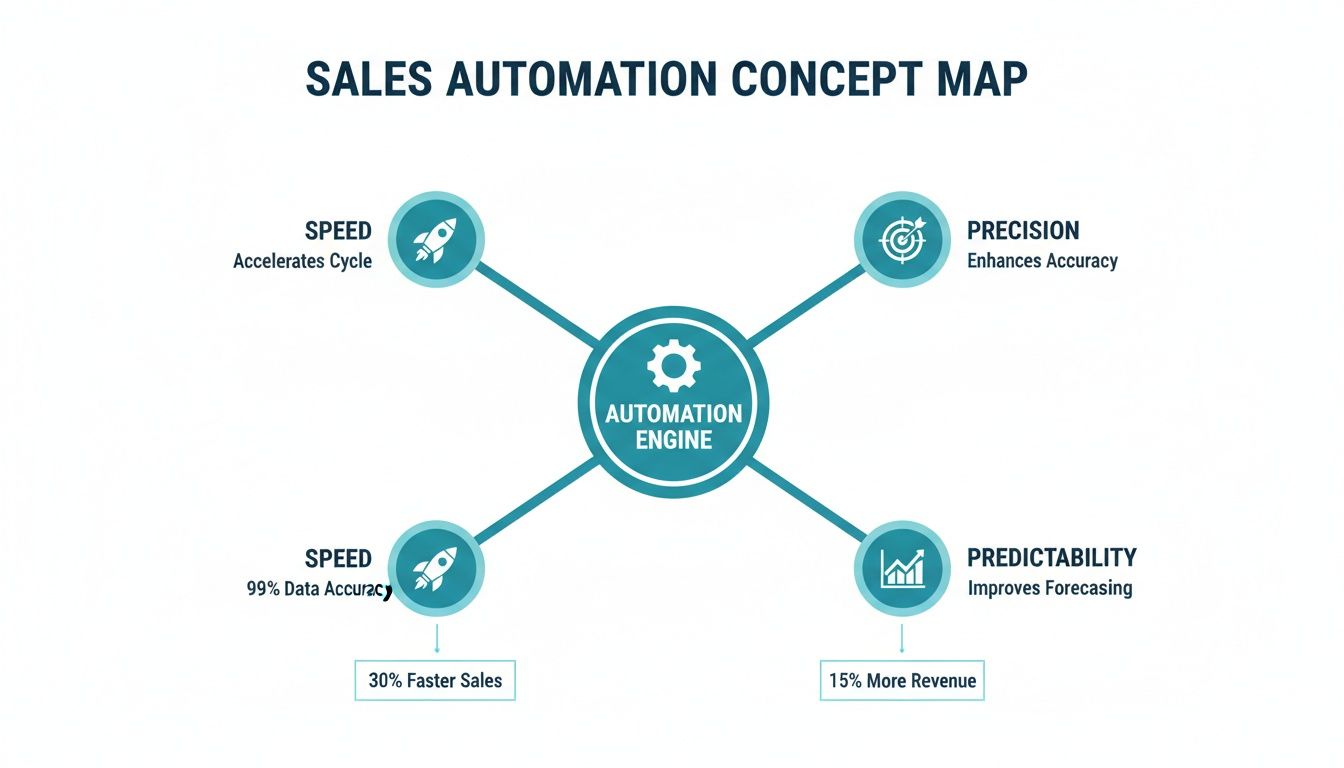
As you can see, the objective is to turn core functions into tangible business results. It’s about accelerating revenue while keeping your targeting razor-sharp and your forecasting dependable.
Contact Data and Segmentation
Let's be blunt: your automation is only as good as the data you put in it. For sales teams, that fuel is clean, accurate, and deep contact data. Without it, even the smartest workflows will just send the wrong message to the wrong people, burning through your TAM and damaging your brand.
An all-in-one platform aggregates data from dozens of sources into a single, unified view of your market. This enables your team to move past basic firmographics (like company size and industry) and build hyper-specific segments based on real buying signals, tech stacks, and job roles. For an SDR, that’s the difference between a messy spreadsheet with 10,000 generic names and a clean, actionable list of 500 perfect-fit prospects ready for outreach today.
Workflows and Triggers
Workflows are the brains of the operation—the "if-this, then-that" logic that powers your entire GTM process. Think of them as the automated steps that guide a prospect through a sequence based on specific actions, which we call triggers.
A trigger is an event that kicks off a workflow. For example:
- If a prospect opens your email three times but doesn't reply, then automatically send a personalized LinkedIn connection request.
- If a new lead from a target account downloads an ebook, then instantly add them to a high-priority outreach sequence.
- If an AE logs a call as a "No-show," then trigger a simple rescheduling sequence to get them back on the calendar without manual follow-up.
These automated rules ensure no opportunity slips through the cracks. Every prospect gets the right touchpoint at the right time, without a rep having to juggle it all in their head or in a separate task manager.
AI-Powered Personalization at Scale
This is where today’s sales automation truly leaves old-school mail merges behind. Prospects can spot a generic, lazy template from a mile away. To earn a reply, your messages must feel genuinely one-to-one, even when you're sending hundreds.
Instead of just plugging in static
{{first_name}}and{{company_name}}fields, advanced AI engines analyze a prospect's LinkedIn profile, recent company news, and job description. From there, they generate unique, relevant opening lines and talking points. The goal is to create a message that sounds like it was thoughtfully written by a human who understands their world, not a robot.
The result? Higher reply rates across email and LinkedIn because prospects feel you've done your homework. This level of smart, template-free personalization helps your team build credibility from the first touchpoint.
Multi-Channel Sequencing and Analytics
Your buyers don't live solely in their email inboxes, so your outreach shouldn't either. A powerful automation platform orchestrates your communication across email, LinkedIn, and calls within a single, unified sequence. This approach lets you create more touchpoints without overwhelming your prospects, ensuring you stay top-of-mind.
Just as important is knowing what’s actually working. Integrated analytics provide a clear, honest look at performance, answering the critical questions every Sales Leader and RevOps professional has:
- Which channels are booking the most meetings?
- Which messaging angles are resonating with our key personas?
- Is all this activity actually building a healthy, qualified pipeline?
This data-driven feedback loop allows you to stop guessing. You can finally cut what isn't working and double down on the strategies that drive revenue.
How Sales Automation Directly Impacts Revenue
Sales automation isn’t just an efficiency tool. It's a direct line from your team's daily activities to your bottom-line results. When you remove the friction of manual, repetitive work, you give your team a clear, measurable path to growing revenue.
For SDRs, it means they can stop spending 10+ hours a week digging for contact info or cleaning messy lists and instead focus on booking more qualified meetings. For AEs, it means receiving higher-quality handoffs and closing deals faster because prospects are a better fit and already warmed up.
And for Sales Leaders? It delivers the one thing everyone wants: a predictable pipeline. Automation turns forecasting from a gut-feel guessing game into a data-backed science, giving you a clear view of what’s working and what isn’t.
From Busywork to a Predictable Pipeline
The connection between automation and revenue is clear. A study found that 61% of overperforming sales teams use automation, compared to only 46% of their underperforming peers. Once implemented, teams report being 14.5% more productive and see deals close 20% faster.
Crucially, 75% of companies say their investment in sales automation directly contributes to revenue growth. This impact ripples across the entire sales funnel. For instance, using AI to score leads can increase sales opportunities by up to 20% by ensuring reps focus on accounts that are actually likely to close.
The result is a stronger, more reliable pipeline built on precision and quality, not just sheer volume.
How Different Roles Win with Automation
Every person on your revenue team experiences the benefits of automation differently, but it all points to the same outcome: driving more revenue, faster. It’s not about saving time for its own sake; it's about reallocating that time to high-value activities that a machine can't do.
For SDRs and BDRs: Automation ends the soul-crushing grind of manual prospecting. Instead of spending half their day on data entry, they can focus on writing compelling, personalized messages for top-tier accounts. The result is better reply rates and more meetings booked.
For Account Executives: AEs get a cleaner, more qualified pipeline. With automated lead nurturing and scoring, the opportunities that land on their desk are much further along in their buying journey. This shortens sales cycles and boosts win rates.
For Sales Leaders: The biggest win is predictability. Automation provides clear, real-time visibility into team performance, outreach effectiveness, and overall pipeline health. This makes it possible to forecast revenue with confidence and scale what’s working without just adding headcount.
For RevOps Teams: For RevOps, an all-in-one platform like Willbe solves the nightmare of juggling fragmented tools and dealing with broken data syncs. It enforces data hygiene, maintains a single source of truth in your CRM, and provides a complete picture of your entire go-to-market motion.
The real power of automation is that it systematically aligns daily activities with strategic goals. Reps aren't just 'being busy'—every automated touchpoint, every piece of data, and every sequence is designed to move opportunities forward.
Ultimately, sales automation isn't about replacing your reps; it's about making them better at their jobs. By taking over the repetitive tasks, it frees up SDRs to be master communicators, allows AEs to be strategic closers, and helps leaders become confident forecasters.
Of course, tracking these improvements is key. To understand what to measure, check out our guide to building a sales performance metrics dashboard.
Choosing Your Automation Strategy: All-In-One vs. Fragmented Tools
Every growing sales team eventually hits a fork in the road: do you cobble together a collection of specialized point solutions, or do you adopt a single, all-in-one platform? This isn’t just a software decision—it’s a choice that shapes your entire sales motion, your team's efficiency, and your ability to scale.
At first, the fragmented approach seems appealing. You pick the "best-in-class" tool for each specific task. But this strategy almost always creates a management nightmare for RevOps and a clunky, frustrating experience for reps.
It's like building a car from the parts of ten different models. Sure, you might get it to run, but it will be wildly inefficient and break down constantly. The hidden costs of managing integrations, wrestling with data silos, and constantly retraining your team on different UIs add up fast.

The Problem with a Fragmented Tool Stack
When you stitch together separate tools for prospecting data, sequencing, calling, and analytics, you introduce a massive amount of friction. Every tool has its own login, its own data structure, and its own way of working. This creates a serious drag on day-to-day operations.
Here's where the pain really sets in for most sales teams:
- Broken Data Syncs: Your RevOps team ends up spending a shocking amount of time playing whack-a-mole with data connections via tools like Zapier. They're constantly trying to get the prospecting database to talk to the sales engagement tool, which then has to sync correctly with the CRM. Information gets lost, duplicates pop up, and reps stop trusting the data.
- No Single Source of Truth: With data scattered across half a dozen platforms, you lose any clear view of the customer journey. You can't definitively say which outreach sequence led to a meeting or which account data is actually up-to-date. This makes it nearly impossible to diagnose what's working and what isn't.
- High Total Cost of Ownership (TCO): Individual subscription fees might look small, but they add up. When you factor in the cost of integration tools and the salaried hours your team spends on manual data entry and maintenance, you're often paying a premium for a system that barely works.
This fragmented reality turns your highly-paid sales reps into manual data integrators, forcing them to waste precious selling time just toggling between tabs and cleaning up messy records.
The Advantage of a Unified All-In-One Platform
An all-in-one B2B prospecting and lead generation platform like Willbe is built from the ground up to work as a single, cohesive engine. It’s the difference between that patchwork car and a precision-engineered vehicle where every part works in perfect harmony.
An integrated platform brings your data, personalization, multi-channel outreach, and analytics together under one roof. This is what truly allows a modern sales team to scale effectively.
An all-in-one platform isn’t just about having fewer logins. It’s about creating a single source of truth for your entire go-to-market motion, from initial prospecting to closed-won deals.
This unified approach gives everyone a clear, shared view of what's driving results, eliminates frustrating data conflicts, and hands your team a streamlined workflow they can actually master.
All-in-One Platform vs. Fragmented Tool Stack
When you place the two strategies side-by-side, the business impact becomes incredibly clear. One path leads to mounting complexity and inefficiency, while the other paves the way for scalable, predictable growth.
Here’s a direct comparison of the two models and what they mean for your business.
For any Sales Leader or RevOps professional focused on building a predictable revenue engine, the choice is obvious. The fragmented model creates constant friction that holds you back. An all-in-one platform removes it, letting your team focus on what they were hired to do—sell.
How to Implement Sales Automation Successfully
Having a great automation strategy on paper means nothing if the rollout fails. Implementing a new platform can feel like a massive undertaking, but breaking it down into a few logical phases turns a complex project into a series of manageable wins.
The goal is to build a solid foundation, get quick proof that it's working, and then scale up—all without disrupting your team or letting opportunities fall through the cracks.

Think of this as a roadmap for a smooth deployment that delivers real ROI and gets your team on board. This is a proven process that bridges the gap between planning and measurable results.
Step 1: Start with a Process Audit
Before you automate anything, you have to get honest about your current sales process. Don't skip this step. Remember: automating a broken process just helps you create a mess faster.
Start by mapping out what your team actually does every day. Where are the real bottlenecks?
- How much time do your SDRs spend building lists versus actually engaging prospects?
- How many clicks and manual entries does it take to log a call or update the CRM?
- Where does crucial data get lost or go stale between marketing handoffs and sales outreach?
Look for the repetitive, low-value work that eats up your team's day. These are your prime candidates for automation. For instance, if you find out reps are wasting 5-10 hours a week just cleaning bad contact data, you've found your first high-impact problem to solve.
Step 2: Define Your Goals and Run a Pilot Program
Once you know where the pain is, set clear, measurable goals. Vague targets like "improving efficiency" won't cut it. You need something you can actually measure.
A strong goal sounds like this: "We will reduce the time SDRs spend on manual data entry by 50% in the first 30 days" or "We will increase our meeting-booked rate by 15% for our top-tier accounts this quarter."
With a specific goal in mind, resist the urge to do everything at once. Start small with a pilot program. Choose a couple of your most adaptable reps and give them the new platform with one specific, high-value workflow to test—like an outbound sequence for a key persona. This lets you work out the kinks, gather real performance data, and prove the concept in a low-risk environment.
Step 3: Build Your First High-Impact Workflows
That successful pilot is your blueprint. Now it's time to build out a few core workflows for the rest of the team, starting with the ones that offer the biggest return for the least effort.
Here are a few classic "first workflows" that deliver immediate value:
- Inbound Lead Nurturing: As soon as a new lead comes in from your website, automatically enroll them in a sequence of emails and LinkedIn connection requests. This ensures every lead gets a prompt, consistent follow-up, even when reps are busy.
- Target Account Prospecting: Set up a workflow that finds the right contacts at your ideal customer accounts and automatically adds them to a personalized outreach sequence. This takes the grunt work out of account-based selling and makes it truly scalable.
- Meeting No-Show Rescheduling: When a prospect ghosts a demo, don't let that opportunity die. An automated sequence can send a friendly follow-up to get them back on the calendar. You'd be surprised how much pipeline this one small automation can recover.
The key is to start with simple, rules-based automations that solve an obvious problem. This builds momentum and gets everyone comfortable before you move on to more sophisticated plays.
Step 4: Train Your Team and Scale with Confidence
A new platform is useless if your team doesn't buy in. True adoption is about more than just a one-hour training session. They need to understand the why behind the what.
Frame it around what’s in it for them: "This platform will give you back five hours a week you're currently spending in spreadsheets. That's five more hours you can spend on conversations that actually make you money."
As you roll the platform out to the wider team, turn your pilot group into internal champions. They can share their wins, answer questions, and show their peers how the new process makes their job easier, not harder. From there, you can scale confidently, layering in more workflows and expanding the system across your entire revenue team.
Answering Your Top Sales Automation Questions
Even when the benefits of sales automation seem clear, there are always tough, practical questions that come up. Investing in a new platform is a big decision, and we've heard all the concerns from Sales Leaders, RevOps pros, and founders who are serious about building a predictable revenue engine.
Let's tackle the big ones head-on.
Will Automation Make Our Outreach Sound Robotic?
This is the number one fear, and it comes from a very real place: a decade of bad automation tools. We've all seen those lazy {{first_name}} and {{company_name}} emails. They get spotted a mile away and are instantly deleted.
But that’s old-school automation. It's not what modern platforms do.
Today’s advanced platforms use template-free AI. Instead of just plugging in names, the AI actually reads a prospect's LinkedIn profile, recent company news, and job description to write messages that sound genuinely human and personal. The point isn't to send more spam; it's to scale authenticity.
With a platform like Willbe, the AI is designed to mimic your best sales reps, not a machine. You end up building trust and credibility from the first touchpoint, which is why reply rates are so much higher. It’s about making every prospect feel like you did your homework, even when you're reaching out at scale.
How Much Time Will My Sales Reps Actually Save?
This is where the rubber meets the road. We consistently see reps get 5-10 hours back each week. That's not a fuzzy "efficiency gain"—it’s time they're no longer wasting on mind-numbing administrative work.
Think about the dead time that adds up from:
- Manually building prospect lists in messy spreadsheets.
- Copying and pasting notes and updates into the CRM.
- Trying to remember who to follow up with and when.
When you eliminate that admin burden, your reps can pour all that recovered time into what they were hired to do: talking to qualified buyers, writing thoughtful messages for high-value accounts, and actually closing deals.
Is Sales Automation Only for Large Enterprise Teams?
Not at all. In fact, it's often more impactful for startups and growing companies. While enterprises use automation to manage massive, complex sales motions, smaller teams use it to level the playing field and compete with much bigger players.
For a startup, a platform like Willbe is the fastest way to build a repeatable go-to-market engine without a huge headcount. A handful of reps can suddenly cover a vast territory with the speed and precision of a team three times its size. If you’ve just closed a funding round, this is how you hit those aggressive pipeline targets without burning through cash on a hiring spree.
How Does an All-In-One Platform Manage Data Quality?
This is one of the biggest hidden costs of a disconnected tech stack. When your tools don't talk to each other, data quality becomes a nightmare. Information gets stuck in silos, syncs inevitably break, and your CRM devolves into a swamp of duplicate, outdated, and conflicting records.
An all-in-one platform is built to solve this from the ground up. Here’s how:
- Centralized Data: It pulls information from dozens of sources into a single place. Willbe, for example, combines data from over 30 B2B databases.
- Automatic Cleaning: The platform constantly works in the background to verify contact details, remove duplicates, and enrich records with fresh information.
- Native CRM Sync: The connection to your CRM is seamless and reliable, ensuring it remains the undisputed source of truth for the entire company.
The end result is simple: your team works with clean, accurate data. That means better targeting, sharper personalization, and reporting you can actually trust. It's the bedrock of any predictable sales process.
Ready to see how an all-in-one platform can build a predictable pipeline for your team? Willbe replaces fragmented tools with a single, powerful engine for finding, personalizing, and converting high-value accounts.