

At its simplest, your cost per lead (CPL) is the dollar amount you spend to get a single potential customer to raise their hand. The math is straightforward: Total Campaign Spend ÷ Total New Leads. But that simple number tells a much bigger story about the health of your entire go-to-market strategy.
It's one of the most critical metrics for building a predictable pipeline.
Why Cost Per Lead Is a Core GTM Metric
In B2B sales, it’s easy to get fixated on lead volume. A full funnel looks great on a dashboard, but if it’s packed with unqualified prospects who will never buy, it’s just noise that burns resources and won't lead to revenue. Tracking your cost per lead forces a critical shift from celebrating quantity to measuring efficiency and real-world impact.
Think of it this way: you can either drill for oil randomly or use seismic data to find the most valuable deposits. CPL is your seismic data.
For any sales leader, a rising CPL is an early warning system. It’s a red flag that signals something in your outbound engine is broken, long before you start missing quota.
These issues often boil down to a few common culprits:
- Ineffective Targeting: Your team is burning budget and hours chasing accounts that are a poor fit for your ideal customer profile (ICP).
- Weak Messaging: Outreach feels generic and fails to connect with your prospects' actual pain points, leading to dismal reply rates.
- Poor Data Quality: SDRs are hitting dead ends with bounced emails and disconnected phone numbers, driving up the real cost of every single conversation.
- Fragmented Tools: Reps waste precious time toggling between different platforms for data, sequencing, and personalization, which creates friction and kills momentum.
CPL isn't just a marketing metric on a spreadsheet; it's a direct measure of your sales team's operational effectiveness. A high cost per lead means you’re wasting money on activities that don’t move the needle. A low, optimized CPL shows your GTM engine is running smoothly, turning every dollar invested into real pipeline.
For a more detailed look at the mechanics, this guide on What Is Cost Per Lead (CPL) provides a great overview.
Ultimately, getting a handle on your CPL is about making sure every dollar you spend is a strategic investment in generating high-quality opportunities. It’s how you transform B2B lead generation in our guide from a cost center into the predictable revenue engine your business needs to grow.
How to Accurately Calculate and Benchmark Your CPL
Getting a handle on your Cost Per Lead is about more than a simple formula. The real story is in the details. To truly understand this critical sales metric, you need to know how to calculate your Cost Per Lead (CPL) and, just as importantly, what that final number actually says about your GTM efficiency.
For any sales or RevOps team, this means looking far beyond just ad spend. A proper calculation takes into account every direct and indirect cost that goes into acquiring a lead. It’s a full accounting of your go-to-market investment.
This image lays out the basic math for figuring out your cost per lead.
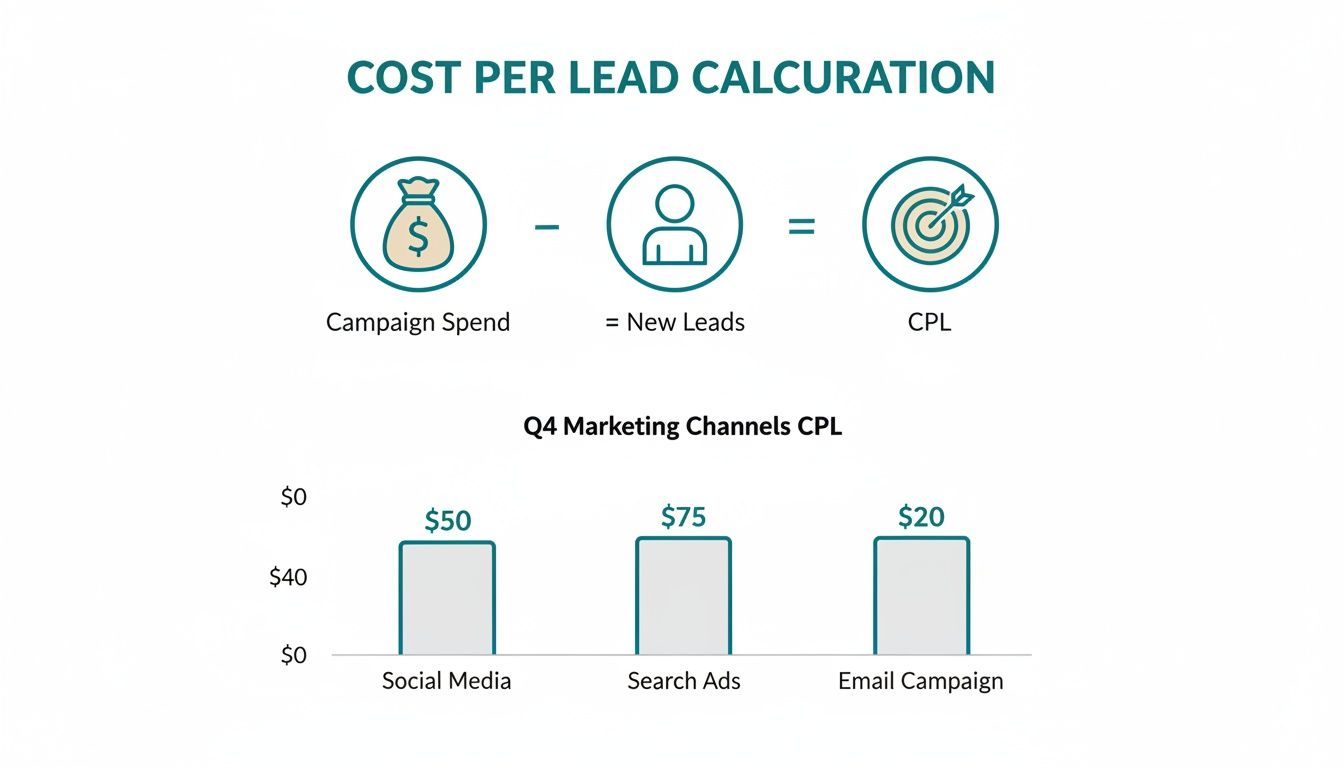
The formula is straightforward: every dollar you put into a campaign needs to be weighed against the number of leads it actually produces.
What Costs to Include
To get a CPL number you can trust, you have to account for the complete picture of your lead generation expenses. Don't let hidden costs throw off your calculations. Think of it like a real-world scenario: a RevOps leader can't claim a campaign was profitable by only counting the LinkedIn ad budget. You have to include the cost of the tools, the time your SDRs spent on outreach, and the assets they used.
- Tool Subscriptions: Tally up the monthly or annual costs for your entire GTM tech stack. This includes data providers, sequencing tools, your CRM, and any AI personalization platforms.
- Ad Spend: This is the most obvious one. It covers all money spent on channels like LinkedIn Ads, Google Ads, and sponsored content.
- Salaries and Commissions: A portion of your SDRs' and marketers' salaries must be factored in. This gives you a much more realistic view of what it truly costs to generate leads.
- Content and Creative: Don’t forget the cost of creating campaign assets, from webinar production fees to graphic design for a whitepaper or video editing.
Benchmarking Your CPL Against the Market
Once you’ve got your CPL, the next question is, "So... is that any good?" The answer depends entirely on your business. Your industry, company size, and go-to-market strategy all play a huge role. A CPL of $1,000 might be a steal for a cybersecurity firm that closes seven-figure deals, but it would be a disaster for a SaaS company with a much lower annual contract value (ACV).
Benchmarking isn't about chasing a single "right" number. It's about understanding the context of your market so you can set realistic goals and spot performance issues before they start hurting your pipeline.
Recent data shows just how wide the CPL gap can be. For B2B companies, the average cost per lead across industries is around $770, but it swings wildly from there. Cybersecurity firms, for example, often see CPLs north of $1,000, while many software companies might average something closer to $213.
This is exactly why a multi-channel strategy is so powerful. While cold email alone might average a $225 CPL, a smart, blended approach can often bring that number down to $188, beating out single-channel efforts. It’s also where teams using an all-in-one prospecting platform like Willbe are finding a serious competitive advantage by consolidating costs and boosting efficiency.
By tracking CPL alongside other key metrics, you get a much clearer, more honest picture of your sales engine's health.
The Hidden Drivers That Inflate Your Cost Per Lead
So you've calculated your cost per lead, and the number is making you wince. What now? Before you slash your ad budget, you need to look closer. The biggest drains on your budget often aren't the obvious expenses. They’re the hidden operational problems that create drag on your entire go-to-market motion, forcing your team to work twice as hard for half the results.
These issues quietly burn through cash, inflating the true cost of every single conversation you manage to start.
Poor Data Quality
Think of bad data as a slow, expensive leak in your pipeline. When your SDRs are working from lists full of bounced emails, outdated job titles, and disconnected phone numbers, they aren't just wasting time—they're driving up your CPL with every single failed touchpoint.
Every sales leader has seen this scenario: a top-performing rep spends half their day manually verifying contacts instead of booking meetings. That’s not a sales activity; it’s an expensive data entry task that’s killing your bottom line. Each of those invalid contacts represents sunk costs in both salary and software.
Generic, Uninspired Messaging
Decision-makers are drowning in outreach. If your message sounds like it could have been sent to a thousand other people, it’s going straight to the trash folder. Generic, one-size-fits-all emails are a surefire way to get ignored.
When your outreach doesn't speak directly to a prospect’s specific role, industry, or challenges, your reply rates will tank. To compensate, you have to contact more and more people just to get a single response, which sends your cost per lead through the roof.
Your CRM has become a graveyard of bad data. Every outdated contact and bounced email represents wasted budget and a missed opportunity, silently inflating your real cost to acquire a customer.
Targeting the Wrong ICP
Even the most perfectly crafted message will fall flat if you send it to the wrong person. Targeting an ideal customer profile (ICP) that’s too broad, or just plain wrong, is a guarantee you’ll burn through resources on leads who can't buy from you. They might lack the budget, the authority, or even the basic need for your solution.
This is exactly how your Account Executive ends up on a "qualified" demo with someone who has zero purchasing power. It’s a massive momentum killer for the deal and a major blow to team morale.
This problem gets bigger and more expensive as you move upmarket. For instance, B2B data shows that enterprise companies with over 1,000 employees have an average CPL of $349. Compare that to smaller firms with 2-50 employees, where the CPL is just $47. The same trend holds for revenue—companies over $500M in revenue pay around $429 per lead, while those under $1M pay $166.
This massive efficiency gap is exactly what platforms like Willbe are designed to close. If you want to dig deeper, you can learn more about these cost per lead breakdowns by industry.
Proven Strategies to Lower Your CPL Today
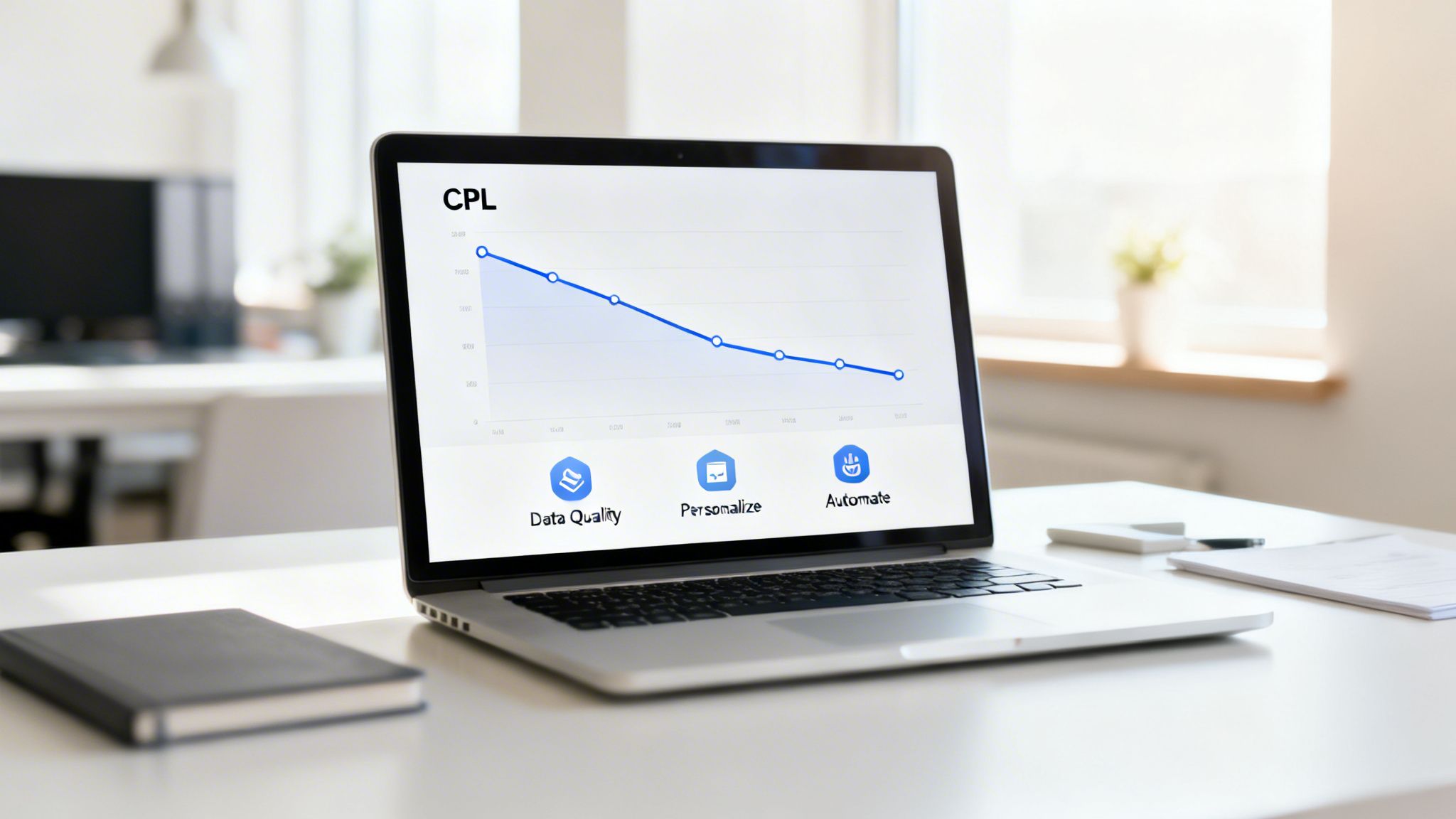
Knowing your CPL drivers is one thing. Actually fixing them is another. Instead of accepting high acquisition costs, the best go-to-market teams get to work building a more efficient engine.
This isn't theory. This is the playbook sales leaders and RevOps teams are using right now to slash their cost per lead and get more pipeline from the same spend.
Double Down on Data Quality
Let's be blunt: bad data is a budget killer. Every bounced email, every outdated job title—that's money down the drain. The fix isn't hiring more people to manually clean lists; it's building your entire outbound motion on a foundation of verified, accurate data from the get-go.
That means using a platform that consolidates high-quality data that’s constantly being refreshed. When your SDRs trust that every contact in their sequence is the right one, they stop wasting hours chasing dead ends and start spending that time actually booking meetings. You'll see a direct, measurable drop in your cost to acquire each lead.
Hyper-Personalize Your Outreach at Scale
We all live in a world of automated noise. The only messages that cut through are the ones that feel like they were written by a real person who understands the prospect's world. Generic, templated emails are a one-way ticket to the trash folder, forcing you into a high-volume, low-conversion game that just inflates your CPL.
The solution is to personalize your outreach at scale. Real personalization means referencing a prospect’s specific role, a recent company announcement, or a shared challenge in a way that proves you've done your homework.
The goal is to make every prospect feel like they're getting a one-to-one message, even when you’re reaching out to hundreds. This is where AI designed to sound like your best reps—not a robot—can be a huge advantage, lifting reply rates and cutting your effective cost per meeting.
Optimize Your Channel Mix
If you're relying on a single, expensive channel, your CPL is going to be high. It's that simple. A much smarter play is to orchestrate your outreach across several more cost-effective channels. The benchmarks make this crystal clear: trade shows can run you an average of $840 per lead, while a multi-channel prospecting strategy comes in at a far more manageable $188.
A modern, multi-channel playbook could look something like this:
- Start with a hyper-personalized, AI-generated email.
- Follow up with a LinkedIn connection request that references the email.
- Send another email a few days later to build on the conversation.
This coordinated approach creates more touchpoints without being annoying, seriously increasing your chances of getting a response and lowering your blended cost per lead. To see exactly how different channels compare, you can explore detailed 2025 B2B CPL benchmarks.
Consolidate Tools and Automate Manual Work
Think about how much time your team spends on work that has nothing to do with selling. Manually updating the CRM, logging every call and email, toggling between different tools—it adds up, creating a massive drag on productivity and driving up your CPL.
Every hour an SDR spends on admin is an hour they aren't generating pipeline. By automating these workflows, you give your team their most valuable resource back: time. Consolidating your tools into an all-in-one platform ensures your prospecting activity syncs perfectly with your CRM, eliminating friction. This operational efficiency is one of the fastest ways to lower your costs and do more with your existing team.
How Willbe Slashes Your Cost Per Lead by Unifying Your Stack
Everyone knows the playbook for lowering cost per lead: clean up your data, personalize your outreach, and automate manual work. The real challenge is executing this without adding more fragmented tools, increasing headcount, or creating a process so complex that no one follows it.
This is exactly why we built Willbe. It’s not just another tool in your stack; it’s an all-in-one prospecting and lead generation platform designed to eliminate the operational friction that drives up CPL. We bring your entire outbound workflow—from finding accounts to booking meetings—under one roof, so your team can build a stronger pipeline with speed, precision, and predictability.
Stop Burning Budget on Bad Data
Let’s be honest: high CPL almost always starts with bad data. Your reps are burning hours verifying contacts or dealing with a constant stream of bounced emails. Every minute they spend on that is a minute they aren't selling, which directly inflates the true cost of every meeting they book.
Willbe tackles this problem at the source. Our platform consolidates over 30 B2B databases into a single data engine that's constantly being cleaned and verified. Instead of juggling multiple data subscriptions and still ending up with stale info, your team gets direct access to high-quality, verified contacts with global reach.
Here’s what that means for your team:
- Fewer bounced emails and wasted outreach efforts.
- More time spent actually selling, not cleaning lists by hand.
- A direct cut in wasted spend and redundant subscription costs, which immediately lowers your effective CPL.
When you can trust that every lead in your sequence is accurate, your reps can prospect with the confidence and precision needed to turn your budget into revenue.
Boost Reply Rates with Human-Sounding AI
Generic, copy-paste outreach is a one-way ticket to low reply rates. This forces sales teams to play a high-volume numbers game, which just sends your CPL through the roof.
Willbe’s proprietary, template-free AI was built to solve this. It generates emails and LinkedIn messages that sound genuinely human, not like generic AI copy. Our AI orchestrator dives deep into a prospect's profile to create messages that reference their specific challenges, company news, or even personal accomplishments—making them feel genuinely understood.
The result is outreach that cuts through the noise and earns a reply. When your reply rate goes up, you need fewer touchpoints to land a meeting—one of the simplest and most effective ways to slash your CPL.
If a sales rep saves just two hours per day on manual tasks and increases their reply rates by 3%, your effective CPL can drop by over 40%. This isn't just about small efficiencies; it's about fundamentally changing the economics of your outbound engine.
Consolidate Tools and Eliminate Manual Work
The modern sales stack is often a fragmented mess of disconnected tools for data, sequencing, and personalization. This creates data silos, sync errors, and forces reps to spend hours on manual CRM entry—all of which add hidden operational costs that bloat your CPL.
Willbe replaces that entire fragmented workflow. We put your data, AI personalization, and multi-channel sequencing all in one platform, where every single activity automatically syncs back to your CRM. For RevOps, this means clean, reliable data. For sales leaders, it means clear visibility into what's actually working.
To see how top teams use this visibility to scale, you can explore Willbe’s sales analytics capabilities. By consolidating, you cut redundant subscription fees and free your reps from the friction of constantly switching between tools, letting them focus 100% on generating pipeline.
Answering Your Top CPL Questions
We've covered the what, why, and how of cost per lead. But theory is one thing—putting it into practice is another. Let's dig into the questions I hear most often from sales and RevOps leaders who are in the trenches trying to make these numbers work.
How Often Should I Recalculate My CPL?
Think of your CPL as a dashboard gauge, not a one-time snapshot. You can't just check it once a year and expect to stay on course.
For any serious B2B team, a monthly and quarterly review is the minimum. The monthly check-in is your early warning system; it tells you if a specific campaign is suddenly bleeding cash. The quarterly review gives you the altitude to see the bigger picture and spot broader trends in your strategy.
This rhythm keeps you nimble. You can spot a channel that’s driving your cost per lead through the roof and make a change right away, instead of finding out three months later that you’ve burned through your budget.
Is a Low CPL Always a Good Thing?
Absolutely not. Chasing a rock-bottom CPL can feel productive, but it's often a trap. You end up with a list of cheap, low-intent leads that clog your pipeline and waste your sales team's precious time.
These are the leads that look great on a spreadsheet but never had any real potential to become customers. They just create noise, kill morale, and distract everyone from the real opportunities.
The goal isn't the lowest CPL. It's the optimal CPL for acquiring high-quality leads that fit your ideal customer profile and have a real shot at closing. It's always better to pay $300 for a lead that actually converts than $30 for one that goes nowhere.
How Does Lifetime Value (LTV) Relate to CPL?
This is where the real business context comes in. To understand what a "good" CPL is for your company, you have to look at Lifetime Value (LTV)—the total revenue you expect from a single customer over their entire relationship with you.
A healthy rule of thumb is to keep your LTV at least 3x your Customer Acquisition Cost (CAC). Since CPL is a huge part of your CAC, this ratio tells you exactly how much you can afford to spend.
For example, if your average deal size is $100,000, spending $1,000 on a lead that eventually closes is a no-brainer. But if your average deal is only $5,000, that same $1,000 CPL would put you out of business fast. Connecting these two metrics helps you set a realistic CPL ceiling and confidently invest in more expensive channels that deliver high-value customers.
Ready to stop burning budget on bad data and generic outreach? Willbe is the all-in-one B2B prospecting platform that helps you find better accounts, engage them with human-sounding AI, and convert pipeline faster—all while driving down your cost per lead.