


Let's be direct. Closing a B2B deal isn't what it used to be. The days of relying on a charismatic pitch and a firm handshake to get a signature are long gone. It’s no longer an art form practiced by a gifted few; it’s a science built on a scalable, efficient system.
The Modern Reality of Closing B2B Deals

Today's buyers come to the table armed with more information than ever, and decisions are almost always made by a committee. The final "yes" shouldn't be a surprise—it should be the natural outcome of a process where you've proven your value at every single touchpoint.
Still, too many sales teams treat the close as a high-pressure, standalone event. They get to the final meeting, go for the hard sell, and then wonder why their pipeline is full of stalled deals. To avoid that trap, you have to understand the entire B2B sales motion from start to finish. If you’re building out your first playbook, getting a clear handle on What Is B2B Sales is the perfect starting point.
Why Are So Many Deals Slipping Away?
The numbers don't lie, and frankly, they can be a bit sobering. The average sales close rate across all industries sits at a mere 29%. Think about that. For every 100 fully qualified opportunities your team works, nearly 70 of them fizzle out. For ambitious B2B teams, that’s not just a statistic; it’s a massive, glaring opportunity for improvement.
The real magic of closing doesn't happen in the final call. It’s a direct result of the precision and intelligence you apply from the very first outreach.
This is where a modern, data-driven GTM platform becomes your competitive advantage. For instance, top-performing teams who use an all-in-one platform like Willbe to aggregate data for hyper-precise segmentation see their win rates for deals under 50 days skyrocket to 47%. That’s not a small jump; it’s a game-changing advantage that comes from working smarter, not just harder.
Shifting From Guesswork To A Predictable System
The gap between the top 1% of closers and everyone else isn't about raw talent—it's about process. The best sales leaders, AEs, and RevOps teams are obsessed with building a repeatable system that turns guesswork into predictable revenue.
This system is built on a few core pillars:
- A Foundation of Clean Data: It all starts with knowing you’re talking to the right person about the right problem. Verified contact and company data is non-negotiable.
- Genuinely Personalized Outreach: Ditch the generic templates. Willbe’s proprietary, template-free AI helps you craft messages that sound like you—not a robot—and build real rapport from day one.
- One Source of Truth: Your team needs a unified platform. When prospecting data, outreach engagement, and CRM updates all sync automatically, your closers have the complete story and context they need to win—without toggling between five different tools.
Ultimately, mastering the close in 2026 means you stop hoping for wins and start engineering them. It’s about creating a process so dialed-in and aligned with your buyer’s journey that the "yes" feels like the only logical conclusion.
Key Closing Metrics at a Glance (2026)
To build a winning process, you need to know what "good" looks like. The table below outlines the critical benchmarks that separate high-performing sales organizations from the rest.
| Metric | Industry Average | High-Performer Benchmark |
|---|---|---|
| Overall Win Rate | 29% | 40%+ |
| Sales Cycle Length | 90+ days | Under 60 days |
| Lead-to-Opportunity Rate | 13% | 25%+ |
| Customer Acquisition Cost | Varies | 3:1 LTV to CAC Ratio |
Use these numbers as your north star. If your metrics are falling short, it's a clear signal that there's an opportunity to refine your data, outreach, or closing strategies to better align with what's working today.
Laying the Groundwork for a Confident Close

The best closers know a secret: the deal isn’t won in the final meeting. It’s won long before you ever ask for the signature. A truly great close feels less like a high-pressure moment and more like the obvious, logical next step for everyone involved.
Your job is to build such a compelling case for value throughout the entire sales process that when the time comes, signing the contract feels completely natural. This isn't about running through a generic checklist. It's about setting the stage so your buyer can make a confident "yes."
From Handoff to a Unified Front
For an Account Executive, the work begins the second a new opportunity hits your pipeline. That handoff from your SDR or BDR isn't just a calendar invite—it’s your first and best source of intelligence. When that handoff is sloppy, the whole deal can lose momentum before it even starts. The AE has to re-ask discovery questions, and the prospect feels like they’re starting over.
This is a classic problem for teams juggling multiple, disconnected tools. Notes get lost, and context disappears between platforms.
But when your team uses a unified platform like Willbe where all outreach history syncs directly to the CRM, it’s a different ballgame. As an AE, you can instantly see the exact messages that resonated, which talking points they engaged with, and their full history. It’s like getting a running start. You’re building on existing rapport, not starting from zero.
The first thing you should do is dive into that history. Look for the details:
- Initial Triggers: What was the specific hook in the early outreach that got them to book a meeting?
- Engagement Patterns: Were they more interested in saving money or driving innovation? Their clicks and replies will tell you.
- Hidden Stakeholders: Who else was included on email threads or mentioned in passing? They might be more important than you think.
This deep context is gold. It helps you frame your conversations and proves you’ve been paying attention from day one.
Conduct a Deal Pre-Mortem
Before you even think about sending that final meeting invite, you need to think about all the ways this deal could fall apart. We’re huge believers in the deal pre-mortem. It’s a simple but powerful exercise: get your team together and pretend the deal is already lost. Then, work backward to figure out what "went wrong."
This isn’t about being negative; it's about being brutally realistic and prepared. Grab your sales manager, the SDR who sourced the deal, and anyone else who has touched the account.
Get together and ask the hard questions:
- Are we absolutely certain we’re talking to the person who can actually sign the check? The economic buyer?
- What budget or timing issues are lurking that we haven't brought up yet?
- Is there a competitor in the wings that we're underestimating or don't even know about?
- Does our champion really have enough political capital to get this deal across the finish line?
By getting these risks out in the open, you can build a plan to tackle them directly. You can neutralize those potential landmines before they ever have a chance to blow up your deal. It’s how you stay in control.
An AE's job isn't just to sell. It's to de-risk the buying process for the customer. A thorough pre-mortem is your single best tool for finding and fixing those risks before the final call.
The Power of a Collaborative Agenda
Here’s a final pro tip: never walk into a closing meeting with a one-sided agenda. A few days before the call, send a brief, collaborative agenda to your main point of contact.
The key is how you frame it. This isn't a list of things you plan to talk about. It’s a shared roadmap for making a final decision together.
Here’s an example of what that might look like:
- Recap of Your Key Business Goals: A quick confirmation that we’re still aligned on solving your primary challenges (e.g., cutting manual data entry by 15 hours/week per rep).
- Confirmation of Solution Alignment: We’ll briefly review how our platform delivers on those goals and the ROI we’ve discussed.
- Final Questions & Partnership Terms: An open floor for any last questions from your team before we walk through the proposal specifics.
- Mutual Plan for Next Steps: Let’s align on the implementation timeline and the immediate path to getting started.
When you invite them to add or adjust the agenda, you’re giving them co-ownership of the meeting. It immediately shifts the dynamic from a pitch you’re delivering to them to a working session you’re having with them. This reinforces your role as a partner, making the final "yes" feel like a shared victory.
Navigating Objections and Mastering Negotiation
There it is. That moment in the sales cycle when you hear the words every AE dreads: "The price is too high," or "Now just isn't the right time." The natural instinct is to get defensive or, even worse, immediately offer a discount. Don't do it.
An objection isn't a rejection. It’s a test. Your prospect is engaged, but they need you to bridge a gap for them. They're looking for conviction, not a concession. How you react in this exact moment can completely change the trajectory of the deal.
The best reps see objections as invitations to go deeper and connect the dots between the prospect's pain and the value you deliver. It’s your chance to turn a potential roadblock into a green light.
Decoding Common B2B Objections
Most objections boil down to one of four core issues. Getting to the root of which one you're facing is half the battle.
Budget: This is the most common smokescreen. When a prospect says, “It’s too expensive,” they’re rarely talking about the sticker price. What they’re really saying is, “You haven’t convinced me the ROI is there.” It's a value problem, not a cost problem.
Timing: "Give us a call next quarter" is the classic stall. This tells you one thing: there's no urgency. The pain of their current situation doesn't feel sharp enough for them to act now.
Authority: Hearing "I need to run this by my boss" can be a red flag. It often means you haven't identified the true decision-maker—the person who can actually sign the check.
Competition: "We're happy with [Competitor X]" is a clear signal that you haven't differentiated your solution. The prospect views you as a "nice-to-have" alternative, not a "must-have" partner for achieving better results.
Once you know the real concern, you can stop defending your price and start diagnosing their problem.
The Feel, Felt, Found Framework in Action
This is an old-school technique for a reason: it works. The "Feel, Felt, Found" method is a simple but powerful way to handle objections because it leads with empathy, showing you’re actually listening.
Imagine your prospect says, "Your platform is way more expensive than we budgeted for."
Instead of launching into a feature-dump, try this:
Feel: First, validate their point of view. "I understand how you feel. It’s smart to make sure any new investment lines up with the budget." This instantly lowers their defenses.
Felt: Next, normalize their concern with a relatable example. "Some of our best customers felt the exact same way when they first saw the numbers. The team at [Similar Company Name], for instance, was also worried about the upfront cost."
Found: Finally, pivot to the positive business outcome. "But what they found was that after they replaced three of their other tools with Willbe and saved each rep 8 hours a week on manual tasks, they hit a positive ROI in less than six months. The cost of sticking with the status quo was actually much higher."
You've just turned a price objection into an ROI conversation. For a deeper look at this strategy, check out our guide on value-based selling.
Shifting from Discounts to a Give-Get Framework
When the negotiation dance begins, your first move should never be to offer a discount. That’s a race to the bottom that cheapens your solution and kills your margins. A much stronger approach is to adopt a give-get framework.
Your price is a reflection of your value. Defend your price, not with aggression, but with a confident and clear articulation of the business outcomes you deliver.
If a prospect pushes for a lower price, your answer shouldn't be a quick "yes." It should be a collaborative "if... then..." scenario.
For example, if they ask for a 15% discount, you could counter with: "We can definitely explore some flexibility on the annual price if you'd be open to signing a two-year agreement or providing a customer case study after we go live."
This simple shift does a few critical things:
- It anchors the discussion around mutual value, not a one-sided handout.
- It protects your margins by trading a concession for something valuable in return (like a longer contract term or faster payment).
- It positions you as a strategic partner looking for a win-win, not just a vendor desperate to close.
This collaborative stance is your secret weapon, especially when dealing with procurement or tough executive stakeholders. It proves you're in it for a long-term partnership, not just a quick sale.
The Art of the Ask: Modern Closing Techniques That Work

This is where all your hard work pays off. You've built genuine rapport, navigated the tough questions, and proven your solution’s value. Now it's time to actually ask for the business. The biggest mistake you can make here is resorting to old-school, high-pressure closing lines that make today’s B2B buyers flinch.
Your goal isn't to trap someone into a "yes." It's to guide them to a decision that feels like the logical, collaborative end to a series of smart business conversations. The best closers are experts at reading the room. They pick a closing style that fits the buyer's personality and the energy of the conversation.
The Assumptive Close: For High-Trust Scenarios
The Assumptive Close is a confident technique that works beautifully when you've got strong buying signals and a solid relationship. You simply act as if the decision has already been made and shift the focus to the next logistical steps.
For instance, after getting positive feedback from every stakeholder, you could say, "Fantastic. To get your team onboarded for next Monday, I'll need to send the agreement over to Jane in legal by the end of the day. Does that timeline work for you?"
Notice how that bypasses the awkward "So, do we have a deal?" question. It’s a powerful move, but it has to be earned. If you misread the room, you risk sounding arrogant. Only use this when the positive signals are crystal clear.
The Summary Close: To Reinforce Value
When you've been through a long sales cycle with multiple stakeholders, the Summary Close is your best friend. It’s the perfect way to tie everything together and remind the decision-maker of the specific value they've already agreed on.
You just recap the key problems they brought up and connect them directly to the solutions you’ve mapped out.
An effective Summary Close isn’t just a list of features. It’s a story about their transformation—from their current state of pain to their future state of success, powered by your solution.
You could frame it like this: "So, just to quickly recap, we're all agreed that by bringing in Willbe, you can consolidate three redundant tools, save each SDR roughly 10 hours a week, and finally give your leadership the pipeline visibility they’ve been asking for. With that in mind, are you ready to move forward with the proposal we reviewed?"
This brings the business case you built together back to the forefront, making the final "yes" feel both easy and smart.
The If-Then Close: For The Final Hurdle
Sometimes a deal is 99% of the way there, but one small, final detail is holding things up. The If-Then Close (or Conditional Close) is tailor-made for isolating that last hurdle and securing a commitment.
The framework is simple: "If I can solve [X final problem], then will you be ready to sign?"
Let's say a prospect tells you, "This all looks great, but our compliance team needs to verify our data processing policies."
Instead of just saying, "Okay, I'll send that over," use the If-Then close to lock in the deal: "If I can get our head of security on a quick 15-minute call with your compliance lead this afternoon, then are we prepared to sign the agreement today?"
This move is brilliant for two reasons:
- It gets you a firm commitment that’s only conditional on you solving one last thing.
- It creates an immediate action item that keeps momentum high and prevents the deal from stalling.
From here, the last piece is making the paperwork completely frictionless. A clean proposal and a simple e-signature process will carry the momentum you’ve worked so hard to build right across the finish line. For more ideas on what to say, our guide on crafting effective closing lines for emails has plenty of actionable language you can adapt.
Scaling Your Success with the Right Tools and Analytics
Closing a big deal feels like an art, but scaling that success across your whole team is a science. The closing techniques we’ve walked through are the foundation, but they only become a repeatable, predictable engine for revenue when you back them up with the right technology and data.
For anyone in Sales Leadership or RevOps, this is about getting out of the dark. It’s the difference between guessing if deals will close and knowing why they close. An all-in-one platform like Willbe connects the dots, giving you a clear line of sight from the very first cold email to the final signature on the contract.
Moving Beyond Gut Feel to Data-Backed Decisions
I've seen it a hundred times: a top rep swears by a certain closing line, but when you look at the data across the entire team, you find it's actually underperforming. Your best people don't run on instinct alone; they test, measure, and refine based on what the numbers tell them. A unified sales platform gives everyone that power.
Suddenly, you can answer the questions that really matter:
- Which closing techniques actually move the needle? Does the Assumptive Close outperform the Summary Close by 15%? Now you know.
- Where are our deals dying? You might discover a bottleneck in the legal review phase that’s killing your momentum.
- Who needs coaching, and on what? The data might show a rep who is a rockstar at discovery but fumbles when it comes to negotiation.
This is how you stop making blanket statements and start providing targeted coaching that lifts the entire team's performance.
The Power of a Single Source of Truth
Nothing kills a sales team’s momentum like a clunky, disconnected tech stack. When your reps are toggling between their prospecting tool, their email sequencer, and a CRM that’s out of date, they’re wasting precious selling time just trying to piece together the story of a deal.
This is why an automated, perfectly synced CRM isn't just a nice-to-have; it's the backbone of a high-performing sales org.
Every single touchpoint—every opened email, clicked link, or booked meeting—needs to flow automatically into one central record. This gives your closers the full picture, so they can walk into any conversation armed with the context they need to win.
With 73% of B2B buyers now saying they prefer to interact through digital channels, tracking these interactions is no longer optional. When you use Willbe's AI-powered outreach, for instance, you're not just personalizing messages to boost replies; you're also logging every single one of those engagements. That data becomes your intelligence for the next conversation.
Turning Your KPIs into Predictable Revenue
To really scale, you have to measure what matters. A good Sales KPI Template is a great starting point, but the real magic happens when your tools serve up these insights automatically. (We actually did a deep dive on the sales performance metrics that drive revenue if you want to go further on this.)
Speed plays a huge role here. The data is clear: while deal cycles are getting longer, teams that manage to close deals in under 50 days see a 47% win rate. That's more than double the industry average of 21%.
A unified tech stack is what makes that speed possible. By automating the grunt work and ensuring reps have clean, reliable data at their fingertips, you empower them to close deals faster. For RevOps leaders tired of wrestling with broken workflows, centralizing your tech with Willbe and automatically syncing your KPIs is how you turn an average 29% close rate into consistent, predictable wins.
Answering Your Toughest Questions on Closing Deals
Even with a solid playbook, closing deals in the real world always throws a few curveballs. We've heard the same questions pop up time and again from AEs, SDRs, and even seasoned sales leaders. Here are our straight-up answers to the most common challenges you're likely facing.
What Is the Single Biggest Mistake Reps Make When Trying to Close a Deal
The biggest mistake? Waiting for the final meeting to actually start closing. Too many reps treat the "close" as a single event at the end of the line. It's not.
A successful close is the natural outcome of the momentum you’ve built from the very first interaction. If you haven't clearly demonstrated value, uncovered their real pain points, and earned their trust along the way, asking for the signature will feel abrupt and desperate. Your prospect will feel it, and you’ll likely get a "we need to think about it."
Top performers treat every single call as a 'micro-close.' They're constantly getting small agreements and confirming value at each stage. This way, the final "yes" is just a formality, not a massive leap of faith.
My Deals Keep Stalling Right Before the Close. How Can I Create More Urgency?
First things first: fake urgency doesn't work on smart B2B buyers. That "special discount expiring Friday" trick? They've heard it a million times. It just makes you look weak.
Real urgency comes from one place: connecting your solution directly to their most critical business priorities and highlighting the cost of inaction.
Go back to your discovery notes. What really happens if they push this off for another quarter? Frame the urgency in their language, tied to their metrics.
For example, you could say: "Based on our conversation, delaying this means another quarter of your team wasting 150 hours on manual data entry, which is costing you about $12,000. If we get started by the end of the month, you can have that time back and see X result by the end of Q3." Suddenly, it’s not about your timeline—it's about their business results.
How Can I Handle Budget Objections Without Just Giving a Discount?
When you hear "it's not in the budget," your first instinct might be to panic and offer a discount. Don't.
Start by validating their concern. It shows you're listening. "I completely understand that budget is a major consideration for you right now." This simple sentence builds trust. Then, you need to isolate the objection. Ask this question directly: "Putting the budget aside for a moment, is our solution the right one to solve your problem?"
If they say yes, you don't have a value problem—you have a pricing conversation.
Now you can pivot from cost to ROI. Break down the numbers for them. "I hear you on the investment. Let's look at the math. The investment is X, but we've established it will save you Y in operational costs and help you generate Z in new opportunities within six months." When you can show them a clear path to a positive return, the price becomes an investment, not an expense.
Platforms like Willbe are great here because they consolidate the spend of multiple point solutions, making the Total Cost of Ownership (TCO) argument incredibly compelling.
The stats below show just how challenging closing can be. Even with fast-moving deals, the win rate is only 47%, and the average close rate is just 29%. It’s no wonder only 27% of reps consistently hit their quota.
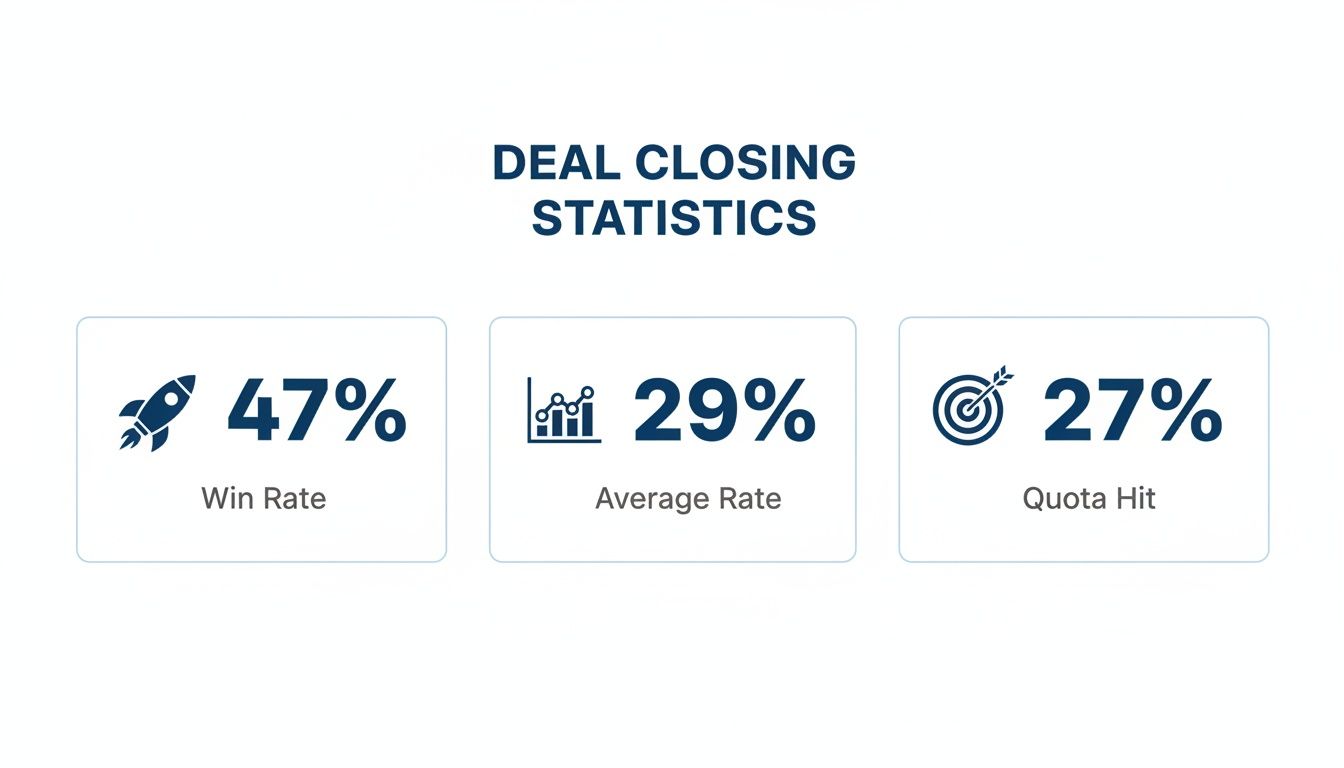
These numbers aren't meant to be discouraging. They show the massive gap between average performance and what's possible when you nail your process.
What's the Best Way to Follow Up After a Closing Call Without Being Annoying?
Every follow-up needs to have a purpose. Your goal is to add value and make the next step crystal clear, not just to "check in."
Within a few hours of your call, send a concise summary email. It should cover:
- The key business outcomes you both agreed on.
- A quick reminder of the core value proposition.
- The specific, agreed-upon next steps.
Don't be vague. Spell it out to create accountability. For instance: "Great conversation today. As we discussed, I'll send over the final proposal by EOD tomorrow. You and the team will review by Friday, and we'll connect for a final sign-off call next Tuesday at 10 AM."
This is where having a tool with automatic CRM sync is a game-changer. Every interaction gets logged without you having to do manual data entry, giving everyone on your team full visibility and letting you focus on what matters: moving the deal across the finish line.
Ready to replace your fragmented tools and build a predictable GTM engine? Willbe centralizes your prospecting, personalizes your outreach, and provides the analytics you need to close deals faster and more predictably.