

Let's be direct: creating an effective email template is about getting replies and booking meetings. Nothing else. In a world where privacy features make open rates a vanity metric, your real success is measured in pipeline generated.
Every word you write has to earn its place. It's time to stop chasing opens and build an outreach strategy around the metrics that signal genuine buyer intent.
Move Beyond Opens to Build Predictable Pipeline
For years, sales teams were conditioned to chase high open rates. It felt like a win—a clear sign that our subject lines were hitting the mark. But as we operate in 2026, that metric has become a ghost.
Privacy features, like Apple's Mail Privacy Protection (MPP), now pre-load email content. This automatically triggers tracking pixels, artificially inflating your open rates and giving you a false sense of success. Your SDRs might celebrate a 70% open rate, but if the reply rate is hovering near zero, the campaign is a failure.
It's a classic vanity metric. It feels good to look at but has no correlation to revenue. Top-performing sales leaders have already shifted their focus. They know that to build a truly effective email template, you must measure what matters: clicks, replies, and ultimately, qualified meetings.
The metrics you track directly shape your team's behavior. Chasing opens leads to clickbait subject lines. Chasing replies forces you to provide real, tangible value in the body of every email.
This chart drives the point home. It shows how opens are just the noisy, unreliable top of the funnel, while clicks and replies are where you find true prospect intent.
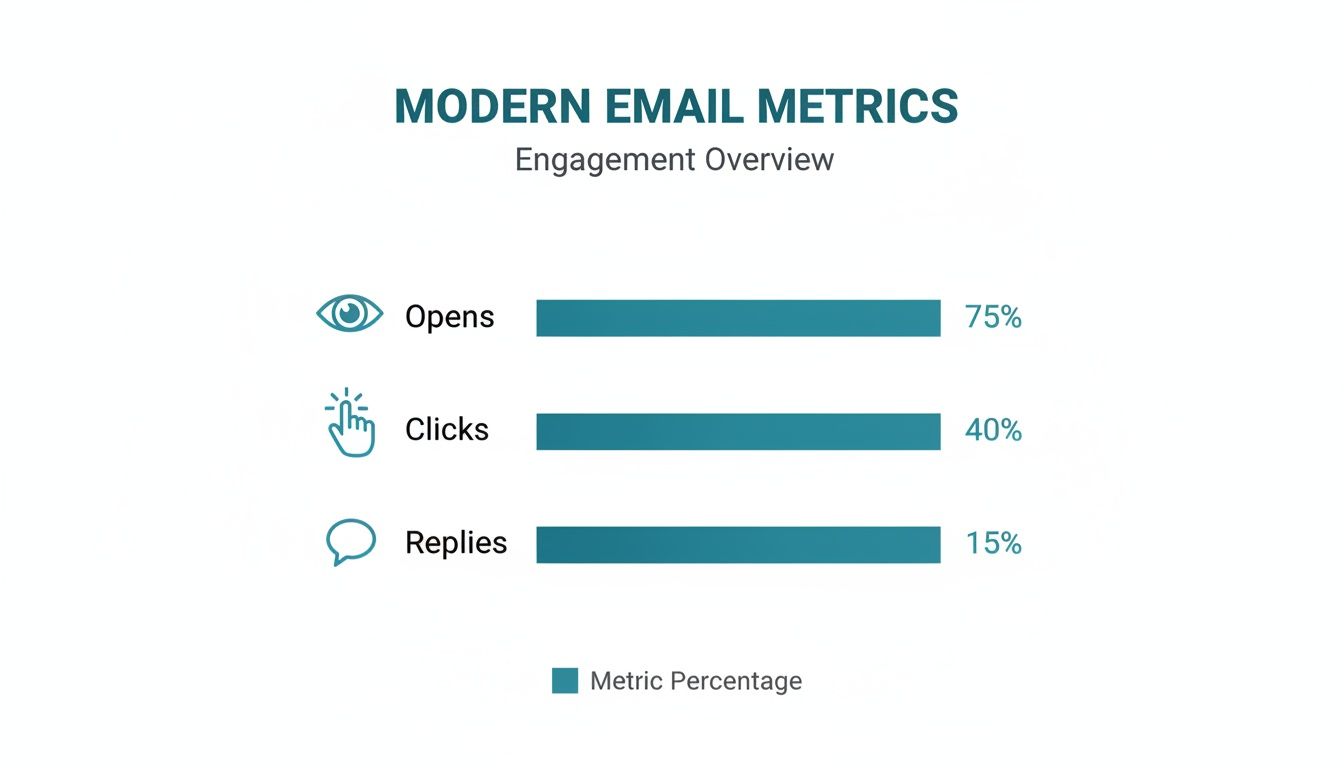
As you can see, a huge number of people might "open" an email, but only a fraction take the crucial next step of clicking a link or hitting reply. Those are the actions that signal real interest.
Benchmarks That Actually Matter
So, what does "good" look like now? The table below breaks down the key performance metrics that matter in 2026, shifting the focus away from vanity numbers and toward signals of real engagement.
Key Performance Metrics for Modern Email Templates
| Metric | What It Really Measures | High-Performance Benchmark (2026) |
|---|---|---|
| Reply Rate | The percentage of prospects who replied to your email. This is the ultimate goal—it starts a conversation. | 2-3% on cold outreach |
| Click-to-Open Rate (CTOR) | The percentage of openers who clicked a link. This shows if your message was compelling enough to drive action. | > 8% (strong) |
| Meeting Booked Rate | The percentage of prospects who booked a meeting from your email. This directly measures pipeline creation. | 0.5-1% of total sent |
These metrics give you a much clearer, more honest view of your template's performance. Recent data from over 3.6 million campaigns shows a median open rate around 43.46%, but the far more important click-to-open rate (CTOR) is just 6.81%.
Think about that for a second. It means that for every 100 people who open an email, only about seven are interested enough to click. If your CTOR is dipping below 4%, something is broken in your value proposition or call-to-action. On the flip side, anything above 8% is a strong signal that you've landed on a message that truly resonates.
The goal today isn't just to be seen in the inbox; it's to be heard and answered. A reply is the ultimate conversion, turning a one-way broadcast into a two-way conversation that builds real pipeline.
Of course, a killer template is just one piece of the puzzle. Even the most perfect copy will fall flat if you're sending it to the wrong people. If you're struggling with engagement, it might be because your cold email lead lists are not converting.
Getting a handle on the true performance of your outreach is the critical first step. You can dive deeper into interpreting these signals by reviewing our guide on modern e-mail analytics. This strategic shift—from blasting for opens to personalizing for replies—is how you build a scalable and predictable revenue engine.
Anatomy of a Reply-Worthy Outreach Email
A high-performing B2B email is a carefully engineered message where every component has a job. If one piece fails—the subject line, the opening sentence, the value prop, or the call-to-action—the entire effort falls apart.
We aren't just filling in a template. We're building a conversation-starter based on a framework that respects the buyer's intelligence and their limited time. This is the difference between a generic pitch that gets deleted and a sharp, relevant message that earns a response.
The Subject Line That Earns the Click
Your subject line has one mission: get your email opened by the right person. That's it. But you have to do it without resorting to deceptive clickbait. Forget tired lines like "Quick question" or the fake "Re:" that every experienced buyer sees through.
The best subject lines are specific, hint at the value inside, and create just enough curiosity.
For example, don't use a generic line like "Intro: Willbe & [Company Name]." Instead, try something that shows you've done your research: "Idea for [Company Name]'s RevOps stack." This immediately signals relevance and promises an insight, not just a sales pitch. For a deeper dive, check out our guide on writing a compelling email subject line for sales.
The Opening That Proves You Did Your Homework
You have one sentence to prove your email is worth their time. The biggest mistake you can make is starting with "Hi, my name is..." or talking about your company. Your prospect doesn't care about you or your company—not yet. They only care about their own challenges and goals.
- Before: "My name is Alex, and I work for Willbe, an all-in-one prospecting platform."
- After: "Saw your post on LinkedIn about the challenge of scaling your SDR team—it's a common bottleneck for companies post-Series B."
The second opener instantly connects to the prospect's reality. It demonstrates you're not just another random salesperson but someone who understands their specific situation. This is how you create an email template that feels like a one-to-one message, even at scale.
The Value Proposition As a Solution
Once you’ve hooked them, connect their problem to your solution—fast. This isn't the time to list product features. It's about articulating the outcome. A sales leader doesn't care about "AI-driven personalization"; they care about hitting pipeline goals without burning out their reps.
Key Takeaway: Frame your value proposition using the language of your prospect's KPIs. Connect what you do directly to the metrics that matter to them, whether it's pipeline growth, SDR efficiency, or lowering customer acquisition cost.
Think from their perspective. An Account Executive struggling with poor-quality handoffs doesn't care about your complex data aggregation methods. They just want leads that are actually qualified and ready for a conversation. Your value prop needs to speak directly to that pain.
The Clear and Low-Friction CTA
Finally, your Call to Action (CTA) must make the next step incredibly easy and feel like a small commitment. A big ask like "Book a demo" in a first email can feel like asking them to run a marathon when they haven't even stretched.
Instead, propose a specific, low-effort next step.
- Weak CTA: "Let me know if you're free to chat next week."
- Strong CTA: "Worth a 15-minute call next week to walk through how we're helping similar SaaS companies solve this?"
The stronger CTA shifts the focus from a generic meeting to a value-driven conversation. It gives them a tangible reason to say "yes" and demonstrates respect for their time.
Personalize Your Outreach Without Sounding Like a Robot
Personalization at scale often feels like a trap. SDRs and AEs are caught between two bad options: spend hours manually researching for one perfect email, or send a blast with clumsy {{company_name}} merge fields that prospects spot a mile away. It's a false choice that causes most outbound efforts to fail.
Top-performing sales teams break this cycle. They understand that real personalization isn't about dropping in a name. It’s about demonstrating you understand your prospect’s world—their pain points, their company's strategic initiatives, and what's top-of-mind for them right now. That's what turns a cold email into a warm conversation.

Go Deeper Than Basic Merge Tags
If your personalization strategy still relies on {{first_name}} and {{company_name}}, you’re using a decade-old playbook. Prospects see right through that low-effort approach. To stand out, you need to use dynamic triggers based on what’s actually happening in their business.
Think about the signals that grab a decision-maker's attention:
- Hiring Sprees: Are they rapidly hiring new SDRs? That's a huge flag that they need tools to ramp and scale effectively.
- Company News: Did they just announce a Series B funding round or a major product launch? This is your chance to tie your solution directly to their growth initiatives.
- Tech Stack Changes: Did they recently add a new marketing automation platform? That signals they're investing in their GTM stack and may have integration gaps.
These are the hooks that prove you've done your homework. They give your outreach immediate context and make your first sentence impossible to ignore.
How Smart AI Fits Into This
This is where the right technology provides a massive advantage. But a word of caution: not all AI is created equal. Asking a generic tool like ChatGPT to write a sales email will produce exactly what you’d expect—robotic, generic copy that lacks a sales rep's tone and industry context.
This is where Willbe’s proprietary AI is different. It’s not a wrapper on a public model; it's a sales orchestration engine trained specifically on B2B GTM data. It learns your unique voice to generate template-free outreach that sounds completely human. This helps your team create email templates that feel like one-to-one conversations, even at scale.
The results are clear. We've seen that AI-powered subject lines can lift open rates by up to 22%, and AI-written email bodies often get an 11% higher click-through rate than those written manually. For sales leaders, this translates directly to revenue, with AI-driven personalization leading to jumps of 41% and a 13% increase in CTR.
Considering 77% of marketers already use some form of personalization and 51% of sales teams are bogged down by manual email writing, this is the most direct path to reclaiming that time and driving better outcomes. You can explore more about these trends and AI's impact on email creation.
Designing Emails for Engagement and Deliverability
How an email looks is as important as what it says. A poorly designed message can kill your chances before your prospect reads the first sentence. Even worse, it can get you flagged as spam. When you create an email template, the goal isn't just to look good—it's to ensure your message lands in the primary inbox.
For B2B sales outreach, simple is almost always better. Forget the fancy, multi-column layouts with heavy graphics common in marketing newsletters. Your target—a busy sales leader or RevOps professional—doesn't have time for fluff. They respond to emails that look and feel like they were written by a real person, not a marketing bot.
Embrace Minimalist Design for Maximum Impact
A clean, simple design is your secret weapon. It laser-focuses the reader’s attention on your message and value. Overly designed emails are distracting and a huge red flag for spam filters, which are naturally suspicious of image-heavy messages.
Your design should be built around a few core principles:
- A Single, Clear CTA: Don’t confuse prospects with multiple choices. Guide them toward the one action you want them to take.
- Ample White Space: Stick to short, scannable paragraphs of one to three sentences. This makes your email easy to digest on any device.
- Simple Formatting: Use bolding and bullets strategically to emphasize key pain points or outcomes. They are tools for clarity, not decoration.
Looking ahead, email design trends for 2026 lean even more into this minimalist aesthetic, but with smart additions. For instance, interactive elements like embedded polls can boost engagement by over 31%. Adding the word "video" to a subject line can lift open rates by 19% and click-throughs by an incredible 65%. These aren't just cosmetic tweaks; they are strategic moves to earn a conversation. You can find more ideas about the future of email design on emailmavlers.com.
Securing Your Spot in the Primary Inbox
Even the most perfectly crafted email is worthless if it lands in spam. Deliverability isn't a dark art; it's the direct result of your sending habits and reputation. Internet Service Providers (ISPs) like Google and Microsoft constantly monitor signals to decide if you're a legitimate sender.
Your sender reputation is your single most valuable asset in outbound sales. Positive engagement—like replies and clicks—builds your score. High bounce rates and spam complaints will crush it. Think of it as a trust score you must earn with every email you send.
To protect your reputation, you must authenticate your sending domain and warm up new email accounts gradually. This process builds a history of good sending behavior. Just as important, you must keep your contact lists clean by using a platform like Willbe to remove invalid addresses. Every bounce is a negative signal that erodes your sender score.
For a deeper dive into the technical components and strategies, check out our complete guide on email deliverability best practices. It’s the foundational work that ensures your carefully personalized messages get seen.
Build a System for Continuous Template Improvement
The biggest mistake sales teams make is creating an email template, seeing some initial success, and then letting it sit untouched. A high-performing template isn’t a static document you create once. It's a living asset that requires continuous iteration.
The best outbound programs treat their templates as products that need constant refinement. This mindset shifts you from random acts of outreach to building an intelligent system that improves with every send. Think of each template as a hypothesis. Now, it's time to test it.

Running A/B Tests Without the Complexity
You don’t need to be a data scientist to run effective A/B tests. The key is discipline: test one variable at a time with a large enough sample size to get a clear winner.
Here’s where you’ll see the biggest impact:
- Subject Lines: Test a direct, benefit-focused subject line like "Hitting Q3 pipeline goals" against a curiosity-driven one like "Idea for your RevOps stack."
- Value Propositions: Does your ICP care more about solving a current pain or achieving a future goal? Test a message focused on eliminating a bottleneck against one about reaching a specific outcome.
- Calls to Action (CTAs): This is critical. Compare a "hard" ask like "Book a 15-min demo" to a "soft" one like "Worth exploring?" The right CTA can dramatically change your meeting-booked rate.
This isn’t about what you think works; it’s about letting the data tell you what actually drives pipeline. What works for one ICP might fail with another. The only way to know is to test systematically.
From Disconnected Data to Actionable Insights
Here's a problem that cripples many sales leaders: reps are running tests, but the results are trapped in a siloed sequencing tool. The data is messy and disconnected from your CRM, making it useless for team-wide strategy. You can't scale what you can't measure.
This is where an all-in-one platform like Willbe changes the game. It eliminates fragmented tools and manual spreadsheet tracking, giving your entire GTM team a single source of truth for performance.
When your template performance data automatically syncs to your CRM, you get a 360-degree view. You can instantly see which templates, subject lines, and value propositions are driving replies and booking meetings—and which ones are falling flat.
This is how modern RevOps teams empower their sellers. They provide the tools to not only send personalized outreach at scale but also measure its impact in real-time. For sales leaders, this means you’re no longer flying blind. You can finally identify which messaging is proven to work and coach the rest of your team based on data, not anecdotes.
Of course, all the testing in the world won’t matter if your emails never hit the inbox. Before you can get clean data, you have to nail the fundamentals of how to improve email deliverability. It’s the foundation for everything else.
By combining disciplined A/B testing with a platform that provides real-time visibility, you can turn your outbound strategy into a predictable, scalable system for generating pipeline.
Your Top B2B Email Questions, Answered
Even with a solid framework, a few questions always come up when building an email outreach strategy. Let's tackle the most common ones we hear from sales teams.
What’s the Magic Number for Follow-Up Emails?
Most successful B2B sequences involve 5-8 touches across multiple channels (email, LinkedIn, calls) over 2-4 weeks. But the exact number isn't the point. What matters is the value you bring with each touchpoint.
Every follow-up needs to offer a new insight, resource, or angle. Simply "bumping" an email to the top of their inbox is a fast way to get ignored. The goal is to be professionally persistent, not annoying.
What Is the Best Day and Time to Send Sales Emails?
You'll read countless articles claiming Tuesday at 10 AM is the golden hour. The truth is, the "best" time depends entirely on your specific audience and industry. A construction manager's schedule is completely different from a SaaS founder's.
Your own performance data is the only source of truth. A modern GTM platform like Willbe provides clear analytics on send times versus reply rates, helping you find what works for your audience and even automating sends for when each prospect is most active.
Can AI Really Write Emails That Sound Human?
Generic AI tools often produce robotic copy that feels impersonal and is easy to spot. It just sounds... off.
However, AI built specifically for sales is a different category of technology. A platform like Willbe uses a proprietary orchestration engine trained on high-performing B2B sales data. It learns your unique tone and writes context-aware messages that sound genuinely human. It's less about generating generic text and more about personalizing outreach at a scale you could never achieve manually.
How Do I Avoid Landing in the Spam Folder?
Staying out of spam comes down to three things: your sender reputation, your email content, and prospect engagement. To ensure high deliverability, focus on these key actions:
- Warm up new email accounts to build a positive sending history.
- Verify contact lists before every send to minimize bounce rates.
- Avoid spam trigger words like "free," "limited time," or "guarantee."
- Write personalized content that earns replies. Positive engagement is the single best signal you can send to email providers like Google and Microsoft.
Ultimately, a high reply rate is your best defense. It proves that people want to hear from you, which directly boosts your sender score and keeps you in the primary inbox.
Ready to stop wrestling with fragmented tools and start building a predictable pipeline? Willbe is the all-in-one B2B prospecting platform that replaces manual workflows. Find better accounts, reach the right people with messages that sound human, and convert pipeline faster. Book a demo and see how top-performing sales teams scale outbound.