


Let's get straight to it: lead generation is the process of finding and attracting potential customers for your business. But that’s a bit dry, isn’t it?
Think of it less like hunting for random buyers and more like farming. You're systematically planting seeds with helpful content, nurturing interest over time, and eventually harvesting qualified prospects who are actually ready to talk business.
The Engine of Your Sales Organization

At its heart, lead generation is what turns casual interest into a predictable revenue stream. Without it, your sales team is essentially sitting by the phone, hoping for a miracle. It’s the engine that powers your entire sales motion, feeding a steady flow of potential business into the pipeline.
This isn’t just about scooping up email addresses and phone numbers. A truly effective strategy is laser-focused on attracting the right people—those who fit your Ideal Customer Profile (ICP). The goal is to engage them in a way that builds trust and proves your value long before a sales pitch ever enters the picture.
Why Lead Generation Is a Top Priority
For any B2B company, getting this right isn't just a nice-to-have; it's the key to survival and growth. It’s how you hit quotas, build a dominant market presence, and create a sustainable business.
The data backs this up. In 2025, a massive 91% of marketers say lead generation is their number one priority. But here’s the catch: 58% of them also say it’s their biggest challenge, which tells you just how hard it is to get right.
A solid lead generation process delivers huge benefits across the board:
- Predictable Revenue: It creates a consistent, measurable flow of opportunities, making your forecasting far more accurate.
- Sales Team Efficiency: Your SDRs and Account Executives spend their time on qualified prospects, not wasting energy on dead-end leads.
- Improved ROI: When you target the right audience with the right message, your Cost Per Lead (CPL) drops and customer lifetime value goes up.
- Market Insights: The whole process gives you priceless data on what messaging works, which channels are best, and what your audience truly needs.
To help you visualize these moving parts, here’s a quick breakdown of what goes into a typical lead generation workflow.
Core Components of Lead Generation at a Glance
Each of these steps works together to create a smooth, efficient system that turns initial interest into real sales opportunities.
A lead is not just a contact; it's the beginning of a potential relationship. The quality of that initial interaction sets the tone for the entire sales cycle, making a thoughtful lead generation strategy essential.
Ultimately, understanding lead generation means seeing it as the first, most critical step in building lasting customer relationships. It’s about creating a system that consistently delivers high-quality opportunities to your sales team, giving them the fuel they need to close deals and drive growth. See how high-growth companies build repeatable go-to-market engines by checking out these case studies.
Understanding Inbound vs Outbound Lead Generation
To really get what lead generation is all about in sales, you have to understand the two core approaches: inbound and outbound. These aren't just buzzwords; they represent two completely different mindsets for finding new customers.
Let's use a simple analogy to break it down.
Inbound lead generation is like setting up an amazing coffee shop on a bustling street. You create a welcoming atmosphere, brew incredible coffee (that's your valuable content), and people who are already looking for a great cup of joe naturally walk in. They find you because you've created something they already want.
Outbound lead generation, on the other hand, is like being a skilled door-to-door salesperson with a very specific list. You don't wait for people to wander by. Instead, you identify exactly which houses are most likely to buy your product, and you go knock on their doors to start a conversation. You're the one initiating contact.
Both are incredibly effective ways to fill a sales pipeline, but they get there in fundamentally different ways.
The Power of Attraction: Inbound Methods
Inbound marketing is all about magnetism. The entire strategy revolves around creating and sharing valuable, relevant content that naturally pulls your target audience toward you. The goal is to attract people who are already actively looking for answers to problems you can solve.
Essentially, you're earning their attention instead of paying to interrupt them. Common inbound tactics include:
- Content Marketing: Publishing insightful blog posts, in-depth whitepapers, and customer case studies that address your audience’s biggest challenges.
- Search Engine Optimization (SEO): Fine-tuning your website and content to show up at the top of Google, making it effortless for prospects to discover you.
- Social Media: Engaging with your community and sharing helpful content on the platforms they use every day.
- Webinars and Events: Hosting educational sessions that showcase your expertise and draw in an interested crowd.
The biggest win with inbound? The leads are almost always warmer. They've already raised their hand, shown interest, and consumed some of your content, so the first sales call feels more like a helpful follow-up than a cold interruption.
Proactive Pursuit: Outbound Tactics
While inbound pulls people in, outbound is all about actively going out to find them. This approach means identifying the specific people and companies that perfectly match your Ideal Customer Profile (ICP) and then reaching out directly. It’s a highly targeted, surgical strike meant to start conversations with high-value accounts.
Outbound is often the weapon of choice for B2B sales teams trying to land major enterprise clients or break into a new market. Key outbound tactics include:
- Targeted Email Outreach: Crafting personalized, one-to-one emails and sending them directly to key decision-makers.
- LinkedIn Prospecting: Using tools like LinkedIn Sales Navigator to pinpoint and connect with ideal prospects through tailored messaging.
- Cold Calling: The classic method of picking up the phone to introduce your solution and quickly qualify interest.
The strength of outbound is in its control and predictability. You aren't waiting around for leads to show up; you're actively creating opportunities with the exact people you want as customers. And the data backs it up: 87% of B2B businesses use email for outreach, and 89% rely on LinkedIn, which is responsible for a staggering 80% of all B2B leads globally. Even better, when you pair outbound with great content, the results amplify—content marketing is 3x more effective than pure outbound alone. You can find more data-driven tips in this guide to 2025 B2B lead generation strategies.
Inbound builds a river of opportunities that flows to you over time. Outbound allows you to build a bridge directly to the highest-value prospects on the other side. A modern sales strategy needs both.
To make the differences even clearer, let's look at these two methods side-by-side. This table breaks down their core attributes, from the initial approach to the typical sales cycle, helping you see where each one shines.
Inbound vs Outbound Lead Generation: A Strategic Comparison
Ultimately, choosing between inbound and outbound isn't an "either/or" decision. The most successful sales organizations have learned to master both, using inbound to create a steady stream of interest and outbound to strategically pursue their most valuable target accounts.
Mapping the B2B Lead Generation Process
Turning a stranger’s name into a real sales opportunity isn’t magic; it’s a methodical journey. Think of your lead generation process as a finely tuned assembly line. Each step is designed to add value, carefully guiding a raw contact from initial curiosity to becoming a paying customer. This isn't a random collection of tasks—it's a structured path.
Having this process mapped out is the key to building a repeatable and scalable revenue engine. It makes sure every potential customer is handled with a clear purpose, moving them from just being aware of you to having a productive conversation with your sales team. Without this map, you’re just flying blind.
This flow chart gives you a bird's-eye view of the typical five-step journey, from capturing interest (through inbound or outbound channels) all the way to nurturing leads until they're hot enough for sales.
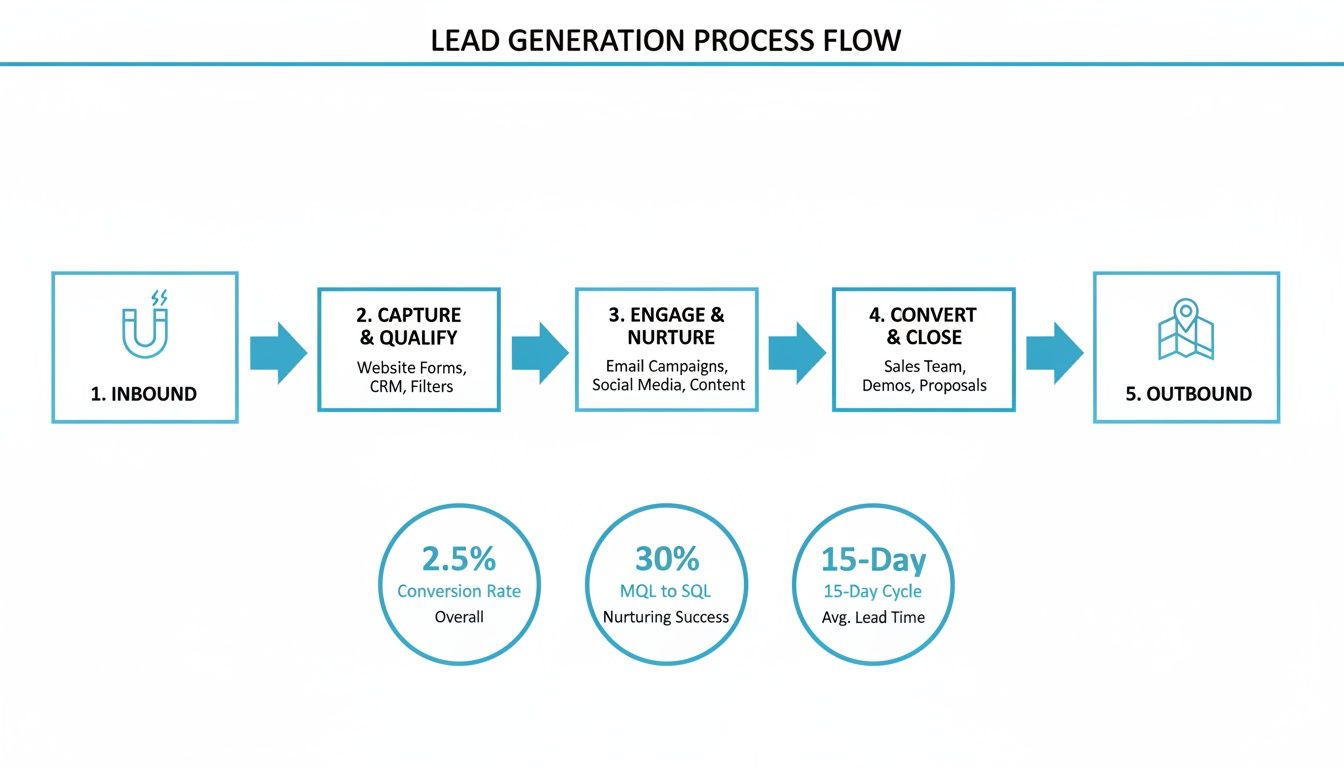
As you can see, both inbound and outbound activities feed the same pipeline. The goal is always the same: qualify interest and turn it into tangible opportunities.
Stage 1: Defining Your Ideal Customer Profile
Before you can find a single lead, you have to know exactly who you're looking for. This first step is, without a doubt, the most important one. Your Ideal Customer Profile (ICP) is a hyper-specific description of the perfect company for your product—not just any company, but the one that gets the most value and sticks around for the long haul.
An ICP isn't some fuzzy, feel-good persona. It’s built on hard data and specific attributes:
- Industry or Vertical: Which sectors feel the pain you solve most acutely?
- Company Size: What's your sweet spot in terms of employee count or annual revenue?
- Geography: Where are the regions or countries you can serve best?
- Technology Stack: Are they using tools that integrate well with yours?
- Budget: Can they realistically afford to invest in what you’re selling?
Without a rock-solid ICP, your team will burn countless hours chasing prospects who were never going to buy anyway.
Stage 2: Capturing Interest and Generating Leads
Once you know who you’re looking for, it’s time to get their attention. This is where your inbound and outbound strategies spring into action. Your team will use different channels to attract people from your target companies and get them to raise a hand.
This stage is all about creating a compelling reason for a prospect to engage. You might offer a detailed whitepaper that solves a nagging industry problem or host a webinar with a speaker they can't afford to miss. The idea is to provide so much value that they happily trade their contact information for it.
Stage 3: Qualifying Leads from MQL to SQL
Let's be honest: not every lead is ready for a sales call. This is where qualification comes in, acting as a filter to separate the window shoppers from the serious buyers. This process usually has two key milestones:
- Marketing Qualified Lead (MQL): This is someone who has shown interest through your marketing efforts, like downloading an ebook or visiting your pricing page a few times. They fit some of your ICP criteria, but they haven't explicitly asked to talk to sales yet.
- Sales Qualified Lead (SQL): An SQL is an MQL who has been vetted and deemed ready for a real sales conversation. They have a confirmed need, they match your ICP, and they've shown clear intent to buy.
That handoff from MQL to SQL is where a lot of companies stumble. B2B firms generate about 1,877 leads per month on average, but quantity means nothing without quality. A staggering 27% of leads passed to sales are actually qualified, which creates massive friction between teams. You can learn more about how to fix this common pipeline qualification gap.
Moving a lead from MQL to SQL isn't just about changing a status in your CRM. It's a critical moment of alignment between marketing and sales. Getting this right stops reps from wasting time and ensures they only focus on high-potential deals.
Stage 4: Nurturing and Engaging Prospects
Most leads aren't going to buy the second they land in your pipeline. The nurturing stage is all about building trust and keeping your brand top-of-mind by providing consistent, helpful information over time.
This means sending targeted content like relevant case studies, personalized email sequences, or invitations to exclusive workshops. The goal is to educate your prospects, handle their objections before they even ask, and guide them along their buying journey until they’re ready for that sales call.
Stage 5: Executing a Seamless Handoff to Sales
The final piece of the puzzle is the handoff. Once a lead is fully qualified and has been nurtured into an SQL, they are passed to an Account Executive (AE) or closer. A smooth handoff is absolutely vital for a good customer experience.
This means the AE gets all the important context—the lead's engagement history, known pain points, and any notes from previous conversations. This preparation ensures the first sales call feels productive and personal, not like a repetitive interrogation. It's the final, crucial link in the chain that turns strangers into happy customers.
Essential Metrics for Measuring Lead Generation Success
Generating leads is one thing. Knowing if those efforts actually make money is another. If you're not measuring your lead generation, you're flying blind, unable to fine-tune your strategy or prove it's profitable. To get from just being busy to being genuinely effective, you need to track the key performance indicators (KPIs) that reveal the real health of your pipeline.
These numbers go way beyond vanity metrics like website traffic. They give sales leaders and RevOps teams a data-backed way to prove ROI, spot what's broken, and make smart decisions that hit the bottom line. Think of them as the gauges on your revenue engine's dashboard—each one tells you something critical about your performance.
Cost and Conversion Metrics
The first place to look is at efficiency. How much does it cost to get a foot in the door with a new lead, and how good are you at turning that initial interest into a real conversation? These two metrics are the bedrock of a financially sound lead gen program.
Cost Per Lead (CPL): This is your core efficiency score. It tells you exactly how much you paid to get one new lead. Just divide your total campaign cost by the number of leads it brought in. A climbing CPL is a classic sign that your targeting is too broad or your ad spend isn't working hard enough.
Lead Conversion Rate: This shows the percentage of leads who take the next step you want them to, like becoming a Marketing Qualified Lead (MQL) or booking a demo. A low conversion rate often means there's a disconnect between your message and what your audience actually needs, or maybe your landing page is just clunky.
Don't be surprised if your CPL looks different from another industry's. For example, SaaS companies average a $141 CPL, while healthcare is a bit steeper at $182, and FinTech tops out at $198. Those differences put serious pressure on RevOps leaders to squeeze every ounce of performance out of their campaigns. You can see more industry-specific numbers in this deep dive into B2B lead generation statistics.
Pipeline Velocity and Quality Metrics
Getting leads in the door is just the start. You also have to ask: are they the right leads? And how fast are they moving? A pipeline clogged with low-quality leads that take forever to move just wastes your sales team's time and energy.
A great metric for this is MQL-to-SQL Velocity. This tracks the average time it takes for a marketing-qualified lead to get the green light from sales. If this process is sluggish, it’s a huge red flag. It could mean your lead nurturing is weak, or more likely, your sales and marketing teams aren't on the same page.
A fast MQL-to-SQL handoff is a sign of a healthy, aligned revenue team. When leads move quickly, it means marketing is delivering high-intent prospects and sales is engaging them effectively before they lose interest.
Revenue and Lifetime Value Metrics
At the end of the day, it all comes down to revenue. These final metrics tie your lead generation activities directly to business results, proving the long-term value of what you're doing.
Customer Lifetime Value (CLV): This is a forecast of the total revenue you can expect from a single customer over their entire relationship with you. When you compare CLV to your CPL, you can quickly see if your customer acquisition costs are sustainable for the long haul.
Lead-to-Close Rate: This is the ultimate scorecard. It’s the percentage of leads that actually sign on the dotted line and become paying customers. It tells you how well your entire funnel—from that first click to the final handshake—is really working.
By keeping a close eye on these metrics, you stop thinking of lead generation as just a series of tasks and start seeing it for what it is: a strategic, measurable engine for growth. For more on how to centralize and track these KPIs, you might be interested in our guide on leveraging powerful analytics features.
Common Lead Generation Mistakes to Avoid
Even the most seasoned sales teams stumble into predictable traps that quietly kill their lead generation efforts. To really understand what lead generation is in sales, you have to know the common pitfalls that burn through budgets, waste time, and flat-out demoralize your team. Dodging these mistakes is the key to building a healthy, predictable pipeline.
The biggest—and often first—mistake is chasing a poorly defined customer profile. When your Ideal Customer Profile (ICP) is fuzzy, your outreach is just a shot in the dark. You end up pouring resources into prospects who were never going to buy because, well, they don’t have the problems you solve.
This lack of focus inevitably leads to another classic blunder: generic, one-size-fits-all outreach. Let’s be honest, prospects can spot a copy-paste template from a mile away. Without personalization that speaks directly to their role, industry, and specific pain points, your messages are just destined for the trash folder. It hurts your response rates and chips away at your brand’s reputation.
Forgetting That Speed and Data Matter
Another costly mistake is letting a warm lead go cold. The second a prospect shows interest, a clock starts ticking. A slow follow-up doesn't just give competitors an opening; it signals that you aren't that interested. This is especially true for inbound leads who have gone out of their way to find you.
This problem gets much worse when sales and marketing teams aren't on the same page. Misalignment creates a messy, dysfunctional handoff where marketing lobs over unqualified leads and sales, in turn, ignores them. It’s a recipe for frustration on both sides and a whole lot of lost revenue. What you get is a leaky funnel where perfectly good leads are left behind.
Operating with inaccurate or outdated data is like trying to navigate with a broken compass. It leads to bounced emails, calls to wrong numbers, and outreach sent to people who left their jobs months ago—all of which is a colossal waste of an SDR's time.
Letting Good Leads Wither on the Vine
Ultimately, the goal is to build a system that just works. But even with a great process on paper, many teams drop the ball at the nurturing stage. For sales development reps at fast-growing companies, this means wading through a lot of noise—a staggering 63% of inbound leads won't be ready to buy for at least three months, and 79% will never convert without consistent nurturing. You can dig deeper into these pipeline challenges and see how top teams solve them with these B2B lead generation statistics.
So, how do you avoid these common blunders? High-performing teams live by a few core principles:
- A Crystal-Clear ICP: They know exactly who they’re after—company size, industry, the specific decision-maker, you name it.
- Hyper-Personalization: Every single outreach attempt is tailored, showing they’ve done their homework and actually understand the prospect's world.
- Rapid Follow-Up: They have ironclad SLAs for responding to inbound leads. No one is left waiting.
- Data Hygiene: Their contact lists are regularly cleaned and updated to keep them accurate and effective.
- Sales and Marketing Alignment: Both teams are locked in on lead definitions (MQLs vs. SQLs) and work together to constantly refine the qualification process.
By getting ahead of these common failure points, you can make sure your lead generation engine is actually turning effort into qualified meetings and closed deals.
Unifying Your Strategy with a Lead Generation Platform
Let’s be honest: trying to manage lead generation with a dozen different tools is a nightmare. Sales teams end up duct-taping together separate subscriptions for prospecting data, email campaigns, LinkedIn outreach, and analytics. It’s a clunky, inefficient system that creates data headaches, eats up valuable time, and makes it impossible to see what's actually driving results.
This is exactly why so many top-performing B2B companies are ditching the patchwork approach. They’re consolidating their efforts into a single, unified lead generation platform that acts as the command center for their entire sales operation. Bringing everything under one roof solves the biggest problems that come with manual or disconnected workflows.

Eliminating Bad Data and Wasted Effort
The best sales pitch in the world is useless if it never reaches the right person. Yet, sales reps often spend up to 20% of their time just digging for and confirming contact details. That’s a massive productivity killer.
A unified platform solves this from the ground up by building in a massive, constantly refreshed B2B database. Your team gets instant access to verified email addresses and direct-dial phone numbers, meaning their outreach actually connects from day one.
The real power of a unified platform isn't just about convenience—it's the massive advantage you get from working with clean, reliable data. This one shift gets rid of bounced emails, stops reps from wasting time on dead ends, and immediately boosts connect rates.
Achieving Personalization at Scale with AI
Generic, copy-and-paste messages are dead. Prospects today expect you to know who they are, what their company does, and why you’re reaching out to them specifically. But who has the time to manually write hundreds of unique emails?
This is where AI orchestration changes everything. Modern platforms can generate hyper-personalized, template-free messages that sound like they were written by a human. The AI analyzes a prospect's profile, recent activity, and company news to craft a unique hook for every single person. It’s how you get true personalization at scale without burning out your team.
For a closer look at how this works, see the powerful features for finding and engaging high-quality B2B leads.
Orchestrating Multi-Channel Campaigns Seamlessly
Today’s buyers are everywhere—checking their email, scrolling through LinkedIn, and engaging with content across the web. To get their attention, you have to meet them where they are. A unified platform makes this incredibly simple by letting you build and manage multi-channel campaigns from a single dashboard.
Imagine an SDR orchestrating a sequence that automatically unfolds like this:
- A personalized email lands in their inbox, introducing a specific solution to a known pain point.
- A day later, a LinkedIn connection request arrives to build a professional link.
- Two days after that, a follow-up email references a recent article the prospect's company published.
- Finally, a LinkedIn message shares a relevant case study that reinforces the initial email's point.
By managing all these touchpoints in one place, you get a complete picture of every interaction. This puts an end to awkward, out-of-sync messages and creates a smooth, professional experience for the prospect. It’s no longer a series of random pokes; it's a smart, strategic conversation that builds trust and gets replies.
Frequently Asked Questions About Lead Generation
It's one thing to understand lead generation in theory, but when you're in the trenches, real-world questions always pop up. Whether you're a new SDR, a sales leader trying to build a predictable pipeline, or a marketer aiming for better alignment, getting the details right is what separates a good strategy from a great one.
Let's clear up a few of the most common questions we hear from teams who are fine-tuning their approach.
What’s the Difference Between a Lead and a Prospect?
Think of it like this: a lead is anyone who has raised their hand, even slightly. They might have downloaded an ebook, visited your pricing page, or dropped a business card in a bowl at a trade show. They've shown a flicker of interest, but that's all you know. They’re at the very top of your funnel, completely unvetted.
A prospect, on the other hand, is a lead you’ve actually qualified. You've done your homework and confirmed they match your Ideal Customer Profile (ICP). They have a problem you can solve and likely have the authority or influence to make a decision. To put it simply, every person who walks into a luxury car dealership is a lead, but only the ones with a driver's license and the budget to buy are true prospects.
How Long Should a B2B Sales Cycle Be?
This is the million-dollar question, and the honest answer is: it depends. There’s no magic number. A straightforward SaaS subscription might close in 30 days, but a complex enterprise deal with multiple stakeholders could easily stretch out for six months, a year, or even longer.
Your industry, the price of your solution, and how many decision-makers need to sign off all play a huge role. The key isn't to chase an arbitrary number but to map out your own average sales cycle and ruthlessly hunt for the bottlenecks. Focusing on higher-quality leads and nurturing them effectively are the two fastest ways to shorten that timeline.
What Is the Best Channel for B2B Lead Generation?
The best channel is always the one where your ideal customers are actually hanging out. That said, for the vast majority of B2B teams, two channels consistently outperform the rest: LinkedIn and email.
- LinkedIn is an absolute powerhouse for zeroing in on specific job titles, industries, and company sizes.
- Email is still the king of direct, one-to-one conversations and personalized outreach.
The smartest teams don’t put all their eggs in one basket. They build a multi-channel strategy, engaging prospects across different touchpoints to stay top of mind.
How Does AI Improve Lead Generation?
AI is like giving your sales team a superpower. It automates the soul-crushing, manual work like digging for verified contact info or trying to guess which leads are ready to buy. But its real power lies in enabling hyper-personalization at scale. An AI assistant can analyze a prospect’s LinkedIn profile, company news, and job postings to suggest an outreach angle that’s actually relevant.
This frees up your SDRs from hours of tedious research and lets them do what they do best: build real relationships and have meaningful conversations. AI handles the robotic work so your team can focus on the human connection.
Ready to stop juggling tools and unify your lead generation strategy? Willbe combines verified B2B data, AI-powered personalization, and multi-channel outreach into a single, powerful platform. See how you can build a predictable revenue engine today.