

Your sales team's LinkedIn profiles are digital storefronts. Are they drawing in qualified buyers, or are prospects walking right by? Your LinkedIn Social Selling Index (SSI) score is the KPI that tells you.
It’s a straightforward score from 0 to 100 that measures how effectively your team uses LinkedIn for B2B prospecting. A higher score directly translates to better visibility, stronger credibility, and a more predictable pipeline. For any SDR, AE, or sales leader, mastering the SSI score isn't a vanity project—it's a core driver of revenue.
Why Your SSI Score is a Leading Indicator of Revenue
In today's market, where buyers research solutions long before talking to sales, a strong LinkedIn presence is non-negotiable. It’s not about just having a profile; it's about systematically finding target accounts, engaging decision-makers, and building pipeline. The SSI score measures precisely these activities, making it a critical KPI for any modern GTM motion.
This isn’t about chasing a score for the sake of it. It's a leading indicator of sales success. LinkedIn's own data shows that social selling leaders create 45% more sales opportunities than peers with lower SSI scores. They are also 51% more likely to achieve quota.
The numbers are clear: top performers aren't just getting lucky. They're executing a deliberate playbook on the platform that generates real business outcomes.
LinkedIn SSI Score Benchmarks By Role
Not everyone uses LinkedIn for revenue, so a "good" score is relative. An average user might be in the 30-40 range, but a dedicated sales professional should aim much higher. This table provides a clear benchmark for where your team should be.
The gap between simply using LinkedIn and strategically selling on it is where revenue is won or lost. Moving your team into that top tier creates a measurable lift in qualified meetings.
A Diagnostic Tool for Sales Leaders & RevOps
For sales leaders and RevOps, a team's average SSI score is a data-backed diagnostic tool for your social selling maturity. If scores are low, it's a red flag signaling critical issues in your outbound strategy.
Common problems tied to a low team SSI score include:
- Inefficient Prospecting: Reps are spending hours manually cleaning lists or using basic search, failing to find the right buyers at high-intent accounts.
- Generic Outreach: Templated messages are burning through lists, resulting in low connection and reply rates that hurt both brand reputation and pipeline.
- Lack of Credibility: Profiles read like resumes, failing to articulate the problems you solve for your ideal customer profile (ICP).
- Missed Pipeline: Your team is invisible in the conversations where your buyers are actively seeking solutions.
In short, a low SSI score signals a reactive, ad-hoc approach to outbound instead of a proactive, predictable engine. It means you are leaving revenue on the table.
Conversely, a high SSI score shows your team is executing the daily activities required to build authority, connect with key stakeholders, and nurture relationships that convert. It’s a direct measure of their ability to build trust at scale in a digital-first world.
If you’re looking for a more comprehensive breakdown of the score and its components, this guide on mastering the ssi score linkedin is a great place to start. Ultimately, tracking and improving this metric is one of the most effective ways to build a more predictable outbound motion.
The Four Pillars of Your Social Selling Success

Your LinkedIn SSI score isn't a black-box metric. It’s a balanced scorecard for your social selling activities. LinkedIn breaks your performance into four core pillars, each contributing up to 25 points toward your total score of 100.
Understanding these pillars allows you to stop guessing and start executing with precision. You'll see how specific actions—from optimizing a headline to personalizing a connection request—directly impact your ability to generate pipeline.
Pillar 1: Establish Your Professional Brand
This is your digital first impression. It measures how well your profile is optimized to serve your ideal customer, not just to list your job history. The goal is to transform your profile from a static resume into a valuable resource for potential buyers. A strong score means you have a customer-centric headline, a summary that speaks to business outcomes, and endorsements for your core skills. You're positioning yourself as a credible expert.
Pillar 2: Find the Right People
This pillar is about precision prospecting. How effectively are you using LinkedIn’s tools to identify the right decision-makers at your target accounts? LinkedIn rewards you for leveraging its search capabilities, especially Sales Navigator, to zero in on high-fit prospects. A high score shows you're not just spraying and praying but strategically building a relevant network. This is where an all-in-one prospecting platform like Willbe provides a critical advantage, enabling teams to find better accounts with speed and accuracy.
Pillar 3: Engage with Insights
Are you just another voice broadcasting content, or are you driving the conversation? This pillar measures how well you share valuable content and spark meaningful discussions. It analyzes your likes, comments, and the relevance of the content you share. The goal isn't to be the loudest voice but the most insightful one. Engaging with insights shows you understand your market and can add value before you ever ask for a meeting.
Pillar 4: Build Relationships
This is where activity turns into pipeline. This pillar tracks how effectively you nurture your network and convert connections into opportunities. A key metric here is your connection request acceptance rate—a direct indicator of how well your personalized outreach is performing.
LinkedIn is increasingly rewarding authentic outreach. By 2026, the platform’s algorithm is expected to give users with an SSI score over 70 about 2-3x more organic reach and a 25-30% higher connection acceptance rate. Conversely, low scorers will face faster flagging from anti-spam filters—a major risk for teams relying on generic automation tools.
This is precisely why template-free, proprietary AI like Willbe’s—which crafts unique outreach that sounds like the user in over 80 languages—is becoming essential. It enables you to build genuine relationships at scale. To understand the broader context of social selling, check out this guide on What You Need To Know About Social Selling.
How to Find and Interpret Your SSI Score
You can't improve what you don't measure. Finding your SSI score on LinkedIn is the first step toward making social selling a scalable and predictable part of your GTM strategy.
Getting your score is simple. Log in to your LinkedIn account and go to linkedin.com/sales/ssi. The dashboard is free for all users—you don’t need a Sales Navigator subscription. Before you do anything else, record your score. This is your baseline.
Interpreting Your Score and Benchmarking Performance
On the SSI dashboard, you'll see your total score broken down by the four pillars, instantly highlighting your strengths and weaknesses. For example, a low score in "Find the Right People" is a clear sign your team isn’t using LinkedIn's search tools effectively to identify high-potential buyers.
The dashboard also provides two critical benchmarks:
- Industry SSI Rank: This shows how you compare to others in your industry. If you’re in the top 10%, you have a significant competitive advantage.
- Network SSI Rank: This compares you to your immediate network. A low rank here indicates your peers are outperforming you in terms of visibility and activity.
For sales leaders, this dashboard is a team-wide diagnostic tool. If your team's average score is low in "Engage with Insights," it signals a need for coaching on content strategy and starting conversations, not just a directive to send more connection requests.
By checking these benchmarks regularly, you can identify performance gaps across the sales floor and measure the ROI of your training initiatives. It transforms the vague goal of "better social selling" into a data-driven process you can manage and tie directly to pipeline growth.
A Playbook to Improve Each SSI Pillar
You know your SSI score. Now the real work begins: turning that number into a revenue-generating playbook with daily habits that build pipeline. This isn't about chasing a metric; it's about executing a smart, outcome-driven strategy that converts LinkedIn activity into qualified meetings.
Here are specific, actionable tactics for SDRs, AEs, and sales leaders to improve each of the four SSI pillars.
Pillar 1: Establish Your Professional Brand
Your profile should be a customer-centric resource, not a resume. The moment a buyer from your ICP lands on your page, they should feel you understand their world.
- For SDRs & AEs: Rewrite your headline and summary. Ditch "SDR at Company X" for an outcome-driven statement like "Helping B2B SaaS Founders Scale Outbound Without Burning Lists." Focus on the problem you solve.
- For Sales Leaders: Use your "Featured" section to spotlight customer case studies, team wins, or high-value content. This positions you as an industry authority and gives prospects a reason to trust you.
- Get Endorsed: Ask colleagues and satisfied customers to endorse your top 3-5 skills. This is simple social proof that provides instant credibility to prospects and the LinkedIn algorithm.
Pillar 2: Find the Right People
This is about precision over volume. The algorithm rewards you for identifying high-fit prospects using its native tools, not for blasting generic connection requests.
This flowchart maps out the process perfectly: check your score, identify weaknesses across the four pillars, and benchmark against your peers to create a clear improvement plan.
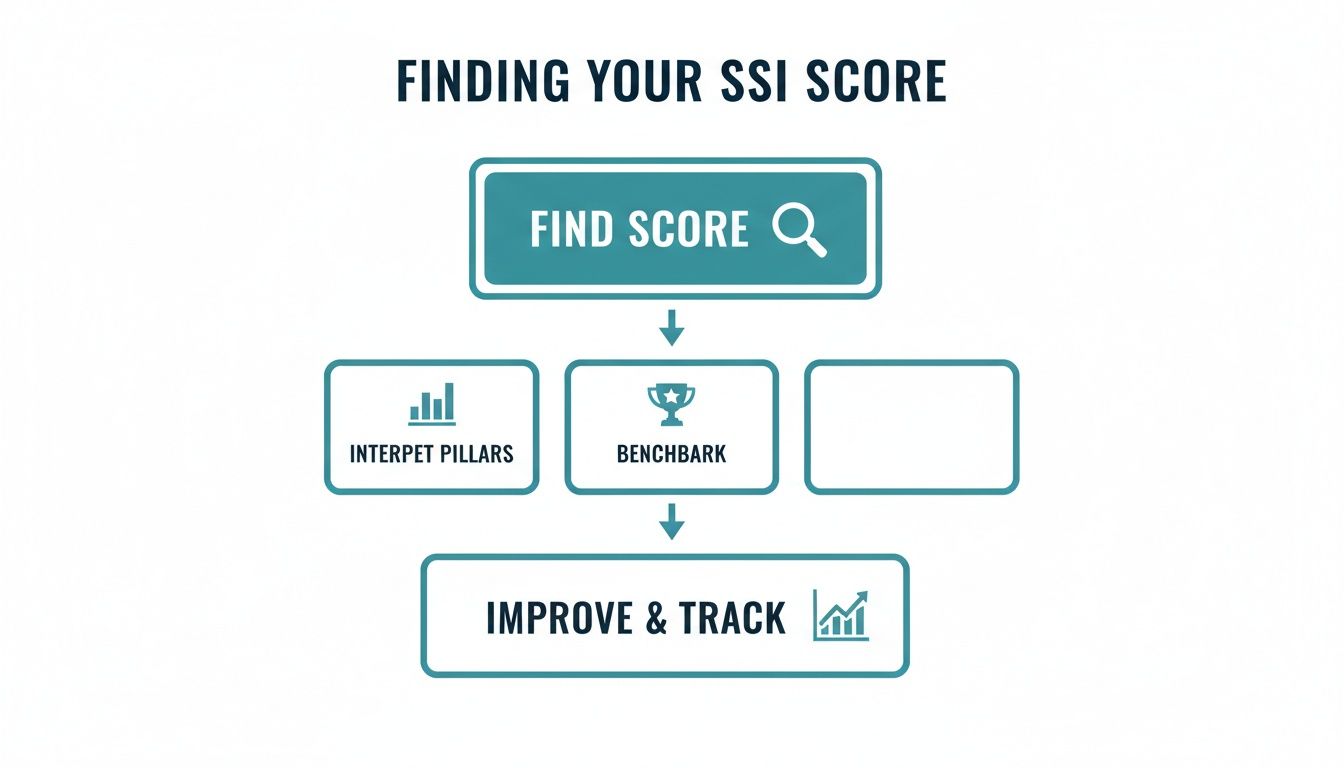
As you can see, it's a strategic cycle of measurement, analysis, and targeted action—not guesswork.
Here’s how to put that into practice:
- Use Advanced Searches: Move beyond basic title searches. Use Sales Navigator to filter by company size, recent job changes, or group memberships to find decision-makers who are relevant now.
- Save Leads & Accounts: When you find good-fit prospects, save them to lead and account lists in Sales Navigator. This simple action signals strategic prospecting to LinkedIn and boosts your score.
- Leverage a GTM Platform: This is where you gain a serious advantage. Willbe helps you operationalize this by aggregating data from over 30 sources. You can build hyper-targeted lists based on technographics, buying intent signals, and more, ensuring your team always focuses on the right people.
Pillar 3: Engage with Insights
This pillar measures your ability to start and contribute to valuable conversations. It’s about relevance, not volume.
A common mistake SDRs make is just broadcasting company content without interaction. LinkedIn's algorithm prioritizes two-way conversations. A single, thoughtful comment on a prospect's post is often more impactful than sharing ten generic articles.
Here are a few actionable steps:
- Comment with Intent: Block 15 minutes daily to leave insightful comments on posts from key prospects and industry leaders. Don’t just write "Great post!" Ask a relevant question or add a new perspective.
- Share with Context: When you share an article, add your own 2-3 sentence analysis. Tell your network why it matters and what the key takeaway is.
- Publish Natively: Create content directly on LinkedIn whenever possible. The platform's algorithm gives preferential reach to native text posts, articles, and videos.
Pillar 4: Build Relationships
This is where your activity converts to pipeline. A high score here indicates a strong connection acceptance rate and that people are replying to your messages.
- Personalize Every Request: Stop sending blank connection requests. Always include a short, personalized note referencing a shared connection, a recent post, or something specific about their company.
- Nurture New Connections: After someone accepts your request, send a non-promotional follow-up. Thank them for connecting and offer a relevant resource—no strings attached. For more on this, check out our deep dive into effective prospecting on LinkedIn.
- Measure Reply Rates: Track which messages get responses. This is where Willbe’s proprietary, template-free AI provides a decisive advantage, generating unique, human-sounding outreach that dramatically increases acceptance and reply rates, directly improving this SSI pillar.
How Willbe Turns SSI Improvement Into a Daily Habit
Knowing your team’s LinkedIn SSI scores is one thing; getting them to improve is another. For sales leaders and RevOps, coaching reps on four different pillars while they juggle prospecting, research, and outreach is an uphill battle. It’s no wonder results are often inconsistent.
This is where an all-in-one prospecting platform like Willbe changes the game. Instead of just telling your team what to do, Willbe embeds SSI best practices directly into their daily workflow. It automates the manual work and guides reps toward the high-value activities that boost their scores and, more importantly, their pipeline.
Automate Your Way to the Right People
The "Find the Right People" pillar is worth 25 points. Reps often lose points here by using basic LinkedIn search or working from stale lists, leading to low acceptance rates and wasted effort.
Willbe solves this at the source. By aggregating and cross-referencing data from over 30 B2B sources, we provide your team with continuously updated contact and company information. This allows them to build laser-focused prospect lists based on advanced criteria:
- Technographics: Target accounts using a specific technology you compete with or integrate with.
- Buying Intent: Pinpoint prospects actively researching solutions like yours right now.
- Global Coverage: Find verified decision-makers anywhere in the world.
This level of precision ensures every connection request is relevant, which immediately improves the quality of your team’s network and boosts this SSI pillar. See how top teams build smarter lists with Willbe's prospecting tools.
Scale Authentic Conversations and Build Real Relationships
The "Engage with Insights" and "Build Relationships" pillars account for a combined 50 points. These scores depend entirely on the quality of your team's outreach. Generic, copy-paste messages get ignored and can harm a rep's SSI score by signaling low-effort activity.
This is where Willbe’s proprietary AI gives your team an unfair advantage. It's not another ChatGPT wrapper producing generic templates. Our AI is designed from the ground up to sound exactly like your individual reps.
Willbe’s AI analyzes a prospect’s profile and writes a unique, personalized message for every outreach. The messages feel genuine and human, even when operating at scale across 80+ languages.
This approach does more than just feel authentic; it dramatically increases connection acceptance and reply rates, directly fueling the two most important SSI pillars. It frees your reps from hours of manual research, allowing them to focus on the real conversations that convert connections into pipeline. All the while, their SSI scores climb naturally.
From SSI Score to Sales Revenue: Making the Connection

For any sales leader or RevOps professional, a metric like LinkedIn's SSI score is only valuable if it drives business results. A rising score is positive, but does it actually impact revenue? The answer is yes—if you track it correctly.
By treating SSI improvement as a core sales activity, you can draw a straight line from your team’s social selling habits to the hard revenue numbers you report to the board. This is how you prove that building a professional brand on LinkedIn leads directly to more closed-won deals.
A Framework for Proving the Revenue Impact of SSI
To connect effort to outcome, you need to map SSI gains to your most critical sales KPIs. Start by baselining. Record your team's average SSI score alongside your current performance metrics. Then, as you implement your improvement plan, track both sets of numbers quarterly.
This is how you turn social selling from a fuzzy concept into hard data. When you can prove that a 10-point increase in your team's average SSI correlates with a 15% lift in qualified meetings, it’s no longer an abstract idea—it's a core part of your revenue engine.
Here’s a simple framework for tracking business impact:
- Qualified Meetings Booked: Are reps with higher SSI scores booking more meetings that convert to qualified opportunities? A rising SSI should lead to more inbound interest and better reply rates, filling their calendars.
- Pipeline Generated: Analyze the total pipeline value each rep creates. As they improve at finding and engaging the right decision-makers, the size and quality of their opportunities should increase.
- Sales Cycle Length: Do deals sourced via LinkedIn close faster? Reps who build trust and credibility—the very things a high SSI reflects—often accelerate the sales process.
- Quota Attainment: Ultimately, this is the metric that matters most. Compare the quota attainment of your top-quartile SSI performers against those in the bottom quartile. The data will almost always show that your best social sellers are your top revenue producers.
By connecting these KPIs, you’re not just encouraging good habits; you’re building an undeniable business case for investing in a modern, scalable social selling motion. For more strategies to fill your funnel, see our guide on how to generate B2B leads.
Common Questions About the LinkedIn SSI Score
Once sales teams start focusing on their ssi score on LinkedIn, a few practical questions always arise. Here are the answers to the most common ones.
How Often Does the LinkedIn SSI Score Update?
Your LinkedIn SSI score updates daily. This provides fast feedback on your social selling activities.
This is a significant advantage. The actions you take today—sending personalized connection notes or commenting on a prospect's post—can positively impact your score within 24 hours. It allows you to quickly identify what’s working and double down on effective tactics.
Does a Low SSI Score Hurt My Profile?
While LinkedIn won't penalize your account, a low score puts you at a significant competitive disadvantage. It directly impacts your visibility and, by extension, your pipeline.
A lower SSI means you’re less likely to appear in search results, and your content will have less reach in your network's feed.
In practical terms, your ideal prospects simply won't see you. You become harder to find, which makes it much more difficult to build your network, start conversations, and generate the inbound interest that top sellers rely on.
Can I Improve My SSI Score Without Sales Navigator?
Yes, absolutely. You don't need a paid plan to make significant improvements. Three of the four pillars are entirely within your control on a free LinkedIn account:
- Establishing Your Professional Brand
- Engaging with Insights
- Building Relationships
Sales Navigator primarily accelerates the fourth pillar: "Finding the Right People." Its advanced search filters and lead-saving features are designed for precise, targeted prospecting. While it isn't required to improve your score, it’s a powerful tool for any team serious about building a predictable outbound engine.
Ready to stop guessing and start building a predictable outbound engine? Willbe integrates SSI-boosting activities directly into your team's daily workflow, turning social selling into a scalable source of revenue. See how our all-in-one platform helps you find better accounts, send messages that get replies, and convert pipeline faster.