


Forget chasing volume. Generating high-quality B2B leads isn't about running faster on a hamster wheel; it's about building a predictable revenue engine. The entire process hinges on razor-sharp targeting, outreach that actually resonates, and a unified tech stack that eliminates friction.
This is the modern playbook. It’s how top-performing teams build pipeline that converts, not just a list of names.
Rethinking the B2B Lead Generation Engine
The old model for generating B2B leads is broken. It was built for a different era, one where SDRs wrestled with fragmented tools, manually scrubbed lists, and blasted generic emails that prospects learned to ignore.
Sales leaders, SDRs, and AEs all know the pain of that outdated approach: burned lists, abysmal reply rates, and a pipeline that feels more like a lottery than a well-oiled machine. In 2026, generating qualified leads isn’t just a marketing task or a sales chore. It’s the core of a modern Go-To-Market (GTM) engine.
This engine doesn't run on brute force. It's powered by a strategic, repeatable process built for both speed and precision. The fundamental shift is from just chasing more leads to engineering better conversations at scale.
This is what that foundational process looks like. It starts with a precise Ideal Customer Profile (ICP), sourcing clean data, and unifying your technology into a single, seamless workflow.
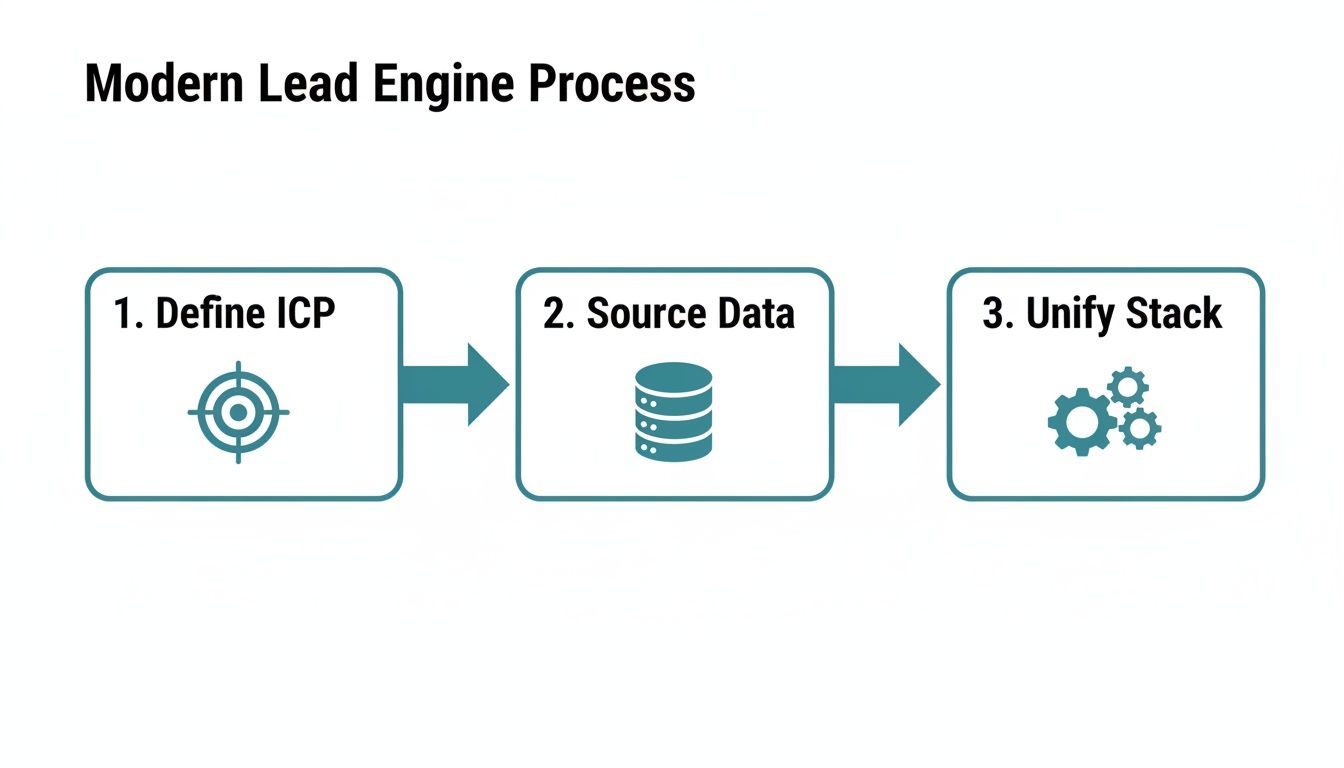
This isn't just a flowchart. It's the strategic framework for eliminating the guesswork that plagues most outbound teams. It's how you build a system that predictably creates real revenue opportunities.
The Problem with the Old Funnel
The traditional sales funnel treats every lead as an equal input, hoping enough will eventually trickle out the bottom. This linear, volume-obsessed thinking is the source of the daily friction that revenue teams face.
- Fragmented Tooling: SDRs are forced to jump between five or more different tools just to source data, verify it, run a sequence, and log everything in the CRM. All that context-switching kills momentum and creates data silos that RevOps teams spend weeks trying to untangle.
- Dirty Data: An SDR wasting the first two hours of their day cleaning a list from a third-party vendor is a painfully common and expensive reality. Bad data means bounced emails, wasted time, and demotivated reps.
- Generic Outreach: When reps are pressured to hit activity metrics, personalization is the first casualty. Prospects get hit with templated messages that show zero understanding of their business challenges, and those emails go straight to the trash.
This modern approach isn't theoretical; it's about building a smarter, more efficient system. Below is a breakdown of the core pillars that make this engine work.
Core Components of a Modern Lead Generation Engine
These three pillars work together to transform a chaotic, manual process into a scalable revenue operation.
A modern GTM platform like Willbe is built to consolidate these fragmented workflows. By bringing verified data, AI-driven personalization, and multi-channel outreach into a single system, you build a predictable pipeline without increasing headcount.
Nail Your Targeting: The Foundation of Every Winning B2B Lead Gen Strategy
Nearly every outbound campaign that falls flat fails for one of two reasons: you’re talking to the wrong companies, or you’re using bad data to reach the right ones. High-quality B2B lead generation doesn't start with a clever email template. It starts with a crystal-clear Ideal Customer Profile (ICP) and a rock-solid source of verified contact data.
A blurry ICP—like "tech companies with over 50 employees"—is a surefire way to burn budget and watch reply rates plummet. It leaves your sales reps guessing, which is the most expensive way to build pipeline. The goal is to get so specific that your team knows exactly which accounts to pursue and, more importantly, why.
This isn't about gut feelings. It's about looking at your best customers and reverse-engineering what makes them great. What do they all have in common? It’s time to look past the obvious and find the signals that scream "perfect fit."
From Vague Guesses to Surgical Precision
A powerful ICP is built on the specific traits that lead to closed-won deals, happy customers, and expansion revenue. This is how you shift from a scattergun "spray-and-pray" approach to a focused, account-based strategy that actually works.
What should you be looking at?
- Firmographics: Go deeper than just industry and employee count. Look for specifics like annual revenue, growth trends (like headcount growth over the past six months), and funding rounds. A Series B startup rapidly hiring salespeople has completely different problems than a slow-moving enterprise.
- Technographics: What's in their tech stack? Knowing the software they use can unlock huge opportunities. You might find a perfect integration partner, a competitor to displace, or a signal they're investing heavily in a certain area. A company that just bought a new marketing automation platform is clearly focused on generating more leads.
- Behavioral Signals (Buying Intent): This is where the magic happens. Is the company posting jobs for a role your product helps? Did a key decision-maker just engage with your content or linger on your pricing page? These are active buying signals that tell you now is the time to reach out.
Your ICP isn't a one-and-done document. The best lead gen machines are built on a living ICP. As you close more deals and learn more about your market, you must constantly tighten your targeting to focus only on the accounts most likely to convert.
Finally Solving the Data Problem
Even with the world's best ICP, your team is dead in the water if they're working with bad data. For most sales teams, the reality is a clunky, frustrating workflow: buy a list, use another tool to enrich it, and then waste hours manually checking if emails bounce and LinkedIn profiles are real. It's a massive productivity and morale killer. No wonder 85% of B2B marketers say lead generation is their biggest challenge—bad data is a huge piece of that puzzle.
This is exactly the problem a modern B2B lead generation platform solves. Instead of making your reps stitch together data from a half-dozen sources, an all-in-one platform provides everything in one place.
Imagine your SDRs having instant access to a global database of verified contacts, ready to be filtered by the exact ICP criteria you just defined. That’s how you change the game for your team.
Here's what an SDR's day looks like without the right tools:
- Wastes 90 minutes trying to find a decent list of target accounts.
- Dumps it into a messy spreadsheet.
- Uses a separate tool to find contact info.
- Manually triple-checks every email and LinkedIn profile.
- Finally uploads a "clean" list to their sales engagement tool.
That entire soul-crushing process can be shrunk to minutes. With a platform like Willbe, which pulls data from over 30 B2B contact databases, your team can build laser-focused segments in seconds. They can filter by tech stack, recent funding news, or hiring trends, and start outreach immediately—all without ever leaving the platform. This is what giving your team both precision and speed really looks like.
Orchestrate Multi-Channel Outreach That Feels Human
You've figured out who to talk to. Now for the hard part: starting a conversation.
In B2B sales, showing up on one channel isn't enough anymore. You're competing with a firehose of noise, and to cut through it, you need a smart, coordinated approach across both email and LinkedIn. It has to feel human, not robotic.
The Old-School Sales Dilemma
We've all been there. Leadership is pushing for more activity—more dials, more emails. But prospects are drowning in generic outreach and will only reply to something that feels like it was written just for them.
This forces reps into a no-win situation. Do you blast out a thousand templates and burn through your best-fit accounts? Or do you spend hours hand-crafting a few perfect messages and miss your activity goals? It’s a frustrating trade-off between volume and quality.
The answer isn't to work harder. It's to work smarter by orchestrating your outreach in a way that respects your prospect's time and context.
Building Sequences That Actually Get Replies
Great outreach isn't about one perfect email. It's about a sequence of intelligent, connected touchpoints that build on one another.
A good sequence might start with a simple LinkedIn connection request. The next day, you send a highly relevant email. A few days later, a profile view or a thoughtful comment serves as a subtle, non-intrusive reminder. This layered approach dramatically increases your chances of being noticed without coming across as pushy.
In this multi-channel mix, LinkedIn is critical. The data is overwhelming: research shows it’s 277% more effective for lead generation than other major social platforms. In fact, 40% of B2B marketers point to it as their number one source for high-quality leads. With over 1.7 billion site visits in February 2025 alone, it's the professional world's town square. You can't afford to ignore it.
But simply being on LinkedIn isn't a strategy. The magic happens when you pair it with email.
- Email for the Details: Use email to lay out your core business case. This is your space for a detailed value proposition, a case study, or a complex solution explanation.
- LinkedIn for the Handshake: Use LinkedIn to add a human touch. It's where you build social proof, see a prospect's work history, and engage with their ideas. It turns a cold email into a warm introduction.
- Putting It All Together: An orchestrated sequence uses both channels in concert. That LinkedIn connection request gives them a face to put with the name before your email ever hits their inbox, making your message feel less like an interruption and more like a conversation starter.
Ditch the Templates, Embrace Real Personalization
Prospects can spot a generic {{firstName}} and {{companyName}} email from a mile away, and they hit delete just as fast.
True personalization goes deeper. It’s referencing a recent post they shared, a company milestone, or a specific challenge you know people in their role are facing. That's what gets replies.
This is where AI has become a game-changer—but not all AI is created equal. The market is flooded with generic writing tools that spit out robotic, uninspired copy. To stand out, you need AI that sounds like your best sales rep.
Willbe’s proprietary AI is built differently. It's template-free and designed to sound like you, not a generic chatbot. It analyzes a prospect’s profile and your value prop to generate unique, context-aware messages. The result? Outreach that makes prospects feel genuinely understood, which is how you scale personalization and skyrocket reply rates.
Think about an SDR's morning. Instead of spending two hours manually researching ten prospects to write a few personalized notes, they can use an AI-assisted platform to generate a hundred unique, high-quality messages in minutes.
This finally solves the volume vs. quality problem. Reps can hit their activity metrics while sending messages that actually resonate. That means more meetings booked and cleaner, higher-quality handoffs to AEs. If you're looking to upgrade your tech stack, check out our guide on the best AI sales tools for modern GTM teams.
How This Transforms Your Pipeline
Adopting an AI-driven, multi-channel strategy does more than just get more replies. It builds a more efficient, predictable, and scalable revenue engine.
For SDRs, it means less time on manual tasks and more time having meaningful conversations. For AEs, it means a pipeline full of high-quality opportunities that are primed to close.
And for sales leaders, it provides clear visibility into which messages and channels are actually driving results, so you can stop guessing and start doubling down on what works. This is how the top-performing teams consistently hit their numbers, quarter after quarter.
Executing Account-Based Plays and Intelligent Prospecting
Blasting generic messages to a huge list is a surefire way to get ignored. Once your team masters multi-channel outreach, the real magic begins with strategic, account-based plays. This is where you combine sharp targeting with intelligent execution, turning the daily grind of prospecting into a series of calculated, high-impact moves.
The concept is simple: instead of casting a wide net, you focus all your energy on a curated list of best-fit accounts. This means shifting your mindset from chasing individual leads to orchestrating targeted campaigns at the company level.

Identifying and Prioritizing High-Value Accounts
So, how do you decide which accounts get this VIP treatment? It goes beyond the static ICP criteria we discussed. You need to look for real-time buying signals. Modern prospecting platforms are a game-changer here, using predictive analytics to surface accounts that are actively showing they’re in-market.
Keep an eye out for signals like these:
- Hiring Trends: A company suddenly posting jobs in a department your solution serves? That’s a huge green flag.
- Technographic Shifts: Did they just adopt a new technology that integrates perfectly with your platform? That’s your in.
- Company News: Fresh funding rounds, a product launch, or a new exec joining the team—all of these are moments of change where a company is open to new ideas.
An all-in-one platform like Willbe automates this, using machine learning to score and rank accounts based on their likelihood to buy. This helps sales leaders point their team’s firepower at accounts that aren't just a good fit, but a good fit right now.
This is a fundamental shift from reactive to proactive prospecting. You’re not waiting for someone to fill out a form; you’re spotting opportunities before your competitors even know they exist.
Running Coordinated GTM Plays
Once you have your prioritized account list, it's time to execute. This isn't about sending a few emails to one person and hoping for the best. A true account-based play is a coordinated, multi-threaded attack that targets multiple decision-makers and influencers within the same company.
This is where a unified platform is non-negotiable. Your RevOps team can build out specific plays—like a "Competitor Displacement" playbook or a "New Executive Onboarding" sequence—that SDRs can launch with a few clicks. These plays should blend channels and messages, all tailored to the various personas on the buying committee.
For instance, a play targeting a new VP of Sales might unfold like this:
- Day 1: An SDR sends a LinkedIn connection request to the new VP.
- Day 2: A highly personalized email lands in their inbox, congratulating them on the new role and touching on a challenge leaders often face in their first 90 days.
- Day 4: The SDR engages with a recent post from the VP on LinkedIn, leaving a thoughtful comment.
- Day 6: A follow-up email goes out to a key director on their team, referencing the same business challenge.
The goal is to surround the account with relevant, valuable touchpoints that build familiarity and trust. Critically, this entire process must sync flawlessly back to your CRM, creating a single source of truth for every interaction. A platform like Willbe handles this automatically, cutting out the manual data entry that kills rep productivity and gives sales leaders reporting headaches. You can dig deeper into structuring these efforts in our guide to account-based marketing best practices.
This strategic approach delivers real results. Effective Account-Based Marketing (ABM) can boost pipeline conversions by up to 14% and deliver a 25% higher conversion rate from MQL to sales-accepted lead. These numbers improve when AI helps sift through data for predictive signals and scores leads based on engagement—a key trend in modern B2B lead generation.
Optimizing Performance with Real-Time Revenue Analytics
Generating B2B leads isn't a "set it and forget it" process. The best GTM teams operate on a tight, data-driven feedback loop. They live by the mantra that you can't scale what you can't measure, which means they look past vanity metrics like open rates and focus on what actually drives revenue.
This is where all your work comes together. You've defined your ICP, sourced clean contacts, and launched multi-channel campaigns. Now what? You need to know what's working—and what's not—in real-time. Without clear analytics, even the most brilliant strategy is just a shot in the dark.
Your sales leaders need to see which channels are sourcing qualified meetings. Your SDRs need to know which messaging hooks are resonating with specific personas. Your AEs need to understand which ICP segments are converting to closed deals. Getting this clarity is nearly impossible when your data is scattered across half a dozen tools.
From Raw Data to Actionable Revenue Insights
A unified lead generation platform turns a messy pile of data points into a clear picture of what's driving results. Instead of waiting for RevOps to pull a custom report, you get instant answers to your most pressing questions.
Imagine seeing, with a single click, that a specific message about cost savings is getting a 3x higher reply rate with VPs of Finance in the SaaS space. That's not just a cool factoid; it’s an insight you can immediately act on and scale across the team.
This is how you build a predictable system. You find winning patterns and replicate them. Key performance indicators (KPIs) to track include:
- Reply Rates by Channel: Is LinkedIn outperforming email for a specific segment?
- Message Effectiveness: Which value props are generating positive replies versus getting ignored?
- ICP Segment Performance: Are you booking more meetings with Series B startups or established enterprises?
- Meeting Conversion: Which job titles are most likely to book a demo after engagement?
Tracking these metrics isn’t just for reporting. It’s about empowering every rep to make smarter decisions. When an SDR knows exactly which levers to pull to hit their quota, their effectiveness and motivation skyrocket.
The ultimate goal is to draw a straight line from a specific sales activity directly to pipeline. When you can connect a particular outreach sequence to a closed deal, you’ve found the formula for repeatable success.
The High Cost of Poor Lead Qualification
Focusing on the right KPIs also helps solve one of the biggest bottlenecks in B2B sales. It's shocking, but research shows that poor lead qualification is the top reason deals fall apart for a staggering 67% of sales teams.
On the flip side, implementing a consistent lead scoring model can lift conversions by over 20%. This highlights the massive gap between raw activity and genuinely qualified pipeline.
Platforms that centralize prospecting, sync with your CRM, and offer predictive analytics are the best defense against this trap. Instead of burning through lists with low-quality outreach, SDRs and BDRs can focus their energy on accounts that show real intent, turning raw volume into predictable pipeline.
Building a Scalable GTM Engine
For sales leaders, this data-driven approach is the key to building a GTM engine that can actually scale. With team-level visibility and predictive analytics, you can finally shift from being reactive to proactive.
A centralized dashboard gives you a bird's-eye view of team performance, allowing you to:
- Identify Your Top Performers: See which reps are consistently winning, then codify their plays for the rest of the team.
- Pinpoint Bottlenecks: Instantly spot where deals are stalling or where outreach is falling flat.
- Forecast with Confidence: Use historical conversion data to predict future pipeline and revenue with far greater accuracy.
This is exactly how high-growth startups scale their outbound efforts after a funding round without just throwing more bodies at the problem. They focus on efficiency, using technology to amplify the impact of every rep. A modern B2B lead generation platform like Willbe provides this single source of truth, ensuring the entire revenue team is aligned and focused on what really moves the needle. To get a handle on what metrics to prioritize, you can learn more about building an effective sales performance dashboard.
B2B Lead Generation FAQs

What Is a Modern B2B Lead?
The definition has evolved. A modern B2B lead isn't just a name scraped from a list. It's a verified contact at a company that fits your Ideal Customer Profile (ICP) and has shown some kind of intent.
The goal isn't just to rack up "leads." It's to start qualified conversations. That means a hard focus on high-quality, actionable contacts who have a real chance of becoming pipeline opportunities, not just vanity metrics for a marketing report.
How Many Touchpoints Does It Take to Generate a Lead?
There's no single magic number, but it's almost never one. The days of single-touch "blast" campaigns are over. Effective B2B lead generation is about well-orchestrated, multi-touch sequences that blend channels like email and LinkedIn.
A solid sequence usually involves 6 to 10 touchpoints spaced out over a few weeks. That persistence is what it takes to cut through the noise and build familiarity before asking for a meeting. The trick is to make every touchpoint feel valuable and relevant, not just another "checking in" email.
What's the Difference Between MQLs and SQLs?
Getting this right is critical for aligning sales and marketing teams and avoiding internal friction.
- Marketing Qualified Lead (MQL): An MQL is a lead marketing has flagged as more likely to become a customer based on engagement, like downloading an ebook or attending a webinar. They’re interested, but they haven't raised their hand to talk to sales yet.
- Sales Qualified Lead (SQL): An SQL is a lead the sales team has vetted and accepted as a legitimate prospect ready for a direct conversation. They've usually shown clear buying intent, like requesting a demo or asking for pricing.
The handoff from MQL to SQL is where many companies drop the ball. A unified platform that gives everyone a single view of all prospect activity is a game-changer. It ensures reps get leads with full context, leading to smarter conversations and less pipeline leakage.
How Can We Improve Lead Quality?
Improving lead quality is about precision, not volume. The fastest way to get better B2B leads is to use data to sharpen every part of your process.
First, build a razor-sharp ICP based on your best customers. Go beyond basic firmographics to include their tech stack and real-time buying signals.
Second, ditch bad data and fragmented tools. When you give your team a platform with verified, up-to-date contact info, you eliminate wasted hours. It stops reps from burning through great accounts with bounced emails and outdated intel.
Finally, use AI-driven personalization to ensure your messages connect. An email that speaks directly to a prospect’s specific pain point will always outperform a generic template when it comes to starting a high-quality conversation.
What Role Does AI Play in Lead Generation?
AI is a core piece of any modern GTM engine. For B2B lead generation, its impact is felt across the entire workflow.
AI can spot high-intent accounts by analyzing buying signals a human could miss. It also enriches data on the fly, ensuring your reps always work with the most accurate information.
But the real power lies in proprietary, template-free AI that can write unique, hyper-personalized outreach at scale. This solves the age-old sales dilemma of choosing between volume and quality. It lets reps send hundreds of messages that sound human and context-aware, which translates directly to higher reply rates, more meetings booked, and a healthier pipeline.
Ready to build a predictable revenue engine? Willbe consolidates your tech stack, providing verified global data, AI-powered personalization, and real-time analytics in one platform. Stop burning lists and start generating pipeline that converts.