

In 2026, the gap between top-performing sales teams and everyone else isn't about effort—it's about the operating system. While most teams are drowning in fragmented tools, manual list-building, and generic outreach that prospects ignore, elite GTM organizations operate from a unified platform. They find the right accounts with precision, engage entire buying committees with messages that feel human (even at scale), and predictably convert pipeline without burning through their market or increasing headcount.
The difference is their mastery of modern sales prospecting best practices, executed through a single, all-in-one prospecting and lead generation platform. This guide breaks down the ten essential practices your team needs to stop guessing and start scaling. We’ll move beyond surface-level advice to give you actionable frameworks for everything from account segmentation to multi-channel orchestration and AI-powered personalization that actually gets replies.
Forget the manual chaos of duct-taping tools together. This is about building a predictable revenue engine. You will learn how to identify in-market accounts, connect with the right decision-makers using relevant triggers, and orchestrate follow-ups across email and LinkedIn without anything falling through the cracks. For sales leaders, this is the blueprint for a repeatable system that generates qualified meetings. For SDRs and AEs, these are the tactics that fill your calendar and help you crush quota. Let’s get into the plays that separate the best from the rest.
1. Account-Based Prospecting (ABP)
Instead of casting a wide net, Account-Based Prospecting (ABP) treats each high-value target account as its own market. This flips the traditional funnel on its head. You start by identifying best-fit companies that align perfectly with your Ideal Customer Profile (ICP), then orchestrate coordinated, personalized outreach to multiple decision-makers and influencers within those specific organizations. The goal is to achieve deep penetration and build consensus across the buying committee, not just generate a single lead from an unknown source.
ABP is one of the most effective sales prospecting best practices because it aligns your most valuable resources—your team's time—with accounts that have the highest revenue potential. This is how modern B2B teams win enterprise deals: by surrounding accounts with multi-threaded campaigns that speak to the unique needs of C-suite executives, department heads, and end-users simultaneously, all managed from a single platform.
How to Implement Account-Based Prospecting
Executing ABP requires an all-in-one system for identifying, targeting, and engaging accounts with precision, not a collection of siloed tools.
- Build Your Target Account List: Use a platform like Willbe to connect your CRM with comprehensive data sources. Filter companies based on firmographics (industry, size, revenue), technographics (current tech stack), and buyer intent signals (companies researching your solution category). This creates a dynamic, high-priority account list without manual data cleaning.
- Map the Buying Committee: For each target account, identify 3-5 key personas, including the economic buyer, champion, and key influencers. Understanding their individual roles and pain points is critical for crafting messaging that resonates.
- Personalize at Scale: Go beyond
{{first_name}}. Reference account-level triggers like recent funding rounds, new executive hires, or strategic initiatives mentioned in earnings reports. Willbe’s proprietary AI can analyze these signals and draft context-aware messages for each persona that sound like they were written by your best rep, not a generic template. - Orchestrate and Measure: Track engagement across all channels at the account level. A unified dashboard should show you which accounts are warming up based on email opens, LinkedIn interactions, and content downloads, helping you prioritize follow-up and provide AEs with high-quality handoffs.
2. Intent-Based Prospecting
Instead of guessing who might be in-market, Intent-Based Prospecting focuses your outreach on prospects who are already showing active buying signals. This data-driven approach shifts the focus from cold lists to warm accounts by tracking digital footprints—like keyword searches, content downloads, and competitor website visits—that indicate a company is actively researching solutions. It’s one of the most effective sales prospecting best practices for prioritizing time and resources on revenue-ready opportunities.
This method allows you to engage prospects at the exact moment their need is highest, creating a relevant conversation instead of another interruption. You're not just finding good-fit companies; you're finding good-fit companies that are ready to talk now. The challenge is consolidating this data from multiple sources and acting on it fast enough to matter.
How to Implement Intent-Based Prospecting
Executing this strategy requires an all-in-one platform for detecting, scoring, and acting on buyer intent signals with speed and precision.
- Aggregate Intent Signals: The key is to combine multiple data sources for a complete picture. Use Willbe to integrate first-party data (your website visitors, content downloads) with third-party intent data from leading providers. This enables you to identify accounts researching your category, even if they've never visited your site, all from one interface.
- Set Up Real-Time Alerts: Don't let hot leads go cold. The moment a target account shows high-intent behavior, like searching for product-related keywords or visiting a pricing page, reps should get an alert. Responding within hours of a signal dramatically increases engagement rates, but this is impossible with manual workflows.
- Personalize with Context: Your outreach must reflect why you're contacting them. Use the intent data as your opening hook. Instead of a generic intro, reference the topic they're researching. Willbe’s proprietary, template-free AI can analyze these signals and draft specific, relevant opening lines that show you've done your homework.
- Track and Optimize: Not all intent signals are created equal. Monitor which signals—like "reading product reviews" versus "visiting a competitor's site"—lead to the highest conversion rates. A unified platform provides the analytics to refine your lead scoring and focus your team on the most valuable activities.
3. Warm Outreach & Social Selling
Instead of approaching prospects as complete strangers, warm outreach and social selling establish credibility and rapport before a sales conversation begins. This method uses existing relationships, mutual connections, and social media platforms like LinkedIn to build genuine connections. The core principle is to lead with value, engaging with a prospect’s content and professional world, so the eventual outreach feels natural and welcome, not like another cold pitch.
This approach is one of the most powerful sales prospecting best practices because it bypasses the inherent skepticism of a cold pitch. Top-performing SDRs and AEs build pipeline by engaging in thoughtful industry discussions and sharing insights first. This value-driven interaction warms up the relationship, dramatically increasing the likelihood of getting a positive response when you finally make a direct outreach.
How to Implement Warm Outreach & Social Selling
A successful warm outreach strategy requires authenticity and a system for tracking engagement to identify the right moment for a direct ask.
- Map Connections and Engage Authentically: Use a platform like Willbe to enrich contact profiles with LinkedIn data, quickly identifying mutual connections for warm introductions. Before reaching out, spend time authentically engaging with a prospect’s content. Like, comment on, and share their posts to get on their radar in a non-transactional way.
- Lead with Value, Not a Pitch: Build a simple content calendar focused on sharing insights relevant to your target audience. Your goal is to be seen as a credible expert, not a salesperson. Adhere to the 80/20 rule: 80% of your activity should be adding value (sharing insights, commenting) and only 20% should be direct outreach.
- Reference Engagement in Your Outreach: When you do send that first direct message, make it context-aware. Reference a specific comment they made, an article they shared, or a mutual connection. This proves you've done your research and aren't just sending another generic template from a disconnected tool.
- Prioritize Relationship Depth: A unified platform helps you track which social selling activities convert into meetings. This data helps you focus your efforts on building deeper connections with a smaller group of high-potential prospects rather than superficial engagement across a broad, untargeted list.
4. Vertical & Industry-Specific Prospecting
Instead of applying a generic go-to-market motion across all business types, vertical prospecting is a specialization strategy. Sales teams focus intently on a single industry, developing deep expertise in that segment’s unique pain points, regulatory challenges, operational workflows, and buying culture. This allows for the creation of exceptionally relevant messaging that establishes immediate credibility.
This approach is one of the most powerful sales prospecting best practices because it positions your team not as generalist vendors, but as indispensable industry partners. By knowing an industry inside and out, you can speak your prospects' language, anticipate their needs, and articulate a value proposition that directly addresses their specific challenges. This is how you win markets.
How to Implement Vertical & Industry-Specific Prospecting
To execute this strategy, your team must become genuine experts in your chosen vertical and align all outreach to reflect that knowledge.
- Segment and Isolate Your Vertical: Use a platform like Willbe to apply precise industry and firmographic filters to your total addressable market. This allows you to build a clean, dedicated target account list based on a specific vertical, such as "SaaS," "Professional Services," or "Healthcare," ensuring your team's efforts are concentrated.
- Build Vertical-Specific Social Proof: Your messaging is only as strong as the proof behind it. Develop case studies and gather testimonials exclusively from customers within your target vertical. Highlighting a competitor's success story is far more compelling than a generic case study from an unrelated industry.
- Create Expert-Level Messaging: Research the vertical’s specific pain points, compliance standards (like HIPAA in healthcare), and common technology stacks. Use Willbe’s proprietary AI to draft email and LinkedIn templates that reference this industry-specific knowledge, making your outreach sound like it's coming from a peer, not a salesperson.
- Immerse Your Team in the Industry: True expertise is built through immersion. Subscribe to vertical-specific publications and use your platform to track and engage with decision-makers on LinkedIn. This provides a steady stream of context and talking points for your outreach, making every interaction more relevant.
5. Multi-Channel Prospecting Sequencing
Relying on a single channel like email is no longer sufficient to break through the noise. Multi-channel prospecting sequencing coordinates outreach across email, LinkedIn, and phone calls in a strategic, timed series. This approach systematically surrounds prospects where they are most active, using complementary channels to increase contact rates and build familiarity, which significantly raises the likelihood of getting a response.
This methodology is a core component of modern sales prospecting best practices because it respects the prospect's communication preferences while overcoming initial message resistance. Instead of a single email getting lost in a crowded inbox, a well-timed sequence of a LinkedIn connection request, two emails, and a follow-up call creates multiple opportunities for engagement. The key is to manage this orchestration without manual effort or broken data syncs between tools.
How to Implement Multi-Channel Prospecting Sequencing
Executing an effective multi-channel strategy requires careful orchestration and a unified platform to track engagement across all touchpoints.
- Design Your Sequence Logic: Start with email as the primary channel. Layer in LinkedIn touches (connection requests, profile views, InMails) and phone calls at strategic intervals. A common sequence involves 3-4 emails, 2-3 LinkedIn interactions, and 1-2 phone calls spaced 2-3 days apart to avoid prospect fatigue.
- Vary Messaging, Not Just Channels: Personalize the message for each channel instead of copying and pasting the same text. Reference previous touchpoints to create a cohesive narrative, for example, "I sent an email on Tuesday regarding...". This shows diligence and makes your follow-up feel more natural.
- Automate Execution and Tracking: Use an all-in-one platform like Willbe to build and automate these sequences. Willbe’s native CRM sync can trigger sequence steps based on prospect actions (or inaction) and automatically stop outreach upon a reply or booking. This ensures no lead falls through the cracks and you respect prospect preferences.
- Measure and Optimize Performance: Track which channel combinations and sequence lengths drive the most conversions for your specific audience. A unified platform provides clear analytics on metrics like reply rates and meetings booked per channel, so you can scale what works and cut what doesn't.
6. Referral & Network-Based Prospecting
Referral and network-based prospecting activates your existing relationships—customers, partners, and employees—to generate warm introductions. This method turns your network into a pipeline engine, using the trust and credibility of advocates to open doors that cold outreach simply cannot. Leads generated through referrals consistently have higher conversion rates and shorter sales cycles because they arrive with built-in social proof.
This approach is one of the most cost-effective sales prospecting best practices, as it relies on goodwill rather than ad spend. The core principle is simple: a warm introduction from a trusted source is more powerful than any cold email. The challenge for most teams is moving from occasional, ad-hoc referrals to a predictable, scalable program.
How to Implement Referral & Network-Based Prospecting
To turn your network into a predictable source of pipeline, you need a systematic process for asking for, managing, and tracking referrals.
- Systematize the Ask: Don't leave referrals to chance. Build formal referral requests into your customer journey at key moments of success, such as after a positive quarterly business review or upon successful onboarding. Train your team to ask satisfied customers for specific introductions to companies that fit your ideal profile.
- Create Clear Incentives: Motivate your advocates with a structured incentive program. This could include discounts for customers, commissions for partners, or bonuses for employees who refer qualified leads. The clearer and more valuable the reward, the more motivated your network will be to send opportunities your way.
- Track and Manage Introductions: Use your CRM as the system of record, fed by clean data from your prospecting platform. Tag the referral source, track follow-up activities, and measure the conversion rate from introduction to closed-won. This provides attribution and helps you identify your most valuable advocates.
- Validate and Prepare: Before reaching out, use a platform like Willbe to verify the contact details of the referred prospect and enrich their profile with additional context. This ensures your data is accurate and enables you to tailor your opening message with relevant insights, making the introduction even warmer.
7. Data-Driven Persona Targeting
Effective prospecting moves beyond assumptions by using detailed data to construct accurate representations of your ideal buyers. Data-driven persona targeting is a methodical approach where sales teams use buyer research, behavioral signals, and firmographic details to identify which prospects are most likely to convert based on the proven characteristics of your best existing customers. This ensures your outreach is always directed at high-propensity profiles.
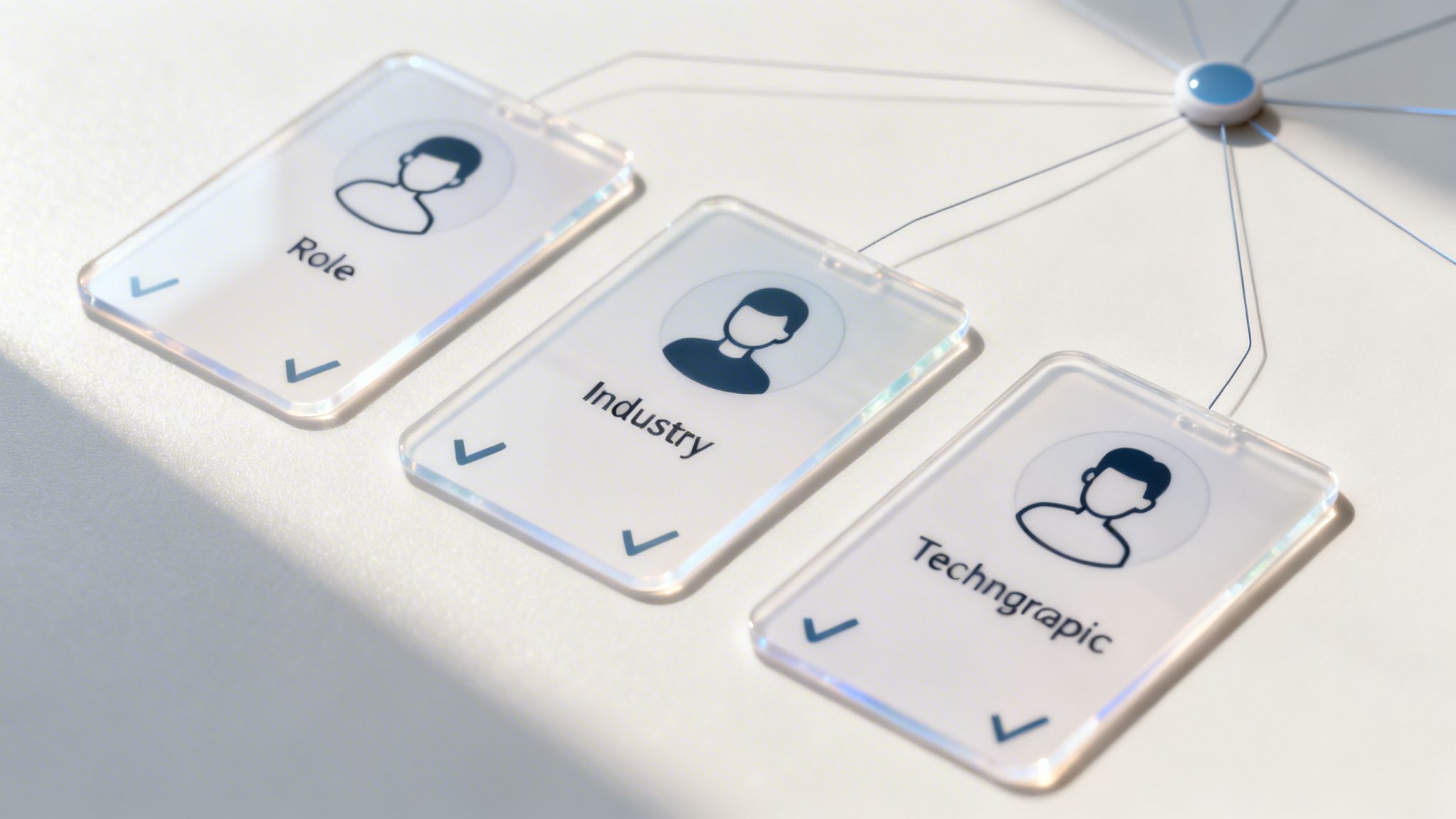
This method is one of the most fundamental sales prospecting best practices because it builds a solid foundation for all other outreach activities. It minimizes wasted effort on low-fit prospects and sharpens messaging for maximum impact. The challenge is that this data often lives in disparate systems, forcing SDRs to spend hours cleaning lists instead of prospecting.
How to Implement Data-Driven Persona Targeting
To build and act on data-backed personas, you need a unified system that translates customer insights into actionable prospecting segments.
- Analyze Your Top Customers: Start by examining the top 20% of your customer base. Identify the common firmographic and technographic traits that define your Ideal Customer Profile (ICP). This evidence-based profile becomes your north star for finding lookalike accounts.
- Segment Prospects with Precision: Use a platform like Willbe to connect to multiple data sources and segment your total addressable market without leaving the platform. Filter potential accounts by specific job titles, industries, company sizes, and technologies used to build hyper-targeted prospect lists that align with your ICP.
- Create Distinct Buyer Personas: For each ICP, develop 3-5 buyer personas representing key roles in the buying committee (e.g., economic buyer, champion, end-user). Document their specific pain points, responsibilities, and motivations. This clarity helps you tailor messaging to what each person actually cares about.
- Build Persona-Specific Messaging: Once personas are defined, use a tool like Willbe’s proprietary AI to create messaging that speaks directly to their unique challenges. For example, a CFO persona gets messaging about ROI, while an IT Director receives content about integration and security. This ensures your outreach is relevant from the first touch.
8. Trigger-Based & Event-Driven Prospecting
Timing is everything in sales. Trigger-based prospecting is a strategy built on identifying and acting on specific business events that signal an immediate need or buying readiness. Instead of prospecting based on static firmographics alone, you prioritize outreach to companies experiencing a catalyst, such as a new funding round, an executive appointment, or a significant expansion. This method moves you from cold outreach to context-aware engagement.
This approach is one of the most powerful sales prospecting best practices because it ensures your message arrives at the exact moment a prospect's problems become urgent. You connect your solution directly to a tangible, recent event within their organization, making your outreach immediately relevant. The key is to act fast, which is nearly impossible with manual research and siloed tools.
How to Implement Trigger-Based Prospecting
Executing a trigger-based strategy requires an all-in-one system for monitoring signals in real-time and quickly acting on them with precision.
- Define and Monitor Your Triggers: Identify the key events that create demand for your product, such as funding announcements (new budget), key executive hires (new strategy), or technology stack changes (competitor vulnerability). Set up automated alerts within your prospecting platform to monitor these signals across your target account list.
- Build Trigger-Specific Playbooks: For each type of trigger, create a specific outreach sequence. An email referencing a $50M Series B funding round should be fundamentally different from one congratulating a new VP of Engineering. Document the core pain points associated with each event to guide your messaging.
- Automate and Act Fast: The window of opportunity for a trigger event is short. Use a platform like Willbe to connect to data sources, automatically identify trigger events in your target accounts, and enroll the right contacts into a pre-built, context-aware sequence. This removes manual monitoring and ensures a rapid, relevant response.
- Personalize Around the Catalyst: The trigger is your reason for reaching out. Your message should lead with it: “Saw your recent funding news and know that scaling the SDR team is often a top priority post-raise.” Willbe's proprietary AI can analyze the trigger and draft a message that connects the event to your value proposition, making the outreach feel bespoke and timely.
9. Personalized Email Outreach & Copy Strategy
In a crowded inbox, generic email blasts are deleted on sight. Personalized email outreach is the practice of combining research-backed insights with compelling copy to create messages that address a prospect's specific context. This strategy moves beyond simple mail merges to reference an individual's role, their company's recent activities, or their unique pain points, proving you've done your homework.

This method is one of the most crucial sales prospecting best practices because it directly increases engagement and reply rates. It’s about creating a "moment of recognition" that makes your prospect feel understood, not just targeted. The challenge is achieving this level of personalization at scale without burning out your reps with hours of manual research.
How to Implement a Personalized Email Strategy
Executing personalized outreach at scale requires a system that balances genuine research with efficient execution.
- Research Key Triggers: Before writing, look for company news, recent LinkedIn posts, or technology mentioned in job descriptions. This provides the raw material for your opening line. Manually, this is a bottleneck; a unified platform surfaces these insights automatically.
- Craft a Compelling Opening: The first sentence is everything. Lead with a specific reference to your research. For example: "Saw your company's recent funding round and had a thought on scaling your SDR team," or "Noticed you're hiring for a role that requires XYZ; we help teams with that."
- Focus on Brevity and a Single CTA: Keep your emails short, ideally 3-4 sentences. The goal is to start a conversation, not close a deal. End with a clear, low-friction call-to-action (CTA), like "Open to a 15-minute call next week to explore this?"
- Scale Authenticity with AI: Manually writing every email is not sustainable. A platform like Willbe’s proprietary, template-free AI engine can analyze company triggers and persona details to generate authentic outreach that sounds like your best rep wrote it. This allows your team to send hundreds of unique-sounding emails without the manual research burden.
- Test and Optimize Relentlessly: Track open rates, reply rates, and meetings booked. A/B test subject lines, opening hooks, and CTAs to identify what resonates with each persona and scale what works—all from a single analytics dashboard.
10. Sales Cadence & Persistent Follow-up
A sales cadence is a structured sequence of touchpoints across different channels, designed to engage a prospect over a set period. Rather than sending one-off emails and hoping for a reply, this systematic approach dictates the timing, messaging, and channel for each follow-up attempt. The goal is to maintain persistent, respectful contact until you get a response, ensuring no qualified lead slips through the cracks.
This method is one of the most crucial sales prospecting best practices because it introduces predictability and discipline into outreach. Data shows it takes an average of 5-7 touches to get a response. Without a cadence, most reps give up after just one or two attempts. By defining a clear follow-up plan, teams can triple their engagement rates and build a repeatable engine for generating meetings.
How to Implement a Sales Cadence
Executing an effective sales cadence requires a balance of automation and personalization to stay top-of-mind without becoming a nuisance.
- Build a Multi-Channel Sequence: Construct a sequence of 5-7 touches spread across a 2-4 week period. A proven mix for B2B includes 3-5 emails, 2-3 LinkedIn interactions (a connection request and a follow-up message), and 1-2 phone calls. Space touches 2-3 days apart to give prospects time to respond.
- Vary Your Value Proposition: Never send a "just following up" email. Each touchpoint should offer new value. The first touch introduces the core problem. The second can share a relevant case study. Subsequent touches might highlight a different pain point or reference recent industry news.
- Automate Execution, Not Personalization: Use a platform like Willbe to automate the sequence's timing and task reminders. It can execute your pre-defined cadence, sending emails and creating tasks for LinkedIn touches or calls at the right intervals. This frees reps from manually tracking every follow-up, ensuring 100% consistency.
- Define Clear Exit Criteria and Optimize: A cadence should stop when you get a response, a definitive "not interested," or an unsubscribe. Track response rates and meetings booked for different cadences. A/B test sequence length and touchpoint intervals to find the optimal rhythm that works for your specific market and persona.
10-Point Sales Prospecting Best Practices Comparison
- Personalized Email Outreach & Copy Strategy | Medium: research-driven copy + A/B testing & deliverability setup | Medium — copywriting, personalization tools, deliverability ops | Higher open/reply rates; scalable authenticity with templates | Persona-based campaigns, targeted cold outreach at scale | Scalable personalization; measurable messaging performance |
- Sales Cadence & Persistent Follow‑up | Medium: design sequences, automate and optimize cadences | Medium — engagement platform, content variations, monitoring | Improved conversion via persistence; predictable pipeline flow | SDR-driven outreach; markets needing multiple touches | Systematic follow-up; data-driven cadence optimization |
From Practices to Pipeline: Unify Your GTM Stack
We've covered the proven sales prospecting best practices that separate top-performing teams from the rest. You now have a framework for identifying high-fit accounts, building targeted contact lists, and engaging decision-makers with personalized, multi-channel outreach that genuinely connects.
But knowing these practices is only half the battle. The most common point of failure for growing teams is operational friction. Your SDRs might understand persona targeting, but if they spend half their day cleaning CSV files and manually logging activities in the CRM, their effectiveness is cut in half. Your AEs may know how to run a great discovery call, but if the handoff from an SDR lacks context because the data lives in a separate tool, the deal starts on the back foot.
This is the central problem that holds modern sales teams back: a fragmented, disconnected GTM stack. When your account data, contact intelligence, sequencing engine, and CRM operate in separate silos, you create a system defined by manual work, broken syncs, and a complete lack of visibility. You can’t scale what you can’t measure, and you can’t measure anything accurately when your data is scattered across five different tools. The era of duct-taping platforms together is over. It’s inefficient, expensive, and a direct path to burning out your best reps.
The Shift from Disparate Tools to a Unified Platform
The future of high-performance prospecting is consolidation. It’s about moving from a patchwork of specialized point solutions to a single, all-in-one system that serves as the command center for your entire go-to-market motion. This is precisely why Willbe was built: to eliminate the chaos of a fragmented toolset and replace it with a unified platform for predictable pipeline generation.
Imagine a world where your team can:
- Find Ideal Accounts and Contacts in One Place: No more exporting from one data provider and importing into another. Willbe centralizes firmographic, technographic, and intent data, allowing you to build hyper-targeted segments without ever leaving the platform.
- Orchestrate True Multi-Channel Outreach: Launch email, LinkedIn, and call sequences from a single interface. The system manages the entire cadence, ensuring perfect timing and persistent, yet human, follow-up across every channel.
- Personalize at Scale with AI That Sounds Human: Our proprietary, template-free AI doesn't just insert
{{company_name}}. It analyzes a prospect's profile and company activity to write outreach that feels genuinely researched and relevant, increasing reply rates without adding manual work. - Maintain Perfect Data Hygiene Automatically: With native, bi-directional CRM sync, every activity, contact update, and prospect response is logged in real-time. This keeps RevOps happy and gives leadership a clean, accurate view of performance.
Mastering these sales prospecting best practices is critical, but true scale is only achieved when you give your team a system that makes execution effortless. By unifying your GTM stack, you remove the operational drag that consumes your reps' time and empower them to focus on what they were hired for: starting valuable conversations and building pipeline. This isn't just about making your team more efficient; it's about building a predictable, repeatable revenue engine.
Ready to stop juggling tools and start generating predictable pipeline? See how Willbe replaces your fragmented sales stack with a single, all-in-one platform designed for modern B2B teams. Explore how top teams scale outbound with Willbe today.