


Stop thinking of LinkedIn prospecting as just another task. Start seeing it as your high-precision revenue engine. It’s about getting straight to the right people, identifying buyers who are already showing intent, and starting conversations that actually convert into pipeline.
Why LinkedIn Is Your Unfair Advantage in B2B Sales
Let's be blunt: if your team still sees LinkedIn as just a place to park a resume, you're leaving revenue on the table. It is the most powerful B2B sales platform available, but most teams only scratch the surface of its potential. While they send generic connection requests and hope for the best, top performers are building a predictable pipeline engine.
This isn't about just showing up; it's about being incredibly precise.
For SDRs and BDRs, this means you can finally stop shouting into the void. You're connecting with decision-makers who are actively signaling their needs, turning a cold start into a warm conversation. For sales leaders, it means building a go-to-market strategy based on high-intent accounts, not a bloated list of unqualified leads. Shifting from random acts of prospecting to a structured linkedin for prospecting strategy is no longer optional.

The Numbers Don't Lie
The data is undeniable. LinkedIn is the undisputed leader in B2B lead generation, responsible for a massive 80% of all B2B leads sourced from social media. It's no surprise that by 2026, an estimated 93% of B2B marketers will actively use it as a core channel.
More importantly for your bottom line, LinkedIn's cost per lead is 28% lower than Google Ads, and it delivers conversion rates that are twice as high as other social platforms.
Every hour your team spends on less effective channels is a missed opportunity. A smart LinkedIn strategy simply delivers higher-quality leads for less cost.
The biggest mistake I see teams make is treating LinkedIn as just a messaging tool. It's an intelligence platform. The signals are all there—job changes, content engagement, company growth announcements. You just have to know how to read them and turn them into pipeline.
Let's look at how this modern approach stacks up against the old way of doing things.
Traditional Prospecting vs. Modern LinkedIn Prospecting
The difference is night and day. One is a high-effort, low-reward numbers game; the other is a targeted, data-driven system built for revenue.
This table drives home the point: the old-school grind just can't compete with the precision and efficiency of a modern LinkedIn workflow.
From Manual Grind to Predictable Engine
The real transformation happens when you stop cobbling together fragmented tools and manual workflows. The old way—endless scrolling, copy-pasting profile URLs into spreadsheets, and manually logging activities in a CRM—is a fast track to rep burnout and mediocre results.
A modern GTM platform like Willbe centralizes this entire motion.
This empowers your team to:
- Find Better Accounts: Go beyond basic firmographics to use deep filters and pinpoint companies that perfectly match your ICP.
- Reach the Right People: Instantly identify key decision-makers and influencers within those accounts so your message lands.
- Personalize at Scale: Craft outreach that sounds human and references relevant context—powered by AI that sounds like your best reps, not a generic template.
- Automate the Busywork: Sync every interaction—emails, connection requests, and messages—to your CRM automatically. This frees up reps to do what they do best: sell.
By building a strong playbook, you can drastically improve your team's effectiveness. Learn how this all ties together in our guide on improving your Social Selling Index score.
Ultimately, a solid LinkedIn prospecting playbook transforms your sales motion from a series of disjointed tactics into a repeatable system for driving revenue.
Laying the Groundwork: Your Profile is Your First Pitch
Before you send a single connection request, let's address your digital first impression. Too many reps treat their LinkedIn profile like a dusty resume—a list of past jobs and accomplishments. That’s a huge mistake. Your profile isn't for you; it's a dynamic, client-facing asset built to earn trust with the exact people you want to sell to.
Think about the user journey. A prospect receives your message. What's the first thing they do? They click your profile. What they see in that split second determines whether they hit "accept," "ignore," or "report as spam." A sloppy, self-focused profile screams that you haven't done your homework, making it easy for them to dismiss you. In fact, reps with an optimized, client-centric profile see a 110% higher connection acceptance rate. It’s the unsung hero of any linkedin for prospecting strategy.

Nail the Headline: It's Not Your Job Title
Your headline is the most valuable real estate on LinkedIn. Don't waste it on your job title. "Account Executive at Acme Corp" tells a prospect nothing about how you can solve their problems. It’s all about you, and frankly, they don't care.
Instead, frame your headline around the outcome you deliver for your ideal customer. This simple switch completely changes your first impression.
- Before: Sales Development Representative | SaaS Solutions
- After: Helping RevOps Leaders Automate Data Sync & Reclaim 10+ Hours Per Week
See the difference? The second headline immediately grabs the attention of a specific buyer persona dealing with a known problem. It starts a conversation before you’ve sent a message, positioning you as a problem-solver, not just another salesperson.
Write an "About" Section That Builds Credibility
Your "About" section is your chance to connect the dots between your buyer's pain points and your solution. Ditch the stuffy, third-person narrative—it feels cold and corporate. Writing in the first person makes you sound like an approachable, credible expert.
This simple structure works consistently:
- The Hook: Start with a bold statement about a major pain point your prospect is dealing with right now.
- Agitate the Problem: Briefly show you understand the messy reality and consequences of that challenge.
- Position Your Solution: Introduce how you help companies like theirs solve this exact problem.
- Soft Call-to-Action: End with a low-pressure invitation, like suggesting they check out a resource or connect to share insights.
This isn't your life story. Keep it tight, scannable, and relentlessly focused on the prospect's world.
Get Your Whole Team on the Same Page
For sales leaders, this is where you go from good to great. Individual profile optimization is effective, but creating a unified brand message across your entire sales team is a force multiplier. When every SDR, BDR, and AE is telling the same story, you create powerful brand consistency.
Imagine a prospect receives messages from three different people at your company over six months. If each profile is different, it’s confusing. But if all three consistently reinforce the same value prop for the same audience? That builds massive credibility. Your team starts to look like a well-oiled machine that truly understands its market.
A prospect should be able to glance at any of your sales reps' profiles and immediately understand who you help, what problem you solve, and why they should care. Anything less is a missed opportunity to build trust at scale.
Finding Your Ideal Buyers With Advanced Search

The real power behind any serious LinkedIn for prospecting playbook is its search capability. But most sales reps barely scratch the surface, sticking to basic filters like job title and industry. That’s like fishing in the ocean with a single hook—you might get lucky, but it’s no way to build a system that consistently hits quota.
Top-performing teams know that precision is everything. They don't just blast a generic list and burn through their total addressable market. Instead, they build dynamic, high-intent lists that save SDRs countless hours and ensure AEs receive handoffs that are already qualified and warmed up. That’s how you accelerate the sales cycle.
Moving Beyond Basic Filters with Boolean Logic
To dial in your search, you need to master Boolean logic. It sounds complex, but it's a simple way to combine and exclude keywords, turning a broad search into a laser-focused one. It’s the difference between finding anyone with "sales" in their title and finding the exact decision-maker you need.
Here are the operators you’ll use constantly:
- AND: Narrows your results.
"VP of Sales" AND "SaaS"will only show profiles that contain both phrases. - OR: Broadens your reach, perfect for related job titles like
"Sales Director" OR "Head of Sales". - NOT: Excludes keywords.
"Marketing Manager" NOT "Digital"weeds out roles that aren’t the right fit. - Quotes (""): Use for exact phrases. Searching
"Vice President of Operations"ensures you don’t get results for a "Vice President" at a company called "Operations Inc." - Parentheses (()): Group terms to build complex searches. A real-world example might look like:
("VP of Sales" OR "Sales Director") AND ("SaaS" OR "Fintech") NOT "Enterprise".
This level of control immediately improves the quality of your prospecting lists. You can learn more about crafting these queries in our deep dive on advanced search tactics on LinkedIn.
The Sales Navigator Advantage
While the standard LinkedIn search is a good starting point, Sales Navigator is non-negotiable for any serious B2B sales team. It was built specifically for prospecting and offers a level of filtering that the free version can't touch.
With Sales Navigator, you can layer in filters that signal real buying intent.
Some of the highest-impact filters include:
- Company Headcount Growth: Spot companies that are expanding—a huge indicator of new budget and initiatives.
- Recent Job Changes: New leaders are golden. They're often looking to bring in new tools and make an impact within their first 90 days.
- Posted Content Keywords: Find prospects who have recently posted about a challenge your solution directly addresses. Talk about a warm intro.
- Seniority Level: Quickly segment lists between individual contributors, managers, directors, and the C-suite.
Simply put, prospecting without Sales Navigator means you're operating with incomplete data. You're missing the crucial context—the 'why now'—that turns a cold outreach into a relevant, timely conversation.
From Search to Sequence
So, you’ve built a hyper-targeted list. That's only half the battle. Now you have to get that list into a sequence and start your outreach. This is where most workflows break down, bogged down by exporting CSVs, cleaning data, and juggling multiple tools.
An all-in-one platform like Willbe changes the game. Instead of a manual mess, you can build your targeted list in Sales Navigator and, with a single click, push those prospects directly into a multi-step, multi-channel sequence.
Willbe’s platform doesn't just transfer names; it enriches data, verifies contact information, and uses its proprietary AI to craft personalized opening lines based on the very criteria you used to find them. This seamless workflow is what separates good teams from great ones. Reps stop wasting time wrestling with spreadsheets and start spending their energy having real conversations with the right buyers.
Getting Replies with Ultra-Personalized Outreach
Let’s be honest: the spray-and-pray approach on LinkedIn is dead. Blasting generic connection requests and boilerplate InMails doesn't just get you ignored—it actively damages your brand and burns your best accounts.
Modern prospecting on LinkedIn is a game of relevance, not volume. The only way to cut through the noise is to send fewer, highly targeted, and genuinely personal messages. It’s about being smarter with your effort to earn a reply.
What a High-Performing Message Actually Looks Like
Generic messages fail because they're completely self-serving. They scream, "I want to sell you something," without offering value or showing you understand the prospect’s world. A message that gets a reply does the exact opposite.
An effective outreach message weaves together a few key elements:
- A Contextual Hook: Start with a specific, timely reason for reaching out. This is your proof of research.
- A Problem Hypothesis: Briefly touch on a challenge you believe they might be facing, based on their role, company, or industry trends.
- A Soft CTA: End with a low-friction question. Make it easy for them to respond without committing to a 30-minute demo.
This structure shifts the dynamic from a cold pitch to a peer-to-peer conversation.
The goal of your first message isn't to book a meeting. It's to get a reply. That’s it. Once you have a dialogue, you can work toward the meeting. Rushing the process is the most common mistake reps make.
Finding Your "Personalization Triggers"
The "hook" is what makes your outreach feel human. You don't need to spend hours researching every prospect's life story. Instead, look for quick, high-impact signals you can reference.
Here are a few real-world examples that work:
- Recent Activity: "Saw your comment on [Influencer]'s post about data integration. Your point about clean CRM data really resonated—it’s a challenge we hear constantly from RevOps leaders."
- Company News: "Congrats to the team at [Company Name] on the new funding round. With plans to scale the sales team, I imagine optimizing the outbound playbook is a top priority."
- Job Changes: "Just saw you started as the new VP of Sales at [Company Name]—congratulations. Leaders in a new seat are often tasked with improving pipeline predictability in their first 90 days."
- Shared Connections: "I noticed we're both connected with [Mutual Connection]. I've always been impressed with her work in the fintech space."
These triggers prove you’re not another automated bot. They build instant rapport and show you’ve taken a genuine interest. For more ideas, check out our guide on the perfect message for a LinkedIn connection.
How to Personalize at Scale (Without Losing Your Mind)
How do you do this for hundreds of prospects without burning out? Manually crafting a unique message for every single person isn't a scalable strategy. This is where most teams get stuck, forced to choose between quality and volume.
The right technology lets you have both.
This is exactly the problem we built Willbe to solve. Our platform uses a proprietary, template-free AI designed specifically for sales outreach. It analyzes a prospect's profile, recent activity, and your custom data points to generate deeply personal opening lines and messages that sound like you, not a generic robot.
The AI orchestrator can draft hundreds of unique variations in minutes. This gives your reps superpowers, freeing them from tedious research to focus on what they do best: having conversations. It’s not a shortcut to spam; it's an accelerator for building real relationships at scale.
The data backs this up. LinkedIn InMail and personalized messages deliver response rates of 10-25%, with open rates hitting around 45%—easily beating cold email. While it takes an average of five touchpoints for a conversion, a multi-channel sequence combining LinkedIn and email generates 3.5x more responses than email alone. This is how top teams generate hundreds of qualified leads and close dozens of deals every month, all by leveraging employee profiles that get 10x more engagement than company pages. Dive deeper into the latest benchmarks in this comprehensive LinkedIn marketing strategy breakdown.
Scaling Prospecting Without Burning Your Lists
Personalization is the key to unlocking real conversations on LinkedIn. But let's be realistic: manually crafting a perfect, hyper-relevant message for every single prospect is a direct path to rep burnout, not a predictable pipeline.
This is the central challenge for modern sales teams: how do you scale outreach without resorting to the kind of spammy automation that torches your accounts and gets your profile restricted?
The answer isn't to just send more generic messages, faster. It’s about building a smarter go-to-market engine. You need a repeatable process that blends meticulous, high-touch outreach for your top accounts with smarter, relevant cadences for the rest of your market. This is how you cover your territory effectively without tanking your brand's reputation with sloppy, robotic messages.
The Volume Tax is Real
Many sales leaders still cling to the old mantra that more activity equals more results. But the data tells a different story. There's a very real "volume tax" for blasting out requests. It turns out that sending fewer, more thoughtful connection requests can actually double your success.
The latest industry benchmarks from 2026 are clear. Reps sending under 25 connection requests weekly are nearly twice as likely to hit a 40%+ acceptance rate compared to their high-volume peers. This precision approach is how top performers consistently book around five meetings per month. They've turned prospecting into a scalable machine without burning their best lists. You can dive deeper in the full LinkedIn prospecting industry report.
This data proves that a smarter, targeted approach isn't just a preference; it's a mathematical advantage.
Smart Sequencing for a Tiered Outreach Strategy
A one-size-fits-all sequence is a recipe for failure. Your top-tier enterprise accounts demand a different level of attention than smaller, high-velocity targets. The best way to manage this is with a tiered strategy. This lets you focus your team's most valuable resource—time—where it will have the biggest impact on revenue.
Here’s what that looks like in practice:
- Tier 1 Accounts (High-Touch): These are your ideal, high-value accounts. The outreach here is almost entirely manual and built on deep research. Every touchpoint—from the initial profile view to the connection request and follow-up messages—is 100% personalized. This is where your top reps should spend most of their time, and where a platform like Willbe provides the deep account intelligence to make that time count.
- Tier 2 Accounts (Personalized at Scale): This tier is for high-fit companies where you can blend smart automation with personalization. A sequence here might kick off with an automated profile view, followed by an AI-generated but human-reviewed connection request that references the prospect's role or recent company news. You maintain a human touch while covering a much larger segment of your market.
- Tier 3 Accounts (Light Automation): For your broadest audience, you can lean on lighter, automated sequences. This could mean liking a prospect's recent post or sending a connection request that’s relevant to their industry rather than their specific profile. The goal here is efficient market coverage and building brand awareness.
This tiered model is how you methodically scale your LinkedIn for prospecting efforts, ensuring every action is perfectly suited to the value of the account.
The biggest mistake RevOps teams make is letting reps use "dumb" automation. The right tools don't just blast out messages; they orchestrate intelligent sequences with built-in safety guardrails that mimic human behavior and protect your domain reputation.
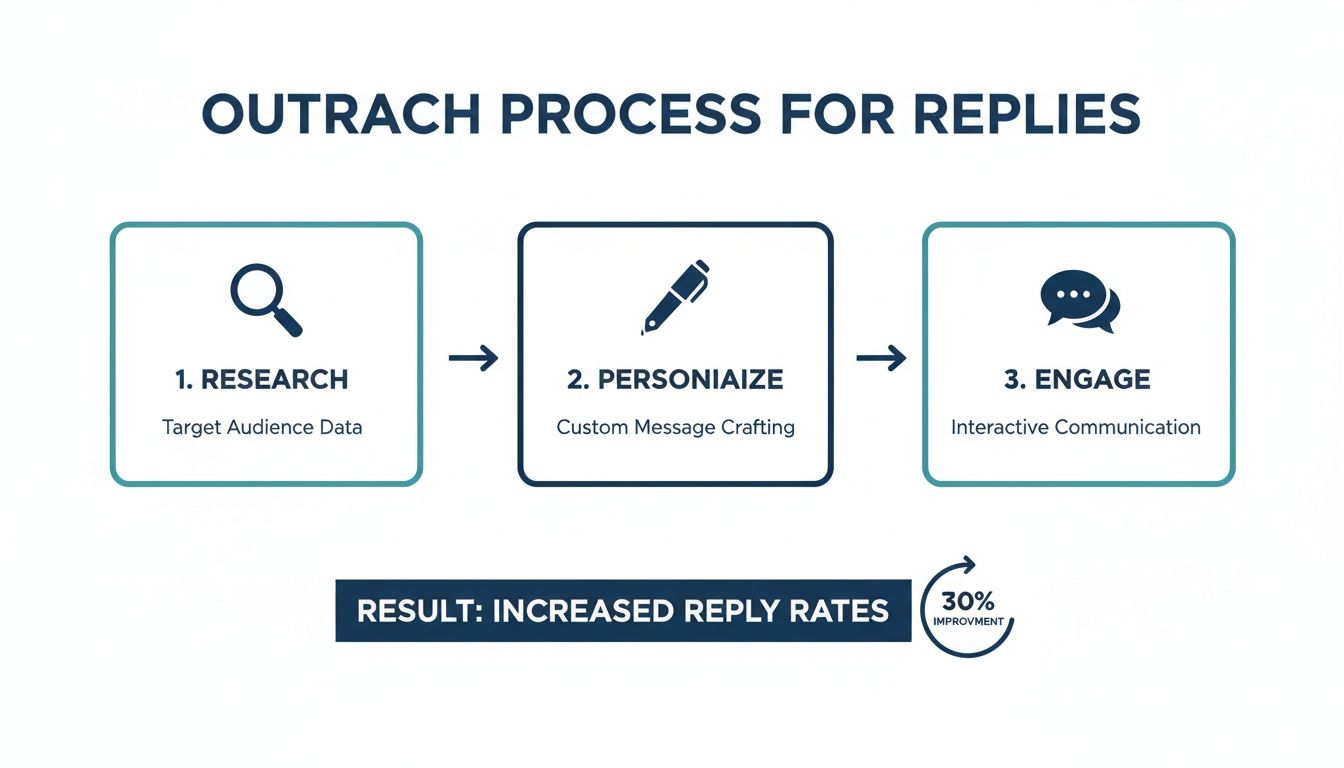
This simple three-step process is the foundation for every single successful interaction on LinkedIn, whether it's for a Tier 1 or Tier 3 account.
Why a Unified Platform Is Critical for Scale
Trying to manage a tiered, multi-channel strategy with a handful of disconnected tools is a nightmare for RevOps and a massive drag on rep productivity. When your data is scattered across a LinkedIn automation tool, a separate email finder, and a CRM that needs constant manual updates, you have zero visibility into what’s actually working.
This is where an all-in-one platform like Willbe becomes the central nervous system for your GTM engine.
By bringing data enrichment, AI-powered personalization, and multi-channel sequencing into one platform, you gain complete control. You can build sophisticated sequences that combine LinkedIn actions, emails, and call tasks, all orchestrated from a single dashboard. Every touchpoint is automatically synced to your CRM, giving sales leaders a clear, real-time view of performance and pipeline. This isn't just about making reps faster; it's about making your entire revenue operation more predictable and scalable.
Common Questions (and Straight Answers) About LinkedIn Prospecting
Every sales team hits a few common roadblocks when getting serious about prospecting on LinkedIn. Nailing the fundamentals is what separates the teams that consistently build pipeline from those that just spin their wheels. Here are straight answers to the questions we hear all the time.
How Many Connection Requests Should We Really Be Sending Each Week?
Think quality, not quantity. The latest data from 2026 is crystal clear: reps who send fewer than 25 highly personalized requests a week nearly double the acceptance rates of those sending over 100. This isn't about slowing down; it's about being deliberate.
Your goal isn't to rack up connections. It's to start real conversations with people who are a good fit for your solution.
As a team, you should be targeting a 30-40% acceptance rate. If you're consistently below that, it's a red flag. It means your targeting is too broad or your initial message is falling flat.
Are LinkedIn Automation Tools a Good Idea?
They can be, but you have to be smart. Avoid any tool that just blasts out generic messages by the hundreds. That’s the fastest way to get your account restricted and tarnish your company's reputation.
Instead, think of automation as an orchestrator for your sales plays. The right tools handle the manual, repetitive tasks that consume an SDR's day.
- Viewing a prospect's profile to get on their radar.
- Creating a follow-up task in your CRM the moment a connection is accepted.
- Liking a post from a key decision-maker at a target account.
The best systems, like the one built into Willbe, use a mix of AI for genuinely unique personalization (no templates) and smart orchestration. This lets your team run sophisticated, multi-channel cadences that still feel 100% human. Whatever you choose, ensure it has robust safety features. Your LinkedIn account is too valuable to risk.
How Can I Actually Measure the ROI of Our LinkedIn Efforts?
You have to look past vanity metrics. Profile views and connection counts feel good, but they don't tell you anything about revenue. To get a real sense of ROI, you and your RevOps team need to track the KPIs tied directly to the bottom line.
Your dashboards should focus on these core metrics:
- Connection Acceptance Rate: Is your first touchpoint effective?
- Reply Rate to First Message: Are you starting conversations?
- Meetings Booked from LinkedIn: Is the channel generating qualified calls?
- Sales-Accepted Leads (SALs): Are these opportunities your sales team actually wants?
- Pipeline Generated and Deals Closed: The ultimate test of success.
Trying to track this with a stack of disconnected tools is a nightmare. You need a unified platform that automatically syncs every LinkedIn touchpoint back to your CRM. It's the only way to get a true, unfiltered view of your ROI.
Is Sales Navigator Really Worth the Money?
For any B2B sales team that's serious about growth? It's a resounding yes. The advanced search filters alone are a game-changer. Add the ability to build dynamic lead and account lists, plus dedicated InMail credits, and it becomes essential.
Prospecting without it is like fighting with one hand tied behind your back. You'll waste countless hours on manual searches and be stuck working with incomplete data. LinkedIn Sales Navigator is the foundation for the kind of hyper-targeted outreach we've been talking about. It’s a non-negotiable part of the modern sales tech stack.
Ready to stop juggling fragmented tools and start building a predictable revenue engine? See how Willbe unifies data, AI personalization, and multi-channel orchestration to help your team find better accounts, book more meetings, and convert pipeline faster. Explore how top teams scale outbound.