


At its heart, inbound lead generation is all about pulling potential customers toward your business, rather than you having to chase them down. You stop interrupting prospects with cold calls and ads. Instead, you create genuinely valuable content and experiences that solve real problems for the people you want to reach.
They find you on their own terms, already interested and looking for answers.
So, What Is Inbound Lead Generation, Really?

Think of it like this: traditional outbound marketing is like shouting with a megaphone in a crowded square, hoping someone who needs your help happens to walk by. It’s loud, disruptive, and mostly ignored.
Inbound, on the other hand, is like hosting a fantastic workshop on a topic your ideal customers are passionate about. They seek you out, show up willingly, and are genuinely eager to learn from your expertise. That one shift changes the entire sales dynamic from a cold pitch to a warm, consultative conversation.
This modern approach is all about building trust and establishing authority long before a sales call is even on the radar. When you consistently provide value—through helpful blog posts, insightful webinars, or detailed guides—you become the go-to resource in your industry. For a deeper look at the basics, you might find our guide on what lead generation in sales entails useful.
The Shift From Interruption to Attraction
The whole game with inbound is to earn attention, not buy it. When a prospect downloads your e-book on improving their workflow, they aren't just giving you an email address; they're raising their hand and saying, "I have this specific problem."
This self-qualification is incredibly powerful. Leads who come through inbound channels are often more educated about their pain points and your potential solution, which means they’re far more prepared for a meaningful sales discussion. This alignment dramatically improves lead quality and can seriously shorten sales cycles.
The real magic of inbound marketing is that it aligns the way you market with the way people actually want to shop and buy. It’s about being helpful and human, not intrusive and annoying.
This shift has a massive impact on the bottom line. Research consistently shows that inbound marketing costs 62% less per lead than traditional outbound methods. For sales teams looking to scale efficiently, that’s a game-changer. Better yet, nurtured inbound leads can deliver a 45% lift in ROI because they've already qualified themselves by engaging with your content.
Inbound vs Outbound At a Glance
To really get a feel for why inbound is so effective, it helps to see it side-by-side with its outbound counterpart. While both can play a role in a well-rounded strategy, their core philosophies—and the results they produce—are worlds apart.
The table below breaks down the key distinctions. It clearly shows why so many B2B companies are building their growth engines on an inbound-first foundation to create a sustainable pipeline of high-intent prospects.
Ultimately, inbound isn't just a set of tactics; it's a philosophy centered on creating real value. By helping first and selling second, you build a stronger, more predictable engine for growth.
Building Your B2B Inbound Engine
A powerful inbound lead generation strategy isn't a single tactic—it's a finely tuned engine with multiple parts working in harmony. To consistently pull in your ideal B2B customers, you need to be everywhere they are, offering real value at every turn. Think of it less like a series of disjointed campaigns and more like building an interconnected system designed for sustainable growth.
This system is built on a few core channels, each playing a distinct but complementary role. When you get them working together, they create a magnetic pull that draws prospects into your orbit and gently guides them toward a sales conversation. The real goal here is to build a predictable pipeline fueled by genuine interest, not aggressive interruption.
Attract Prospects With Search Engine Optimization
Search Engine Optimization (SEO) is the foundation of your entire inbound engine. It’s all about making your website and content show up when people are actively searching on Google for solutions like yours. When a potential customer types a question about a business problem they're facing, you want to be the answer they find.
But effective B2B SEO isn't just about stuffing keywords onto a page. It's about getting inside your customer's head and understanding their intent. What keeps them up at night? What language do they use to describe their challenges? By creating content that speaks directly to these questions, you attract high-intent traffic from people who are already looking to solve a problem.
This is what makes SEO one of the most efficient forms of inbound lead generation. Instead of hunting for leads, you're setting things up so the leads find you at the exact moment they need help.
Educate and Build Trust With Content Marketing
If SEO is the foundation, then content marketing is the framework you build on top of it. This is where you create the valuable assets—blog posts, whitepapers, case studies, and webinars—that actually solve your audience's problems and establish your company as a trusted authority. Good content doesn’t just get clicks; it educates people and builds the credibility you absolutely need to make a B2B sale.
Every piece of content should have a job to do, mapping directly to a stage in the buyer's journey.
- Top-of-Funnel Content: Deep-dive blog posts and articles answer broad questions, introducing your brand as a helpful resource without a hard sell.
- Mid-Funnel Content: Webinars, e-books, and practical guides offer more detailed solutions in exchange for an email, turning an anonymous visitor into a known lead.
- Bottom-of-Funnel Content: Case studies and detailed product comparisons help prospects who are actively evaluating their options and move them closer to making a decision.
This strategic approach ensures you’re delivering the right information at just the right time, nurturing prospects from initial awareness all the way to serious consideration. For more on this, check out our guide on B2B lead generation best practices.
Engage Your Audience on Professional Networks
For B2B, professional networks like LinkedIn are non-negotiable. This isn’t just a place to dump links to your latest blog post. It's a platform for building a community, jumping into industry conversations, and sharing valuable insights directly with your target audience. Your company's experts can use it to build their personal brands and become the go-to voices in your space.
By consistently sharing useful perspectives and engaging in relevant discussions, you build relationships at scale. This keeps your brand top-of-mind and positions you as a helpful partner long before a prospect is even thinking about buying.
Globally, 91% of B2B companies find content marketing generates more leads than traditional tactics, with 70% swearing by video for conversions. LinkedIn leads the pack, chosen by 89% of businesses as the top platform, while email follows closely with an 87% reliance rate. Discover more insights about doubling your B2B pipeline on pepperinsight.com.
Nurture Relationships With Email Marketing
Finally, email marketing is the connective tissue that holds your inbound engine together. Once a visitor hands over their email address for a resource, email is how you keep the conversation going. We're not talking about generic email blasts. This is about delivering targeted, personalized nurturing sequences that guide leads further down the funnel.
A well-crafted email sequence can deliver bonus resources, invite a lead to a relevant webinar, or share a case study based on their initial interest. By providing ongoing value, you build a relationship over time, keeping your solution on their radar until they're truly ready for a sales conversation. This systematic nurturing is what transforms a lukewarm lead into a sales-ready opportunity.
Qualifying Leads Without Losing Momentum
Getting traffic to your website is one thing, but turning that traffic into revenue is a whole different ball game. The critical step that connects the two is effective lead qualification. Without a rock-solid system to sort and prioritize your best opportunities, your sales team ends up spinning their wheels on prospects who aren't ready—or just aren't a good fit—while your best deals go cold.
This isn’t about putting up roadblocks; it’s about creating a clear path to your sales team. Think of it like an air traffic control tower at a busy airport. Instead of letting every plane land at once and causing chaos, the tower identifies the jumbo jets on a direct flight path (your hottest leads) and guides them to an open runway immediately. Smaller planes on longer journeys (your cooler leads) are placed in a holding pattern, getting the attention they need when the time is right. It’s all about smooth, efficient operations.
This decision tree helps visualize how to align your inbound channels with your goals, whether you're trying to attract brand new faces or nurture the contacts you already have.
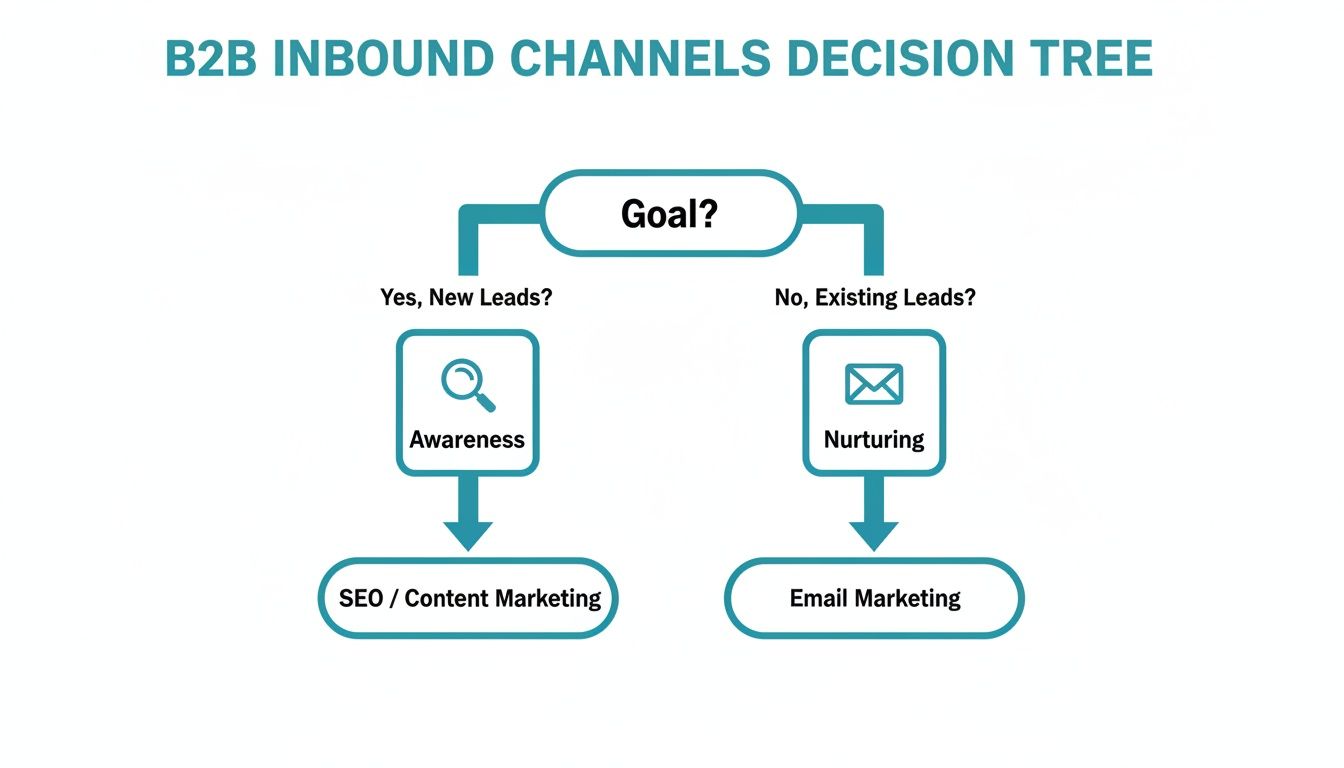
The big takeaway here? Channels like SEO and content marketing are fantastic for bringing new people into your world, while something like email is perfectly built for warming up the leads already in your database.
Differentiating MQLs and SQLs
To get qualification right, your sales and marketing teams need to be speaking the same language. That conversation starts with a crystal-clear definition of a lead’s journey, most often broken down into the Marketing Qualified Lead (MQL) and the Sales Qualified Lead (SQL). If you get this part wrong, you’re setting yourself up for friction and lost deals.
Marketing Qualified Lead (MQL): This is someone who has raised their hand in some way. They've engaged with your marketing—maybe they downloaded a whitepaper or attended a webinar. They fit your general target profile but aren't quite ready for a sales call.
Sales Qualified Lead (SQL): This is an MQL who has been properly vetted and is confirmed to be ready for a direct sales conversation. They check all the right boxes (job title, company size, etc.) and have taken actions that scream "I'm interested in buying," like requesting a demo.
A bulletproof MQL-to-SQL definition is the foundation of any great inbound program. It’s how marketing proves they’re sending over real opportunities and how sales learns to trust the pipeline being built for them.
Building a Simple Lead Scoring Model
So, how do you turn those definitions into a system that actually works? The answer is lead scoring. It’s a simple but incredibly powerful practice of assigning points to leads based on who they are (firmographics) and what they do (engagement). It’s a straightforward way to quantify how "sales-ready" someone is.
Start with a basic framework. You’ll want to give more points for actions that signal strong intent and for attributes that line up perfectly with your Ideal Customer Profile (ICP).
For example, a "Director of Marketing" at a 500-person tech company who just visited your pricing page is way more valuable than an intern from an unrelated industry who only read one blog post. Your scoring needs to reflect that reality.
Here’s a quick look at what a basic scoring model could look like. It’s a great starting point for prioritizing your inbound leads.
Example Lead Scoring Model
This sample model shows how to assign points based on a lead's profile and on-site behavior, helping you focus your sales team's energy where it counts most.
By tweaking these values to match your specific business, you create a dynamic system that bubbles the best leads right to the top.
Creating Intelligent Lead Routing
Once your scoring system is up and running, the final piece of the puzzle is lead routing. This is the automated process that sends leads to the right person or system based on their score. No more manual handoffs.
Hot Leads (e.g., Score > 75): These need to go straight to an Account Executive’s calendar for a discovery call—instantly. Speed is everything here. A fast response can boost conversion rates dramatically.
Warm Leads (e.g., Score 30-74): These are perfect for your Sales Development Reps (SDRs). They can do a bit more digging, qualify them further, and then book a meeting.
Cool Leads (e.g., Score < 30): These folks aren’t ready for a sales conversation. Drop them into a long-term email nurturing sequence to keep providing value and stay top-of-mind until they are.
This kind of automated handoff ensures every single lead gets the right kind of follow-up without anyone having to lift a finger, maximizing your team's efficiency and making sure no good opportunity ever falls through the cracks.
Measuring What Matters for Inbound Success
Running an inbound lead generation program without the right metrics is like flying a plane with no instruments. Sure, you feel the motion, but you have no idea if you’re gaining altitude, burning through fuel, or heading completely off course. To really get a grip on performance, you have to look past vanity metrics like website visits and zero in on the Key Performance Indicators (KPIs) that actually drive revenue.
Your CEO and sales leaders don't care about traffic for traffic's sake. They want a predictable engine for growth. That means tracking the numbers that show the health of your entire funnel, from the very first click to the final signature on a contract. By focusing on a few core metrics, you can prove the ROI of your work, justify your budget, and make smart, data-backed decisions.
From Visitors to Qualified Leads
The first major checkpoint is turning anonymous website visitors into actual contacts. This is that initial handshake where someone is interested enough to give you their email in exchange for something valuable. Measuring this transition is the bedrock for understanding how well your content and landing pages are performing.
The go-to metric here is the Visitor-to-Lead Conversion Rate. It tells you exactly what percentage of people landing on your site take the action you want them to, like downloading a guide or signing up for a webinar.
Calculation: (Total number of new leads generated / Total website visitors) x 100
A low rate is a pretty clear signal that something's off. It could be a mismatch between your ads and your offer, a confusing call-to-action, or a clunky landing page. On the flip side, a high rate means you've nailed it—your content is hitting the mark with the audience you're attracting.
Gauging the Quality of Your Inbound Leads
Getting leads is just step one. The real question is: are they the right leads? This is where you measure the handoff from marketing to sales to make sure you’re not just flooding the pipeline with noise. The key metric for this is the MQL-to-SQL Conversion Rate.
This number tracks the percentage of Marketing Qualified Leads (MQLs) that your sales team actually accepts as Sales Qualified Leads (SQLs). It's a direct reflection of how accurate your lead scoring is and how well marketing and sales are aligned.
A low MQL-to-SQL rate is a huge red flag. It usually means marketing’s definition of a “good lead” is completely different from what sales needs to hit their numbers. This leads to wasted time, frustrated reps, and a lot of internal friction.
Proving the Financial Impact of Inbound
At the end of the day, everything has to tie back to the bottom line. The most compelling way to show the value of your inbound program is by calculating the Customer Acquisition Cost (CAC) by channel. This KPI shows you exactly how much you're spending to get a new customer through inbound versus other methods.
To figure it out, just add up all your inbound marketing and sales costs for a given period and divide that by the number of new customers you brought in from those efforts. Keeping a close eye on this helps you:
- Justify Budget: You can walk into any leadership meeting and show that inbound is a cost-effective way to bring in revenue.
- Optimize Spend: It becomes obvious where you should double down—like on organic search or referrals that bring in customers for less.
- Forecast Growth: You can build reliable models that show how much investment is needed to hit future revenue goals.
By consistently tracking these three core metrics, you build a dashboard that tells a clear, compelling story about your inbound performance. You can spot weaknesses, celebrate wins, and steer your strategy with confidence. For more on how to surface these critical numbers, explore our guide to using powerful analytics for your sales data.
Making the Marketing-to-Sales Handoff Invisible
Even the best inbound lead in the world can go cold in a matter of hours if the handoff from marketing to sales is a mess. A slow or clunky transition isn't just inefficient; it's a terrible experience for the buyer. It forces your sales reps to start the conversation over, killing any trust and momentum your marketing team worked so hard to build.
Getting this right isn't about one magic bullet. It’s about building a solid, reliable bridge between your teams—a bridge built on shared data, clear context, and zero guesswork. When a new lead lands in a Sales Development Rep's (SDR) queue, they need more than just a name and an email. They need the full story. That intelligence is what turns a simple form submission into a real sales conversation.
Don't Just Send a Lead, Send the Whole Story
Before an SDR even thinks about picking up the phone, they need to know what’s happened so far. This context is everything. It’s the difference between a generic, forgettable pitch and a conversation that actually clicks with the prospect. Marketing's job during the handoff is to package this story up and put it right where sales can see it—inside the CRM.
Every lead that comes across should be enriched with details that tell you who they are and what they care about. Think of it as a cheat sheet for the first call.
- Lead Source: How did they find you? Someone who searched Google for a specific problem has a totally different mindset than someone who registered for a general industry webinar. This tells you their starting point.
- Content History: What have they been looking at? If you know they downloaded your "Advanced SEO" whitepaper and read three related blog posts, your SDR can skip the fluff and dive right into that specific pain point.
- Website Activity: Did they linger on the pricing page? Did they check out a specific customer story? These are massive buying signals that scream interest and urgency.
- Lead Score Details: Why did they hit the score to get routed? Don't just show the number; show the actions that added up to it. This gives sales an instant snapshot of why this person is worth their time.
When you provide this level of detail, that first outreach call stops being a cold interruption. It becomes the natural next step in a conversation the prospect already started with you.
Setting the Rules with a Service Level Agreement (SLA)
To make sure leads don't fall through the cracks and to eliminate any friction, marketing and sales need to agree on the rules of the game. A Service Level Agreement (SLA) does exactly that. It’s a simple document outlining who does what and when, creating real accountability and a shared definition of success.
An SLA isn't about micromanaging your teams. It's about building a predictable system that drives revenue. It gets marketing and sales focused on the same goal: creating a fantastic buyer journey that values speed and quality above all else.
Your SLA should nail down a few key commitments from both sides.
- Lead Qualification Criteria: What, exactly, is a Sales Qualified Lead (SQL)? Get both teams to agree on a concrete definition and sign off on it. No more arguments about lead quality.
- Lead Routing Rules: Who gets which lead? Set up clear, automated rules based on territory, industry, company size, or lead score.
- Response Time: This is a big one. How long does an SDR have to follow up on a hot new lead? For inbound, speed is everything. We're talking minutes, not hours.
- Follow-up Cadence: How many times will an SDR try to connect before closing out a lead? Define the minimum number of calls, emails, and social touches required.
Putting these rules in writing removes all the "I thought you were going to..." confusion. It guarantees every single lead gets the prompt, persistent attention it deserves. This rock-solid alignment is the engine of any great inbound lead generation program, making sure the energy marketing creates flows straight into the sales pipeline and, ultimately, into revenue.
Building Your Modern Inbound Tech Stack

Let's be honest, you can have the most brilliant inbound strategy in the world, but without the right technology, it’s just a great idea. Your tech stack is the engine that actually makes everything go. It’s what automates the grunt work and turns raw data into real revenue.
Trying to run a modern inbound program with a clunky or disconnected set of tools is like trying to build a house with a hammer and a rock. You'll eventually give up from the sheer weight of manual tasks and missed opportunities. The real goal isn't just to buy a bunch of software subscriptions; it's to build a unified system where information flows effortlessly from one tool to the next, giving everyone on your team the context they need to win.
The Core Components of Inbound Technology
A solid inbound stack really boils down to three essential pillars. Each one has a specific job to do, but the magic happens when they work together in harmony. Think of it like a relay race—the baton of customer data needs to be passed flawlessly from marketing to sales without ever dropping.
Here are the three non-negotiables for your core stack:
- Customer Relationship Management (CRM): This is your single source of truth. It's the central hub for every interaction, data point, and conversation you have with your leads, prospects, and customers. For your sales and marketing teams, this is home base.
- Marketing Automation Platform: This is the workhorse that handles engagement at scale. It’s what powers your email campaigns, landing pages, and lead scoring models, automatically guiding a new lead down the path to becoming a sales-ready opportunity.
- Analytics and Reporting Tools: These are the tools that tell you what’s actually working. They’re how you track website traffic, monitor conversion rates, and ultimately prove the ROI of all your hard work.
The Problem With Disconnected Tools
So many companies make the classic mistake of adopting tools one at a time without a bigger plan. They grab an email tool over here, a landing page builder over there, and a separate analytics dashboard for good measure. Before they know it, they've created a messy, tangled web of software that causes more headaches than it solves.
This patchwork approach creates dangerous data silos, trapping critical information inside one system where no one else can see it.
When your marketing automation platform and your CRM aren't on speaking terms, your sales team is essentially flying blind. They have no idea what content a lead just downloaded or why they suddenly have a "hot" lead score. This forces them into generic, uninformed conversations that completely kill the trust your marketing team worked so hard to build.
A fragmented tech stack forces your team to spend more time manually moving data and trying to connect the dots than actually talking to prospects. It's a hidden tax on your team's productivity and a major roadblock to scaling your inbound lead generation efforts.
Unifying Your Stack for a Cohesive GTM Motion
This is where a modern Revenue Operations (RevOps) mindset changes the game. RevOps is all about aligning your marketing, sales, and service teams around a single, unified go-to-market (GTM) strategy—and that strategy is powered by a seamlessly integrated tech stack. The objective is to create one cohesive system that speeds up the entire revenue cycle.
This is also where a platform like Willbe comes in. It complements your core stack by centralizing prospecting and enriching data, ensuring the information you feed into your CRM and marketing tools is clean, accurate, and ready to use.
When your systems are all connected, you can finally automate complex workflows, deliver true personalization, and give your sales team the full story behind every single inbound lead. That’s how you build a scalable, repeatable system that turns inbound interest into predictable revenue.
Common Questions About Inbound Lead Generation
Even the best-laid plans run into questions. Let's tackle some of the most common hurdles and curiosities B2B pros have when they're getting an inbound lead generation engine up and running.
How Long Does It Really Take to See Results?
This is the big one, and the honest answer is: be patient. Inbound lead generation is a marathon, not a sprint. While a well-timed webinar or a popular social post might give you a quick win, you're typically looking at 6 to 12 months before you see a significant, predictable flow of leads.
Think of it like planting a tree. You don't get shade overnight. The foundational work—getting your content to rank in search engines, building a library of genuinely helpful resources, and establishing your brand as a trusted voice—takes time to take root. The good news is that this effort compounds, and those assets will keep generating leads for you long after you've hit "publish."
Does Inbound Actually Work for My Niche B2B Industry?
Yes, it absolutely can. The core idea of inbound—attracting people by solving their problems—works everywhere. The difference isn't if it works, but how you make it work for your specific audience.
A SaaS company might go all-in on a free trial and product-led growth, while a heavy machinery manufacturer will likely see more success with in-depth technical whitepapers and ROI case studies. It all comes down to knowing your customer's world inside and out and creating content that speaks directly to their biggest headaches.
The strategy is universal, but the execution has to be custom-fit. Success comes from tailoring your content and channels to the exact questions your ideal customers are asking, no matter what industry they're in.
Should We Ditch Our Outbound Sales Team Then?
Definitely not. Inbound and outbound aren't enemies; they're partners. They work best when they work together, covering different parts of the field.
- Inbound is your magnet: It consistently pulls in warmer leads who already know who you are and have shown some level of interest. This feeds your sales team a steady diet of hand-raisers.
- Outbound is your spear: It lets you go after high-value, strategic accounts that might not stumble across your content on their own.
Better yet, the data from your inbound efforts can make your outbound outreach smarter. Knowing someone downloaded a guide on a specific topic gives your sales reps the perfect opener for a truly relevant conversation. Combining both creates a much stronger, more resilient pipeline.
Ready to unify your GTM motion and empower your sales team with the data they need? Willbe centralizes prospecting and enriches every lead, ensuring your team spends more time selling and less time on manual tasks. Discover how Willbe accelerates revenue.