


Qualifying a sales lead is all about figuring out if a potential customer is a good match for what you sell and, just as importantly, if they're actually in a position to buy. It's a systematic check to see if they have a real need, the budget to solve it, the authority to make a decision, and a timeline that makes sense.
This process is what separates a random list of contacts from a predictable revenue engine. It’s about making sure your sales team is spending its time on opportunities that can realistically close, not chasing ghosts.
Why Most Sales Teams Waste Time on the Wrong Leads

Here's a hard truth: the silent killer of a sales pipeline isn't a shortage of leads. It's having way too many of the wrong ones. When your Sales Development Reps (SDRs) are stuck chasing prospects who were never going to buy in the first place, the damage spreads. It tanks morale, burns through marketing dollars, and directly hurts your bottom line.
Too many teams make the classic mistake of treating every inbound signal the same. A whitepaper download gets thrown into the same bucket as a demo request, with no real distinction. This forces reps to manually sift through a mountain of digital noise, just hoping they’ll get lucky and find a real buyer.
The Real Cost of Poor Qualification
This isn't just a minor headache; it's a massive financial leak. Think about it. Every hour one of your reps wastes on an unqualified lead is an hour they could have spent nurturing a prospect who's actually ready to talk business.
This misstep leads to painfully long sales cycles, dismal win rates, and a team that’s constantly on the verge of burnout. The data tells the story loud and clear.
When leads are properly qualified—meaning their fit, need, authority, and timing are assessed before a salesperson engages—conversion rates can hit 40%. Compare that to the paltry 11% conversion rate for unqualified prospects. That’s a nearly 4x difference in performance, proving just how much a solid qualification system is worth.
A robust qualification process isn't about putting up barriers. It's about accelerating revenue. You're simply pointing your most valuable resource—your sales team's time—directly at the deals most likely to close.
Building a Modern Qualification Engine
To break this cycle, you have to stop treating qualification like a simple checklist. It needs to be a strategic system, one built on data and smart automation, not gut feelings. A modern approach stands on a few key pillars that turn a leaky pipeline into a growth machine:
- A Solid Customer Profile: You can't find the right leads if you don't know who you're looking for. It all starts with a crystal-clear Ideal Customer Profile (ICP).
- Intelligent Scoring: You need a system that automatically scores leads based on company data (firmographics) and their actions (behavioral signals), pushing the best ones right to the top of the list.
- Smart Automation: Let technology handle the tedious work of enriching data and doing the initial filtering. This frees up your reps to do what they do best: have meaningful conversations. To learn more about this, check out our guide on B2B lead generation best practices.
Adopting these principles moves you from a reactive, "spray and pray" approach to a proactive, predictive model. You start building for success right from that very first touchpoint.
First Things First: Who Are You Actually Selling To?
Before you can even think about qualifying a lead, you have to know what a "good" lead actually looks like. Trying to qualify leads without a clear target is a recipe for wasted time and frustrated sales reps. You'll end up chasing ghosts. This is where your Ideal Customer Profile (ICP) comes in—it’s the single most important tool in your entire sales playbook.
An ICP isn't just a vague persona with a stock photo and a cute name. It's a laser-focused, data-backed definition of the exact company that gets the most out of your product. These are the customers who stick around, grow with you, and tell their friends about you. Nailing this profile is the bedrock of a predictable, high-performing qualification process.
Your Best Customers Hold the Blueprint
So, where do you start? Look at the customers you already have. But don't just look at everyone—zoom in on your absolute best partners. I'm talking about the top 10-20% who are ecstatic with your product, see massive success, and are your most profitable accounts. These are the ones you wish you could clone.
Once you’ve identified this group, it’s time to play detective. Dig into their shared characteristics and find the common threads. This isn’t a guessing game; it's a systematic search for the signals that point to a fantastic, long-term fit.
Think of your ICP as a filter for your entire go-to-market motion. It ensures the time, energy, and money you spend on sales and marketing goes toward attracting leads who are actually likely to become your next great customers.
To build a solid ICP, you need to look at three main categories of data. These pillars will form the foundation of your qualification criteria and shape every conversation your team has with a prospect.
The Anatomy of a Powerful ICP
A truly effective ICP blends firmographic, technographic, and behavioral data. Each piece of this puzzle gives you a clearer, more complete picture of what makes a company the perfect match.
- Firmographics: This is the basic company DNA. Think of it as their trading card stats: industry, company size (both revenue and employee count), and where they’re located.
- Technographics: This is all about the technology a company already uses. Knowing their tech stack can instantly reveal compatibility, highlight easy integration wins, or show that they're already investing in similar solutions. For example, if they use a CRM that plugs right into your platform, that’s a massive green flag.
- Behavioral Data: This is where you see intent. It’s all about how a potential customer interacts with you. Are they binge-watching your webinars? Did they just download a deep-dive, bottom-of-funnel case study? These actions scream "I'm interested!" and are far more valuable than a simple newsletter signup. A solid approach to inbound lead generation is crucial for capturing this kind of data effectively.
When you bring all these data points together, you graduate from a hazy idea to a sharp, actionable profile. This becomes the blueprint your sales team uses to spot a diamond in the rough from a mile away.
Turning Your ICP into a Real-World Tool
Let's make this tangible. Imagine you're a B2B SaaS company selling project management software to marketing agencies. After analyzing your star customers, your ICP might look something like this.
Ideal Customer Profile (ICP) Criteria Example
An ICP like this doesn't just collect dust in a Google Doc. It directly fuels the questions your SDRs ask on discovery calls. Instead of a generic "Tell me about your business," they can lead with, "I saw you're using HubSpot. How are you currently managing the handoff between your sales and account teams?"
That one, well-informed question completely changes the dynamic of the conversation. It shows you've done your homework and immediately elevates your team from "seller" to "potential partner," which is exactly where you want to be.
Implement a Lead Scoring Model That Actually Works
A great ICP is just a document until you turn it into a living, breathing system that tells your reps who to call right now. That's what a good lead scoring model does. It’s less about complex algorithms and more about putting a number on a gut feeling.
We’re essentially blending two types of signals here: explicit data (the hard facts) and implicit data (their digital body language). Think of it as mixing what they tell you with what they show you. This combo is what separates the tire-kickers from the truly interested buyers.
Here’s how I break down the inputs:
- Firmographics (Explicit): This is the basic stuff—company revenue, industry, employee count, and where they're located.
- Technographics (Explicit): What software are they already using? This is gold for understanding integration potential or competitive openings.
- Behavior (Implicit): Are they just browsing the blog, or did they binge-watch a product webinar? Page views, content downloads, and email clicks all tell a story.
- Milestones (Implicit): These are the money moves. Booking a demo, starting a trial, or returning to the pricing page for a third time are huge buying signals.
Mixing these data points ensures you don't just find good-fit companies, but good-fit companies that are actively looking for a solution today.
Assigning Point Values
Alright, so how do you decide what’s worth 5 points versus 15? You let your past wins be your guide. Pull up your CRM and look at the last six months of closed-won deals. What do they have in common?
For example, if you notice that 70% of your best customers are companies with over $10M in revenue, that attribute needs a hefty point value. On the flip side, someone who just reads a single blog post might only get a point or two. A demo request? That’s easily +15. It's all about weighting actions and attributes based on their proven connection to closed deals.
Don’t overcomplicate it. Just start with your core ICP pillars, analyze what your best customers look like, and assign points proportionally. The goal is to create a system where no single action can artificially inflate a lead's score.
Here’s a simple way to visualize this.
Sample Lead Scoring Matrix
This table is a basic example of how you can start assigning points to different attributes and actions. It's a starting point—you'll want to customize this based on your own sales data.
As you can see, a demo request carries the most weight because it signals strong intent, while firmographics help confirm they are the right fit.
Defining MQL and SQL Thresholds
Once you’re scoring leads, you need to define the handoff points. This is where you draw the lines in the sand for what constitutes a Marketing Qualified Lead (MQL) versus a Sales Qualified Lead (SQL).
Having clear thresholds eliminates the guesswork and stops reps from chasing contacts who aren't ready. A two-tiered system works best for most teams:
- MQL Threshold: A score of 25-39 is a good starting point. These leads are a good fit but might need more nurturing. They can be added to an automated email sequence.
- SQL Threshold: Anything 40+ should trigger an immediate alert for an SDR to begin personalized outreach.
- Disqualify: I recommend automatically disqualifying anything under 15 points to keep your pipeline clean and focused.
The real magic happens when you automate this in your CRM. When a lead hits that SQL threshold, a task should automatically pop up for the right rep. Tools like Willbe can enrich leads with verified data, apply your scoring rules instantly, and sync everything right back to Salesforce or HubSpot.
This diagram shows how all those different data points—firmographics, technographics, and behaviors—flow together to produce a single, actionable score.
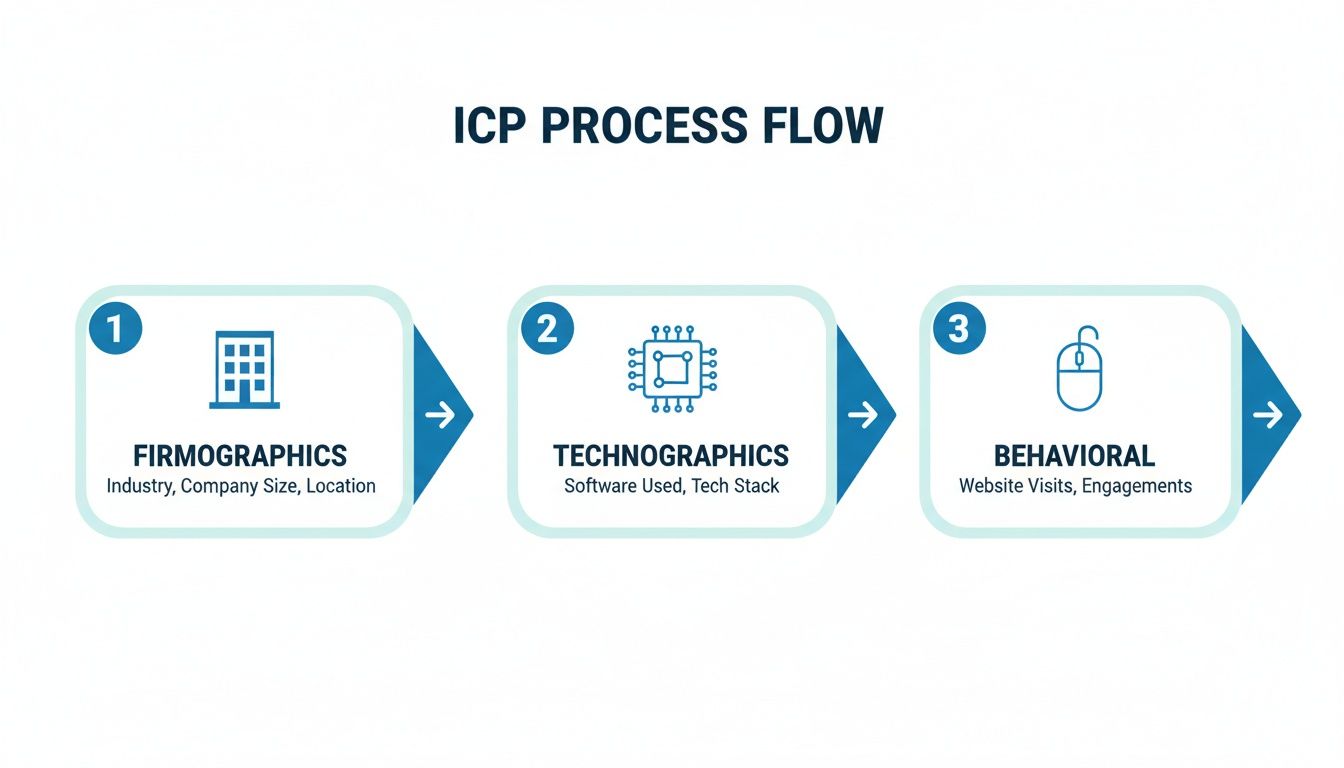
The big takeaway here is that no single piece of data gives you the full picture. It’s the combination of all these layers, weighted intelligently, that makes your pipeline a reliable forecast of who is most likely to buy from you.
A dynamic lead scoring model gets marketing and sales on the same page, aligning everyone around what truly matters: a combination of perfect fit and high intent.
If you want to go deeper on how to manage these workflows and keep your entire sales machine running smoothly, our guide on sales pipeline management best practices is a great next read.
And remember, this isn’t a "set it and forget it" exercise. Revisit your scoring model every quarter. Look at what’s closing and what isn't, and be prepared to tweak your point values. When your sales team trusts the score, they'll focus their energy on leads that actually move the needle. I saw one fintech startup increase their qualified meeting rates by 20% in a single month just by adjusting the score for demo requests.
Make sure you build in a feedback loop. Your SDRs are on the front lines; they need a simple way to log why a lead was disqualified. This is invaluable for finding blind spots in your scoring.
- Get feedback from SDRs weekly.
- Use analytics in a tool like Willbe to see which attributes are underperforming.
- Keep a shared document of any changes to your scoring rules so the whole team stays aligned.
By creating an adaptive model that learns from your wins and losses, you’ll stop guessing and start qualifying leads with confidence.
Weave Proven Frameworks into Smarter Conversations
So, your Ideal Customer Profile (ICP) tells you who to talk to, and your lead scoring model flags when they're ready. The final piece of the puzzle is giving your team a playbook for what to say. This is where qualification frameworks come into play, turning what could be an awkward interrogation into a natural, value-driven conversation.
Without a solid framework, reps are left to wing it. They miss critical details, forget key questions, and leave you with a CRM full of inconsistent data. Worse, they pass poorly qualified leads over to Account Executives, which is a massive time-waster for everyone involved. Frameworks are the guardrails for a great discovery call, making sure every rep gathers the intel needed to qualify a lead properly.
The point isn't to have reps read from a script like a robot. It's about getting them to internalize a structure that helps them guide the conversation while uncovering the stuff that actually matters.
The Classic Go-To: BANT
BANT is one of the oldest qualification frameworks in the book, born at IBM decades ago. It's still incredibly effective, especially in high-velocity sales environments where deals are less complex and cycles are shorter. Think of it as the perfect tool for small to mid-market deals where you need a quick, reliable way to know if an opportunity is worth chasing.
BANT is an acronym for:
- Budget: Do they have the money to buy your solution?
- Authority: Are you talking to the decision-maker, or at least someone with serious influence?
- Need: Is there a real business pain you can solve?
- Timeline: When are they actually looking to buy and get started?
One of the most common mistakes I see is reps asking these questions way too directly. "Do you have the budget for this?" is an instant conversation killer. The trick is to weave these concepts into the flow of a natural dialogue.
Unlocking BANT with Better Questions
Let's get past the basic, box-ticking questions. Here are some more insightful ways your team can uncover BANT information without sounding like they're running through a checklist.
To figure out Budget:
- "What are you guys currently spending to manage this problem, factoring in tools and staff time?"
- "When you've invested in similar software before, what did that budget process typically look like?"
- "Just so we're on the same page, top solutions in this space usually run between $X and $Y. Does that align with what you were expecting?"
To find the real Authority:
- "Who else on your team will be kicking the tires on this solution with you?"
- "Besides yourself, whose input is absolutely critical for a project like this to get off the ground?"
- "What does the approval process for a new tool usually look like at your company?"
To dig into the Need:
- "What's the real-world impact on the business if this problem is still around next quarter?"
- "If you could wave a magic wand and fix one thing about your current process, what would it be and why?"
- "What was the tipping point that made you start looking for a solution right now?"
To nail down the Timeline:
- "Is there a specific event or deadline that’s pushing this initiative forward?"
- "When would you need to have a solution fully up and running to get the results you're after?"
- "What are the next steps on your end for evaluating potential partners?"
By reframing direct questions into consultative ones, your reps can gather crucial qualifying data while building trust and positioning themselves as helpful advisors rather than just sellers. This subtle shift is key to having productive conversations.
For Deeper Dives, Use MEDDIC
For those big, complex, high-value enterprise deals, BANT is often too shallow. When you're staring down the barrel of a long sales cycle with multiple stakeholders and a six-figure price tag, you need a far more robust framework. That’s where MEDDIC comes in.
MEDDIC is an acronym that forces a much deeper level of qualification and strategic thinking:
- Metrics: What are the specific, quantifiable business outcomes they need to achieve? Think revenue gains, cost savings, or efficiency improvements.
- Economic Buyer: Who is the person with ultimate profit-and-loss responsibility for this purchase?
- Decision Criteria: What are the exact technical, financial, and vendor-related criteria they'll use to make their choice?
- Decision Process: What are the formal steps, timeline, and people involved in getting from evaluation to a signed contract?
- Identify Pain: What's the primary business pain that’s driving this whole initiative?
- Champion: Who is your insider—the person who has a personal stake in your success and will advocate for you when you're not in the room?
Let's be clear: MEDDIC isn't for every sales team. It demands more in-depth discovery and is best suited for strategic account executives who are skilled at navigating complex corporate politics. A rep trying to apply MEDDIC to a simple, transactional deal would just overwhelm the prospect and kill the momentum.
Knowing how to qualify sales leads means picking the right tool for the job. Use BANT for speed and simplicity, and pull out MEDDIC when you need to go deep on strategic, high-stakes deals.
Use the Right Tech to Automate Your Qualification Process

It’s one thing to have a solid ICP and a killer lead scoring model on a spreadsheet. It’s another thing entirely to put them to work for you. Without automation, those brilliant strategies are just documents.
Manual lead qualification is a bottleneck. It’s slow, it’s riddled with human error, and it just can't scale. This is where your tech stack comes in, turning your static rules into a living, breathing engine that flags the best opportunities the second they appear.
The whole point is to bridge the gap between your strategy and your team's day-to-day. You need to build your ICP, scoring rules, and qualification frameworks directly into the tools they already use. Your CRM should be the command center for this whole operation, the single source of truth for every lead and their qualification status.
Make Your CRM the Qualification Hub
Think of your CRM as more than just a fancy rolodex. It's where your qualification strategy gets real. By building out workflows, you can vaporize dozens of tedious manual tasks that eat up your reps' time, freeing them up to focus on conversations that actually drive revenue.
Imagine the old way: a new lead comes in, and a rep has to manually dig around for company info, find missing contact details, cross-reference it with the ICP, and then decide if it’s worth a call. With a smart tech stack, that whole process takes seconds, not hours.
Here are the foundational automations you should set up first:
- Automatic Data Enrichment: The moment a new lead hits your system, a tool like Willbe can instantly flesh out the profile with verified company and tech data. This fills in the blanks, ensuring your scoring model isn’t running on empty.
- Real-Time Lead Scoring: Your scoring shouldn't be static. As leads browse your site or engage with content, their score should update automatically. Someone who just hit the pricing page for the third time? Their score should jump, and your team should get an instant alert.
- Automated Task Creation: When a lead's score crosses that magic SQL threshold, the system should automatically create and assign a task to the right SDR. No more hot leads going cold because they got lost in a queue.
Let AI Handle the First Touch
Beyond the basic plumbing of CRM workflows, AI is a total game-changer for that first stage of qualification. You can use AI-powered outreach to handle the initial back-and-forth, saving your human reps for the nuanced, high-value conversations.
For example, an AI agent can fire off a hyper-personalized email that references a lead's recent website activity and even ask a few basic qualifying questions. Depending on how they reply, it can either book a meeting straight into an SDR's calendar or flag the conversation for a human to take over.
This dramatically shortens your speed to lead. The impact is huge—AI tools have been shown to slash research time by 50% and can boost response rates by up to 300% through personalized, scalable outreach. Machine learning is also incredibly good at ranking and prioritizing leads by spotting subtle patterns you'd never notice, as highlighted in some recent lead generation trends.
Automating your qualification process isn't about replacing your sales team. It's about empowering them with better data, cleaner workflows, and more time to spend on what they do best: building relationships and closing deals.
By letting technology handle the grunt work of enrichment, scoring, and initial outreach, you build a system that’s not just more efficient—it’s far more effective at finding and engaging your next best customer.
A Few Common Questions on Qualifying Sales Leads
Even with the best frameworks and automation running, things get messy in the real world. Building a truly high-performance lead qualification process always brings up practical questions. Working through these challenges is what separates a system that looks great on paper from one that actually pumps out a high-quality pipeline.
Let's dig into some of the most common questions I hear from sales leaders and reps who are dialing in their lead qualification. I'll keep the answers direct and actionable, so you can use them to troubleshoot your own process.
How Often Should We Review Our Lead Scoring Model?
Your lead scoring model is not a crockpot—you can't just "set it and forget it." Markets shift, your product gets new features, and the way buyers research solutions changes. To keep your model sharp, you need to revisit it regularly.
A quarterly review is the gold standard.
During this check-in, your main job is to analyze the deals you won and lost over the last 90 days. You're hunting for patterns. Are those high-scoring leads consistently turning into happy customers? Did you lose deals that, looking back, scored way too high? Even more importantly, did you win deals from leads your model might have initially pushed aside?
That last part is where the real insights are hiding. This analysis helps you spot outdated criteria or point values that are just plain wrong. For example, you might find that downloading a new case study is a massive buying signal, or maybe you realize leads using a specific competitor's tool never end up buying from you.
Regular tweaks ensure your model adapts to reality and keeps pointing your sales team toward the leads who are actually ready to talk.
What's the Biggest Mistake Companies Make When Qualifying Leads?
Easy. It's relying too heavily on a single data point. The most common culprit is getting fixated on firmographics, like a prospect's job title or the size of their company.
Sure, a lead from a Fortune 500 company in your target industry looks great, but they’re a complete waste of time if they have zero need, no budget, and no real timeline. Qualification has to be multi-dimensional.
A solid process blends a few different data types to get the full picture:
- Firmographics: Does the company fit your Ideal Customer Profile?
- Behavioral Signals: Have they shown genuine interest by engaging with your content, visiting the pricing page, or watching a demo?
- Direct Conversation: What did you actually learn when you talked to them using a framework like BANT or MEDDIC?
Another huge pitfall is inconsistent application of the rules. If half your SDR team follows the script and the other half just wings it, your qualification data becomes a mess. That makes forecasting a guessing game and creates a ton of friction between sales and marketing. The only solution is to build a solid system and get everyone on the team to use it, every single time.
How Do You Handle a Lead That Fails a Qualification Call?
First off, a "failed" qualification call isn't a failure—it's an intelligence-gathering mission. When a lead looks perfect on paper but doesn't pan out on the phone, your next steps need to be crystal clear.
The lead should obviously be disqualified from immediate sales follow-up, but never, ever delete them.
Instead, the SDR or AE must log the specific reason for the disqualification right in the CRM. Things like "No budget until Q4," "Chose Competitor X because they have Y feature," or "Internal project was put on hold." This data is pure gold for your marketing and product teams.
From there, you can drop the lead into a targeted, long-term nurturing sequence based on why they were DQ'd:
- Bad Timing: If the problem is just timing, set an automated task in the CRM to reach back out in six months.
- Feature Gap: If they need a feature you don't have yet, add them to a specific list. The moment you launch it, they should be the first to know.
- Lost to a Competitor: This is invaluable feedback. It can directly inform your competitive battle cards and help marketing sharpen its messaging.
Use every bit of insight—good or bad—to make your next move smarter.
Can We Implement Lead Qualification Without Expensive Tools?
Absolutely. You don't need a fancy tech stack to get started. While platforms and data enrichment services make things faster and more scalable, the core principles work just fine with a basic CRM and a spreadsheet.
Don't let a tight budget become an excuse for a sloppy process.
Start by manually looking at your ten best customers. What do they have in common? Use those traits to build the first version of your ICP. Then, create a simple scoring matrix in a Google Sheet that your reps can use to tally points for each new lead. Write down your core discovery questions and make sure the whole team is using them.
Discipline and process have to come first. Once you can prove the system works by generating more pipeline and closing more deals, you'll have a rock-solid business case for investing in technology that can automate and scale what you've already built.
Ready to stop wasting time on manual research and inconsistent data? Willbe combines verified B2B data with an AI orchestrator to deliver hyper-personalized outreach that gets responses. Find your ideal customers, automate your scoring, and sync everything to your CRM so your team can focus on what they do best—selling. Discover how at Willbe.ai.