


Boosting sales productivity isn’t about a magic bullet. It’s about giving your team the one thing they can’t make more of: time. The goal is to focus them on high-impact, revenue-generating work by cutting out the manual busywork that kills momentum.
This means replacing a fragmented tech stack with a single platform, automating the tasks that don’t require a human touch, and ensuring every decision is backed by clean, reliable data. It’s how modern sales teams build a repeatable go-to-market engine.
The Hidden Costs of a Stitched-Together Sales Stack

Here’s the paradox of the modern sales stack: we’ve given teams an arsenal of software—a tool for prospecting, another for data enrichment, a sequencer for outreach, a separate dialer—yet productivity often flatlines. The problem isn't a lack of tools; it's the constant friction from bouncing between them.
This friction shows up in all the non-selling activities that consume a rep’s day. Reports from Salesforce consistently find that reps spend a shockingly low amount of their time actually selling—some studies put the number as low as 28% of their workday. The rest of that time vanishes into a black hole of administrative tasks, manual CRM updates, and a sea of open browser tabs. The research on B2B sales trends shows just how wide this productivity gap has become.
A Day in a Disjointed Workflow
Think about a typical SDR's morning. They might pull a static list from one data provider, upload it to a separate tool to verify emails, then manually check each contact against the CRM to hunt for duplicates or see if another rep is already working the account.
Hours can pass before they even start writing their first email. By the time they do, some of that contact data is already stale. This isn't a rare occurrence; it's the daily reality for thousands of sales teams.
Each manual step and context switch is a tiny drain on efficiency. Multiplied across an entire team for a full week, those tiny drains become a massive leak in your pipeline-building engine. It's a system that rewards reps for being good at administrative work, not for engaging prospects.
This constant toggling between apps is where productivity goes to die. Look at how these common tasks stack up when handled with separate tools versus an all-in-one platform like Willbe.
The Daily Time Sink: Where Sales Productivity Dies
As you can see, the hours add up fast. Consolidating this workflow doesn't just save a few minutes; it fundamentally changes what a sales rep can accomplish in a day.
The real cost of a fragmented tech stack isn't just the monthly subscription fees. It's the opportunity cost of lost selling time, the team-wide frustration, and the strategic handicap of never having a single source of truth.
The only way to fix this is to move away from a patchwork of tools and consolidate everything into a single, unified B2B prospecting and lead generation platform where data flows seamlessly from one step to the next. When you do that, you eliminate the friction, give your team back their time, and empower them to focus on what actually moves the needle: building relationships and closing deals.
Build a Foundation of High-Quality Data
You can't automate chaos. It’s a simple truth, but one that gets ignored all the time.
Many sales leaders think productivity starts with a slick email sequence or a new dialer. But the work that builds a predictable pipeline begins with something far less glamorous: the quality of your data. A messy, fragmented database is the silent killer of any outbound strategy. It’s the direct cause of wasted hours, burned lists, and demoralized reps.
Every SDR knows this feeling. They get a list of 500 "qualified" leads, dive in, and immediately find that 20-30% of the contacts are outdated. The company sizes are wrong, the job titles are off—it's a mess. All the time they spend cleaning that data and cross-referencing it in the CRM is time they aren’t selling. This isn’t an inconvenience; it’s a strategic bottleneck that chokes your entire growth engine.
This is exactly why a single source of truth for your prospecting data isn't a "nice-to-have." It’s non-negotiable for any team that's serious about scaling. When your B2B data, enrichment tools, and outreach sequences all live in one platform, you kill the friction that leads to data decay and broken workflows.
Go Beyond Basic Firmographics
The old way of building target account lists—based on employee count and industry—is dead. That approach is a recipe for generic outreach that gets deleted on sight. Modern prospecting requires a much sharper, more dynamic way to segment your market. The real goal is to build lists based on buying intent and fit, not just static company details.
To do this right, your data platform must support sophisticated, multi-layered filtering. Think of it like creating a composite sketch of your Ideal Customer Profile (ICP) using real-time signals.
High-Intent Filters to Prioritize Your Outreach:
- Tech Stack: Pinpoint companies using complementary—or competitive—technologies. This gives your reps an instant, relevant hook for a conversation.
- Hiring Trends: Is a target account suddenly hiring sales reps or engineers? That’s a massive signal of growth, new budget, and an urgent need for tools like yours.
- Funding Events: A recent funding round is one of the most powerful buying signals. It means new cash, new initiatives, and a clear mandate to invest in growth.
- Company Keywords: Forget rigid industry codes. Search for companies based on the specific language they use on their own websites to describe their business and their problems.
When you combine these filters, you stop handing your team static spreadsheets that are outdated the moment you export them. Instead, you give them dynamic, high-intent account lists. Reps stop wasting time on dead-end leads and focus all their energy on accounts that are actively signaling they’re ready to talk.
From Static Lists to a Dynamic Prospecting Engine
A unified platform like Willbe, which aggregates and cross-verifies data from over 30 B2B sources, is constantly verifying this information in the background. Your data is never stale. When a contact changes jobs or their company gets acquired, the system updates automatically. This means your reps are always working with the most accurate info, which protects your brand's reputation and keeps your email deliverability high.
The real power of a unified data foundation is that it turns prospecting from a reactive, manual chore into a proactive, automated engine. It's the difference between giving your team a fishing pole and giving them a sonar-equipped fishing trawler.
This approach helps everyone. SDRs get cleaner lists and book more meetings. AEs get better-qualified opportunities handed to them with rich context. And RevOps can finally trust the data flowing into the CRM. This clean data is also the bedrock for effective lead scoring best practices and better qualification.
Getting your data house in order is the first and most critical step. It’s how you eliminate busywork, sharpen your targeting, and ensure every outreach effort is aimed at an account with a real probability of becoming a customer.
Automate Your Workflows, Not Your Relationships
Let's clear the air: "sales automation" isn't about blasting robotic emails that torch your contact lists and your brand reputation. That’s a 10-year-old mindset. Today, smart automation is about removing the manual work so your reps can be more human. The goal is to orchestrate workflows, not fake relationships.
Think about the time-sucking tasks that bog down a sales professional's day. An SDR building a multi-channel sequence has to manually find contacts, enrich their data, write personalized emails, schedule LinkedIn connection requests, and set follow-up reminders. That's not selling; it's administrative quicksand that kills momentum.
Orchestrating High-Impact Workflows
With an all-in-one B2B prospecting and lead generation platform like Willbe, you can design that entire process in minutes. You build the logic once, and the platform executes it flawlessly. This frees your reps to spend their time actually talking to high-intent prospects. It’s not just about moving faster; it’s about being precise and consistent.
Here are a few game-changing workflows you can set up to win back precious selling time:
- Automated Lead Sourcing and List Building: Forget pulling static lists. You can set up dynamic rules based on your ICP, so the system is constantly scanning for new accounts that fit your criteria—like a company hiring a VP of Engineering or announcing a funding round. These accounts get added directly into a prospecting sequence.
- Real-Time Data Enrichment: The second a new lead enters a workflow, the platform automatically enriches the record with verified contact info, company details, and relevant buying signals. This means no more toggling between tabs to use separate verification tools. Every outreach is built on solid, accurate data.
- Multi-Channel Sequencing: You can build and deploy sophisticated outreach cadences that intelligently blend email, LinkedIn actions, and call tasks. The system automatically moves prospects through the sequence based on how they engage, so reps know exactly who to call and when.
This workflow orchestration is the engine of sales productivity. It systematically removes the friction that slows reps down, letting them focus their talent on building rapport and solving real problems for prospects.
This whole process has to start with a solid data foundation. You need clean, aggregated data to define a sharp ICP, which in turn allows you to build those hyper-targeted account lists for your automated workflows.
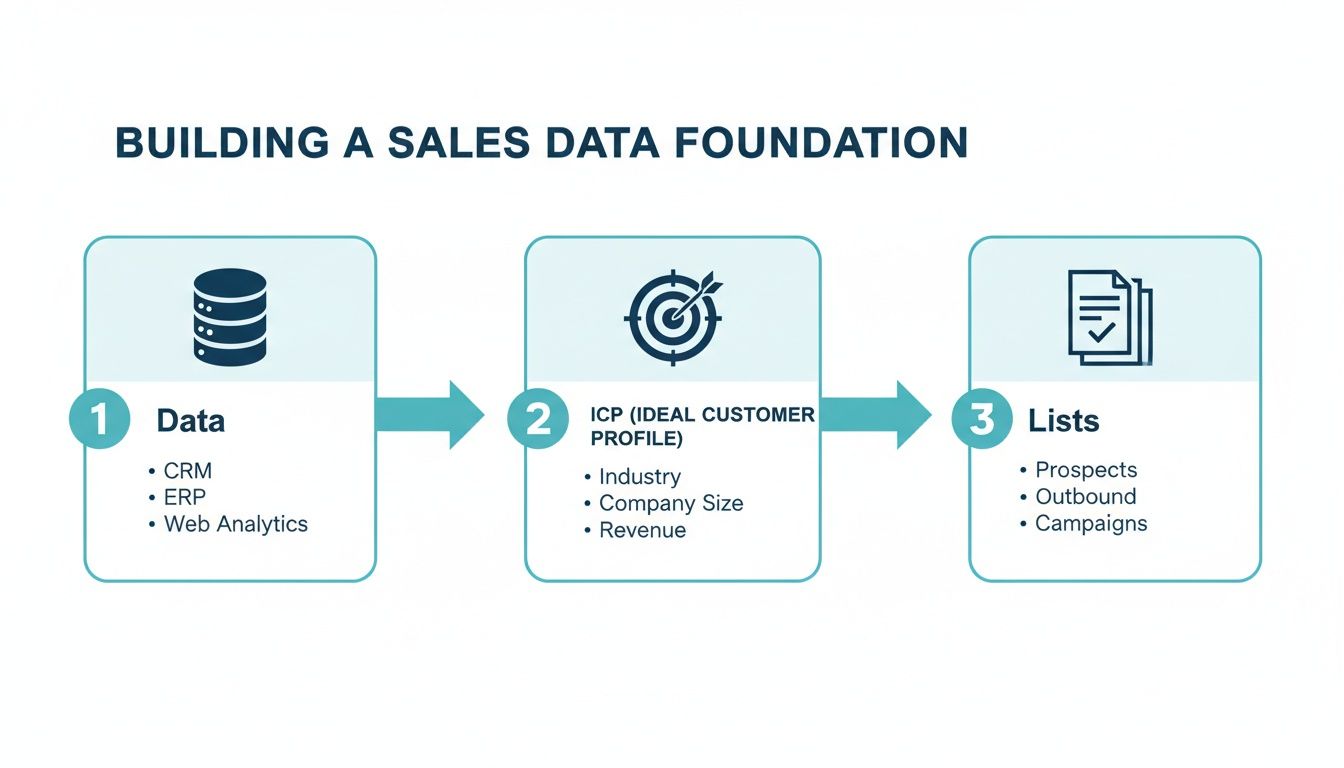
As you can see, if you try to build automation on shaky data, you're just setting yourself up for wasted effort and dismal results.
AI That Sounds Like Your Best Rep
One of the biggest fears sales leaders have is that automation kills personalization. This is where modern AI flips the script. Generic AI tools that just tap into public models spit out robotic, easy-to-spot templates that do more harm than good. A proprietary AI orchestrator is a different beast entirely.
Willbe’s AI, for example, is template-free. It’s designed to learn your unique voice, your value proposition, and your style. It can scan a prospect's LinkedIn profile, check recent company news, and identify role-specific pain points to generate outreach that feels genuinely human and relevant. We're not talking about just inserting {company_name} into a canned sentence; we're talking about crafting an opening line about a specific project that prospect just posted about.
This is the secret to scaling authentic relationships. The AI handles the heavy lifting—the research and initial drafting—which is the most time-consuming part of personalization. It gives the rep a high-quality starting point they can quickly review, tweak, and send. The prospect feels understood, not just targeted.
This approach gives you the best of both worlds: the speed and scale of automation combined with the authenticity of a one-to-one conversation. This directly impacts reply rates and, ultimately, the number of qualified meetings your team books. In fact, the best sales cadence practices are all built on this principle of blending automated efficiency with genuine, AI-assisted personalization.
When you get it right, workflow automation creates a powerful flywheel. Your reps save hours on manual tasks, which means they can engage more prospects with higher-quality, personalized outreach. This leads to more conversations, a healthier pipeline, and a more productive and motivated sales team.
Scale Personalized Outreach Without Sounding Robotic
"Personalization at scale" has always sounded like an oxymoron. For years, sales teams have been caught between two bad options: blast out generic, templated emails to everyone and get ignored, or spend hours researching each prospect for a single, handcrafted message. One method fills the CRM with activity but no results, while the other is completely unsustainable.
This dilemma is arguably the single biggest drain on outbound sales productivity.
The old {first_name} and {company_name} mail merge trick just doesn't cut it anymore. Today's buyers can spot a low-effort template from a mile away. Research consistently shows that genuinely personalized emails get significantly higher open and reply rates than standard messages. If you want to break through the noise, your outreach has to make the prospect feel seen, not just targeted.
This is where modern, proprietary AI comes in—not generic AI writers that churn out robotic, soulless copy. Purpose-built AI for sales can digest a prospect's entire digital footprint—from their LinkedIn profile and recent company news to the specific pain points of their role—and generate outreach that sounds like a real person did their homework.
Moving Beyond Generic Templates
The difference between lazy personalization and smart, AI-assisted outreach is night and day. One gets you a one-way ticket to the trash folder; the other starts a real conversation.
Let’s walk through a common scenario. Imagine an SDR wants to connect with a VP of Marketing at a rapidly growing tech company.
The Old Way (Generic Template):
Hi Sarah,
I saw you're the VP of Marketing at TechCorp. We help companies like yours increase their marketing ROI with our innovative platform.
Are you free for a quick 15-minute demo next week?
This email is all about the sender. It's generic, self-serving, and gives Sarah absolutely no reason to care. It shows zero understanding of her world, her challenges, or what she’s been working on. Delete.
Now, let's see what happens when that same rep uses an AI-powered platform like Willbe to do the heavy lifting. The AI scans Sarah's LinkedIn and immediately flags a recent post she shared celebrating a new brand campaign launch.
The New Way (AI-Assisted Personalization):
Hi Sarah,
Saw your post on LinkedIn about TechCorp's new brand campaign—congrats on the launch! Pulling off a rebrand at that scale while your team is growing so fast is seriously impressive.
Usually, when marketing leaders are managing that much growth, the pressure to prove ROI on campaign spend gets intense. Our platform helps teams consolidate their performance data so they can get a clearer view of what's driving pipeline.
No pressure for a demo, but thought it was relevant enough to share.
See the difference? This version is all about Sarah. It leads with a specific, genuine compliment. It connects that achievement to a highly relevant business challenge. It demonstrates that the sender understands the context of her role. The AI handled the research and drafted the core message in seconds, freeing up the rep to simply review, approve, and send a message that feels 1-to-1.
The goal of AI in sales isn't to replace the seller. It's to give every seller the research capabilities of a dedicated analyst, empowering them to deliver one-to-one personalization at a one-to-many scale.
How AI Unlocks Genuine Personalization
The table below breaks down the fundamental shift from outdated personalization tactics to modern, AI-driven approaches that actually work.
From Generic to Genuine Personalization at Scale
As you can see, the tactics that generate the highest engagement are historically the hardest to scale. AI flips that model on its head, making what was once manual and time-consuming an automated part of the workflow.
A sophisticated AI engine connects multiple data points to create a compelling reason to reach out. It’s not just about finding one piece of information; it’s about weaving it into a relevant narrative.
- LinkedIn Activity: It can reference a recent post, a comment someone made, or a promotion they received to create a timely and human opening line.
- Company News & Triggers: It can pull in details about a recent funding round, a new product launch, or a key executive hire to show you're paying close attention to their business trajectory.
- Role-Specific Pain Points: It connects a prospect’s job title to the common challenges associated with that role, demonstrating an immediate, empathetic understanding of their world.
- Multi-Lingual Capabilities: With a platform like Willbe, this deep personalization can even be executed across 80+ languages, allowing teams to scale authentic, native-language outreach across the globe.
By automating the most grueling part of prospecting—the research—this technology gives reps their time back. Instead of digging for data, they can focus on the distinctly human elements of selling: building real rapport, asking intelligent questions, and closing deals. This is exactly how top-performing teams are boosting their sales productivity and building a pipeline that actually converts.
Make Your CRM Sync and Sales Handoffs Seamless
Productivity doesn't just slow down with bad processes; it grinds to a halt where they completely break. One of the most common points of failure in any sales motion is the messy, friction-filled gap between the prospecting team and the closers. This is where deals go to die, lost in a mess of manual data entry, duplicate records, and incomplete contact info.
For an SDR, manually logging every email, call, and LinkedIn touchpoint is a soul-crushing time suck. For an AE, getting a "qualified" lead with a nearly blank CRM record is a nightmare. They're forced to start from square one, re-asking questions the SDR already covered. It makes the entire company look disorganized and wastes the prospect's valuable time.
This gap isn’t a minor annoyance. It’s a direct threat to your pipeline. When information gets lost in translation, deals stall out.
Why a Native, Real-Time Sync is Non-Negotiable
The only real fix is to eliminate the manual work. A platform with a native, real-time CRM sync isn't just a nice-to-have feature; it's the foundation of any high-performing sales team. It acts as the central nervous system, ensuring every piece of data from prospecting flows instantly and accurately into your system of record.
This means every action is logged automatically.
- Emails sent and received? Attached to the contact record.
- Prospect replies and opens? The record is updated the moment it happens.
- New contacts found during prospecting? Created cleanly, without duplicates.
- Key account and contact fields? Constantly enriched with fresh data.
This constant, automated flow of information creates a single source of truth that everyone—from SDRs to AEs to leadership—can actually trust. Your CRM goes from being a static database to a living, breathing history of your entire customer journey.
A broken CRM sync forces your AEs to play detective, piecing together clues from past interactions. A seamless, real-time sync turns them into surgeons, giving them a complete patient history so they can make precise, informed decisions.
Turning Cold Handoffs into Warm Conversations
Imagine an AE getting a handoff from an SDR within a unified platform like Willbe. They don't just get a name and an email. They get the full story—a complete history of every touchpoint. They can see the exact messages that worked, the pain points the prospect brought up, and the specific value props that got them to book the meeting.
This is the huge difference between a cold transfer and a strategic handoff. The AE can walk into that first call already knowing the person.
The conversation starts on the 20-yard line, not way back at the kick-off. AEs can skip the repetitive discovery questions and jump right into a high-value discussion about solving the prospect's real challenges. This doesn't just speed up the sales cycle; it creates a far better experience for the buyer.
Ultimately, cleaning up your CRM sync and sales handoffs is one of the highest-impact things you can do to improve sales productivity. It kills the manual busywork that burns out your reps, cleans up the data your RevOps team relies on, and gives AEs the context they desperately need to close deals faster. It ensures the momentum your SDRs build isn't just maintained—it's amplified.
Measure What Actually Moves the Needle
You can't fix what you can't see. For too long, sales teams have been fixated on vanity metrics—things like open rates and click-throughs. They give you a hint of what's happening, but they don't tell you what’s actually generating pipeline.
Real sales productivity isn't about the sheer volume of emails sent. It's about how many of the right conversations you’re starting. To boost performance, you have to measure the outcomes that matter.
This means shifting your focus from top-of-funnel activity to the KPIs that directly link your team's outreach to revenue. When your prospecting, engagement, and analytics all live in a single platform, you finally have a single source of truth. You can stop wasting time trying to tape together reports from five different tools.
Turning Data into Your Strategic Advantage
With the right analytics at your fingertips, raw data transforms from a simple report into a powerful strategic asset. Having everything in one place lets you slice and dice performance data in ways that are impossible with a fragmented tech stack.
What does this look like in practice?
- Pinpoint Your Best Channels: Are your best meetings coming from carefully crafted email sequences or from savvy LinkedIn engagement? Knowing this tells you exactly where to double down.
- Identify Winning Messages: Which value props are hitting home with your ICP? You can test different angles on pain points and scale what resonates.
- Spot Coaching Opportunities: A clear dashboard view of team performance makes it easy to see who your top reps are and where others might need coaching.
- Refine Your Go-to-Market Strategy: Are you getting better traction with companies that just landed a new round of funding? Is a specific vertical converting at a much higher rate? These insights sharpen your entire GTM.
The goal isn't just to look back at what happened last quarter. It’s about getting a live, real-time view into what’s happening now so you can make smarter, faster decisions that impact this quarter's number.
This visibility is what separates good GTM engines from great ones. You stop guessing what works and start knowing with confidence. Sales coaching shifts from generic advice to targeted, data-backed guidance that helps reps improve.
This is how you build a system for improving sales productivity. You find the plays that consistently generate high-quality opportunities and then you scale them across the entire team. To see how this all comes together, check out our complete guide on building a powerful sales performance metrics dashboard. It’s all about making every move count.
Answering Your Top Sales Productivity Questions
We've walked through the framework, but let's be real—making these changes brings up some tough questions. Here are the honest answers to what we hear most often from sales leaders trying to get their GTM engine humming.
How do I know if my team really has a productivity problem?
It’s all about the symptoms. The most obvious one? Look at your reps' calendars. If they're spending less than 30-40% of their day actually selling, you have a problem.
Listen to what they're complaining about. Is "CRM data entry" a dirty phrase in your weekly meetings? Are your AEs constantly frustrated by handoffs from SDRs that are missing crucial context? These aren't just minor gripes; they’re huge red flags telling you that friction in your process is actively killing revenue. A truly productive team is in front of prospects, not buried in admin work.
Is AI personalization actually better than a rep researching on LinkedIn?
Yes, when it's done right. Think of it this way: a good AI tool, like the one built into Willbe, isn't just grabbing a single fact from a press release. It's connecting multiple dots at once—a prospect's recent LinkedIn post, their company's latest funding announcement, and the common challenges for someone in their specific role. It synthesizes that information to create an outreach angle that feels genuinely insightful.
The AI does the heavy lifting in seconds, giving your reps a relevant starting point. This means they can deliver that "wow, they did their homework" feeling at scale, something that's flat-out impossible to do manually without burning out your best people.
I'm worried that consolidating our tech stack will just create a whole new set of problems. Is it worth it?
That's a completely fair concern. Nobody wants to rip and replace their tools only to end up with a different, more expensive mess. But a truly unified platform is built to eliminate complexity, not just shift it around.
The real goal is to get rid of the data silos and sync errors that cause most of the operational headaches in the first place.
When you bring prospecting, outreach, analytics, and your CRM sync under one roof, you create a single, uninterrupted flow of information. Suddenly, your SDRs, AEs, and leadership are all working from the same playbook with the same data. That's not just convenient—it's the foundation of a predictable, scalable sales machine.
Ready to stop fighting friction and start building a high-performance sales engine? Willbe is the all-in-one B2B prospecting and lead generation platform that replaces fragmented tools and manual workflows. See how top-performing teams are scaling their outbound and closing pipeline faster by exploring Willbe today.