


Account-based marketing (ABM) for lead generation isn't just another buzzword; it’s a focused, revenue-driven GTM strategy. It’s about concentrating your sales and marketing firepower on a handpicked list of high-value target accounts. Instead of spraying and praying for individual leads, ABM treats each target company as its own market, orchestrating personalized campaigns designed to win over the entire buying committee.
Why The Old Outbound Playbook Is Broken
Let’s be direct—the traditional outbound sales playbook is failing. SDRs are burning through generic lead lists, chasing MQLs that marketing celebrates but sales can’t close. They're sending the same templated emails that every other rep is, and prospects have learned to ignore them. It's a high-volume numbers game where efficiency is low and burnout is high.
This "more is more" approach creates massive friction. SDRs waste up to 40% of their time researching prospects who were never a good fit. They then hand off these lukewarm leads to AEs who lack the context to have a meaningful conversation. Sales leaders are left wondering why the pipeline is so unpredictable. The fundamental flaw is a model that values raw activity over revenue impact, treating every prospect as a commodity.

Shifting From Volume To Value
ABM flips that broken model on its head. It’s not just a marketing campaign; it’s a core GTM strategy that aligns sales and marketing on a single objective: revenue. The philosophy is simple but powerful.
- Identify First: Pinpoint your best-fit future customers before any outreach begins.
- Engage Deeply: Orchestrate personalized, multi-channel outreach to connect with the entire buying team, not just one contact.
- Measure Impact: Track metrics that actually matter—like target account engagement and pipeline velocity—not vanity stats like open rates.
This laser-focused approach solves the real problems that inhibit growth. It stops your team from wasting time and budget on companies that will never buy and directs all that energy where it counts.
The old playbook was about finding any customer. A modern ABM strategy is about engineering the right customer relationships from the first touchpoint, aligning your entire GTM motion with your most valuable market segments.
Instead of shouting for attention in a crowded inbox, you're delivering relevant messages to key players actively looking for a solution. This is how top revenue teams build predictable, high-growth pipelines. It means moving beyond fragmented tools and manual workflows to an all-in-one platform built for speed, precision, and scale.
Building Your High-Value Target Account List
A successful ABM lead generation program lives or dies by its targeting. It’s time to stop casting a wide net and start using a scalpel. Your Target Account List (TAL) isn't just a list; it's the foundation of your GTM strategy, ensuring every bit of sales and marketing effort is aimed at companies that can become your best customers.
This goes beyond basic firmographics like industry or employee count. The TALs that drive predictable revenue are dynamic, built from a multi-layered understanding of what makes an account a perfect fit. It’s about combining who they are with what they’re doing and what they need right now.
Defining Your Dynamic Ideal Customer Profile
Think of your Ideal Customer Profile (ICP) as a living framework, not a static document. It should evolve with your business and the market. The best way to build it is to analyze your biggest wins.
Your RevOps team can start by digging into your CRM. Look at the accounts with the highest lifetime value, the fastest sales cycles, and the best product adoption. What do these champions have in common?
- Firmographics: The basics still matter. Think company size, industry, and geography. Are your best deals consistently coming from 500-employee tech companies in North America?
- Technographics: What technology stack are they using? A competitor’s platform signals a replacement opportunity, while complementary tools indicate a clear need.
- Growth & Intent Signals: This is the game-changer. You're looking for buying triggers—a recent funding round, a hiring surge for a specific department, or spikes in online research around your solution. These signals indicate budget and urgency.
Imagine a sales leader at a mid-market SaaS company reviews her data. She might define her ICP as: "US-based software companies with 200-1,000 employees, currently using Salesforce and HubSpot, that have hired more than 10 new sales reps in the last quarter." That's a profile that’s specific, actionable, and tied directly to revenue.
A well-defined ICP isn't just a filter; it's a strategic lens. It tells your SDRs not only which doors to knock on but also gives them the context needed to craft a message that gets opened.
From ICP To A Precise Target Account List
Once your ICP is sharp, you can build your TAL. This is where manual list-building and scraping websites completely break down. By the time you’re finished, the data is already outdated, leading to wasted effort and frustrated reps.
This is why modern GTM teams use all-in-one platforms. Instead of patching together data from multiple providers, a solution like Willbe unifies dozens of B2B databases into a single source of truth. Suddenly, your team has access to a massive, verified pool of account and contact data that’s continuously refreshed.
You can apply your detailed ICP criteria with precision filters to generate an instant list of high-fit accounts, complete with accurate contact information for the entire buying committee. You can find more detail on this in our guide to account based marketing best practices.
This transforms list building from a manual chore into a data-driven, strategic process. Your team gets a clean, verified TAL, so they can spend less time digging for intel and more time engaging the right people with messages that convert.
Orchestrating Multi-Channel Outreach That Converts
You've built your high-value account list. Now comes the critical part: earning their attention.
A perfect target list is useless without outreach that cuts through the noise in a way that feels human and relevant. This is where most ABM strategies succeed or fail. The goal is to move beyond the stale, single-channel cadences that every other SDR is using. An effective approach orchestrates a consistent, compelling message across multiple channels—like email, LinkedIn, and targeted ads—to surround the entire buying committee.
This multi-channel strategy starts with how you build the initial account list.
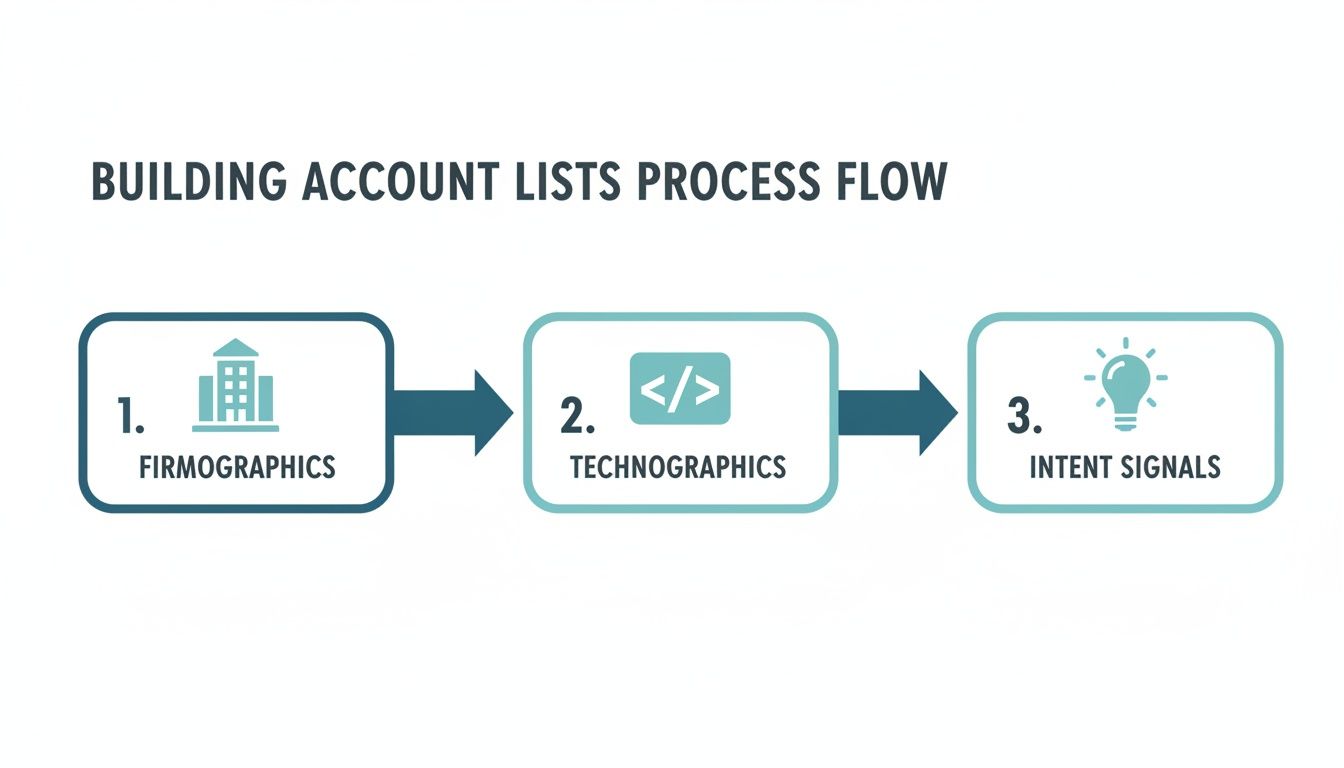
As you can see, the modern playbook layers firmographics, technographics, and crucial intent signals to pinpoint accounts that aren't just a good fit on paper but are actively showing signs they're ready to buy.
Ditch the Generic Templates
The biggest mistake teams make is blasting generic, one-size-fits-all messages to scale outreach. Buyers can spot a robotic, template-driven email from a mile away. It’s the fastest way to get your domain flagged and burn your entire target list before you even start.
The solution isn't just being present on more channels; it's delivering a more relevant message on every channel. This is where proprietary AI changes the game. I’m not talking about generic AI wrappers that produce awkward copy. I’m talking about a platform like Willbe that is designed to sound exactly like you.
This type of AI learns your unique value propositions and writing style, then pulls in real-time context from the prospect's world—like a recent LinkedIn post or a new company initiative. The result is outreach that feels 1-to-1, even at scale. Prospects feel understood, which is why reply rates increase dramatically.
The point of multi-channel outreach isn't just to be everywhere. It's to deliver a consistent, personalized message that builds trust and familiarity with the entire buying committee before you ever ask for a meeting.
Crafting a Multi-Touch Playbook That Works
A winning playbook is an orchestrated sequence, not a checklist of tasks. The data is clear: outbound teams that use an omnichannel ABM strategy with email, LinkedIn, and phone calls see a 234% acceleration in pipeline growth compared to single-channel teams.
It makes sense, considering 80% of buyers say personalized content makes them more likely to do business with a company. It's all about staying top-of-mind in a valuable way.
So, what does this look like for an SDR or BDR targeting a new enterprise account?
Here's a breakdown of a typical two-week sprint:
- First Contact (Days 1-3): Your initial touchpoints should build familiarity, not make a hard pitch. Start with a LinkedIn connection request mentioning a shared connection or a recent company milestone. Follow up with a highly personalized email that connects to a specific pain point you’ve identified.
- Deliver Value (Days 4-7): Now it’s time to be a resource. Share a relevant case study, a short video explaining a key concept, or an article that speaks to their role. On LinkedIn, leave a thoughtful comment on a post from one of your key contacts. Be helpful, not just another salesperson.
- Provide "Air Cover" (Ongoing): While your SDR runs this sequence, your marketing team provides support with account-based ads. The buying committee starts seeing your brand and content on LinkedIn, reinforcing the exact messages the SDR is sending. This creates an echo chamber of value.
- The Direct Ask (Days 8-14): You’ve laid the groundwork and provided value. Now you can make a direct ask for a meeting, referencing your previous touchpoints. The approach feels earned and respectful, not cold and abrupt.
This blended, multi-touch strategy ensures you’re not just another name in a crowded inbox. You become a recognized, helpful expert who shows up consistently where your buyers are. Each channel reinforces the others, making your entire effort more memorable and effective.
If you want to master one of the most critical channels in this mix, check out our complete guide to prospecting on LinkedIn. It's packed with playbooks for turning the platform into a meeting-generation engine.
Omnichannel ABM Playbook Example
Here is a sample multi-touch sequence for a high-value target account over two weeks. This playbook blends automation for scale with hyper-personalization for the key personas you’re trying to engage.
This orchestrated plan ensures that by the time you ask for a meeting, you've already established credibility and context. You're no longer a stranger but a persistent, valuable partner.
Unifying Sales And Marketing For Maximum Impact
Even with a perfect target list and slick outreach sequences, your ABM efforts will fail if sales and marketing operate in silos. Effective account-based marketing isn't a sales "play" or a marketing "campaign"—it's a single, unified GTM strategy. Both teams must be focused on the same targets, working from the same data, and driving toward the same revenue goals.
When they’re not aligned, the result is chaos. SDRs send cold emails to accounts that marketing is trying to warm up with a different message. AEs try to book meetings, unaware that the CIO they're chasing just engaged with a high-intent ad. This disconnect doesn't just stall deals; it creates a fragmented and unprofessional buyer experience that kills them.

Creating A Surround Sound Effect
The best ABM programs create a "surround sound" effect by integrating outbound prospecting with Account-Based Advertising (ABA). As your SDRs and AEs run their personalized outreach, your marketing team serves targeted digital ads to the entire buying committee at those same accounts.
Consider how this plays out:
- An Account Executive is running a multi-touch sequence to land a meeting with the CIO at a target logistics firm. Her messaging focuses on how your platform reduces supply chain costs.
- Simultaneously, the marketing team launches a LinkedIn ad campaign targeting the CIO, Director of Ops, and other key players at that company. The ads feature a case study from another logistics giant that cut its shipping costs by 30%.
Now, the CIO doesn’t just get another cold email. She sees your brand, your social proof, and your value proposition everywhere online. When the AE's email lands in her inbox, it’s not from a stranger. It’s from a company that’s already on her radar, talking about a solution to a problem she’s actively trying to solve. You’ve turned cold outreach into a warm conversation.
The goal is to make your brand feel inevitable to your target accounts. When sales and marketing messaging are perfectly in sync, every touchpoint—from an ad impression to an email—builds on the last, accelerating trust and pipeline velocity.
Shared Visibility And Actionable Insights
This coordinated execution is only possible if everyone works from a central platform. When sales and marketing share the same source of truth, insights flow freely in both directions.
Sales reps can see which of their target accounts are engaging with marketing ads, giving them the perfect trigger for a timely follow-up. Marketing can see which sales messages are generating replies and use that real-world feedback to sharpen their ad copy. This constant feedback loop separates top-performing revenue teams from the rest.
The data backs this up.
Studies show that companies aligning their ABM and ABA efforts see 60% higher win rates compared to those with fragmented tactics. This isn't just a nice-to-have; it’s a proven revenue driver.
Alignment also simplifies internal operations. RevOps no longer has to patch together data from a dozen tools to figure out what’s working. A unified platform gives leaders a single dashboard to track an account's entire journey, from the first ad impression to the closed-won deal. This makes it easy to attribute revenue and optimize your strategy. For a deeper dive, check out our guide on sales and marketing alignment best practices.
Measuring What Matters in Your ABM Engine
You can't scale what you can't measure. In traditional lead generation, teams get fixated on vanity metrics like email open rates and MQL volume. While those numbers might look good on a marketing dashboard, they say very little about revenue.
An ABM engine requires a different set of gauges. Successful account-based marketing is about the quality of engagement within your highest-value accounts, not the quantity of leads. For sales leaders and RevOps teams, this means shifting focus from top-of-funnel activity to metrics that tie directly to pipeline and revenue.
Moving Beyond Vanity Metrics
The real difference in measurement comes down to one question: are you tracking individual actions or account-wide momentum? An SDR might get a great open rate on an email, but if none of those opens come from decision-makers at target accounts, the effort was wasted.
A modern ABM program tracks progress with KPIs that reveal a deeper level of engagement and influence inside a target company. This data-driven feedback loop is what allows you to refine your strategy, double down on what works, and build a predictable revenue engine.
- Target Account Coverage: What percentage of your ideal accounts have you identified and started engaging? Are you reaching the key personas within the buying committee?
- Target Account Engagement: How many contacts at your target accounts are actively engaging with your outreach, ads, and content? This gives you a holistic view of account-level interest.
- Pipeline Velocity: How quickly are your target accounts moving from the first touchpoint to a qualified opportunity? A faster velocity is a strong indicator that your messaging is resonating.
- Meeting-to-Opportunity Conversion Rate: Of the meetings booked with target accounts, how many convert into qualified pipeline? This is a direct measure of your SDR team’s effectiveness and the quality of your TAL.
The Shift to Revenue-Focused KPIs
The market has already shifted. Modern ABM programs deliver pipeline growth for 84% of companies that adopt them. Looking ahead to 2026, 43% of marketers see advanced data management as critical, powering a shift to intent-led strategies where deal velocity is more important than raw impression counts. You can dive deeper into the 2026 ABM trends over at clientcurve.com.
This requires a new scorecard. Instead of rewarding reps for hitting call quotas, leaders should incentivize them based on the number of qualified meetings they book with key personas inside high-value target accounts.
Your measurement framework should answer one simple question: "Is our activity with our most valuable accounts creating real pipeline?" If your KPIs can't answer that, they're the wrong KPIs.
This is where having an all-in-one platform like Willbe is a game-changer. Fragmented tools make getting a coherent view of account engagement nearly impossible. When your data, outreach, and analytics are in one place, you get real-time visibility into what’s actually working.
A sales leader can instantly see which email sequences generate the most replies from VPs of Engineering or which LinkedIn plays drive engagement with CFOs. This isn't just reporting; it's actionable intelligence that helps you optimize your entire GTM strategy on the fly.
From Old Metrics to New Money
Let's break down how the KPIs change when you move from a traditional, volume-based game to a modern, value-based ABM strategy.
Traditional Lead Gen vs. ABM Lead Gen KPIs
Making this shift transforms your sales floor. Reps stop chasing low-quality leads and focus their energy on high-potential accounts. The result is better morale, higher win rates, and a more predictable business.
Common Questions About ABM Lead Generation
Even experienced revenue teams have questions when refining their GTM strategy. Shifting to an account-based marketing model isn't a small tweak; it’s a new way of operating. Here are answers to common questions from sales leaders, SDRs, and RevOps pros.
How Is ABM Different From Traditional Lead Generation?
It flips the entire model.
Traditional lead gen is a numbers game. You cast a wide net with broad marketing campaigns to pull in as many individual leads (MQLs) as possible. Then, you filter them and hope for the best. Success is measured by the volume of leads marketing sends to sales, even if most are a poor fit. This creates friction, with sales reps wasting hours on dead ends.
Account-based marketing starts focused.
- You identify your best-fit accounts first. You hand-select a curated list of high-value companies that match your Ideal Customer Profile. No guesswork.
- You go deep, not wide. Instead of spraying and praying, you run coordinated, personalized campaigns to engage the entire buying committee at those target accounts.
- You measure what matters: revenue. Forget lead volume. The focus shifts to quality and impact. You track account engagement, pipeline velocity, and, most importantly, closed-won revenue from your target list.
At its core, ABM aligns sales and marketing on a single revenue goal. You treat each target account like its own market, ensuring every ounce of effort is spent on prospects with the highest potential to become your best customers.
What Are The First Steps To Launching An ABM Program?
Getting an ABM program off the ground doesn’t have to be overly complex. The key is to build a solid foundation.
The first step is total alignment between sales and marketing leadership. This is non-negotiable. Both teams must agree on the goals, the definition of a qualified account, and the KPIs used to track success. Without this shared vision, you’re just running disconnected campaigns.
Next, define your Ideal Customer Profile (ICP) with data, not gut feelings. Analyze your best customers. What do they have in common? Look at firmographics, technology stacks, and behavioral signals. A rock-solid ICP is the blueprint for everything that follows.
From there, use your ICP to build an initial Target Account List (TAL). Don’t try to boil the ocean. Keep it manageable—perhaps 50-100 accounts—to prove the model works before you scale.
A common pitfall is trying to execute a sophisticated ABM strategy with a fragmented tech stack. Using separate tools for data, outreach, and analytics creates manual work, data sync issues, and no clear view of what’s driving results.
Finally, choose the right technology. An all-in-one platform is a significant advantage. It unifies your entire workflow, providing the clean data, coordinated outreach, and unified analytics you need to launch and scale efficiently from day one.
How Can AI Help Scale ABM Without Sounding Robotic?
This is a critical question because the wrong AI can destroy your outreach. Most generic, template-based AI tools produce copy that feels off—awkward, impersonal, and easily spotted by prospects.
The solution is to use an advanced, proprietary AI built specifically for sales outreach. It operates on a completely different level.
Instead of just plugging variables into a template, this type of AI digests multiple layers of real-time context. It learns your personal writing style, understands your product’s value propositions, and pulls in timely signals from your prospect’s world—a recent LinkedIn post, a new company initiative, or a quote in an article.
The outcome is template-free, hyper-personalized messaging that genuinely sounds like it came from you. It gives a single SDR the ability to craft hundreds of unique, 1-to-1 messages that connect with each individual. This is how top teams scale high-quality personalization across their entire target list, increasing reply rates without losing the human touch that builds relationships.
Ready to replace fragmented tools and manual workflows with a single, intelligent platform? Willbe helps your team find better accounts, engage the entire buying committee with personalized outreach that converts, and build a predictable pipeline—faster.